
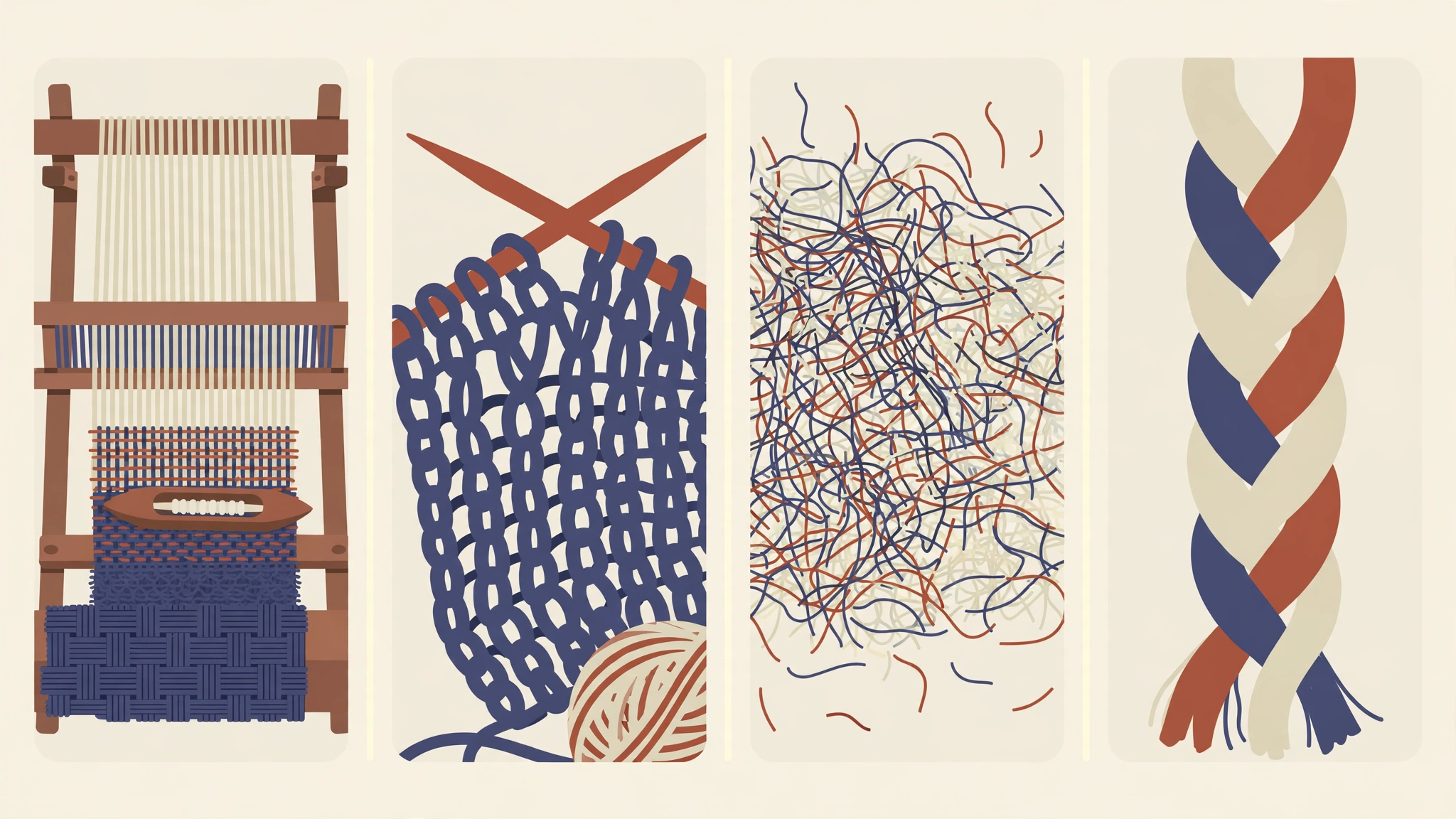
Fabric construction is the method by which fibres or yarns are assembled into cloth — and it decides more about a garment than the fibre itself. The same cotton, woven, knitted and made into a nonwoven, stretches, frays and holds its shape differently in each form. A buyer who specifies “cotton” without specifying the construction has specified only half the fabric.
This article compares ten fabric construction methods: the four major ones — weaving, knitting, nonwoven and braiding — and six more that matter for specific products. It explains how each is made, how to tell them apart without laboratory equipment, and how to choose between them by garment category. Knitting counts as one method, with weft knitting and warp knitting as its two families; tufting and laminating count as methods in this article’s classification. The definitions follow the standard textbook sources, principally the textile course material of IIT Delhi’s NPTEL programme and Britannica’s textile entries, as cited by the Textile School guide that this article uses as its starting source; where a definition comes from a standard, the standard itself is cited.
The ten methods at a glance
| Method | Starts from | How it holds together | Stretch and edge behaviour | Typical uses |
|---|---|---|---|---|
| Weaving | Yarn | Two sets of yarns interlaced at right angles, held by friction at the crossings | Low stretch; cut edges fray; woven selvedge parallel to the warp | Apparel, home textiles, industrial cloth; plain weave (muslin, taffeta), twill (denim, gabardine), sateen |
| Knitting | Yarn | Loops formed row by row across the width (weft knitting) or along the length by guide bars (warp knitting, on tricot and raschel machines) | Weft: greatest stretch across the width; can ladder if a loop breaks; single jersey curls at cut edges. Warp: closer, flatter, less elastic; usually run-resistant | Jersey, rib, interlock for apparel and sportswear (weft); tricot for lingerie and laminated backings; raschel for openwork lace-like fabrics (warp) |
| Nonwoven | Fibre | Web bonded by heat, mechanical or chemical means — no yarn stage | Strength depends on web formation and bonding; carded webs bonded with adhesive are weaker across the width | Geotextiles, filtration, wipes, hygiene products, surgical gowns and masks, automotive interiors |
| Braiding | Yarn | Three or more yarns interlaced diagonally into a flat or tubular narrow fabric | Structure defined by braid angle; narrow-width product | Shoelaces, cords, trims, belts, composite preforms |
| Felting | Fibre (wool, fur or some hair fibres) | Heat, moisture and friction lock the fibres together | Dense, no woven structure; fulling can shrink the area by as much as 50% (upper bound; process-dependent) | Hats, padding, insulation, polishing, gaskets, papermaking felts |
| Knotting and netting | Yarn | Knots at the corners of each mesh | Open mesh structure | Fishing nets, curtain nets, macramé |
| Lace | Thread | Openwork formed by looping, interlacing, plaiting or twisting | Decorative openwork; woven openwork cloth such as gauze is not lace | Trims, veils, curtains |
| Tufting | Yarn tufts inserted into an existing base fabric | Tufts stitched through a base cloth; it does not make the base fabric | Cut or loop pile on a stable base | Carpets and rugs (mainly); originally chenille bedspreads |
| Laminating | Already-made fabric layers | Layers joined by flame bonding or adhesive (full-surface, dot or powder) | Stability depends on the bond; delamination is the failure mode to test | Rainwear, foam-backed fabrics, fabric bonded to lining |
| Stitch-bonding | Fibre web or laid yarns | Stitched through with a third yarn, joining the web or yarn layers into a fabric | Depends on the base web or yarn layer; stiffer than the web alone | Interlinings, blankets and technical textiles (minor method in apparel) |
The table counts ten methods: the four major families — weaving, knitting, nonwoven and braiding — and six further methods. Knitting is counted once, with its two families, weft and warp knitting, described together in the row and in detail below.
One division runs through the whole table. As the Textile School guide puts it: “Weaving, knitting and braiding start from yarn; nonwovens and felt start from fibre.” That starting point explains much of what follows — including why nonwovens are specified by web formation and bonding method rather than by yarn count, and why a nonwoven cannot be judged by the same specification sheet as a woven cloth.
The four major methods
Weaving
Weaving interlaces two sets of yarns — the lengthwise warp (each thread an end) and the crosswise weft or filling (each thread a pick) — so that they cross normally at right angles. The yarns are held in place not by any bond but by friction where they touch, in Britannica’s description as cited by the Textile School guide. Three basic actions make the cloth: shedding (opening the warp), picking (inserting the weft) and beating up (pushing the weft into place), in the NPTEL course’s account.
The three basic weave structures are plain, twill and sateen, defined in ISO 3572:1976, “Textiles — Weaves — Definitions of general terms and basic weaves”, published in February 1976 and confirmed on review in 2021. This article names them only; the detail of how each structure behaves belongs to a dedicated article on weave structures, which WEFTSIGNAL will publish separately. Jacquard is a mechanism for producing patterned weaves rather than a separate basic structure; readers who want the jacquard detail can refer to our guide on types of jacquard fabric.
Woven cloth stretches less than knitted cloth, and its cut edges fray. That is the trade-off a buyer accepts for stability: a woven fabric holds its shape, takes a press, and resists distortion in cutting and sewing — which is why tailored garments, shirts and structured outerwear are predominantly woven.
Knitting
Knitting makes fabric from a series of intermeshed loops, and knitted fabrics are in general more stretchable and more porous than woven ones, in the NPTEL description. The two families behave differently enough that a buyer should specify which one is meant.
Weft knitting forms loops row by row across the width, from a single yarn if necessary. It stretches most across the width, and a broken loop can run down a wale — the laddering that buyers know as a run. Single jersey, the simplest weft-knit structure, curls at cut edges. Warp knitting works the whole width of warp yarns at once, laid by guide bars onto the needles of tricot and raschel machines; it can only be done by machine. Warp knits are closer, flatter and less elastic, and usually run-resistant.
The practical consequence is a choice, not a ranking: weft knitting for stretch and comfort next to the skin, warp knitting for stability, flatness and resistance to runs. Our knit versus woven fabric guide sets out the construction and specification differences in full, and our warp knitting explainer covers the warp-knitting process and its uses in detail.
Nonwoven
Nonwovens are the exception to the yarn rule, and the definition matters because it is a standard, not a description. The ISO 9092:2026 sample document reproduces the definition in Clause 3, term 3.1.1. The definition, as reproduced in the sample document, is: a nonwoven is an “engineered fibrous assembly, primarily planar, which has been given a designed level of structural integrity by physical and/or chemical bonding processes, excluding weaving, knitting or paper-making”. The sample document states the fourth edition, published in April 2026, replacing the 2019 edition. The definition, the clause reference and the edition details are taken from the standard’s own sample document, which reproduces the standard’s cover (April 2026, fourth edition) and the Clause 3 text; see the ISO 9092:2026 entry in Sources. For contractual classification, buyers should consult the applicable official edition of ISO 9092 rather than rely on the sample document alone.
Nonwovens are made in two stages: web formation and bonding. Webs are formed by dry laying (carded or airlaid), wet laying, or spun laying and meltblowing. Bonding is by heat (calendering or through-air), by mechanical means (needlepunching, hydroentanglement or spunlacing, stitch bonding) or by chemical means (liquid binders). Because there is no yarn stage, a nonwoven is specified by its web formation and bonding method and by its weight in grams per square metre (ISO 9073-1), not by a yarn count. Its uses follow from its properties: geotextiles, filtration, wipes, hygiene products, surgical gowns and masks, and automotive interiors — applications where a flat, engineered fibre assembly is worth more than a woven or knitted structure.
One specification trap follows from this. A nonwoven’s strength depends on how its web was formed and bonded: a carded web bonded with adhesive, for example, is weaker across the width, and cross-laying the web makes it more uniform. A buyer who specifies a nonwoven by weight alone has not specified its strength.
Braiding
Braiding interlaces three or more yarns or fabric strips diagonally into a flat or tubular narrow fabric, in Britannica’s description as cited by the Textile School guide. Each yarn follows a helical path around the braid axis, and the key parameter is the braid angle — the angle between the yarn and the axis of the braid. Diamond, regular and Hercules braids interlace in the manner of plain weave, 2/2 twill and 3/3 twill respectively.
Braiding is a narrow-fabric technology: shoelaces, cords, trims, belts and composite preforms. It rarely appears in a garment specification as a main fabric, but it appears often enough in trims and tapes that a buyer should recognise it — and should not confuse a braided tape with a woven one, because the two behave differently under tension and at the cut end.
The other six methods
Felting. Felting needs wool, fur or some hair fibres, and works by heat, moisture and friction locking the fibres together. As little as 10% wool in a blend can be enough to make a felt, in Britannica’s account as cited by the Textile School guide, and fulling — the finishing process that shrinks and firms the felt — can shrink the area by as much as 50%, again in Britannica’s account as cited by the same guide. Both figures are upper bounds, not typical values and not general production parameters: the blend that felts and the shrinkage a fulling process produces depend on the specific fibre, blend and process, which must be set per product rather than read off a general figure. Felt is used for hats, padding, insulation, polishing, gaskets and papermaking felts. Two similarly named materials should not be confused with it: woven felts, which are woven cloths finished by fulling, and needle felts, which are needlepunched nonwovens.
Knotting and netting. Each mesh has a knot at its corners. Bobbinet, a hexagonal mesh, is used for veils and curtains; tulle is a fine net; fishnet was once made by hand by fishermen and is now machine-made curtain cloth. Macramé is a knotted lace. Machine-made nets are often produced on knitting machines, which is why netting is sometimes grouped with knitting — but the knot is what defines it.
Lace. Lace is a decorative openwork fabric made by looping, interlacing, plaiting or twisting thread. The distinction matters: a woven openwork cloth such as gauze is not lace. Needle lace and bobbin lace are the two hand traditions; modern machine lace descends from the bobbinet machine, and Leavers lace can be made from almost any yarn. Raschel warp-knitting machines can also make openwork lace-like fabrics — a reminder that the same effect can be reached by more than one construction.
Tufting. Tufting does not make a base fabric at all: it stitches pile yarns into a base cloth that already exists. It began around 1900 with hand-tufted bedspreads in Dalton, Georgia, in the United States, and tufted carpet has become the dominant construction in modern carpet production. The shift from woven to tufted carpet is reported by the Carpet and Rug Institute, as cited by the Textile School guide, without a publication date, so it is described here as a direction of change, not as a dated statistic. Carpet terminology follows ISO 2424, the vocabulary for textile floor coverings.
Laminating. Laminating joins layers of fabric that have already been made. Rainwear manufacturers first used natural rubber as the adhesive; the process later developed into flame bonding or adhesive bonding — full-surface, dot or powder — which can join fabric to foam or film, or two fabrics to each other, with the adhesive chosen to add as little stiffness as possible. Fabric can be bonded to a lining, and a single layer that is unstable on its own can be made dimensionally stable by lamination. The failure mode is delamination, and it is the subject of the acceptance section below.
Stitch-bonding. Stitch-bonding sits on the boundary between nonwoven and knitting, and should be described as such. Three stitch-bonding machines were invented in East Germany in 1958: Malimo, which lays warp yarns over weft yarns and stitches them with a third yarn, and Maliwatt, which stitches a fibre web directly. It is a minor method in apparel, but it illustrates the point that the ten methods are a working classification, not a set of sealed boxes.
How to tell them apart: a seven-step check
No laboratory is needed for a first, preliminary identification. The following sequence, adapted from the Textile School guide’s inspection order, is written for a buyer receiving bulk fabric. Each step gives a preliminary indicator, not a conclusive identification: finished edges, bonded constructions, composite fabrics and mechanically processed materials can all defeat a single test, and where the identification affects acceptance, it should be confirmed by microscopy or laboratory testing.
1. Look at the cut edge. If the edge frays into separate yarns, the fabric is probably woven. If it curls, it is probably single-jersey weft knit. If it shows no yarns at all, it may be nonwoven or felt — but the absence of visible yarns does not by itself distinguish a nonwoven from a felt, or from a heavily finished woven.
2. Pull across the width. Large, easy stretch across the width typically points to weft knitting. Little stretch typically points to weaving. Moderate, even stretch with a flat hand typically points to warp knitting — a preliminary indicator only; the actual stretch depends on the construction, yarn, density and elastane content, and these trends do not apply to every warp-knit construction.
3. Look for loops. Visible intermeshed loops on the face indicate knitting. A grid of crossing yarns at right angles indicates weaving.
4. Check the selvedge. A woven selvedge runs parallel to the warp and is part of the weaving process. Knitted and nonwoven fabrics have no true selvedge. A finished or cut edge is not a selvedge, and some knitted fabrics are finished to look as if they have one.
5. Try to separate a yarn. In a woven fabric, a single yarn can usually be pulled out along the warp or weft. In a weft knit, pulling a loop can start a run. Most nonwovens have no yarn to pull; the web usually tears or separates instead.
6. Look for layers. If the fabric separates into two or more layers, or shows a film or foam between layers, it is probably laminated. Check the bond by flexing and by the delamination procedure in the acceptance section below.
7. Check the pile. If tufts pull out of a base cloth, it is probably tufted. If the pile is part of the woven structure, it is a woven pile such as velvet — a different construction with a different failure mode.
None of these steps is conclusive on its own, and a fabric can combine methods — a laminated woven, a knitted base with a nonwoven interlining. The sequence is a triage tool: it tells a buyer which specification to reach for, not what the laboratory will confirm. Where construction identification determines acceptance — for example, whether a fabric qualifies as a nonwoven under a specification — confirm it by microscopy or laboratory testing rather than by these steps alone.
Same fibre, different fabric
| Property | Woven | Weft knit | Warp knit | Nonwoven (adhesive-bonded carded web) | Basis |
|---|---|---|---|---|---|
| Stretch | Low | High across the width | Moderate, more controlled | Low; depends on bonding | NPTEL; Britannica (via Textile School) |
| Cut edge | Frays | Curls (single jersey); can run | Stable; usually run-resistant | No yarns; tears rather than frays | NPTEL; Britannica (via Textile School) |
| Shape retention | Good | Lower; relaxes with wear | Better than weft knit | Depends on bonding and web formation | NPTEL; Britannica (via Textile School) |
| Porosity | Lower | Higher | Intermediate | Engineered — set by the process | NPTEL; Britannica (via Textile School) |
Note on the porosity row: typical trend; actual porosity depends on construction, yarn diameter, cover factor and finishing.
The direction of each difference in that table follows the NPTEL and Britannica descriptions cited above; no quantified comparison — no stretch percentages, no strength figures — has been added, because none was verified. The size of each difference varies with yarn count, fabric density, finishing and bonding conditions, so the table states directions, not magnitudes: the same fibre, made four ways, gives four fabrics with different behaviour at the cutting table, on the body, and in the wash. These trends do not apply to every warp-knit construction; stretch depends on the construction, yarn, density and elastane content. Porosity in particular depends on the construction, yarn diameter, cover factor and finishing, and cannot be inferred from the construction family alone; the porosity ordering in the table is a typical trend, not a rule. The table is a guide to general trends for specification discussions; it is not an acceptance standard and must not be used as a pass/fail criterion for a delivery.
Choosing by garment category
This is the section the textbook lists do not write: how a buyer should choose a construction for a specific garment, and what is given up in each case. These are application-dependent starting points, not universal rules. The right choice depends on the yarn, the fabric structure, the finishing, the garment engineering and the performance the garment must deliver; a construction that is right for one product can be wrong for another even within the same category.
Outerwear, windcheaters and rainwear — woven, plus lamination. The shell needs stability, wind resistance and a surface that takes a durable water repellent (DWR) finish. DWR improves surface water repellency only; it is not waterproofing. Waterproofing and windproofing come from lamination to a film or membrane. What is given up is stretch and softness, and the risk is delamination — which is why the acceptance section below matters for this category above all. Our fabric specification checklist sets out the specification fields that should be agreed before ordering a laminated shell.
Close-fitting and sportswear — weft knit, with warp knit where stability matters. The garment needs stretch across the body and recovery after movement. Weft knitting gives the stretch; warp knitting gives it with generally better shape retention and run resistance. The trade-off is the cut edge: weft knits curl and can run, so the pattern and the seam construction must be designed for it, and the fabric should be checked for runs at goods-in. Readers who want the full comparison can use our knit versus woven fabric guide.
Lingerie and laminated backings — warp-knit tricot. Tricot can provide a relatively flat and stable structure, and it bonds well as a backing for laminates; its skin-contact handle depends on yarn selection, fabric density and finishing. Weft knitting is used widely in lingerie — seamless underwear and cotton jersey briefs among them — but for the specific structures that need dimensional stability, flatness and run resistance, such as laminated backings and structured pieces that must hold their shape, warp-knit tricot is a common choice. The risk to watch is not stretch but handle: a tricot that is too stiff defeats the purpose, and stiffness is a property of the yarn and the machine settings, not of the construction name.
Home textiles and carpets — tufting. For floor coverings, tufting is widely used in modern carpet production because it puts the pile where it is needed on a stable base, and in many applications it offers production efficiency and cost advantages over woven carpet. The check is the tuft bind — how firmly the tufts are anchored — not the construction name. The historical shift from woven to tufted carpet is a reminder that the “best” construction is often the one the economics favour, not the one the textbook ranks first.
Industrial uses — nonwoven, chosen by web and bonding, not by yarn. Filtration, geotextiles, hygiene products and medical disposables need an engineered fibre assembly, not a yarn-based cloth. The choice here is between web formations and bonding methods. As a common direction — not an exclusive requirement — spunlaid and meltblown can be used in filtration media, depending on fibre characteristics, web structure and specified filtration performance, needlepunching for geotextiles, and hydroentanglement for wipes; these are the editor’s summary of common application examples only, and they do not replace verification of the performance the product must deliver — for filtration, efficiency, pore size and pressure drop; for other uses, the product’s end use — which must be specified per order rather than read off the construction name. A buyer who asks for a nonwoven “by yarn count” has asked the wrong question; the specification should name the web formation, the bonding method and the weight in grams per square metre.
Across all five categories, the same rule applies: specify the construction by name, and specify the properties that the construction is supposed to deliver. “Cotton woven” is a start; “cotton plain weave, 115 × 56, with the shrinkage and tearing limits in the specification” is a purchase order. Our fabric sourcing buyer guide sets out how to turn a construction choice into a supplier specification.
Acceptance checks: what to verify on delivery
Construction determines which acceptance test applies, and using the wrong test is a common and expensive mistake. Three checks cover most cases.
Delamination of laminated fabrics. Bond strength for bonded, fused and laminated apparel fabrics is measured under ASTM D2724, whose current edition is D2724-19. Clause 1.1 (Scope) states that the method covers procedures for characterising bond strength “before or after drycleaning and laundering”. Clause 5.1 (Significance and Use) states that the method “is considered satisfactory for acceptance testing of commercial shipments of bonded and laminated apparel fabrics”. That is a statement about the method’s suitability for acceptance testing, not an acceptance standard: the method measures bond strength, while whether a shipment passes is decided by the buyer’s material specification or by agreement between purchaser and supplier, which set the sampling plan and the pass value. Two things must be understood. First, the standard does not set a universal pass limit: the number of rolls sampled and the pass value are set by the applicable material specification or by agreement between purchaser and supplier. Any article that quotes a “standard” delamination limit without naming the buyer’s specification is inventing one. Second, the cleaning state for the test is set by the order, not by the standard: Clause 1.1 covers bond strength before or after drycleaning and laundering, and Clause 5.1 does not require every commercial shipment to be tested after cleaning. For products that will be washed or dry-cleaned in use, the buyer’s specification should require testing after the agreed cleaning conditions — a laminate that meets the initial bond-strength requirement but fails the agreed post-cleaning requirement has failed — and the before-cleaning bond strength can be tested as well, as a baseline.
Weight, checked by the right method for the construction. Fabric weight is measured by different standards for different constructions: ISO 3801 for woven fabrics, ISO 9073-1 for nonwovens, and ASTM D3776, which provides methods for determining mass per unit area within its stated scope; the applicable procedure should be selected according to the fabric construction and product specification. For knitted fabrics, the mass-per-unit-area procedure must likewise be determined by the applicable test method, specimen conditions and purchase specification; the construction family alone does not determine which standard applies. A buyer who checks a nonwoven against a woven weight standard, or who compares a knitted fabric’s weight with a woven fabric’s weight without accounting for the construction, is comparing unlike with unlike. Our guide to fabric GSM and specifications explains how weight is specified and what it does and does not tell a buyer.
Defects and inspection, by construction. The four-point system, covered in our four-point system guide, is a method for grading fabric defects — assigning points per fault — and it was designed for woven and knitted fabrics, whose defect categories assume a yarn-based cloth. It is not, by itself, a shipment acceptance decision: whether a delivery is accepted is decided by a sampling plan applied to a defined inspection lot — a lot being the quantity of fabric of one style, one colour and one delivery that is judged together. A sampling plan states the lot size, the sample size, and the accept and reject numbers. The lot is accepted or rejected according to the applicable sampling plan’s acceptance number (Ac) and rejection number (Re), including any applicable multiple-sampling or switching rules. The AQL (acceptable quality level) for each defect class must be agreed per order and is not supplied by this article. The sampling standard and inspection level must also be agreed, since these determine the applicable sample size and acceptance/rejection criteria for the selected lot size and AQL. AQL is a parameter used in the agreed acceptance sampling scheme; it does not mean that the same percentage of defects is automatically permitted in every delivered lot. Rolls for inspection should be selected at random across the delivery, not hand-picked by the supplier. For nonwovens and laminates, the defect list is different: delamination, uneven bonding, thin spots and web faults, not the yarn faults of a woven — and the same distinction applies: grade the defects first, then judge the lot against the agreed sampling plan. The inspection plan should name the construction first and the defect list second, and should state who inspects (buyer, third party or supplier), how rolls are selected for inspection, and what happens to a rejected lot: segregation, re-inspection, or return. The final acceptance decision rests with the buyer’s quality team, or with the third-party inspector acting for the buyer; the supplier’s own inspection is not the acceptance decision. A third-party inspector acts only within the scope of the buyer’s authorisation, making acceptance recommendations or carrying out inspections on the buyer’s behalf; the final acceptance responsibility remains with the buyer. Our fabric defect classification guide and our shrinkage test specification guide cover the two most common acceptance failures — visible defects and dimensional change — and both should be read with the construction in mind.
Frequently asked questions
What are the four main methods of fabric construction? Weaving, knitting, nonwoven and braiding, in the classification used by the IIT Delhi NPTEL textile course. Weaving, knitting and braiding start from yarn; nonwovens start from fibre. Six further methods — felting, knotting and netting, lace, tufting, laminating and stitch-bonding — cover the remaining ways of making cloth.
What is the difference between woven, knitted and nonwoven fabric? Woven fabric interlaces two sets of yarns at right angles and is held by friction; knitted fabric intermeshes loops and is generally more stretchable and more porous; nonwoven fabric is an engineered assembly of fibres bonded by physical or chemical means, with no yarn stage at all. The three are specified differently: woven by yarn count and thread count, knitted by wales and courses, nonwoven by web formation, bonding method and weight.
What does a fabric construction such as 115 × 56 mean? When expressed as ends and picks per inch, for a woven fabric it is the thread count: 115 ends (warp threads) by 56 picks (weft threads) per inch. It is not a weight, and it does not by itself determine the fabric’s mass — yarn count and crimp also matter. An order must state the counting unit explicitly; the bare numbers are not a universal format. The same form of expression does not apply to knitted or nonwoven fabrics, which are counted and specified differently.
How do I tell a weft knit from a warp knit? Pull the fabric across its width: a weft knit stretches most in that direction and may run if a loop breaks; a warp knit is closer, flatter and usually run-resistant. Look at the cut edge — single-jersey weft knit curls — and check the loops: weft knitting forms successive courses across the fabric width, while warp knitting uses multiple warp yarns to form interconnected loops along the fabric length. When in doubt, the distinction is confirmed by the fabric’s behaviour at the cutting table, not by its appearance on the roll.
How does acceptance testing differ by fabric construction? The test follows the construction: woven and knitted fabrics are graded with the four-point system and judged against an agreed sampling plan; laminated fabrics are tested for bond strength under ASTM D2724, with the pass value set by the buyer’s specification; nonwoven weight is measured under ISO 9073-1, and knitted fabric weight must be determined by the applicable test method, specimen conditions and purchase specification. The AQL for each defect class, the sampling standard and the inspection level must all be agreed per order, since these determine the sample size and the acceptance and rejection criteria for the lot.
Sources
- Textile School, “Fabric Construction: 10 Types and Methods Compared”, published 15 May 2025, accessed 12 November 2026. textileschool.com
- ISO 9092:2026, “Nonwovens — Vocabulary”, fourth edition, April 2026 (definition as reproduced in the standard’s sample document, Clause 3, term 3.1.1; publication details — fourth edition, April 2026, replacing ISO 9092:2019 — from the sample document’s cover and foreword). The sample document is a sample of the standard, not the complete official standard text; the definition quotation in this article is taken from the sample document and should not be treated as an independent verification of the complete standard text. standards.iteh.ai
- ISO 3572:1976, “Textiles — Weaves — Definitions of general terms and basic weaves” (published February 1976, confirmed on review in 2021). iso.org
- ISO 3801:1977, “Textiles — Woven fabrics — Determination of mass per unit length and mass per unit area”, first edition, September 1977, last reviewed and confirmed in 2023 (mass per unit area of woven fabrics). iso.org
- ISO 9073-1:2023, “Nonwovens — Test methods — Part 1: Determination of mass per unit area”, second edition, June 2023, replacing ISO 9073-1:1989 (mass per unit area of nonwoven fabrics). iso.org
- ASTM D3776, “Standard Test Methods for Mass Per Unit Area (Weight) of Fabric” (Scope 1.1: measurement of fabric mass per unit area, applicable to most fabrics; four options, A–D). No edition year is stated, as the current edition year was not verified for this article. Reference entry pending editorial verification of the current edition year; not cited as a verified current edition.
- ASTM D2724-19, “Standard Test Method for Bond Strength of Bonded, Fused, and Laminated Apparel Fabrics” (Scope, Clause 1.1; Significance and Use, Clause 5.1). store.astm.org
- NPTEL (IIT Delhi), “Nonwovens” course FAQ. archive.nptel.ac.in
- NIOS, “Module 5: Fabric Construction”, course material. digital.nios.ac.in
- Wiley, “Fabric Making Technologies”, Chapter 19 (Bipin Kumar, IIT Delhi), first published 3 April 2020. onlinelibrary.wiley.com
- ISO/TC 38/SC 20, catalogue listing ISO 4921:2000 and ISO 8388:1998. iso.org
Illustrative image: this article uses an AI-generated illustration as its featured image. It is not a photograph of a loom or a textile mill.
