
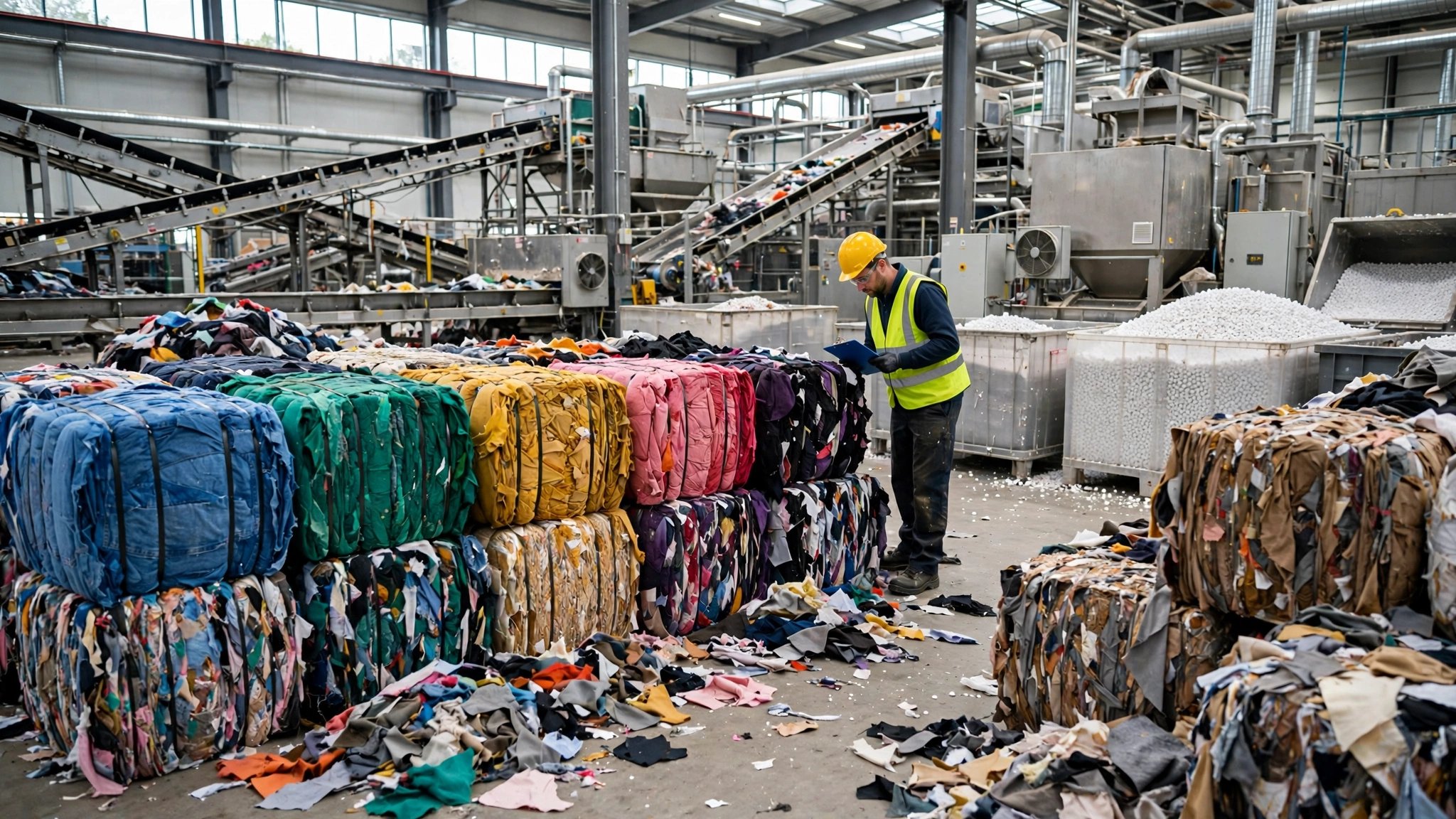
Syre, the textile-to-textile recycling company launched by H&M Group and investor Vargas, is rethinking the scale of its proposed US$1 billion polyester recycling project in Vietnam. Feedstock restrictions and financing challenges are complicating its ambitions, according to Ecotextile News on 9 November 2026.
For buyers planning recycled polyester supply for 2027 and beyond, the story is not simply “the plant is delayed”. It is a lesson in reading recycling numbers carefully — because the figures circulating about this project measure different things, and confusing them leads to wrong sourcing decisions.
Three numbers that do not mean the same thing
The confusion starts with three figures that look comparable but are not:
| Figure | What it measures | Source |
|---|---|---|
| 300,000–400,000 tonnes per year | Feedstock the original proposal would require annually | Syre’s original proposal, reported 2025 and restated by Ecotextile, 9 Nov 2026 |
| 46,000 tonnes | Reported textile-waste input figure; reporting period and operational status not specified | Latest report cited by Ecotextile, 9 Nov 2026 |
| 100,000–250,000 tonnes per year | Finished circular polyester a Gigascale plant is designed to produce annually | Syre, reported May 2025 |
The 46,000-tonne figure is the one that matters most — and the easiest to misread. Ecotextile points out that it describes textile waste entering the facility, whereas earlier figures referred to finished recycled PET production. Waste in is not output out: sorting losses, contamination, and process yield sit between the two. Four quantities need to be kept apart: feedstock input (waste entering the plant), processing capacity (what the plant can take in), yield (how much of that waste becomes usable output), and finished-product output (circular polyester leaving the plant). The 46,000-tonne figure is a feedstock-input figure; it is not a statement of finished output, and it should not be read as the plant’s revised operating capacity. Ecotextile calculates that 46,000 tonnes is 12 to 15 per cent of the original annual feedstock requirement of 300,000 to 400,000 tonnes — but the report does not state whether the 46,000-tonne figure is an annual figure, so that comparison should be read as the publication’s own illustration, not as a confirmed shortfall ratio.
The gap does not depend on that one comparison. The annual figures are established independently: estimated domestic national supply is about 40,000 to 60,000 tonnes a year against an annual requirement of 300,000 to 400,000 tonnes — roughly 10 to 20 per cent of what the project as originally proposed would need, as a rough comparison of reported quantities. That domestic estimate is a national figure, not confirmed Syre-eligible feedstock: it does not establish that this supply meets Syre’s technical specifications, is commercially accessible, or is contractually available.
That is the gap in one line. A plant designed to consume hundreds of thousands of tonnes of waste a year, in a country that can currently supply only a fraction of that volume domestically, and where importing the rest is restricted.
Why Vietnam cannot simply import the waste
The bottleneck is regulatory, and it has been visible since the project was first announced. When Syre operations director Tim King met the Binh Dinh provincial People’s Committee in February 2025, he highlighted challenges in sourcing sufficient raw materials. Domestic sources could supply only about 40,000 to 60,000 tonnes a year against a requirement of 300,000 to 400,000 tonnes — so imports would be necessary. Those domestic figures were the numbers discussed at the meeting, an estimate of national supply rather than a confirmed volume of Syre-eligible feedstock. The problem: Vietnamese regulations classify used clothing and fabrics as banned imports.
That ban does not cover every category of recyclable material in the same way, but the exact treatment of each category is a matter requiring confirmation under the applicable Vietnamese import classification and licence. Used garments and post-consumer clothing are the prohibited category; production offcuts, cutting waste and factory scrap are industrial waste streams, and whether they are classified differently — and whether any of them can currently be imported — has not been publicly established. Syre has said it would need to import such material while collection and sorting infrastructure is built, but no statement here should be read as confirmation that these streams are importable.
The province indicated that the regulations prohibiting imports of used textiles might be reconsidered, and assured Syre it would strive to meet the project’s energy requirements. But “might be reconsidered” is not a licence. Syre’s own conditions for an investment decision, set out when it signed an agreement with Binh Dinh province in May 2025 to establish its first Gigascale textile-to-textile recycling plant, include a pilot mechanism with a licence to import recyclable textile material from surrounding countries. Until that mechanism exists, the feedstock maths does not close.
The logic behind the restriction is understandable from Vietnam’s side. The country does not want to become a dumping ground for the world’s used clothing, and its waste rules distinguish between different categories of materials. Syre’s original strategy relied heavily on imported textile waste — which is precisely the category the rules treat most cautiously. The tension is structural, not a misunderstanding: scaling textile-to-textile recycling needs waste to move across borders, while waste policy in most countries is designed to keep it from moving.
Syre sustainability and public affairs director Stina Billinger has described this as a paradox of the sector: there needs to be enough waste in the first place despite the ultimate aim being to tackle the waste problem. Collection and sorting infrastructure for post-consumer waste is underdeveloped in Europe, the United States and Asian countries alike, so while that infrastructure is built, recyclers need to import production spill, cutting waste and factory scrap. That is the category Syre has said it would need to import — but whether any of it can currently be imported, and under what licence conditions, has not been publicly established.
Financing, power and the timetable
Feedstock is not the only open item. Three other conditions attach to the project:
Financing. After signing a multi-year supply agreement with Nike — described by chief executive Dennis Nobelius as a “bankable offtake agreement” — Syre prepared to raise up to US$700 million in new funding for the Vietnam plant, expecting to approach lenders and investors and complete a capital raise of US$500 million to US$700 million within about a year, according to Apparel Resources in November 2025. No close has been publicly confirmed in the sources reviewed as of 13 November 2026 — which is not the same as establishing that no financing has occurred, only that no close has been announced. Ecotextile’s November 2026 report cites financing challenges alongside feedstock restrictions as complicating the project’s ambitions.
Energy. The February 2025 meeting also raised the adequacy of Binh Dinh’s electricity infrastructure for a facility of this scale and duration. Syre wants to produce recycled polyester on green energy, which adds a further condition: not just enough power, but power from renewable sources, in a province whose grid is still developing. Whether a renewable-energy arrangement has been agreed has not been publicly confirmed in the sources reviewed as of 13 November 2026.
Timetable. The plan reported in late 2025 was to construct the plant by 2027, with production targeted to begin in late 2029 — explicitly dependent on Vietnamese government approval of import licences for textile waste. The November 2026 report that Syre is rethinking the project’s scale suggests that timetable, and the scale it assumed, are both under review. Buyers should treat late 2029 as a scenario, not a commitment.
The company’s long-term goal — around a dozen facilities worldwide over the next decade, capable of producing roughly three million tonnes of circular polyester annually — depends on the Vietnam plant working first. It is the blueprint plant. If its scale is cut, the template for the next eleven changes with it.
What this means for recycled polyester buyers
Do not write Syre’s nameplate capacity into your 2027–2030 plans
A Gigascale plant is designed to produce 100,000 to 250,000 tonnes of circular polyester a year. That is a design figure for a plant at full scale with full feedstock. The 46,000-tonne waste figure illustrates the feedstock position as reported — Ecotextile calculates it at 12 to 15 per cent of the original annual feedstock requirement, though the report does not state whether 46,000 tonnes is an annual figure, so it cannot establish an annual operating shortfall or current plant utilisation — and the domestic supply figures alone (an estimated 40,000 to 60,000 tonnes a year of national supply, not confirmed Syre-eligible feedstock, against a 300,000 to 400,000-tonne annual requirement) show the same gap without relying on that comparison. Buyers who have pencilled in Syre volumes for 2029 or 2030 should apply a discount for feedstock, financing and licensing risk — and keep alternative recycled and virgin polyester sources qualified in parallel.
Watch the import licence, not the press releases
The single most informative public signal for this project is whether Vietnam grants a pilot mechanism with a licence to import recyclable textile material. That is an observable event — but it is not a simple yes-or-no. A pilot mechanism may set conditions on which material categories can enter, their origin, contamination limits, permitted quantities and duration, so buyers should watch what the licence actually covers, not only whether one exists. Until a mechanism with workable scope is granted, announcements about scale, financing or partnerships do not change the feedstock maths. Buyers tracking the project should put the licence — and its approved categories and volumes — at the top of their watch list, ahead of fundraising headlines.
Chemical data is the second bottleneck
Feedstock volume is only half the recycling problem. According to speakers at the ZDHC Global Circularity Summit in Lisbon on 5 November 2026, as reported by Ecotextile, gaps in chemical data across supply chains are now the biggest barrier to textile-to-textile recycling: textile waste often reaches recyclers without chemical data sheets. That is the summit’s assessment, not an independently established industry-wide finding, and the speakers were not named in the reporting — but the practical point is concrete. Our report on the ZDHC summit and chemical data explains why that matters: a recycler cannot confidently process waste it cannot characterise — its chemical composition, restricted substances and traceability through the waste stream — and a buyer needs more than chemical data to claim recycled content with confidence. Chemical characterisation, chain of custody and recycled-content verification are related but distinct evidence requirements, and each may be required depending on the applicable recycled-content standard, verification scheme and intended claim. Operational characterisation — knowing what is in the incoming waste — is a different requirement from claim verification — proving that a finished fibre contains recycled content under a given scheme. Syre’s feedstock problem is quantitative; the chemical-data problem is qualitative, and it affects recyclers that cannot characterise incoming waste, not just Syre.
The offtake logic still holds — but it cuts both ways
Nike’s multi-year agreement matters because bankable offtake can strengthen the financing case for recycling plants. Early customers also include H&M Group, Gap Inc., Target Corp. and Houdini Sportswear. For buyers, the lesson is that offtake commitments are now a strategic tool: brands that commit early help plants get built. But an announced offtake agreement is not by itself proof of bankability — what matters is the contract: committed volumes versus optional volumes, conditions precedent, termination rights, and who bears the shortfall if volumes arrive late or at reduced scale. Buyers should check what their agreements say about delay, shortfall and substitution before treating an offtake announcement as a guarantee of supply.
A feedstock availability audit for buyers
Before writing any recycler’s committed capacity into a sourcing plan, check these five signals. The first three can be checked from public sources; the last two usually require confidential due diligence — commercial financing terms, private offtake agreements and infrastructure commitments are often not publicly disclosed, and a buyer that relies only on press releases will overstate what is verified.
Public signals
- Import licence or pilot mechanism. Has the host country granted a licence, pilot or exemption covering the waste categories the plant needs — and what are its conditions on origin, classification, contamination, quantities and duration? For Syre in Vietnam, this is the gating item.
- Financing close. Has the capital raise closed, or only been announced? Announced targets (US$500–700 million in Syre’s case) are not closed funds.
- Green-energy agreement. Is there a signed power arrangement for renewable energy at the site, or only an aspiration? Reliance on coal-intensive electricity could materially weaken the emissions advantage; buyers should request the project’s energy mix and lifecycle emissions assessment.
Due-diligence signals (ask under NDA where necessary)
- Offtake contract terms. Are there named, multi-year offtake agreements with creditworthy buyers — and what do they actually commit? Check committed volumes versus optional volumes, conditions precedent, termination rights and responsibility for shortfalls. An announced offtake is a signal; the contract is the evidence.
- Local infrastructure commitments. Has the host province or industrial park committed in writing to power, water and logistics upgrades on a dated timetable — and who pays if the upgrades slip?
Applied to Syre today, the score is mixed: offtake exists (Nike and others), the site agreement exists (Binh Dinh, May 2025), but the import licence, the financing close and a published green-energy arrangement remain open. That is not a verdict on the project — it is a reason to plan around scenarios rather than a single date.
Frequently asked questions
What is Syre building in Vietnam?
Syre plans its first Gigascale textile-to-textile recycling plant in Binh Dinh province, Vietnam, designed to produce 100,000 to 250,000 tonnes of circular polyester a year from textile waste. The project was announced with an investment figure of US$700 million to US$1 billion.
What is the feedstock problem?
The original proposal would need about 300,000 to 400,000 tonnes of feedstock a year. Estimated domestic national supply is only about 40,000 to 60,000 tonnes — a national estimate, not confirmed Syre-eligible feedstock — and Vietnam classifies used clothing and fabrics as banned imports. The latest reported figure of 46,000 tonnes of waste entering the facility is, on Ecotextile’s calculation, 12 to 15 per cent of the original annual requirement — though the report does not state whether 46,000 tonnes is an annual figure, so it should not be treated as a confirmed shortfall ratio. The 10 to 20 per cent comparison of domestic supply against the original requirement is likewise a rough comparison of reported quantities, not a confirmed measure of feedstock available to Syre.
Is the project cancelled?
No public statement says so. Ecotextile reported on 9 November 2026 that Syre is rethinking the scale of the project. Rethinking scale is not cancellation — but it does mean the original scale and timetable should not be relied on.
When could the plant start producing?
The timetable reported in late 2025 targeted construction by 2027 and production from late 2029, dependent on government approval of waste-import licences. That timetable is now under review.
How should buyers verify a recycler’s recycled-content claims?
Ask for the chain-of-custody evidence behind the recycled content — feedstock origin, chemical characterisation of incoming waste, and the audit trail under the applicable recycled-content standard or verification scheme, checking its scope, chain-of-custody requirements and audit evidence — that follows the material from waste to finished fibre. Without adequate supporting evidence under the applicable scheme, a recycled-content claim should not be treated as verified.
What feedstock does the plant actually need, and can it be imported?
Post-consumer used clothing is a banned import in Vietnam. Whether production offcuts, cutting waste and factory scrap are classified differently — and whether any of them can be imported — requires confirmation under the applicable Vietnamese import classification and licence. Ask which categories a recycler’s licence or pilot mechanism covers, in what quantities, and for how long.
What supply-contract exposure should buyers check before committing?
In any offtake or supply agreement, check committed versus optional volumes, conditions precedent, termination rights, and who bears the shortfall if deliveries arrive late or below the agreed scale. Do not promise customers volumes or dates that the contract does not guarantee.
What should buyers do instead?
Keep recycled polyester supply diversified, qualify alternative sources, and track the audit signals above — above all the import-licence decision and its approved categories and volumes — before committing volumes or dates to customers.
Sources
- Ecotextile News, “Feedstock hurdles test Syre’s Vietnam ambitions”, 9 November 2026 (paywalled; lead paragraphs read 13 November 2026). https://www.ecotextile.com/2026110967114/news/features/feedstock-hurdles-test-syres-vietnam-ambitions/
- ScandAsia, “Swedish Textile Firm Syre Plans $1 Billion Polyester Recycling Plant in Central Vietnam”, 20 February 2025. https://scandasia.com/swedish-textile-firm-syre-plans-1-billion-polyester-recycling-plant-in-central-vietnam/
- Global Textile Source, “H&M-Backed Syre to Build ‘Gigascale’ Textile-to-Textile Recycling Plant in Vietnam”, 1 May 2025. https://www.globaltextilesource.com/news/hm-backed-syre-to-build-gigascale-textile-to-textile-recycling-plant-in-vietnam
- Apparel Resources, “Syre AB to raise up to US $700 million for Vietnam recycling plant after Nike deal”, November 2025. https://apparelresources.com/business-news/sustainability/syre-ab-raise-us-700-million-vietnam-recycling-plant-nike-deal/
- Ecotextile News, “ZDHC summit: data holds back circularity”, 5 November 2026. https://www.ecotextile.com/2026110567085/news/dyes-chemicals/zdhc-summit-data-holds-back-circularity/
- WEFTSIGNAL, “Textile-to-Textile Recycling: What Buyers Need to Know”. https://appareldispatch.online/textile-to-textile-recycling/
- WEFTSIGNAL, “Textile-to-Textile Recycling and Chemical Data: What the ZDHC Summit Showed”. https://appareldispatch.online/textile-to-textile-recycling-chemical-data-zdhc-summit/
