
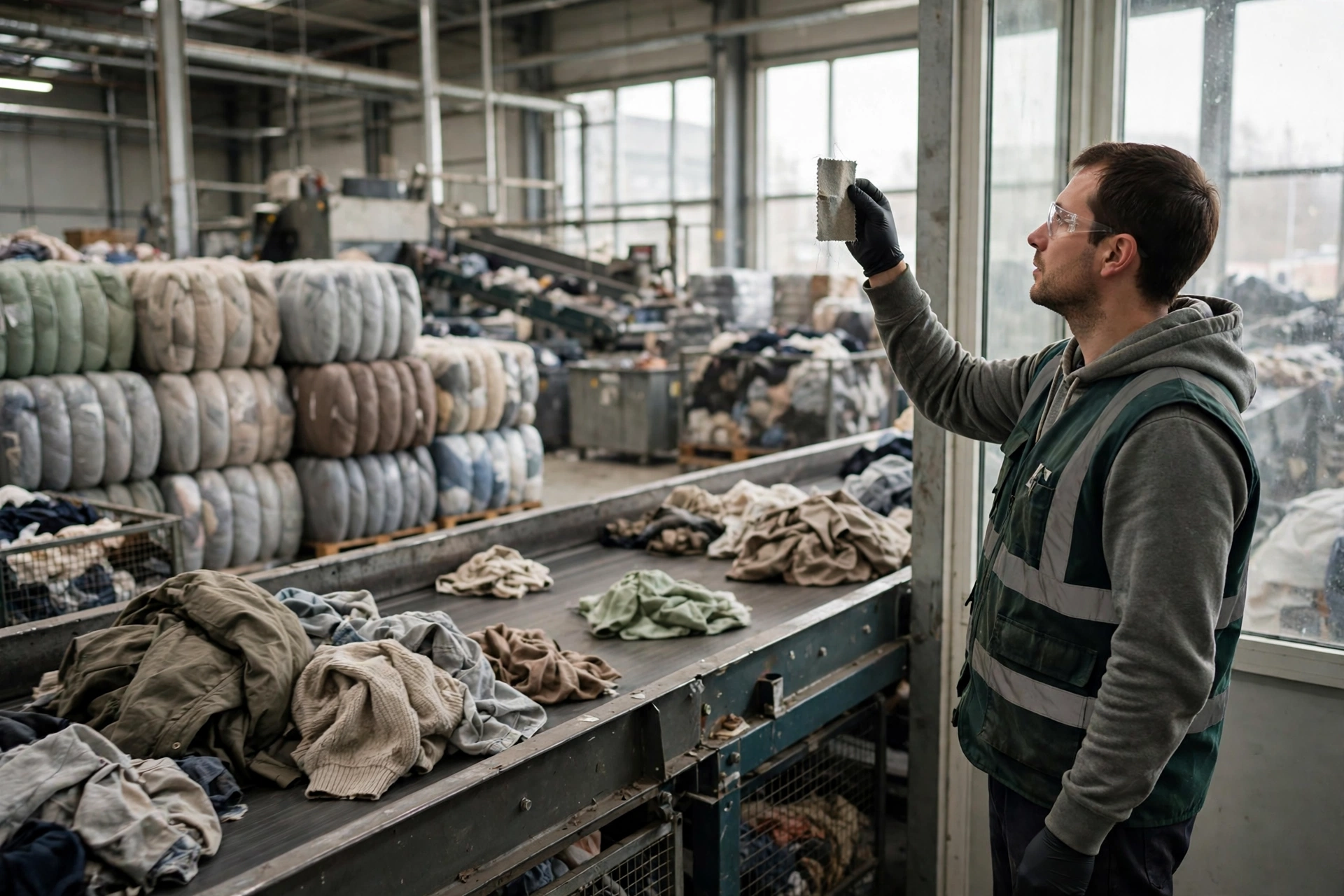
Textile waste often reaches recyclers without any record of the chemicals used to make it. Speakers at the first ZDHC Global Circularity Summit in Lisbon on 4–5 November 2026 said gaps in chemical data across supply chains are now the biggest barrier to textile-to-textile recycling, according to Ecotextile News reporting from the event. That is the speakers’ assessment as reported, not an official summit resolution: no published summit conclusion states it in those terms, and chemical data is one barrier among others — including recycling technology, economics, collection infrastructure and policy — rather than the only obstacle to circularity at scale.
The summit, held at MAAT in Lisbon in partnership with Católica Lisbon under the theme “Decoding the Chemistry Behind Scalable Circularity”, brought together recyclers, brands, manufacturers, chemical suppliers, investors and policymakers. Its focus was narrower and more practical than most circularity conferences manage: not whether recycling technology exists — new mechanical and chemical routes are already operating — but whether recyclers can know what they are taking in.
What the summit discussed
When waste reaches a recycler, it is almost impossible to know exactly which chemicals were used to manufacture any given product. Dyes, finishes, coatings and contaminants all affect sorting, recycling and the quality of recovered material — yet, as Ecotextile News reported from the summit, waste often reaches recyclers without any chemical data sheets. The chemical data that suppliers already report during production — formulation information and MRSL conformance evidence — is held in buyer and supplier systems; there is no established, industry-wide system that carries it with the product through sale, use and collection, so by the time a garment becomes feedstock, years later, the recycler is working without that record. That absence is documented beyond the summit: a 2024 study by the European Parliament’s Panel for the Future of Science and Technology found the data needed for reuse, reselling and recycling “still largely missing”, with collection and handling still often relying on spreadsheets and email; and a 2022 report prepared for the international chemicals framework (TemaNord 2022:549) found that most chemical information in textile supply chains is “negative information” — lists of substances that must not be present — rather than a positive record of what a garment contains.
ZDHC’s position, set out in its chief executive’s welcome remarks published ahead of the summit, is that circularity will only reach its full potential if it is built on sustainable chemical management — and that what circulates must be safe, traceable and fit for future use. Chemicals of concern that enter materials at the start of the value chain do not necessarily disappear when those materials are recycled; they can be carried into the next product. That is a statement about hazard, not a finding of risk: whether a recycled material poses a risk depends on the substance, its concentration, and how the next product is used. That is why the organisation is putting chemistry at the centre of its circularity strategy rather than treating it as a separate workstream.
The summit’s programme moved from feedstock, chemical risks and recycling methods on day one to financing and implementation on day two, with sessions on what feedstock can tell recyclers before processing, the opportunities and limits of mechanical and chemical recycling, and the role of chemical information in traceability and product data systems. A session by the Cradle to Cradle Products Innovation Institute, “Data as the Passport to Circular Products”, examined why chemical information belongs in traceability systems and how better data supports sorting, recycling decisions, compliance and trust in recycled materials.
In this article, “chemical data” covers three different kinds of evidence, which should not be confused: (a) formulation and composition information — what went into a chemical product or a material; (b) MRSL conformance evidence — a third-party certificate or conformance rating showing that a formulation meets the MRSL at a given level, held in systems such as the ZDHC Gateway; and (c) test evidence — laboratory results for a specific material or product, where they are relevant to that material and its intended use. MRSL conformance evidence is not a recipe: it records that a formulation was assessed against the MRSL, not its full composition, and no ZDHC conformance level requires a full recipe review — the ZDHC MRSL Conformance Guidance (December 2019) states that currently no ZDHC-accepted certification system performs a full recipe formulation review, and describes a full formulation review only as a possible future level beyond Level 3. A formulation list, a chemical inventory, a test report and a finished-product restricted substances list each answer a different question, and a buyer should match each piece of evidence to the relevant material, facility and intended use.
Where the data breaks
Our analysis: the data gap is not a single missing document. It breaks at four distinct points, and each break has a different owner:
| Stage | What happens to chemical data | Consequence |
|---|---|---|
| Production | Suppliers report chemical data — formulation information and MRSL conformance evidence — to brands and to systems such as the ZDHC Gateway | Data exists, but it is held in buyer and supplier systems |
| Sale and use | The product is sold; no established, industry-wide system carries the chemical information with it | The link between product and data is broken |
| Collection and sorting | Waste reaches sorters and recyclers without chemical data sheets | Sorters generally cannot separate feedstock by chemical risk from the information that travels with the waste. Sorting for fibre-to-fibre recycling is still mainly done by hand, and automated sorting and identification technologies are still needed (European Parliament STOA study, §3.8.2); chemical recycling needs detailed data on fibre content, dyes, chemicals, fire retardants and coatings (§3.8.4), and data on harmful chemicals in textiles is “particularly important and often lacking, even in certified textiles” (§3.8.3) |
| Recycling | Recyclers must decide whether to accept feedstock they cannot characterise | Material may be rejected, or recycled into lower-value uses — a decision that also turns on price, available capacity and regulation, not on chemical data alone |
This four-stage breakdown is our analysis, not a summit conclusion. It is a framework for organising where data is lost, not a finding that every supply chain breaks in the same four places: it has not been tested against, or shown to hold for, all supply chains, and the stages may look different where data systems or waste routes differ. It is an editorial organising framework, not a new finding — it claims no discovery about how recycling works, only a way of arranging where the data breaks. It also offers one explanation for why the problem persists despite years of chemical management work: most of the chemical information that does circulate is “negative information” — lists of substances that must not be present — rather than a positive record of what a garment contains (Bylund, Stibolt and Gustavsson, TemaNord 2022:549), which is what a recycler would need to decide how to handle a garment. In our assessment, the chemical data that does circulate is collected mainly to demonstrate production-stage compliance, rather than structured for recovery at the end of life. That consequence is not hypothetical: the European Parliament study cited above found that only a fraction of post-consumer waste can currently be used for fibre-to-fibre recycling, and that mechanically recycled post-consumer fibre seldom returns to garment production — in part because data on harmful chemicals in textiles is, in the study’s words, “particularly important and often lacking, even in certified textiles”. Fixing it will therefore require both things at once: data that travels with the product, and factory data collected and organised so that it can be reused when the product returns.
The numbers in context
Two figures quoted around the summit are worth reading carefully, because they are frequently used with the wrong denominator. Both come from Textile Exchange’s Materials Market Report 2026 data, reporting 2025 data by weight across all end uses, including apparel, home textiles, technical textiles, automotive, construction and medical applications; the 0.76% share itself is stated in Textile Exchange’s press release of 22 September 2026, and the report gives the same share as “around 1%” of the global fibre market, around 1–1.5 million tonnes (p. 13):
- 139 million tonnes of fibre were produced globally in 2025, according to Textile Exchange, up from 132 million tonnes in 2024. Of that total, 0.76% came from textile-to-textile recycling in 2025 (Textile Exchange press release, 22 September 2026; the report itself states the same share as “around 1%” of the global fibre market, around 1–1.5 million tonnes, p. 13). The denominator is all fibre output by weight, across all end uses — the figure describes how small the entire fibre-to-fibre loop still is. No year-on-year trend is claimed here: the 2021 comparison figure appears only in Textile Exchange’s press release and cannot be checked against a published definition in the 2026 report, so it is not stated.
- 97% of recycled polyester came from plastic bottles. The denominator here is recycled polyester only, not all recycled fibre. Textile Exchange’s press release states it as “The majority of this came from plastic bottles (97%)”; a separate sentence in the same release — “the vast majority of recycled polyester … was from plastic bottles and other non-textile sources” — carries no percentage. The report itself gives both sides of the split: on p. 57, bottles are 97% of all recycled polyester feedstock and textile-to-textile recycled polyester is 3% of all recycled polyester, and p. 13 gives the same split (around 3% textile-to-textile, 97% from plastic bottles). The 97% is therefore the bottle share and the remaining 3% is textile feedstock, as the report’s own breakdown — not an arithmetic inference from the 97% alone. The bottle percentage itself includes a very small share of non-bottle feedstock (report, p. 11, note 8). The figure describes where recycled polyester comes from, not the size of textile recycling. The two numbers answer different questions and should not be combined into a single claim.
Other figures from the summit’s background material give a sense of scale. In its 2024 review of the Circular Fashion Partnership in Bangladesh, which began in 2022, Global Fashion Agenda reported a cumulative total to that date: 36 facilities had segregated more than 11,000 tonnes of post-industrial textile waste, with more than 5,000 tonnes of that waste digitally traced to textile-to-textile recyclers. Those figures describe different steps in the chain — segregation and traceability are not the same as conversion into saleable fibre — and the 5,000 tonnes is a subset of the segregated volume, not a second, separate volume. A separate 2026–2029 initiative from ZDHC and Agence Française de Développement aims to support at least 100 textile, apparel and leather facilities in Bangladesh, with planned work covering chemical inventories, training, wastewater testing and corrective action. Fashion for Good’s Wealth in Waste study, launched in July 2022, estimated that up to 7.8 million tonnes of textile waste is accumulated in India each year — about 8.5% of the global total — made up of roughly 51% post-consumer waste, 42% pre-consumer waste and 7% imported waste. The 42% share is that 2022 study’s own label: in its usage, “pre-consumer” meant factory waste and offcuts, whereas this article otherwise follows Fashion for Good’s 2025 three-way split, under which factory waste is post-industrial waste and pre-consumer waste means unsold, excess or returned garments. The gap between waste generated and waste recycled as fibre is the space the summit was addressing.
What ZDHC is doing first
ZDHC’s initial focus will be post-industrial textile and leather waste, where manufacturing controls and chemical information are more accessible than for discarded consumer products. Post-industrial waste, as the term is used in this article, means waste generated inside the factory during manufacturing — cutting waste and off-cuts, misprints, defective textiles and surplus trims — whose lot and composition history is known. There is no single standardised definition of post-industrial and pre-consumer waste across the industry, so this article uses Fashion for Good’s 2025 three-way split — the factory-stage meaning — throughout. Unsold finished stock and returns that have already left the factory are generally classed separately as pre-consumer waste, not post-industrial waste, although the two terms are sometimes used interchangeably in the industry; this article keeps the factory-stage meaning throughout. One caution on terminology: Textile Exchange’s market statistics use a narrower definition of pre-consumer feedstock — in its Materials Market Report 2026, unsold goods, returns and overstock do not count as eligible reclaimed feedstock, even though waste-classification frameworks such as Fashion for Good’s count unsold stock and returns as pre-consumer waste. This article uses Fashion for Good’s waste classification for the waste discussion and Textile Exchange’s figures for the market statistics; the two frameworks should not be mixed. Post-consumer waste means discarded products, whose coatings, repairs and history of use are harder to establish. That is a deliberate sequencing choice: start where data exists, prove the model, and then extend it to the harder problem of post-consumer waste. Whether a circularity-specific watch list should be established remained on the table ahead of the summit, according to Ecotextile News’ 14 October 2026 preview; no post-summit outcome on that question has been published.
The timing is close, and worth stating precisely. ZDHC launched MRSL Version 4.0 on 29 October 2026, and its transition period began on 1 November 2026 — three days before the summit opened — running to full implementation by 1 June 2028. Between those dates, certifier applications open on 15 December 2026, and formulation recertification runs from 1 February to 1 November 2027 (ZDHC MRSL V4.0 Industry Implementation Approach, October 2026, Table 1). Version 4.0 adds new substance groups. Three things should be kept apart. First, the headline number: ZDHC’s launch announcement describes 16 substances not previously covered, naming bisphenols, formaldehyde, polychlorinated biphenyls (PCBs) and certain UV absorbers. Second, the Change Log introduces four new chemical groups: bisphenols; aldehydes and ketones, including formaldehyde; PCBs; and oxidising and reducing agents, including permanganate salts. The two new UV absorbers, UV-326 and UV-329, are additions to the existing UV Absorbers group, not new groups. Third, additions to existing groups: 1,4-dioxane, styrene, dicumyl peroxide, triphenyl phosphate and OBSH, Solvent Green 1 acetate salt, and the metals zinc, iron and manganese. The Change Log publishes no single numbered list of all 16, and no counting rule in the published documents reproduces the 16 figure from those entries. This article therefore describes the changes by group and does not present a numbered inventory of 16. Version 4.0 also sets defined limits for unintentional PFAS contamination in chemical formulations. The two developments are parts of one programme, but the link between them is narrower than it may sound: the MRSL controls what goes into production, which reduces the hazardous chemicals entering circulation, but it does not track chemicals in products already sold and does not by itself decide whether a used product can be recycled. The circularity work asks what happens to those chemicals when the product comes back — a question the MRSL alone cannot answer. Our coverage of the MRSL update — ZDHC MRSL V4.0: New Substance Groups and Defined PFAS Contamination Limits — explains the new limits and the transition timetable to June 2028.
The choice between mechanical and chemical recycling is not a simple either-or. Which route fits depends on the feedstock, the output quality required and the intended application, as well as the energy, water, chemical inputs and residues involved within the same reporting boundary.
What buyers and factories can do now
The discussion at the summit points to practical steps that do not require new regulation:
- Ask for chemical data that travels. When specifying a product, ask whether chemical information can be carried with it — through a digital product passport or an equivalent data system — rather than held only in the supplier’s compliance files. Note that the textile passport’s contents are not yet fixed: under the EU Ecodesign for Sustainable Products Regulation (Regulation (EU) 2024/1781), Article 9(2)(a) leaves the data to be included in a passport — chosen pursuant to Annex III — to the delegated act for the product group, and the textile delegated act has not been adopted, so what a passport must contain is still to be decided. Article 4(2) also allows the Commission to decide that no information requirements are set for certain product parameters. The Commission’s indicative timetable is adoption of the textile delegated act in Q4 2027 (ESPR Working Plan 2025–2030, COM(2025) 187), and under Article 4(4) a delegated act normally applies no earlier than 18 months after it enters into force, so textile passport duties are not expected before 2029. Our guide to digital product passports for textiles explains the framework and where its timetable stands: Digital Product Passport for Textiles: What Apparel Suppliers Need to Know in 2026.
- Treat post-industrial waste as the starting point. Factories generate cutting waste and off-cuts whose chemical history is known. Segregating and documenting that stream is ZDHC’s stated starting point for fibre-to-fibre recycling: it is the stream whose chemical history is best known, which is why the summit’s pre-reading framed post-industrial waste as the first to tackle.
- Put chemical questions into the sorting decision. Recyclers need to know about finishes, coatings and contaminants before accepting feedstock. Suppliers that can answer those questions are more likely to find their waste accepted; those that cannot are more likely to find it rejected or downcycled. Chemical information helps, but it is not the only factor: price, available capacity, the recycler’s process and regulation also shape whether a load is taken.
- Start with the streams where data already exists, rather than waiting for a perfect standard. The summit’s own framing — “decoding the chemistry behind scalable circularity” — treats data as a practical problem to be worked through, while standards work continues.
For the waste side of the equation, our guide to fabric waste in garment manufacturing sets out where waste arises and how it is currently handled: Fabric Waste in Garment Manufacturing: Where It Arises and How to Reduce It.
What to watch next
Three things will show whether the summit changes practice or merely records it. First, whether ZDHC publishes a concrete circularity work programme with dates, rather than a statement of intent. Second, whether the chemical-data question is carried into the EU’s digital product passport work and the Circularity Blueprint being advanced by the Global Fashion Agenda and ReHubs — the EURATEX–Global Fashion Agenda strategic alliance announced on 5 November 2026 is one channel for that. Third, whether brands begin asking suppliers for end-of-life chemical data in the same way they now ask for production-stage data. The summit’s argument is that they should, because without it the recycling capacity now being built risks having too little verifiably safe feedstock to work with.
For the regulatory backdrop, see our coverage of the EU textile EPR framework and the October 2026 Parliament vote: EU Textile EPR: Parliament Vote and What Exporters Must Prepare.
This article provides general industry information, not legal or regulatory advice. Applicability depends on the product, customs classification, business role, destination market and relevant national implementation measures.
Sources
- ZDHC Foundation, “ZDHC Global Circularity Summit 2026” (official event page: date, venue, theme, “first-of-its-kind”). https://events.roadmaptozero.com/event/122/detail?utm_medium=paid&utm_source=fb&utm_id=52604060122322&utm_content=52604060122522&utm_term=52604060122122&utm_campaign=52604060122322
- ZDHC Foundation, “CEO Welcome Remarks”, Roadmap to Zero (welcome remarks for the Lisbon summit, 4–5 November 2026; “very first ZDHC Circularity Summit”). https://www.roadmaptozero.com/post/ceo-welcome-remarks
- Ecotextile News, “ZDHC summit: data holds back circularity”, 5 November 2026. https://www.ecotextile.com/2026110567085/news/dyes-chemicals/zdhc-summit-data-holds-back-circularity/
- Ecotextile News, “ZDHC puts chemistry at circularity’s core”, 14 October 2026 (pre-summit preview: post-industrial focus; watch list “remains on the table”). https://www.ecotextile.com/2026101466492/news/dyes-chemicals/zdhc-puts-chemistry-at-circularitys-core/
- SusFuture, “What Makes Recycled Textile Fibre Fit for Its Next Use?”, 4 November 2026. https://www.susfuture.org/post/what-makes-recycled-textile-fibre-fit-for-its-next-use
- Textile Exchange, “Textile Exchange’s Materials Benchmark shows promise of progress…”, 22 September 2026 (Materials Market Report 2026: 139 million tonnes in 2025; 0.76% textile-to-textile; 97% of recycled polyester from plastic bottles; figures by weight; “marginal growth” is the release’s own wording for the increase since 2021). https://textileexchange.org/news/textile-exchanges-materials-benchmark-shows-promise-of-progress/
- Textile Exchange, “Materials Market Report 2026”, September 2026 (official Textile Exchange report page: https://textileexchange.org/knowledge-center/reports/materials-market-report-2026 — dated 22 September 2026, it repeats the report’s key takeaways, including 139 million tonnes, 97% of recycled polyester from plastic bottles, and the rise from 0.61% in 2021 to 0.76% in 2025. The report is listed on Textile Exchange’s official report page (above). The PDF copy checked for this article is hosted on refashion.fr: a 96-page document dated September 2026 carrying the Textile Exchange imprint, whose figures agree with the press release and the official report page — but it is a third-party-hosted copy, not a file distributed from textileexchange.org, so it is cited here as the checked copy. The press release above is the public summary of the same data. Recycled polyester “primarily made from plastic bottles (97%)”, p. 57; textile-to-textile recycled polyester 3% of all recycled polyester, p. 57, and the same 3%/97% split on p. 13; bottle percentage includes a very small share of non-bottle feedstock, p. 11, note 8; pre-consumer feedstock eligibility, p. 13; the 0.76% textile-to-textile share of all fibre is stated in the press release and on the official report page, and does not appear as readable text in the report PDF; the report itself states the same share as “around 1%” of the global fibre market, around 1–1.5 million tonnes, p. 13). https://media-pro.refashion.fr/2026/09/2026-materials-market-report.pdf
- Global Fashion Agenda, “The Global Circular Fashion Forum: Transforming Waste into Opportunity” (2024 review of the Circular Fashion Partnership, begun 2022: 36 facilities, cumulative 11,000+ tonnes segregated, 5,000+ tonnes of that waste digitally traced to recyclers). https://globalfashionagenda.org/news-article/the-global-circular-fashion-forum-transforming-waste-into-opportunity/
- ZDHC Foundation, “From Compliance to Capability: Transforming Chemical and Wastewater Management in Bangladesh” (ZDHC–AFD initiative, 2026–2029, at least 100 facilities). https://www.roadmaptozero.com/post/from-compliance-to-capability-transforming-chemical-and-wastewater-management-in-bangladesh
- Fashion for Good, “Sorting for Circularity India” (Wealth in Waste, July 2022: up to 7,800 kilotonnes of textile waste accumulated in India annually; 51% post-consumer, 42% pre-consumer, 7% imported; 8.5% of the global total; the 42% “pre-consumer” share is that study’s own label for factory waste and offcuts, not the 2025 three-way meaning used elsewhere in this article). https://www.fashionforgood.com/case-study/sorting-for-circularity-india/
- Fashion for Good, “Wealth in Waste: India’s Potential to Lead Circular Textile Sourcing”, 27 July 2022 (report launch: up to 7,800 kilotonnes annually; composition as above). https://fashionforgood.com/our_news/wealth-in-waste-indias-potential-to-lead-circular-textile-sourcing/
- Fashion for Good, “The Intelligent Factory: How AI and Digital Innovation are Tackling Textile Waste”, 12 August 2025 (post-industrial vs pre-consumer vs post-consumer definitions: post-industrial is factory-generated — off-cuts, misprints, defective textiles, surplus trims; pre-consumer is unsold, excess or returned garments from retail). https://www.fashionforgood.com/our_news/digital-innovation-textile-waste/
- ZDHC Foundation, “ZDHC MRSL Conformance — Guidance for Demonstrating Chemical Formulation Conformance to the ZDHC MRSL”, December 2019 (conformance levels 1–3; the guidance states that currently no certification system performs a full recipe formulation review — in context, the certification systems the guidance covers are those accepted by ZDHC — and a full formulation review is described only as a possible future level beyond Level 3). https://cdn.prod.website-files.com/5c4065f2d6b53e08a1b03de7/5e8de0a3c5077cd5d6846799_Conformance_Guidance_V1_1.pdf
- ZDHC Gateway Help Centre, “ZDHC Gateway — Chemical Module (Formulator)” (conformance is shown by a third-party certificate stating the MRSL conformance level; registration alone does not mean conformance). https://knowledge-base.roadmaptozero.com/hc/en-gb/articles/11718121165725-ZDHC-Gateway-Chemical-Module-Formulator
- LG Fashion Labs, “Apparel DPP Data Fields: Draft Study Prepared for the JRC”, October 2026 (no EU law yet lists apparel DPP data fields; the ESPR textile delegated act has not been adopted; Art. 9(2) leaves the data to that act). https://lgfashionlabs.com/apparel-dpp-data-fields-jrc-study.html
- Regulation (EU) 2024/1781 of the European Parliament and of the Council of 13 June 2024 establishing a framework for the setting of ecodesign requirements for sustainable products (ESPR), EUR-Lex (Article 9(2)(a): the data to be included in a digital product passport, pursuant to Annex III, are specified in the delegated act; Article 4(2): the Commission may establish that no performance or information requirements are set for certain product parameters; Article 4(4): a delegated act normally applies no earlier than 18 months after it enters into force). https://eur-lex.europa.eu/eli/reg/2024/1781/oj/eng
- European Commission, “Ecodesign for Sustainable Products and Energy Labelling Working Plan 2025–2030”, COM(2025) 187, 16 April 2025 (textiles and apparel a priority product group; the Commission’s published timeline gives Q4 2027 as the indicative adoption date for the textile delegated act, Q3–Q4 2027 in the general timeline; dates are indicative and may change).
- Global Fashion Agenda, “EURATEX and Global Fashion Agenda build strategic alliance…”, 5 November 2026 (alliance; Circularity Blueprint launched earlier in 2026 by GFA with ReHubs). https://globalfashionagenda.org/news-article/euratex-and-global-fashion-agenda-build-strategic-alliance-as-textile-policy-and-regulation-become-more-important/
- ZDHC Foundation, “ZDHC MRSL V4.0 Industry Implementation Approach”, October 2026 (Table 1: transition begins 1 November 2026; certifier applications open 15 December 2026; formulation recertification 1 February–1 November 2027; fully executed by 1 June 2028). https://downloads.roadmaptozero.com/ZDHC_MRSL_V4.0_Implementation_Approach
- ZDHC Foundation, “ZDHC Launches MRSL V4.0”, 29 October 2026 (launch announcement: “Version 4.0 introduces 16 new substances not previously covered under ZDHC MRSL V3.1”, naming bisphenols, formaldehyde, polychlorinated biphenyls (PCBs) and certain UV absorbers). https://www.roadmaptozero.com/post/zdhc-launches-mrsl-v4-0
- ZDHC Foundation, “ZDHC MRSL V4.0 — Change Log V3.1 to V4.0”, October 2026 (new groups §§1T–1W; two new UV absorbers §1S; further additions §§1G, 1M, 1R; entries are named group by group and not numbered). https://downloads.roadmaptozero.com/ZDHC_MRSL_V4.0_Change_Log
- Niinimäki et al., “Identifying data gaps in the textile industry and assessing current initiatives to address them”, European Parliament, Panel for the Future of Science and Technology (STOA), PE 762.850, July 2024 (Executive summary: downstream data for reuse, reselling and recycling “still largely missing”; §3.8.2 waste collection and sorting — sorting for fibre-to-fibre recycling currently mainly manual, only a fraction of post-consumer waste usable for fibre-to-fibre recycling; §3.8.3 mechanical recycling — chemical data “particularly important and often lacking, even in certified textiles”; §3.8.4 chemical recycling — detailed data needed on fibre content, dyes, chemicals, fire retardants and coatings). https://www.europarl.europa.eu/RegData/etudes/STUD/2024/762850/EPRS_STU(2024)762850_EN.pdf
- Bylund, Stibolt and Gustavsson, “Indicators for chemical information transfer in the textile value chain”, TemaNord 2022:549, Nordic Council of Ministers, 2022 (most chemical information in textile supply chains is “negative information” on the absence of certain substances, as opposed to “positive information” listing which chemicals were used; positive information would give recyclers what they need to decide how to handle a garment). https://pub.norden.org/temanord2022-549
