
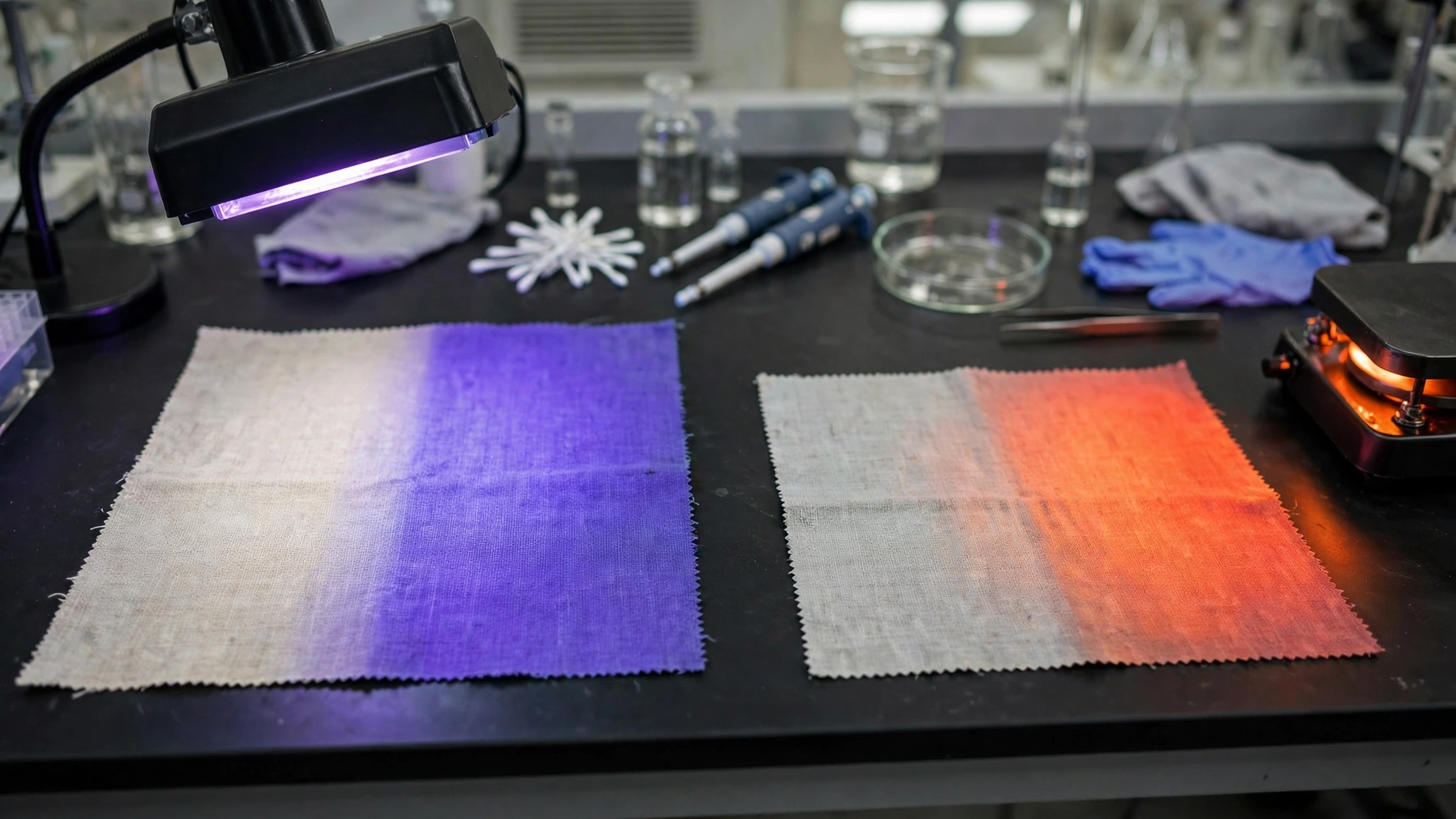
Colour-changing fabric is cloth whose appearance changes in response to something outside it — a dye, pigment, coating or film that changes which light it absorbs, reflects or lets through when the stimulus changes. The trigger names the type: ultraviolet light makes photochromic fabric colour up, heat switches thermochromic fabric, a small voltage drives electrochromic fabric, water reveals a hydrochromic print, and stretching shifts a structural-colour film. The idea is old — heat-sensitive shirts were a craze in 1991 — but the chemistry has moved on, and so have the claims buyers now hear from suppliers. This guide explains how each type works, where each one fails, how to test a claim, and what the commercial record actually shows.
The types compared
Table 1. Colour-changing fabric types compared: stimulus, chemistry, reversibility and key limits. Sources: Gupta (2021); Solanki et al. (2025) and its erratum; Lu et al. (2026); Graßmann et al. (2020); Matsui Hydrochromic White technical data sheet; MIT News (2022); Victoria and Albert Museum (shot organza sample).
| Type | Stimulus | Typical chemistry | Reversible? | Key limits |
|---|---|---|---|---|
| Photochromic | Ultraviolet light | Spiropyrans, spirooxazines, naphthopyrans | Yes — fades once the UV is gone | Limited light fastness; in one laboratory study a spirooxazine print lost 16–26% of its colour strength over 30 UV cycles (Mode B) |
| Thermochromic, leuco dye | Heat, at a set temperature | Leuco dye + developer + solvent, sealed in microcapsules | Yes (irreversible types also exist) | Capsules break in laundering and abrasion; switches at different temperatures on heating and cooling |
| Thermochromic, liquid crystal | Heat | Cholesteric liquid crystals | Yes | High cost and weak colour |
| Electrochromic | Low voltage, typically 1–5 V (Graßmann et al., 2020) | Conducting polymers such as PEDOT:PSS, polyaniline; tungsten oxide; Prussian blue | Yes, by reversing the voltage | Needs wiring and power; bulky and costly so far |
| Hydrochromic | Water | White water-sensitive base that disappears when wet and reappears when dry | Yes, on drying | Reveals a print rather than making a colour; maker gives no wash figures |
| Mechanochromic, structural colour | Stretching or pressing | Nanostructured photonic film | Yes | Research stage |
| Not chromic: shot weave | Viewing angle | Warp yarn of one colour, weft of another | Permanent — nothing in the fibre changes | An optical effect only |
Photochromic fabric: colour that appears in sunlight
Photochromic fabric is pale or white indoors and takes on colour in sunlight. Its dye molecules turn from colourless to coloured under ultraviolet light, in general across the UVB (280–315 nm) and UVA (315–400 nm) bands, and fade back once the UV is gone. The three dye families most commonly used on textiles are spiropyrans, spirooxazines and naphthopyrans. In simplified terms, what the three families share, according to Gupta’s review of photochromic dyes for smart textiles, is that the ring in the molecule opens under UV and the carbon-to-oxygen bond in the pyran core breaks, giving a flatter, more conjugated open form — a merocyanine — that absorbs visible light and looks coloured. Gupta states this directly of naphthopyrans: their mechanism is similar to spiropyrans and all three break the C–O bond in the pyran core.
The pathway by which that bond opens is not the same in all three families, and the difference matters. In spiropyrans and spirooxazines the opening is a heterolytic cleavage that gives a merocyanine; in naphthopyrans it is a 6π electrocyclic ring opening that gives neutral merocyanine isomers, first the cis-transoid form and then, under further UV, the more stable trans-transoid form. The open merocyanine form is itself best described as an equilibrium between quinoidal and zwitterionic structures, with the balance depending on the environment and the substituents — so “zwitterionic” alone is a shorthand, not the whole description. A recent review of naphthopyran switches also notes that the mechanism is not always a simple concerted electrocyclic opening — in some cases the evidence points to a polar, heterolytic pathway — so any single-sentence mechanism is a summary, not the full picture. Fading, too, is not one process: these are T-type dyes, so the coloured form reverts mainly by heat once the UV is gone, and visible light can also drive the return for some dyes. The photochromism of spiropyrans was discovered in 1952.
The dyes reach cloth in several ways. Aldib and Christie applied commercial photochromic dyes to polyester as disperse dyes by exhaust dyeing (M. Aldib and R. M. Christie, “Textile applications of photochromic dyes. Part 4: application of commercial photochromic dyes as disperse dyes to polyester by exhaust dyeing”, Coloration Technology 127, 282–287, 2011): the fabrics showed only a weak background colour, developed pronounced colours under UV, and returned to their original state when the UV source was removed. The same dyes can be printed in a thickened paste and cured at 140 °C, or padded on with a binder and cured — in the methods Gupta describes — or added to polypropylene before it is extruded into filament. For the underlying methods, see our textile dyeing process buyer guide and textile printing methods buyer guide.
Light is also the problem. The UV that switches the dye also destroys it. Little and Christie screen-printed five commercial photochromic dyes and found “limited photostability”: adding a UV absorber improved photostability only to a degree that depended on the dye and absorber pair, and always weakened the colour, while hindered amine light stabilisers improved photostability up to fivefold. Those findings are from the authors’ own paper (Coloration Technology, 2011), whose published abstract states them directly. Fatigue can be measured: Solanki, Viková and Vik (2025, DOI 10.2478/ftee-2025-0009) screen-printed a spirooxazine dye on 65/35 polyester/cotton and measured the loss of colour strength as ΔK/S photodegradation over 30 UV cycles in a single measurement block (Mode B) — 16.30% at 100 g of dye per kg of paste, and 26.01% at 200 g/kg. A later erratum to the same paper (DOI 10.2478/ftee-2025-0011) corrected Table 1, adding an omitted ΔK/S value of 14.61% at 100 g/kg under Mode C (a single UV cycle without a decay phase). Those figures describe one dye, one fabric and one laboratory measurement method; they are not a general rate at which photochromic colour fades. In the same Little and Christie study, spirooxazine prints gained colour strength over the first washes and then lost it, while naphthopyran prints lost a little at each wash.
In fashion, the best-known outing was at Paris Fashion Week on 28 February 2023, when the Japanese label Anrealage showed its Autumn Winter 2023 collection in white; moving UV lamps brought out coloured checks, plaids and polka dots, and the garments returned to their original colour after about three minutes.
Thermochromic fabric: colour that changes with heat
The typical thermochromic system for textiles is a three-part leuco mixture. The leuco dye, such as crystal violet lactone, is the electron donor and sets the colour; the developer, such as bisphenol A, is the electron acceptor; and the solvent is an organic compound whose melting point largely determines the temperature at which the colour changes. Crystal violet lactone changes colour by reversibly opening and closing a lactone ring in its structure. In the three-component mixtures studied in a Dalhousie University thesis (D. C. MacLaren, Investigations of reversible thermochromic mixtures, PhD thesis, Dalhousie University, 2003), the solvent is most of the mixture — 75 to 90 mol% against 1 to 3 mol% dye and 5 to 25 mol% developer — and the colour depends on a competition between the dye and the solvent for the developer.
That solvent rule belongs to the leuco system only. It does not describe every thermochromic material: in cholesteric liquid crystals the colour is set by the temperature-sensitive pitch of a helical structure, not by a solvent melting point, and in polymer-matrix systems the switch can coincide with a glass transition of the matrix rather than with a solvent melting. Read any claim that “the melting point sets the switching temperature” as a claim about a three-component leuco formulation, and ask which system the supplier is actually selling.
Bisphenol A needs a safety note that the original draft did not carry. It is named here only as an example of a developer — the common pairing in the literature is crystal violet lactone with bisphenol A — not as a recommendation. The European Chemicals Agency has listed bisphenol A on the REACH Candidate List of substances of very high concern: it was listed on 12 January 2017 as toxic for reproduction (category 1B), and ECHA subsequently identified it as an endocrine disruptor for human health in July 2017 and for the environment in January 2018. Being on the Candidate List is not itself a restriction. The best-known restriction, Regulation (EU) 2016/2235, prohibits bisphenol A in thermal paper at a concentration of 0.02% by weight or more after 2 January 2020 — but that restriction covers thermal paper, and it is not a ban on bisphenol A in textiles. Do not read it as one, and do not read the absence of a textile-specific ban as proof that a bisphenol-A print is safe for skin contact. The same caution applies to the substitutes: bisphenol S was added to the REACH Candidate List on 17 January 2023 as toxic for reproduction and as an endocrine disruptor for human health and the environment, so “bisphenol-free” is not the same as “BPA-free” — a developer labelled BPA-free may still be based on bisphenol S or bisphenol F. Bisphenol F was proposed for the same list in an ECHA consultation opened on 1 September 2025, but the proposal was withdrawn before the Member State Committee meeting in December 2025, as disclosed when the Candidate List was updated on 4 February 2026 — and bisphenol F was not added to the list, which stood at 253 entries after that update. The story is not closed: Sweden has lodged a new intention to identify bisphenol F as a substance of very high concern, dated 26 June 2026 and listed in ECHA’s Registry of Intentions, with the dossier expected by 1 February 2027 — so it is back under consideration but, as of the sources read for this revision, still not listed. Ask the supplier whether the developer is bisphenol-A-based or bisphenol-free, what the developer is if it is not, and what skin-contact, migration and REACH compliance evidence exists for the finished print. Encapsulation is not proof of no exposure, particularly if the capsules break in use or laundering.
The mixture is sealed in microcapsules so it survives printing and wear. Capsules with melamine-formaldehyde shells have been widely commercialised, and one maker, Matsui, encapsulates its dyes in capsules 3 to 5 µm across (Lu et al., 2026, section 3.3). The durability evidence for those capsules is qualitative rather than a cycle count: the same review lists inadequate wash durability among the field’s central challenges, and capsules can break in laundering. It also notes that melamine-formaldehyde resin releases formaldehyde upon degradation, posing health risks, and that formaldehyde-free shells — for example polyurethane-urea — are being developed in response. A capsule size, in other words, is not a durability figure: ask for wash data, not a diameter.
A fever-indicating mask print shows how the switch works — and how narrow the evidence for it is. Below its activation temperature of 37.5 °C in that formulation the dye and developer interact strongly and the print is blue; at 37.5 °C the solvent melts and breaks up that interaction, so the dye takes its colourless form and the print turns clear; below the melting point again, the coloured pairing re-forms. The temperature at which it returns can differ from the one at which it left — that gap is called hysteresis. The mask in question is a laboratory prototype, not a validated health product. It was tested on a PVC head manikin fitted with an electric heated pad around the cheek area, not on people, and its authors state that future research will focus on wearer trials; they also conclude that ambient temperature affects performance, with both hot and cold extremes impairing it. The print responds to the temperature of the fabric surface where it sits, not to core body temperature, and the paper’s own framing is that normal core temperature is about 37 °C and fluctuates by about 0.5 °C through the day. A print that has turned clear is therefore a screening cue at most — a prompt to check with a clinical thermometer — never a diagnosis of fever, and a print that has stayed blue is not proof that there is no fever. Do not use a colour-changing print in place of a thermometer, and do not treat a colour change as medical advice.
The switching temperature is set by the formulation. In one research system, based on sulfones with bromocresol purple as the developer, it could be placed anywhere from 13 to 46 °C by changing the ratio of long-chain alcohols to stearic acid (Lu et al., 2026, section 2.1). Thermochromic inks go on commonly by screen printing and frequently by inkjet; thermochromic fibres are made by melt spinning, either by mixing a thermochromic masterbatch into the polymer or by putting the thermochromic material in the core of a sheath-core fibre.
The limits are durability and stability. Leuco systems give a wide colour range and a fast response but lack stability and wash durability: they are sensitive to repeated washing, abrasion and prolonged ultraviolet exposure, and the capsules can break in laundering.
A second thermochromic family works by reflection, not absorption. Cholesteric (chiral nematic) liquid crystals have a periodic helical structure that makes them a soft photonic crystal: their colour is reflected, and they are highly sensitive to temperature. The reflected wavelength is set by the helical pitch, which changes with temperature — there is no leuco dye, no developer and no solvent melting point in this mechanism. They have no affinity for fibres, so they must be microencapsulated and combined with a binder before printing, which reduces their brightness, and they are costly and give a weak colour change.
The best-known thermochromic product is also a cautionary tale. Hypercolor, made by the Seattle sportswear company Generra, sold $50 million of heat-sensitive T-shirts, shorts, pants, sweatshirts and tights between February and May 1991, according to Smithsonian Magazine. The garments were dyed twice, once with a permanent dye and once with a thermochromic one, so the warmth of a hand or of the body changed the colour where it touched. After a handful of washes, or one wash in water that was too hot, the effect died and the shirt stayed a purple-brown. Generra went bankrupt in 1992.
Electrochromic fabric: colour changed by a voltage
In an electrochromic device, a lasting but reversible colour change is produced by an electrochemical oxidation or reduction process. The materials include inorganic compounds such as tungsten oxide and Prussian blue, organic compounds such as viologens, and conducting polymers such as polyaniline, polythiophene derivatives and PEDOT:PSS. On cloth the material is built into a thin cell: a PEDOT:PSS colour layer that is also an electrode, an electrolyte (gel or film) and a counter electrode.
Graßmann and colleagues built a five-layer cell on polyester fabric — a polyurethane pre-coat, a carbon counter electrode, a gelatin and glycerol electrolyte with titanium dioxide, and a PEDOT:PSS layer sprayed onto a thin plastic membrane. PEDOT:PSS is light blue and semi-transparent when oxidised and dark blue when reduced. Their cells switched in 2 seconds at 2.0 V when new and in about 4 seconds at 2.8 V after 12 months, and the dark state was not self-sustaining: it needed at least 0.5 V to hold.
Military camouflage is one aim of this research. A 2025 cotton fabric coated with PEDOT:PSS, run between −1.0 and +1.0 V, changed between light blue and navy in 14.1 seconds and back in 6.3 seconds, showed no marked decline in current density over 1,280 electrochemical cycles, and with the voltage removed took 115 minutes to lose half its colour difference. Those 1,280 cycles were a test of electrochemical cycling stability, not of wash or mechanical durability — the paper reports no wash test — and its optical contrast (ΔE 24.70) was measured separately, not after those cycles. Its authors state the obstacle plainly: current electrochromic fabrics “are often bulky, involve complicated processes, and have high production costs”.
Low voltage is not, on its own, a safety certification, and neither of the two electrochromic studies cited above reports a wash test for the cell. Graßmann’s cell was non-encapsulated, and glycerol in the electrolyte extended its lifetime by retaining moisture — a laboratory lifetime result, not a laundry result. Treat any “washable” claim for powered fabric as a maker claim until wash-cycle data exists: ask for the number of wash cycles and the method, whether the battery and connectors must be removed before washing, how the cell is encapsulated, and what care and safety instructions the maker supplies. The same caution applies to electrically driven prototypes generally: ChroMorphous, described below, was still a prototype technology as of 2018, with its team working on power optimisation and connectorisation for wide-scale adoption — not a garment that can be laundered as normal. A prototype that can be washed with its power removed is not the same as a garment that can be laundered as normal.
A related idea changes colour electrically but works thermally. ChroMorphous, from the College of Optics and Photonics at the University of Central Florida, carries a thin metal micro-wire in each thread; a current through the wire warms the thread, and pigments in it change colour. The wearer can change colours and patterns from a smartphone app. The fibres are made by melt-spinning: the team’s patent (US20200240041A1, granted as US12037710B2 in 2024, assigned to the University of Central Florida Research Foundation) states that the fibres “were fabricated using a melt-spinning machine … to extrude the polymer infused with the thermochromic pigment around a 37 AWG copper wire”. The high-volume claim is the team’s own 2018 statement, not a finding of the patent: the team lead told Photonics Spectra (June 2018) that the team had “transitioned to a different manufacturing procedure — melt-spinning — that enables production of fibers at the rates needed for the high-volume textile industry”, and the university’s 2018 announcement, as reproduced by PIC Magazine, said the technology was “scalable at mass-production levels via a process known as fiber-spinning”. The technology was patent-pending and in development with Hills Inc. in Melbourne, Florida, as of 2018.
Water and stretch: hydrochromic and structural colour
Hydrochromic prints work by hiding and revealing. Matsui’s 1901 Hydrochromic White is a water-sensitive screen-printing base for cotton. Its technical data sheet describes a white print that disappears when wet and reappears when dry. A design printed underneath is hidden while the fabric is dry and appears when it is wet. The maker describes the print as having a soft hand feel and recommends adding 1–5% Fixer WF-N to help with wash fastness; the technical data sheet does not provide quantified wash- or rubbing-fastness results.
Colour can also come from structure. Engineers at MIT adapted Lippmann’s 19th-century colour photography to stretchy holographic film, which they bonded to a silicone backing. The film’s nanoscale structure reflects one wavelength; when it stretches and thins, the structure reflects a shorter one — changing, for instance, from red to blue. The team was exploring colour-changing bandages that show pressure. Fabric that changes colour where it is touched or rubbed can be thermochromic: the warmth of a hand is enough to switch a heat-sensitive print, which was the trick that sold Hypercolor.
Do not confuse any of these with colour-shifting fabric. Fabric sold as colour-shifting, changeant or shot changes with the angle you view it from, not with a stimulus, and nothing in its fibres changes. It is woven with warp yarns of one colour and weft yarns of another. The Victoria and Albert Museum holds a sample of shot organza that the London maker Zika Ascher launched in 1956 in 34 colourways, “so that from a distance the fabric looked a single colour, but in motion it shimmered with a second colour”.
Testing colour-changing fabric: what to ask for
No standard test measures the photochromic switch itself — its speed, its fatigue over repeated cycles, or how much of the effect survives washing. Researchers measure the change with ordinary instruments — an independent source of ultraviolet irradiation and traditional colour measurement instrumentation — and results are reported as a colour difference or a colour strength value.
One standard does exist for a narrower question. ISO 105-B05:1993, Detection and assessment of photochromism, exposes a specimen briefly to intense light, assesses the immediate colour change with the grey scale, then stores it in the dark and assesses it again to judge whether the change reverses. That is a detection test: it establishes that a fabric is photochromic, not how fast it switches, how many cycles it survives, or how washable the effect is. Do not let a B05 result stand in for those measurements.
The ordinary colour fastness tests still apply to the fabric and its permanent colours, and each one targets a known weakness:
Table 2. Colour-fastness test methods for colour-changing fabrics (ISO 105 / AATCC).
| Property | ISO method | AATCC method | Why it matters for chromic fabric |
|---|---|---|---|
| Light | ISO 105-B02, colour fastness to artificial light: xenon arc fading lamp test | AATCC TM16.3, Colorfastness to Light: Xenon-Arc | Photochromic dyes have limited photostability; leuco systems suffer under prolonged UV |
| Washing | ISO 105-C06, colour fastness to domestic and commercial laundering | AATCC TM61, Colorfastness to Laundering: Accelerated | Microcapsules can break in laundering; Hypercolor failed after a handful of washes |
| Rubbing | ISO 105-X12, colour fastness to rubbing | AATCC TM8, Colorfastness to Crocking: Crockmeter | Abrasion damages thermochromic prints |
On a photochromic print, the fastness tests cannot be graded as written: the colour comes and goes, so the grey scale does not apply to the photochromic effect itself, and the result is expressed as the colour the print develops under UV after the test as a fraction of what it developed before (ΔE/ΔE0). Here ΔE is the measured colour difference between two states, and ΔE0 is the colour difference the print develops under UV before the test — so ΔE/ΔE0 is the fraction of the original colour change that survives. Gupta’s chapter states this directly: the traditional grey-scale assessment is not appropriate for photochromic dyes, so a comparative method is used, and for light fastness a normalised value — the degree of photo-colouration after exposure as a fraction of the initial degree — is calculated. It is Gupta’s comparative method, not a standardised protocol. That grading problem is exactly why buyers should treat durability claims with care — and it is also why our garment defect classification guide matters here: a faded chromic effect is easy to misread as an ordinary colour defect, and the two need different acceptance criteria.
What the market numbers can and cannot tell you
No market size is given in this article as a fact. Published commercial estimates for thermochromic fabrics disagree by orders of magnitude: DataBridge puts the 2025 market at USD 168.47 billion, while Future Market Insights puts it at USD 314.5 million — and DataBridge’s own thermochromic materials market, which covers all applications including textiles, is only USD 2.6 billion (2024). The free summaries disclose too little about scope and method for the gap to be resolved: each DataBridge summary page carries the same short generic “Research Methodology” paragraph — data triangulation, data mining and primary (industry expert) validation, with the models listed by name — and refers readers to an inquiry for anything more, so no verifiable inputs, sample or data sources are disclosed. The figures therefore remain attributed but unverified estimates, and no estimate is used here as evidence of the market’s size. Neither estimate covers photochromic or electrochromic fabric.
What has actually been sold or shown is a short record. Hypercolor was a three-month boom in 1991 and its maker was bankrupt in 1992. Around 2008, Puma, American Apparel and smaller designers tried colour-changing sneakers, T-shirts and scarves (Smithsonian Magazine, 22 January 2013). Thermochromic inks have been proposed as a security feature in garment labels — Avery Dennison’s heat-transfer label patent, for example, lists thermochromic ink as an authenticity feature — but no published source read for this article names clothing brands using them in production, so no claim is made here about how widely they are used. Photochromic garments reached a Paris runway in 2023. The phone-controlled ChroMorphous fabric was a prototype technology as of 2018. Outside clothing, hydrochromic binders are sold for printing on fabric and recommended for toys.
The same three problems recur in the research: durability in washing, rubbing and light; the absence of a standard way to measure fatigue; and, for electrically driven fabric, power, bulk and production cost. Research is aiming at anti-counterfeiting, where leuco systems suit textiles that are not in direct contact with skin, and temperature monitoring in patient caps, protective clothing and firefighter uniforms. Electrochromic work targets wearable displays and military camouflage, and structural-colour films target bandages that show pressure.
The original insight: a four-question supplier test
The four questions below are a supplier check assembled for this article. A search on 9 November 2026 for “colour-changing fabric” returned the established guides — TextileSchool, Fieldtex, TextileTuts and an Alibaba buying guide among them — and none of them combines all four questions in one supplier check: wash durability and switching temperatures are discussed in buyer guides (Fieldtex gives wash-cycle ranges for thermochromic pigments; TextileTuts gives switching temperatures and ΔE values for the switch itself), while the third and fourth questions — the source of a market forecast, and the developer’s identity and safety evidence — are the parts other guides do not ask as supplier questions. What no guide can supply is a standard test for the switch itself: no standard measures its speed, its fatigue over repeated cycles, or how much of the effect survives washing. ISO 105-B05:1993 only detects and assesses photochromism; it provides none of those three measurements — so the check has to be built into the purchase conversation. Before approving a colour-changing fabric, ask the supplier these four questions, and treat a vague answer as the answer:
- “Show me the colour that survives washing — as a number.” Ask for the colour difference (ΔE) the fabric still develops after a stated number of wash cycles, and the wash method used. A claim of “washable” without a cycle count, a method and a ΔE figure is unverifiable: the published evidence shows capsules breaking in laundering and, in one laboratory study, a spirooxazine print losing 16–26% of its colour strength within 30 UV cycles.
- “At what temperature does it switch — heating and cooling?” Ask for both directions. Hysteresis means a print can switch at one temperature on warming and another on cooling, so a single switching temperature is a laboratory number, not a garment specification. A fever-indicating print is a screening cue, not a thermometer: ask for its return temperature as well, and for any human wearer-trial evidence before it is specified for health screening — a laboratory manikin result is not that evidence.
- “Where does your market forecast come from?” If a supplier justifies a premium with a market size, ask for the source. Published commercial estimates for thermochromic fabric disagree by orders of magnitude — DataBridge’s USD 168.47 billion against Future Market Insights’ USD 314.5 million for 2025 — and the free summaries disclose too little about scope and method to reconcile them. A forecast quoted without a source is marketing, not evidence, and it tells you more about the sales pitch than about the product.
- “What safety evidence exists for the finished fabric?” Ask what the developer is — bisphenol A, bisphenol S, bisphenol F or something else — and what skin-contact, migration and REACH compliance evidence exists for the finished print, including whether formaldehyde is released as the capsule shells degrade. If the fabric is intended for children’s products, ask what assessment exists for that use: no source read for this article establishes a child-specific safety assessment for these prints. For electrically driven fabric, ask what electrical safety evidence exists, whether the battery and connectors must be removed before washing, and what care instructions the maker supplies. A “washable” claim without a cycle count and a method is unverifiable, and a low operating voltage is not, on its own, a safety certification.
A fabric that passes all four questions — measured wash retention, a two-direction switching temperature, sourced market claims, and safety evidence — is still a speciality product with a short commercial record. But it is one you can specify, test and stand behind. One that fails them is a demonstration, not a product.
Sources
Sources read on 9 November 2026. Where no public URL could be located for a thesis or a journal abstract, the citation is given by title, author and date; no URL has been invented. Links were re-checked for rev6 on 9 November 2026: where a publisher returns 403 to automated checks (Wiley, RSC) the canonical DOI resolver link is given and the block is noted in the entry, not treated as a dead link.
- V. K. Gupta, “Photochromic Dyes for Smart Textiles”, IntechOpen (2021), DOI 10.5772/intechopen.96055 — ring-opening mechanism for spiropyrans, spirooxazines and naphthopyrans, including §5.3 (naphthopyran mechanism similar to spiropyrans; all three break the C–O bond in the pyran core); grey scale not appropriate for photochromic fastness, comparative ΔE method and normalised ΔE/ΔE0 for light fastness: https://www.intechopen.com/chapters/75235
- A. F. Little and R. M. Christie, “Textile applications of photochromic dyes. Part 3: Factors affecting the technical performance of textiles screen-printed with commercial photochromic dyes”, Coloration Technology 127, 275–281 (2011), DOI 10.1111/j.1478-4408.2011.00307.x — five commercial photochromic dyes screen-printed on textiles; published abstract read for this revision: “limited photostability”; UV absorber improvement specific to dye/absorber pair and always weakening colour; hindered amine light stabilisers improving photostability up to fivefold; spirooxazine prints gaining colour strength over the first washes then losing it, naphthopyran prints losing a little at each wash: https://doi.org/10.1111/j.1478-4408.2011.00307.x (DOI confirmed against independent reference lists; Wiley returns 403 to automated fetches, so the page itself could not be opened directly).
- M. Aldib and R. M. Christie, “Textile applications of photochromic dyes. Part 4: application of commercial photochromic dyes as disperse dyes to polyester by exhaust dyeing”, Coloration Technology 127, 282–287 (2011), DOI 10.1111/j.1478-4408.2011.00308.x — commercial photochromic dyes applied to polyester as disperse dyes by exhaust dyeing; reversible photochromism from a weak background colour to pronounced colours under UV: https://doi.org/10.1111/j.1478-4408.2011.00308.x (Wiley returns 403 to automated fetches, so the page itself could not be opened directly).
- D. C. MacLaren, Investigations of reversible thermochromic mixtures, PhD thesis, Dalhousie University, 2003 — three-component leuco mixtures: functional dye 1–3 mol%, weakly acidic colour developer 5–25 mol%, high-melting organic solvent 75–90 mol%: https://DalSpace.library.dal.ca/handle/10222/55939?show=full
- M. E. McFadden, R. W. Barber, A. C. Overholts et al., “Naphthopyran molecular switches and their emergent mechanochemical reactivity”, Chemical Science 14, 10041–10067 (2023), DOI 10.1039/d3sc03729k — naphthopyran reversible 6π electrocyclic ring opening to merocyanine dyes; mechanism not always concerted electrocyclic: https://doi.org/10.1039/d3sc03729k (RSC returns 403 to automated fetches, so the page itself could not be opened directly).
- Molecules (2017), review of spiropyran photochromism — the merocyanine open form as an equilibrium of quinoidal and zwitterionic structures, depending on environment polarity and substituent electronics: https://pmc.ncbi.nlm.nih.gov/articles/PMC6149790/
- Avery Dennison, US Patent 7906189B2 (heat-transfer labels) — thermochromic ink listed as a security/authenticity feature in garment labels; cited only as a proposed use, not as evidence of brand adoption: https://patents.google.com/patent/US7906189B2/en
- U. B. Solanki, M. Viková and M. Vik, “Photochromic Print’s Distinct Photo-Fading Characteristics under Continuous UV Irradiation Measurement Modes”, Fibres & Textiles in Eastern Europe 33(1), 87–95 (2025), DOI 10.2478/ftee-2025-0009 — full text read for this revision: a spirooxazine dye (5-chloro-1,3-dihydro-1,3,3-trimethylspiro[2H-indole-2,3-(3H)naphth[2,1-b](1,4)oxazine) screen-printed on 65/35 polyester/cotton; ΔK/S photodegradation over 30 UV cycles in one measurement block (Mode B) of 16.30% at 100 g/kg and 26.01% at 200 g/kg: https://doi.org/10.2478/ftee-2025-0009
- U. B. Solanki, M. Viková and M. Vik, Erratum to the above, Fibres & Textiles in Eastern Europe 33(1), 96 (2025), DOI 10.2478/ftee-2025-0011 — corrects Table 1, adding an omitted ΔK/S value of 14.61% at 100 g/kg under Mode C (a single UV cycle without a decay phase): https://doi.org/10.2478/ftee-2025-0011
- Q. Lu et al., “Recent Advances in Reversible Thermochromic Materials for Smart Textiles: A Review”, Materials 19(4), 742 (2026) — leuco solvent rule (section 2.1), sulfone system with bromocresol purple developer adjustable 13–46 °C by varying the long-chain alcohol to stearic acid ratio (section 2.1), liquid crystals (section 2.2), Matsui 3–5 µm capsules and wash durability as a central challenge (section 3.3), melamine-formaldehyde formaldehyde release: https://doi.org/10.3390/ma19040742
- N. Jariyapunya et al., “Development of a Color-Changing Face Mask for Fever Detection Applications”, Materials 18(9), 2042 (2025) — 37.5 °C activation in that formulation, PVC head manikin with heated cheek pad, no wearer trials, ambient-temperature limits: https://doi.org/10.3390/ma18092042
- C. Graßmann et al., “Textile Based Electrochromic Cells Prepared with PEDOT:PSS and Gelled Electrolyte”, Sensors 20(19), 5691 (2020) — 2.0 V / 2 s when new, about 4 s at 2.8 V after 12 months, 0.5 V to hold the dark state, non-encapsulated cell; “The color change in electrochromic cells is possible at low voltages between 1 and 5 V”: https://doi.org/10.3390/s20195691
- J. Wang et al., “Electrochromic Fabrics with Horizontal Patterning…”, Molecules 30(6), 1249 (2025) — −1.0 to +1.0 V, 14.1 s / 6.3 s, no marked decline in current density over 1,280 electrochemical cycles, 115 minutes to lose half the colour difference, optical contrast ΔE 24.70 measured separately: https://doi.org/10.3390/molecules30061249
- Smithsonian Magazine, 22 January 2013 — Hypercolor, $50 million in sales February–May 1991, Generra bankrupt 1992; 2008 colour-changing revival by Puma, American Apparel and indie designers (sneakers, T-shirts and scarves): https://www.smithsonianmag.com/arts-culture/why-hypercolor-t-shirts-were-just-a-one-hit-wonder-3353436/
- DataBridge Market Research, “Global Thermochromic Fabrics Market” — 2025 market size USD 168.47 billion, 2033 forecast USD 272.59 billion, CAGR 6.20%; cited here only to show that published estimates disagree and cannot be reconciled, not as evidence of market size; the free summary’s “Research Methodology” section is a generic paragraph (data triangulation, data mining, primary expert validation) with no verifiable inputs disclosed: https://www.databridgemarketresearch.com/reports/global-thermochromic-fabrics-market
- DataBridge Market Research, “Global Thermochromic Materials Market” — 2024 market size USD 2.6 billion, 2032 forecast USD 5.31 billion, CAGR 9.35%; the materials market covers all applications including textiles, yet is far smaller than the fabrics figure above, which is why neither figure is used as evidence of market size; same generic methodology disclosure as above: https://www.databridgemarketresearch.com/reports/global-thermochromic-materials-market
- Future Market Insights, Thermochromic Fabrics Market summary (USD 314.5 million, 2025) — a commercial estimate, cited here only to show that published estimates disagree, not as evidence of market size: https://www.futuremarketinsights.com/reports/thermochromic-fabrics-market
- ISO 105-B05:1993, Textiles — Tests for colour fastness — Part B05: Detection and assessment of photochromism — brief intense exposure, grey-scale assessment, dark storage and reassessment; last reviewed and confirmed in 2025 (ISO abstract): https://www.iso.org/standard/22232.html
- European Chemicals Agency, Candidate List of substances of very high concern — bisphenol A (listed 12 January 2017, toxic for reproduction category 1B; identified as an endocrine disruptor for human health in July 2017 and for the environment in January 2018); bisphenol S (added 17 January 2023, toxic for reproduction and endocrine disruptor for human health and the environment): https://echa.europa.eu/candidate-list-table
- Regulation (EU) 2016/2235 (REACH Annex XVII, entry 66) — bisphenol A in thermal paper: “Shall not be placed on the market in thermal paper in a concentration equal to or greater than 0,02% by weight after 2 January 2020”: https://eur-lex.europa.eu/eli/reg/2016/2235/oj
- Bisphenol F: proposed for the Candidate List in an ECHA consultation opened 1 September 2025 (with bisphenol AF); the proposal was withdrawn before the Member State Committee meeting in December 2025, as disclosed in the Candidate List update of 4 February 2026, which added only n-hexane and bisphenol AF and took the list to 253 entries; a new intention to identify bisphenol F was lodged by Sweden, dated 26 June 2026 and listed in ECHA’s Registry of Intentions, with the dossier expected by 1 February 2027, and it remained unlisted as of the sources read for this revision. The consultation, withdrawal and re-intention were cross-checked against consistent reports of the ECHA update by SGS (SafeGuardS 134/25), CIRS, Intertek, Bureau Veritas and SATRA; the ECHA registry pages themselves could not be opened directly during verification, so the 26 June 2026 intention date and the 1 February 2027 expected submission rest on the registry as reported by RegAffairs AI (https://regaffairsai.com/articles/svhc-list-update), not on a directly opened ECHA page. No source found in this revision supports an expected submission date of 8 February 2027.
- L. Kortekaas and W. R. Browne, “The evolution of spiropyran”, Chemical Society Reviews 48, 3406–3424 (2019), DOI 10.1039/C9CS00203K — spiropyran photochromism discovered 1952: https://pubs.rsc.org/en/content/articlehtml/2019/cs/c9cs00203k
- Dezeen, 10 March 2023 — Anrealage Autumn Winter 2023 show (28 February 2023), Paris Fashion Week, garments returning in about three minutes: https://www.dezeen.com/2023/03/10/anrealage-colour-changing-clothes-paris-fashion-week/
- Photonics Spectra, “Smartphone App Moves Fashion Forward”, June 2018 — ChroMorphous (CREOL, University of Central Florida): thin metal micro-wire, thermochromic effect, smartphone app control, melt-spinning, Hills Inc., Melbourne, Florida; patent-pending as of 2018; the melt-spinning/high-volume wording is a verbatim Abouraddy quote in this article (“transitioned to a different manufacturing procedure — melt-spinning — that enables production of fibers at the rates needed for the high-volume textile industry”): https://www.photonics.com/Articles/Smartphone_App_Moves_Fashion_Forward/a63613
- A. Abouraddy, J. Kaufman, F. Tan and M. Monroe, “Fibers having electrically conductive core and color-changing coating”, US20200240041A1 (published 30 July 2020; granted as US12037710B2, 16 July 2024), assigned to University of Central Florida Research Foundation Inc — the ChroMorphous fibre patent: the fibres “were fabricated using a melt-spinning machine … to extrude the polymer infused with the thermochromic pigment around a 37 AWG copper wire”; the patent itself makes no high-volume or mass-production claim: https://patents.google.com/patent/US20200240041A1/en
- University of Central Florida / CREOL announcement of ChroMorphous, as reproduced verbatim by PIC Magazine — “scalable at mass-production levels via a process known as fiber-spinning”; no ucf.edu-hosted original of the 2018 announcement was located, so the reproduction is cited, not a UCF URL: https://picmagazine.net/article/104303/Change_Fabric_Color_with_a_Smartphone_App
- Matsui Shikiso Chemical Co., Ltd., 1901 Hydrochromic White technical data sheet — water-sensitive base for screen printing on cotton (Substrate Type: Cotton); “disappears when wet and reappears when dried”; extremely soft hand feel; no quantified wash- or rubbing-fastness results; recommends Fixer WF-N 1–5% to help with wash fastness: https://www.screenprintsupplies.com/wp-content/uploads/2020/03/1901_Hydrochromic_White.pdf
- MIT News, 1 August 2022 — stretchable structural-colour film, red towards blue (MIT News release as carried by EurekAlert): https://www.eurekalert.org/news-releases/960505
- Victoria and Albert Museum, object O1193742 — Zika Ascher shot organza, 1956, 34 colourways: https://collections.vam.ac.uk/item/O1193742/
