
Introduction
Textile printing puts colour and pattern onto fabric after the fabric is made. That simple description hides the decision buyers actually face: the same artwork can look sharp by one method, dull by another, wash out by a third, and cost far more than expected by a fourth. The method is not a detail to leave to the printer. It decides colour accuracy, durability, minimum quantity, lead time, and what artwork file the buyer must supply.
This guide compares the main textile printing methods from the buyer’s side, explains what each method does well and where it fails, and sets out what to specify before production. Printing terms are industry usage unless a formal standard is cited; where a claim needs a certificate or a test, this guide says what evidence to ask for, rather than assuming the print will perform.
Printing Is Not Dyeing, and the Difference Matters
Dyeing colours the fibre or the fabric itself, usually in a single colour or a limited range, and the colour penetrates the material. Printing applies colour to the surface of the fabric in a pattern, and different colours in the same design may be applied by different screens, print heads, or transfer steps.
That difference explains three common buyer mistakes. First, a printed colour cannot be approved by the same route as a dyed colour: the buyer needs a strike-off, a printed sample on the actual fabric, not just a colour swatch or a screen image. Second, a print’s durability depends on the ink, the fabric, and the curing or fixation step together, not on the ink alone. Third, a design that works as a digital image may not work as a screen print, because screen printing separates a design into individual colours, each with its own screen and cost.
Buyers who already specify dyeing should keep the two processes separate in the tech pack. Our guide to the textile dyeing process covers dye method by fibre, colour approval, and fastness for dyed fabric; this guide covers printed pattern, where the approval sample and the durability test are different.
The Main Methods at a Glance
| Method | How the pattern is made | Best for | Main limits |
|---|---|---|---|
| Flatbed screen printing | Ink pushed through a mesh screen, one colour at a time | Bold graphics, repeat orders, good opacity on dark fabric | Setup per colour; fine detail and photographic gradients are limited |
| Rotary screen printing | Ink through a cylindrical screen on a continuous line | Large-volume continuous yardage | High setup cost; only economic at volume |
| Digital textile printing | Inkjet heads print the design directly onto fabric | Small runs, complex colour, photographic detail, sampling | Slower per metre at volume; cost and colour vary by ink and fabric |
| Heat transfer printing | Design printed onto transfer paper or film, then heat-pressed onto fabric | Small runs, names and numbers, placement prints | Hand feel and durability depend on film and pressing; not ideal for large all-over prints |
| Sublimation printing | Dye turns to gas under heat and bonds with synthetic fibre | All-over polyester prints, vivid colour, no heavy hand feel | Mainly for polyester and light colours; poor on cotton and dark fabric |
Each method below is explained in buyer terms: what it does, what to check, and what to specify.
Screen Printing: Flatbed and Rotary
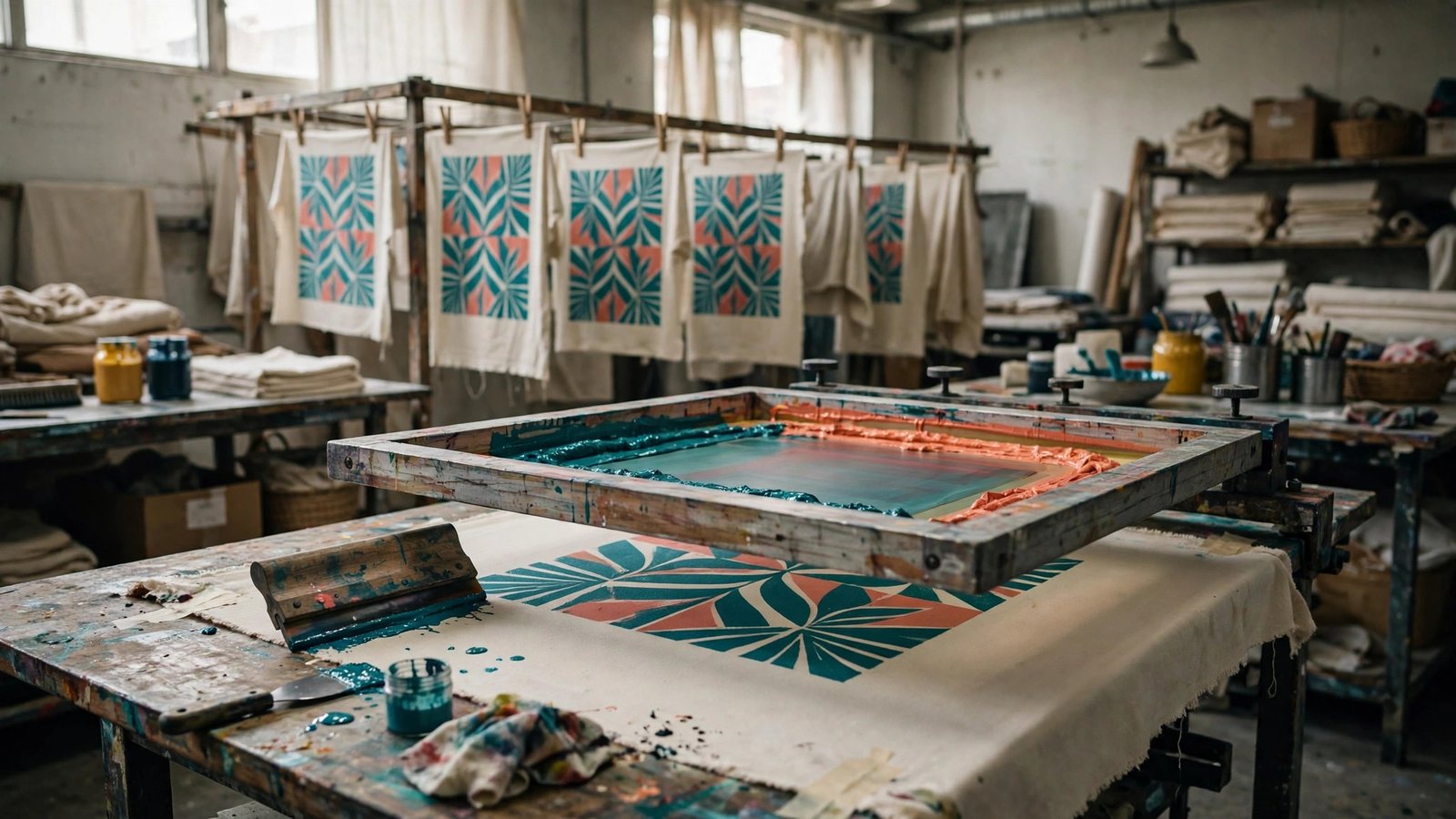
Screen printing is the workhorse of apparel graphics. A screen is prepared for each colour in the design, ink is pushed through the mesh onto the fabric, and the fabric is then dried and cured so the ink bonds. Flatbed screens print cut pieces or short lengths; rotary screens are cylinders that print continuously, which suits long runs of yardage.
Screen printing suits bold, flat-colour designs: logos, typography, simple illustrations, and repeat patterns where colour count is controlled. It gives good opacity, which matters on dark fabric, where a thin digital print may look washed out. It also gives a consistent result across a long run once the screens are set, which is why it remains common for core styles.
Its limits are set by colour count and detail. Every additional colour adds a screen, a setup cost, and a registration risk — the risk that colours do not align exactly. Fine lines, small text, and smooth photographic gradients are harder to hold in screen print than in digital print. A buyer who approves a design with twelve colours should expect a higher setup cost and a longer setup time than a design with three, and should ask whether the design can be simplified without losing its intent.
Specify for screen printing: the number of colours, the exact artwork as separated files or as a file the printer can separate, the fabric and its colour, the print placement and size, the ink type the printer proposes, and the curing step. Ask for a strike-off on the actual fabric and colour, and approve it in the same lighting conditions that will be used for bulk approval. State the tolerance for registration, in plain terms, before production: how much misalignment, if any, is acceptable.
Digital Textile Printing
Digital printing works like a large inkjet printer for fabric. Print heads deposit ink directly onto the fabric according to a digital file, with no screen per colour. That removes the per-colour setup cost and makes small runs, one-off samples, and designs with many colours or photographic detail practical.
Digital printing suits sampling, small collections, and complex artwork: detailed illustrations, gradients, and all-over patterns where screen setup would be prohibitive. It also shortens the sampling loop, because a revised file can be printed without remaking screens.
Its limits are volume cost and fabric dependence. At large volumes, digital printing is usually slower and more expensive per metre than rotary screen printing, and the result depends heavily on the ink system and the fabric preparation. A digital print on untreated cotton will not behave like the same file printed on prepared polyester, and a buyer should not approve a digital sample on one fabric and assume it proves the result on another.
Specify for digital printing: the file format and resolution the printer requires, the exact fabric and its preparation, the ink system, and the post-print fixation or washing step. Ask for a strike-off on the production fabric, not on a sample cloth, and test wash fastness where the garment will be washed repeatedly. If the design will later move to screen printing at volume, say so now: a design optimised for digital colour may need to be re-separated and re-approved for screen.
Heat Transfer and Sublimation
Heat transfer and sublimation are often grouped together, but they work differently and suit different products.
In heat transfer printing, a design is first printed onto transfer paper or film, then pressed onto the garment with heat and pressure. It suits placement prints, names, numbers, and small runs where making screens is uneconomic. It can produce sharp detail on a finished garment, including on items that are awkward to print flat.
Its limits are hand feel and durability. A transfer film sits on the fabric surface, so a large transfer can feel heavier and stiffer than a direct print, and its wash durability depends on the film, the pressing conditions, and the fabric. Buyers should wash-test a transfer sample under the garment’s stated care conditions, and should not accept a sample that has only been pressed and photographed.
In sublimation printing, heat turns a special dye into gas, which bonds with synthetic fibre, most commonly polyester. The result has no heavy surface layer, because the colour is in the fibre, and it suits vivid all-over prints on light-coloured polyester. Its limits are fibre and colour: sublimation performs poorly on cotton, because cotton does not take sublimation dye in the same way, and it cannot produce a light print on a dark fabric, because there is no white sublimation ink to lay down a light base.
Specify for transfer printing: the transfer type, the pressing temperature and time the printer will use, the fabric, and the wash test to be applied. Specify for sublimation: the fibre content, with polyester share stated, the base fabric colour, and whether the design is all-over or placement. In both cases, approve a sample on a finished garment, not only on flat fabric, because pressing a shaped garment introduces placement and distortion risks that flat fabric does not show.
What to Specify Before Any Print Run
Whatever the method, a print specification should answer the same questions before production, so the printer, the factory, and the buyer are approving the same thing.
- Artwork: file format, resolution, colour mode, and, for screen printing, whether the file is already colour-separated
- Fabric: exact fabric, colour, and construction, because the same print behaves differently on different fabrics
- Placement and size: where the print sits on the garment, its dimensions, and its tolerance
- Colours: colour references for each printed colour, and the approval method — strike-off on production fabric
- Ink and fixation: ink type and the curing, fixation, or washing step that makes the print durable
- Durability: wash fastness, rub fastness, and, where relevant, light fastness, each tied to a test where one is specified, and to the garment’s care label
- Quantity and repeat: minimum per colour and per design, and whether screens, files, or transfers can be reused for a reorder
- Defects: what counts as a print defect — misregistration, colour shift, cracking, peeling, or incomplete coverage — and how it will be judged at inspection
Colour deserves a specific caution. A colour approved on a screen, on paper, or on a different fabric is not an approved print colour. Approve the strike-off on the production fabric, in the production colour, under agreed lighting, and keep that strike-off as the bulk reference. If bulk colour shifts, the strike-off is the evidence that decides whether the shift is within tolerance.
Durability deserves the same discipline. A print that looks perfect when new and cracks after five washes has failed, however good the first sample looked. State the wash conditions the garment will actually face, and ask for a wash test on the strike-off before bulk approval where durability is a selling point or a compliance risk.
Cost, Minimums, and Lead Time by Method
Print cost is not a single per-piece figure. It is a setup cost plus a run cost, and the balance differs sharply by method.
Screen printing has a setup cost per colour and per screen, so a small run carries a high setup cost per piece, while a long run spreads that cost thinly. Digital printing has little setup cost per colour, so a small run is practical, but a long run may cost more per metre than rotary screen. Transfer printing has a per-design setup cost and a per-piece pressing cost, which suits names and numbers but penalises large all-over designs. Sublimation has a setup and pressing cost that suits all-over polyester, but the fabric restriction limits where it can be used at all.
Minimums follow the same logic. Ask for the minimum per design and per colour, not just a general minimum, and ask whether screens or transfer plates are stored for reorder and for how long. A screen stored badly, or a file lost between seasons, turns a reorder into a new setup cost.
Lead time also differs. Digital sampling can be fast, because no screens are made, but bulk digital printing at volume can be slow. Screen setup takes time up front, but a long run then proceeds quickly. Build the approval sequence into the lead time: artwork approval, strike-off, wash test where required, then bulk. A lead time that starts at artwork approval and ends at bulk delivery is not comparable with one that starts at bulk approval, and the buyer should ask which one is being quoted.
Our guide to reading a garment factory quote shows how to separate print, fabric, and other cost lines so that two quotes can be compared on the same basis, rather than on a single total that hides where the money goes.
Chemical Safety and Claims: Ask for Evidence, Not Adjectives
Printed textiles raise chemical safety questions that a buyer should handle with evidence, not adjectives. Inks, transfer films, and fixation chemicals differ, and a claim that a print is “eco-friendly,” “non-toxic,” or “safe for skin” needs a document behind it that covers that ink, that fabric, and that product.
Where a chemical safety certification is claimed for a textile, ask for the certificate itself, check that it covers the finished product and not only a component, and check its validity. OEKO-TEX STANDARD 100, for example, is described by OEKO-TEX as a label for textiles tested for harmful substances, setting the benchmark for textile safety from yarn to finished product, with every thread, button, and accessory tested against its list of harmful substances. That description is useful for understanding what the label covers, and it is not a substitute for checking the certificate for the specific product being bought. See the OEKO-TEX STANDARD 100 page.
Do not let a print claim travel further than its evidence. A certificate for a yarn is not a certificate for a printed garment. A test report for one ink is not a test report for a different ink. And a supplier’s general statement about chemical management is not a restricted substances list for the product. Where no certificate or test exists, describe the print in plain technical terms — method, ink type, and fixation — and leave the safety claim out until evidence exists. ZDHC and bluesign chemical management frameworks are mentioned in industry discussion of textile chemistry; this guide does not link them as authority for any specific print claim here, because no specific claim in this article relies on them.
Inspection: What to Check in Bulk Print
Print inspection should be planned before bulk, not improvised at the end of production. Agree the inspection basis with the factory and the printer: how many pieces will be checked, how print defects will be judged, and what happens to a lot that fails.
Check, on a sample drawn from bulk production: placement and size against the specification, colour against the approved strike-off, registration between colours, coverage and opacity, especially on dark fabric, and hand feel where a transfer film is used. Check a washed sample where durability was specified, under the garment’s care conditions, before accepting the lot.
Record the result against the strike-off, not against a photograph of the strike-off. Photographs shift colour, and a bulk lot judged against a photograph will generate disputes that a physical reference would have settled. Keep the approved strike-off until the lot is accepted, and file it with the order record so a reorder can be judged against the same reference.
Our guide to apparel inspection sampling explains how acceptance sampling works for garment orders, and when sampling alone is not enough — a useful companion where print defects must be judged across a whole lot rather than on a single sample.
A Buyer Checklist Before Print Production
- Method chosen for the design, quantity, and fabric — not by habit
- Artwork supplied in the printer’s required format and resolution, colour-separated where screen printing requires it
- Fabric and base colour stated exactly, and strike-off approved on production fabric
- Placement, size, and tolerance written into the tech pack
- Ink type and fixation or curing step stated, with wash test where durability matters
- Minimums per design and per colour confirmed, and screen or file storage for reorder confirmed
- Cost compared as setup plus run cost, on the same quantity and fabric basis
- Chemical and safety claims supported by a certificate or test covering that finished product
- Inspection basis agreed: sample size, defect definitions, and the physical strike-off as reference
- Reorder plan noted: what is stored, for how long, and what a reorder will cost to set up again
Textile printing rewards the same habit as fabric sourcing: specify early, approve a physical sample on the real fabric, and test the property that matters — colour, durability, or hand feel — before bulk. A print approved on a screen image is a hope. A print approved on a strike-off, washed where washing matters, is a specification that bulk production can actually meet.
Sources and further reading
- OEKO-TEX, STANDARD 100: https://www.oeko-tex.com/en/our-standards/oeko-tex-standard-100
- WEFTSIGNAL, Textile Dyeing Process: https://appareldispatch.online/textile-dyeing-process-buyer-guide/
- WEFTSIGNAL, How to Read a Garment Factory Quote: https://appareldispatch.online/how-to-read-a-garment-factory-quote-a-line-by-line-cost-breakdown-for-buyers/
- WEFTSIGNAL, Apparel Inspection Sampling: https://appareldispatch.online/apparel-inspection-sampling-how-aql-2-5-works-for-garment-orders-and-when-it-doesnt/
- WEFTSIGNAL, Tech Pack for Clothing: https://appareldispatch.online/tech-pack-clothing-factory-quotation-checklist/
