
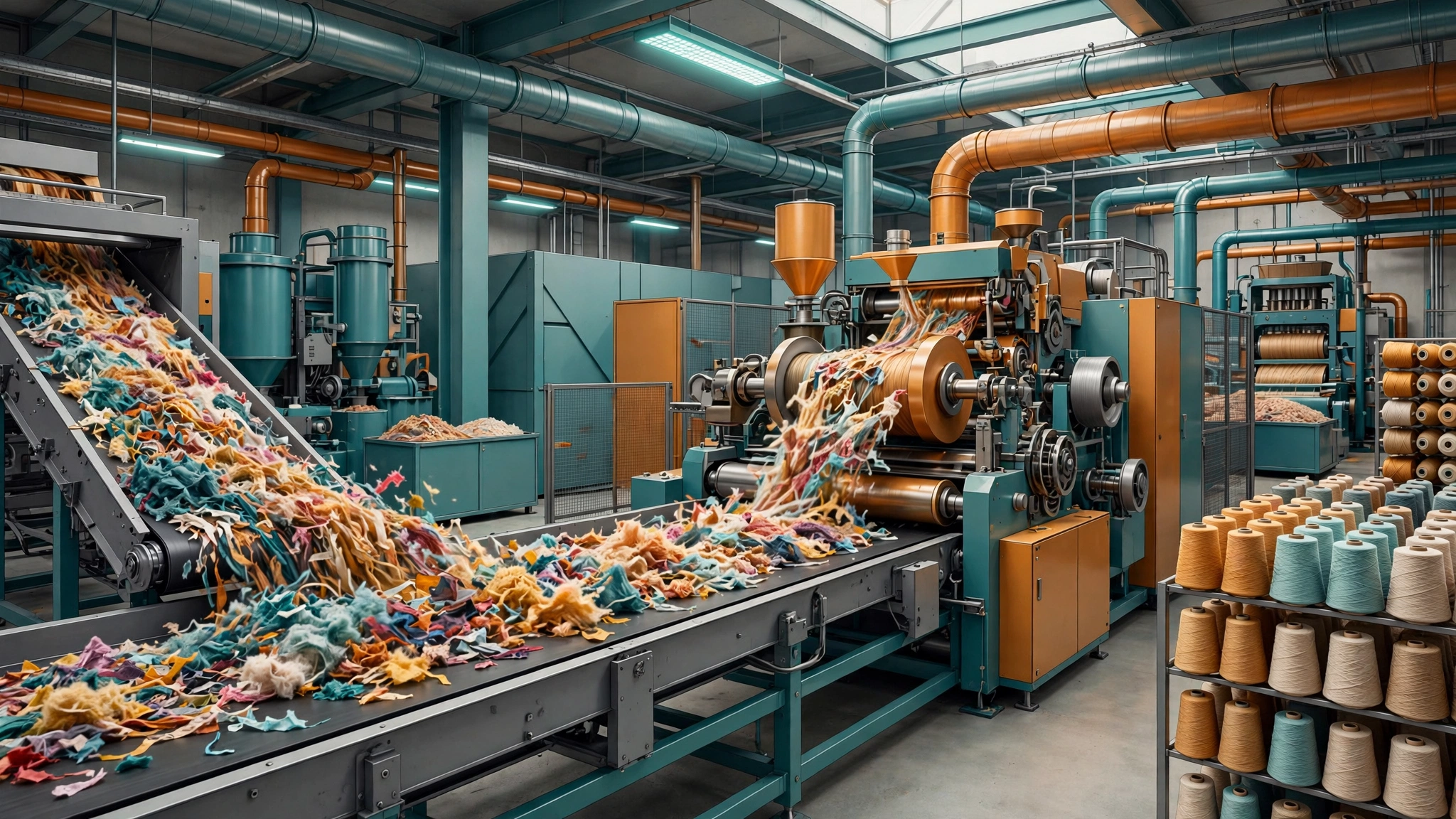
Most recycled textiles today are “downcycled” — turned into insulation, wiping cloths, or shoddy for low-grade uses. Textile-to-textile recycling aims higher: turning discarded textiles back into fibres good enough to spin into new yarn and weave or knit into new fabric. It is one of the most talked-about technologies in apparel sustainability, and one of the least understood.
This article explains the two main routes — mechanical and chemical — what each can and cannot do, and where the technology realistically stands for apparel buyers evaluating recycled-content claims.
Why “textile-to-textile” is the hard problem
Recycling a plastic bottle into another bottle is straightforward because the feedstock is uniform. Textiles are the opposite: mixed fibres, mixed colours, elastane in nearly everything stretch, plus dyes, finishes, zippers, and labels. A recycling process has to undo all of that complexity and still produce a fibre that spins, dyes, and performs.
That is why the industry distinguishes carefully between:
- Downcycling — waste textiles become lower-value products (insulation, rags). Useful, but it does not displace virgin fibre production for apparel.
- Textile-to-textile recycling — waste textiles become new textile fibres. This is the route that can actually close the loop.
Route 1: Mechanical recycling
Mechanical recycling is the older, simpler, and currently more scaled route:
- Collect and sort. Waste textiles are collected and sorted — ideally by fibre content and colour, since sorting quality determines output quality.
- Remove trims. Zippers, buttons, labels, and elastane-containing components are cut away where possible.
- Shred. The fabric is torn back into fibre through mechanical shredding (garnetting).
- Re-spin. The recovered fibres are blended — usually with virgin fibres — and spun into new yarn.
Strengths: low energy, no chemistry, established equipment, works today at commercial scale for cotton and wool.
Limits: every mechanical cycle shortens the fibres, so 100%-recycled mechanically-processed yarn is weaker and is typically blended down with virgin fibre. Blended fabrics (cotton-polyester, anything with elastane) are difficult because the process cannot separate the fibre types. Colour-sorted input avoids re-dyeing; mixed-colour input produces heather/grey yarns.
Pre-consumer waste — clean cutting-room offcuts sorted by fibre content — is the ideal feedstock, which is why cutting-waste segregation at the factory directly feeds this stream.
Route 2: Chemical recycling
Chemical recycling breaks textiles down to a more fundamental level and rebuilds the fibre:
- For polyester: depolymerisation processes (such as glycolysis) break polyester back into its monomers, which are purified and re-polymerised into virgin-quality polyester. Brands have piloted this with factory offcuts, pre-loved garments, and flawed goods — for example, PUMA’s RE:FIBRE programme has used polyester from factory offcuts and old garments to produce new polyester for apparel.
- For cellulosics (cotton, viscose): dissolution processes dissolve the cellulose and regenerate it as new man-made cellulosic fibre, similar in principle to lyocell production.
Strengths: can deliver near-virgin quality, handles some inputs mechanical recycling cannot, and removes dyes in the process.
Limits: higher energy and chemical intensity, more expensive, and still scaling — commercial plants exist but capacity is small relative to global fibre production. Feedstock preparation (sorting, de-trimming, removing elastane) remains a bottleneck for both routes.
The bottleneck both routes share: sorting
Whichever route a recycler uses, the process starts with sorting — and sorting is where most textile-to-textile ambitions stall. A recycling line needs to know the fibre content of every piece it takes in, and today’s collection streams are overwhelmingly mixed: polycotton shirts, elastane-blend denim, multi-fibre activewear. Manual sorting by label is slow and unreliable (labels are missing, wrong, or describe the shell but not the lining). Automated sorting using near-infrared (NIR) spectroscopy can identify fibre content at speed, but it struggles with dark colours, multi-layer garments, and elastane below a few percent — which is exactly where much of the waste sits.
This is why pre-consumer waste remains the preferred feedstock: a factory’s cutting-room offcuts are already sorted by fibre content, clean, and traceable. Post-consumer textiles — the larger prize — will only scale when collection, automated sorting, and de-trimming mature together. Buyers hearing ambitious recycled-content targets should ask suppliers where in this chain their feedstock comes from.
What buyers should realistically expect
For apparel buyers, three practical takeaways:
- Ask which route. “Recycled polyester” on a hangtag most often means mechanically recycled PET from bottles (a different stream), not textile-to-textile. If a supplier claims textile-to-textile, ask whether it is mechanical or chemical and what the feedstock is.
- Ask about the blend ratio. Mechanically recycled textile fibre is routinely blended with virgin fibre for strength. The percentage matters — for both performance and the credibility of the claim.
- Evidence still rules. Recycling technology does not change the documentation discipline: scope certificates, transaction certificates, and chain-of-custody evidence are what make a recycled-content claim defensible. (See our recycled content claims guide and GOTS scope vs transaction certificates.)
Where the technology is heading
The direction of travel is clear: sorting automation (including AI-assisted fibre identification), better elastane separation, and growing chemical-recycling capacity. Regulatory pressure is accelerating it — the EU’s incoming textile EPR schemes will put a price on textile waste and create funded feedstock streams, which is exactly what recycling economics has been missing.
But scale takes time. For the next few years, textile-to-textile recycling will remain a premium, capacity-constrained option rather than a commodity input. Buyers who understand the two routes — and ask suppliers which one sits behind a claim — will be better positioned than those who treat “recycled” as a single undifferentiated label.
Related reading: Fabric Waste in Garment Manufacturing · Recycled Content Claims in Apparel · EU Green Claims Directive in 2026
