
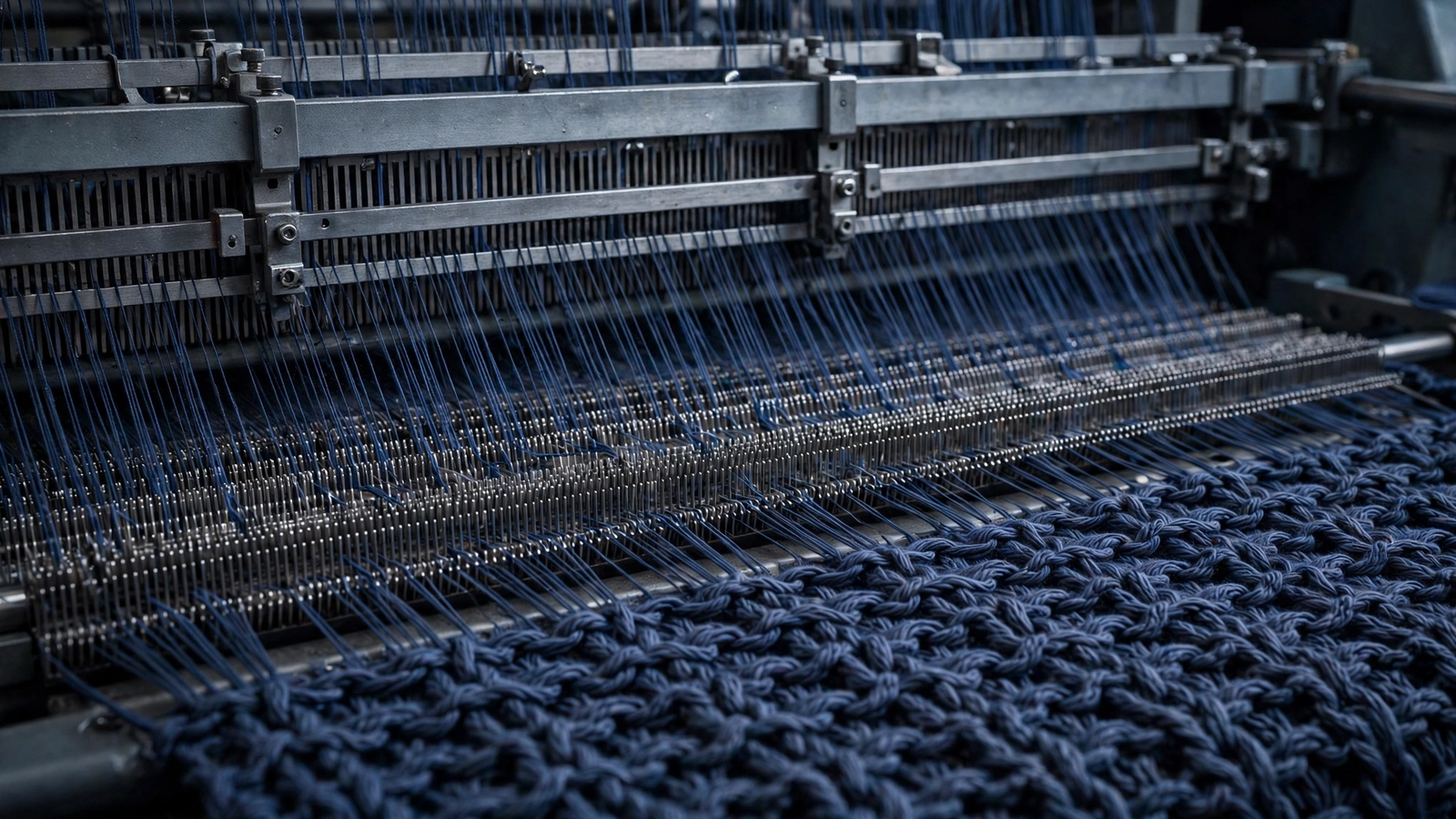
Most buyers meet warp knitting without knowing it: the tricot lining inside a jacket, the power-net in a swimsuit, the lace on lingerie, the spacer mesh in a car seat. Warp knitting is among the highest-output ways to turn yarn into fabric — thousands of yarns knitted at the same time — yet it is the least understood of the three great fabric-forming methods. This guide explains how it works, how it differs from weft knitting, where it is used, and the part most guides skip: how to decide whether it is the right choice for your product, and what to write on the spec sheet.
How warp knitting works
All knitting builds fabric from loops of yarn drawn through other loops. What makes warp knitting different is the direction the yarn travels.
In warp knitting, a sheet of parallel yarns arrives from one or more warp beams — the same kind of beam preparation used in weaving. Every needle is fed its own yarn. Guide bars, each fitted with one guide eye per yarn, swing to and fro and shift sideways between needle columns, wrapping the yarns around all the needles at once. Every yarn therefore zigzags along the length of the fabric, forming a loop in one column of loops (a wale), then in the neighbouring wale, and back again.
Two features of this geometry matter for everything that follows. First, all the needles are fixed in a single needle bar and move together, so a whole course of loops is knitted in one cycle — there is no sequential, needle-by-needle action as in weft knitting. Second, each guide’s path has two parts: the overlap, a sideways move that wraps the yarn around the needle hook and forms the head of the loop, and the underlap, the return move that carries the yarn to the next overlap and joins one wale to the next. The overlap and the underlap together decide the fabric’s dimensional behaviour — a point we will return to, because it is where most buying mistakes begin.
The trade counts its output in racks: one rack is 480 courses, the standard unit of warp knitting. The run-in — the length of yarn a guide bar feeds over one rack — controls loop size: a longer run-in gives bigger loops and a looser fabric. When a mill talks about adjusting the run-in, it is adjusting the fabric’s hand and cover factor at the most fundamental level.
Tricot and raschel: the two machine families
Nearly all warp knitting runs on one of two machine types, and knowing which one made your fabric explains most of its behaviour.
Tricot machines are the high-speed workhorses. They carry two to four guide bars, use compound needles on modern machines (bearded needles survive mainly on older ones), and draw the fabric away at roughly a right angle to the incoming warp. They produce fine, smooth, plain structures — the classic tricot plus locknit, sharkskin and queenscord — at remarkable speed: Karl Mayer rates its two-bar HKS 2-S tricot machine at up to 3,200 rpm and its HKS 2-SE elastic-fabric machine at 4,400 rpm, calling it the fastest warp knitting machine in the world. Working widths run from about 130 to 210 inches, in gauges from E28 to E50 (E being needles per inch). Tricot is where lingerie fabrics, linings and smooth swimwear bodies come from.
Raschel machines are the versatile ones. They use a trick plate to knock the loops over, take the fabric off at roughly 170 degrees, and can carry dozens of guide bars — commonly anywhere from 4 to 70 — which gives them far greater patterning capability than tricot. Older raschels run latch needles; modern ones increasingly use compound needles. The high take-up tension suits open structures and elastic inlays such as power-net. Raschel makes lace, nets, meshes and double-needle-bar spacer fabrics, runs coarser gauges than tricot, handles a wider range of yarns (including staple yarns, where most tricot machines want continuous filament), and runs slower. A detailed side-by-side of the two machine types is published by Textile Learner.
Warp knitting vs weft knitting: the short version
In weft knitting, one yarn runs across the fabric and the needles form the loops of a course one after another from it — think of a T-shirt jersey, where a single yarn makes each row. In warp knitting, every needle has its own yarn and all needles knit at once. Everything else follows from that single difference:
- Stretch. Weft knits stretch most across their width. Warp-knit stretch is set by the lapping: long underlaps give width-way stretch, while pillar stitches lock the length.
- Laddering. A plain weft knit can ladder and unravel from a broken yarn. A warp knit cannot be unravelled course by course — each broken end is confined to its own wale.
- Shaping. Weft machines can knit shaped panels and even whole garments. Warp knitting produces continuous widths only; every shaped piece must be cut.
- Speed and scale. Warp knitting’s thousands of simultaneous yarns make it the highest-output fabric-forming process of the three.
For the fuller picture of how construction choices flow through to a garment specification, see our guide to how knit and woven constructions change a garment’s specification. Textile School’s weft-vs-warp knitting reference is the most carefully sourced technical overview available online and is worth bookmarking.
Where warp knitting is used
The end-use list reads like a catalogue of products where stability, run-resistance or open structure matters more than maximum stretch: lingerie and foundation garments, swimwear and sportswear, lace and trimmings, mosquito and sports nets, automotive interiors, mattress covers, and a wide span of technical textiles. Filament yarn is the usual feed; staple yarns are harder to run on most tricot machines, which is one reason raschel keeps its place for heavier and more textured work.
Two properties explain the list. Run-resistance makes warp knits the default where a ladder would ruin the product. And the ability to engineer open structures — from delicate lace to industrial mesh — on the same fundamental principle gives warp knitting a range neither weaving nor weft knitting covers economically.
The buyer’s decision framework: when warp knit is the right call
Here is the part most guides leave out. Comparing warp and weft knitting as columns of attributes — stretch, speed, stability — rarely helps a buyer decide, because the answer is almost never “which is better”. It is “which failure mode can you afford”. Work through the questions in this order:
1. Do you need shaped pieces? If the product depends on shaped panels or whole-garment knitting with minimal cutting waste, warp knitting is excluded by construction. It produces continuous widths, full stop. No attribute advantage elsewhere in the table can override this. Decide it first and save yourself the rest of the analysis.
2. What happens when a yarn breaks? In a weft knit, one broken yarn can ladder across an entire course and unravel the fabric. In a warp knit, the break stays in its own wale. If your product cannot tolerate laddering — swimwear, sheer fabrics, anything where a run means a return — warp knit’s run-resistance is a structural guarantee, not a finish you pay extra for. If laddering is a non-issue for the end use, stop treating run-resistance as a buying criterion.
3. Where does the stretch need to come from? Never ask a mill “is this warp knit stretchy” — the question has no answer until you know the lapping. Long underlaps give width-way stretch; pillar constructions lock the length down. Two fabrics both honestly described as “warp knit tricot” can behave completely differently on the body. Ask for the construction, not the adjective.
4. Tricot or raschel — and why? Put the machine class on the enquiry, not just “warp knit”. Tricot means fine, smooth, fast, and limited in pattern; raschel means open, patterned, textured, or technical — and slower, which shows up in the price. A lace buyer who accepts a tricot quote and a raschel quote as interchangeable is comparing two different processes.
The thread running through all four questions: specifying “warp knit” without the lapping is like specifying “woven” without the weave. The lapping — the overlap and underlap each guide bar makes — is the structure. Ask the mill for the guide-bar plan or lapping notation, not just a fabric name. Mills that cannot supply it are telling you something about their process control.
What to put on a warp-knit spec sheet
Translate the framework into a checklist. For every warp-knit development, specify:
- End use and the failure mode you are designing against (laddering, stretch loss, abrasion) — one line that tells the mill what matters.
- Machine class: tricot or raschel, and the gauge (E).
- Number of guide bars and the lapping/construction — e.g., two-bar tricot, locknit — or the mill’s lapping notation.
- Fibre and yarn type, including whether elastane is laid in and on which bar.
- Courses and wales per centimetre, stating whether measured relaxed or finished — the two are not interchangeable.
- Finished width, weight (GSM), and dimensional-stability expectation after washing.
- Run-resistance requirement, stated as a testable condition (for example, the maximum wale-wise damage permitted after a standard snag test), not as the word “run-proof”.
- Colour, pattern method, and finishing — noting that heat-setting behaviour differs by fibre and construction.
Build these into your enquiry the way you would any fabric sourcing specification: the mill can only quote accurately what you have described accurately.
Three pitfalls buyers walk into
Treating “run-resistant” as “indestructible”. Warp knits resist unravelling course by course. A snag, a cut, or abrasion still damages them — the damage is localised, not absent. Write the requirement as a test result, not a superlative.
Skipping stability testing because “warp knits are stable”. Flatter and more stable than weft knits is a relative statement. Dimensional behaviour still depends on the construction, the fibre, and the finishing — particularly heat-setting of synthetics. Test wash shrinkage and spirality on the bulk construction, not on a lab dip of a different lapping.
Forgetting the beam. Warp preparation resembles weaving: thousands of ends must be wound onto beams before a metre is knitted. That setup is real work, and it is why warp-knit pricing rewards volume and punishes tiny trial runs. Ask how setup is quoted and what the minimum economical run is — before you fall in love with a construction you will only ever order 200 metres of.
The bottom line
Warp knitting earns its place wherever a fabric must hold its shape, resist runs, or carry an open engineered structure at industrial speed. Buyers who get the best out of it share one habit: they specify the construction — machine class, gauge, guide bars, lapping — instead of the category. Do that, and the mill’s quote, the lab dip, and the bulk production are finally talking about the same fabric.
