
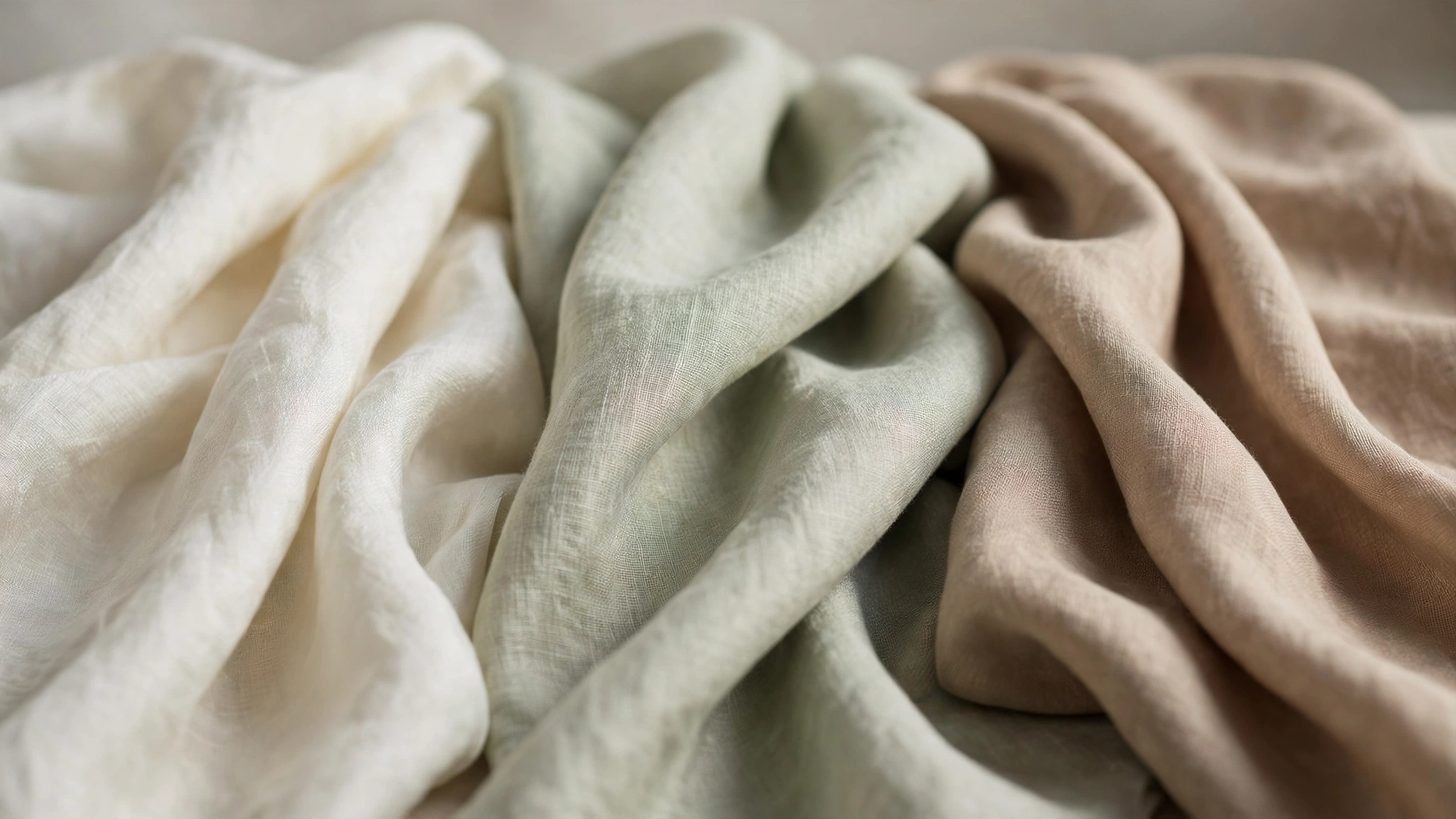
One family, three generations
Viscose, modal, and lyocell are often listed together on fabric specs as if they were interchangeable. They are not. All three are regenerated cellulose fibres — wood pulp dissolved and re-spun into fibre — but they come from three different generations of manufacturing technology, and those differences show up in shrinkage, dyeing behaviour, durability, and price. For a buyer specifying fabric, choosing the wrong one means living with the wrong shrinkage allowance, the wrong colour fastness expectations, and the wrong cost base.
This guide compares the three from a buyer’s perspective: what each fibre is, how it behaves in production and in the finished garment, and where the costly mistakes happen when they are mixed within a single order.
How each fibre is made
Viscose: the first generation
Viscose is produced by treating wood pulp (or cotton linters) with carbon disulphide to form cellulose xanthate, dissolving it, and extruding it into an acid bath. The process is mature and cheap, which is why viscose remains the workhorse of the regenerated cellulose family. The trade-off is structural: conventional viscose has relatively low wet strength — it loses a significant share of its strength when wet — and the process chemistry raises well-documented environmental concerns around emissions and effluent.
Modal: the second generation
Modal uses a modified viscose process with different spinning conditions that produce a higher wet modulus — in plain terms, the fibre stays stronger and more dimensionally stable when wet. It is most commonly associated with beech wood pulp. Modal fabrics feel soft, resist shrinkage better than conventional viscose, and hold their shape through repeated washing, which is why the fibre dominates in underwear, loungewear, and premium jersey.
Lyocell: the third generation
Lyocell dissolves pulp directly in an amine oxide solvent (NMMO) in a closed-loop system where the solvent is recovered and reused. No carbon disulphide is involved. The resulting fibre has high strength both dry and wet, and the closed-loop process gives lyocell the strongest environmental profile of the three. The best-known branded lyocell is TENCEL, produced by Lenzing, which also produces Lenzing Modal — brand names worth verifying on specs, since “lyocell” is the generic fibre name and TENCEL is a trademark.
Property comparison: what changes on the spec sheet
| Property | Viscose | Modal | Lyocell |
|---|---|---|---|
| Wet strength | Low — loses much of its strength when wet | High — designed for wet stability | High — close to dry strength |
| Shrinkage tendency | Highest of the three; needs generous allowances | Moderate; better dimensional stability | Lowest; most stable |
| Moisture absorption | High | High, slightly better management | High, with efficient moisture release |
| Surface / hand feel | Soft, fluid drape | Very soft, smooth, silk-like | Smooth, cool touch; can fibrillate |
| Pilling / fibrillation | Moderate pilling | Good resistance | Can fibrillate unless treated; cross-linked variants resist it |
| Dye affinity | Excellent with reactive dyes; level dyeing needs care | Excellent, very level | Excellent, but fibrillation can cause frosty appearance in dyeing |
| Typical cost ladder | Lowest | Mid | Highest |
| Process profile | Carbon disulphide route; highest environmental scrutiny | Modified route; improved | Closed-loop solvent; strongest eco credentials |
What this means in dyeing and finishing
All three fibres dye readily with reactive dyes, which is one reason they are popular in fashion fabrics. The differences emerge in the details. Viscose’s lower wet strength means dyeing and finishing must be gentler — aggressive processing causes strength loss and surface damage. Modal’s wet stability makes it more forgiving in the dyehouse and gives very level shades. Lyocell’s tendency to fibrillate — tiny microfibres splitting from the surface — can produce a frosty or peach-skin effect during dyeing; mills manage it with enzyme treatments or cross-linking finishes, and buyers should confirm which route their mill uses before approving a lab dip. For a deeper look at how dye chemistry drives these decisions, see our buyer’s guide to the textile dyeing process.
Shrinkage: the number that moves the pattern
Shrinkage is where the three fibres diverge most sharply in commercial terms. A viscose jersey can shrink several percentage points more than a lyocell jersey of the same construction, which changes pattern allowances, shrinkage test specifications, and ultimately the graded measurements of the finished garment. When a tech pack specifies “regenerated cellulose” without naming the fibre, the factory may default to the cheapest option — viscose — while the buyer’s shrinkage tolerances were written with modal or lyocell in mind. Name the fibre on the spec, and set the shrinkage test method against the fibre actually ordered.
The mixed-use risk matrix: when one order uses two or three of them
Here is the scenario competitor comparison articles rarely address: a single collection — or worse, a single garment — that combines viscose, modal, and lyocell across panels, linings, or trims. Each fibre is fine on its own. Together, their different behaviours create faults that only appear after washing.
Risk 1 — Differential shrinkage. A viscose body panel sewn to a lyocell lining will not shrink at the same rate. After two or three washes, the garment puckers at the seams or the lining pulls the shell out of shape. The fault looks like a sewing problem; the cause is a fibre-mix decision made at fabric sourcing.
Risk 2 — Differential dye uptake. Panels of different fibres dyed in the same bath — or even in separate baths to the same recipe — can finish in visibly different shades. A modal collar on a viscose body, both specified “navy,” can read as two different navies under store lighting. Confirm shade continuity on the actual fibre combination during lab dip approval, not on a single reference fabric.
Risk 3 — Differential pilling and wear. In a garment mixing lyocell and viscose, the viscose areas may pill while the lyocell areas stay smooth, producing a visibly uneven garment after a season of wear. Customer complaints will describe “poor quality fabric” — the real issue is mismatched fibre performance within one product.
The buyer’s rule: within a single garment, keep regenerated cellulose fibres consistent across all visible panels, or explicitly test the combination through wash trials before bulk approval. Within a collection, you can mix them across styles — but document which fibre goes where, because care labels, shrinkage allowances, and quality expectations all follow the fibre, not the style number. Construction interacts with all of this: a knit versus woven choice amplifies or dampens these effects, so evaluate fibre and construction together.
Sourcing notes: brands, claims, and verification
Branded fibres — TENCEL lyocell, Lenzing Modal, and similar — carry chain-of-custody systems that let buyers verify the fibre in the finished fabric. Generic “lyocell” or “modal” on a spec sheet does not. If the selling point of the product is the fibre brand, require the brand’s hangtag or certification paperwork; if the selling point is performance, test the performance rather than paying the brand premium. And as with any fibre claim, a quick specification checklist review plus a field screening keeps substitution honest — regenerated celluloses all burn like paper, so the burn test confirms the family but cannot separate the three; separation needs lab analysis or documented chain of custody.
Choosing between them
Specify viscose when cost matters most and the design tolerates its shrinkage and wet-strength limits — fluid woven blouses and linings are its natural home. Specify modal when softness, wash stability, and a premium hand feel justify the mid-range price — jersey, underwear, and loungewear. Specify lyocell when durability, low shrinkage, and environmental credentials top the brief — and budget for it. The expensive mistake is not choosing the “wrong” fibre; it is failing to choose at all, leaving the decision to the cheapest default, or mixing them unknowingly within one product.
