
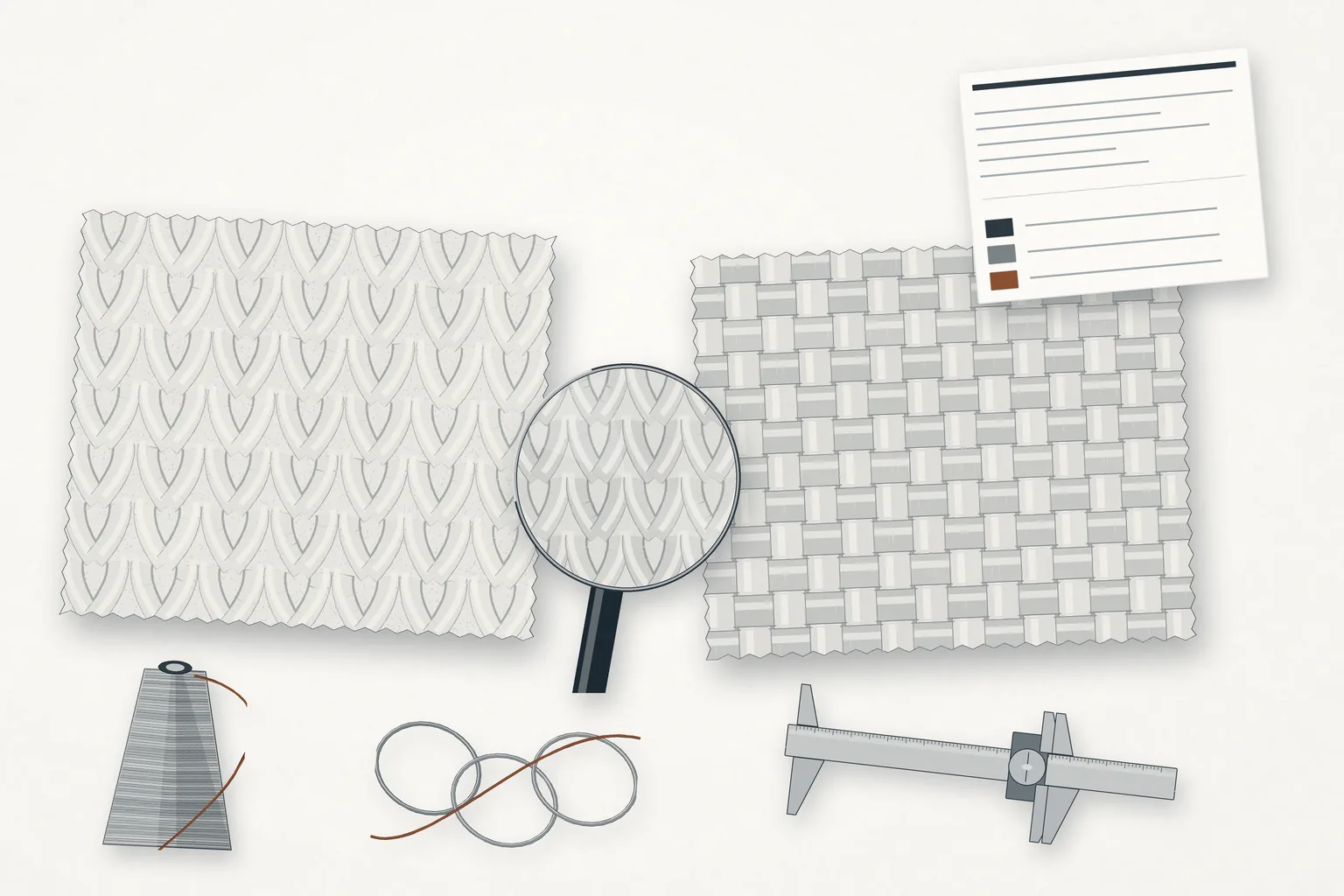
Cover: AI-generated conceptual illustration for WEFTSIGNAL, not documentary photography.
Loops or interlacing: the distinction that decides the rest
A knit is built from intermeshed loops, each passing through its neighbours. A woven fabric interlocks two yarn sets at right angles — warp lengthwise, weft across. CottonWorks, the textile education platform published by Cotton Incorporated, describes knitted structures as conforming easily to the body and woven constructions as comparatively rigid and stable. Everything downstream follows.
Why construction changes what fit can mean
Woven fit is engineered: darts, panel seams and ease cut and joined into a defined silhouette. Knit fit is partly inherent, because the loops accommodate movement themselves. The same chest measurement therefore describes settled cloth on a woven shirt, and on a knit polo a dimension the wearer extends by moving.
Under tension: stretch, recovery and grain
Pull a knit and it extends; whether it returns depends on fibre, yarn, loop structure and finishing, so recovery is specified and tested rather than assumed. Woven cloth resists extension far more strongly, and its characteristic problem is geometric: whether the weft sits square to the warp, and whether bow (a curved weft) or skew (a diagonal displacement) appears after finishing or laundering. Those are different concerns, and “no distortion” alone leaves the argument to inspection.
Cutting and marker planning
Marker planning assumes a fabric whose behaviour is already known. On woven cloth the binding constraint is the grain line: pieces align with the warp, where stability sits. Knit panels bring different constraints; because a compressed loop structure can relax once released, cutting plans for knits manage how far the lay is compressed rather than treating the cloth as a flat sheet. That logic continues onto the sewing floor.
Seams and stitch types follow the structure
Seam selection is a consequence of construction. A woven join can lean on the fabric’s resistance to extension, which is why lockstitch, chainstitch and felled constructions are common there. A knit join must extend with the cloth it holds, or the seam becomes the failure point; overlock and coverstitch carry that extensibility into the join. A seam specified without its construction is an incomplete instruction.
Edge finishing and stability
Cut edges behave differently on each structure. Woven fabric frays, because yarns can be drawn out of the interlacing at a cut edge, so the edge is enclosed or bound. Knit behaviour depends on the knitting system: CottonWorks notes that weft knits curl, run and unravel at the ends, while warp knits cut across the width do not fray or curl in the same way. Edge treatment is settled before sampling, not afterwards as a trim detail.
Dimensional behaviour and wash testing
What the customer meets is dimensional change after care. On woven styles the recurring questions are shrinkage along warp and weft and whether bow or skew develops; on knits, the same wash can alter loop geometry, so growth through wear and laundering is planned for. These are properties of the piece tested, not of the material in the abstract, so the testing regime belongs in the specification. ISO 139:2005 defines the characteristics and use of a standard atmosphere for conditioning, for determining physical and mechanical properties of textiles, and a standard alternative atmosphere that may be used if agreed between parties.
An illustrative example: one chart, two constructions
Imagine, illustratively, a buyer moving a measurement chart from a woven shirting programme to a knit polo programme without re-approval. The tolerance language was written for a stable panel. The knit meets those numbers measured flat and relaxed, and the chart says nothing about how far it extends under tension or whether it recovers. It passes inspection and does not sit as the chart implied — the paperwork is not wrong, it was written for a different structure.
Before writing a specification for a given construction
These questions come before the document itself. The complete specification checklist is set out in our fabric specification checklist.
- Structure: which construction, and which direction is grain, elongation or stretch measured in?
- Reference state: is each measurement flat and relaxed, under stated tension, or both?
- Conditioning: which atmosphere and test method, confirmed by whom?
- Care route: which wash and dry process is the acceptance test?
- Join: which seam and stitch types, and will they extend with the fabric?
- Edge: how is the cut edge secured, and how verified?
- Change control: who re-approves the chart when construction changes?
What to record when approval happens
Record the construction, the fibre and yarn, and the reference state for each measurement; the conditioning and test method; the care route serving as the acceptance test; the seams and stitches accepted; and the version and date of the approved chart. Record what was not agreed: approval that omits the reference state approves a sample, not a specification.
Source and further reading
Sources consulted 16 October 2026: CottonWorks — Cotton Textiles Learning Hub; CottonWorks — Knit Basics; ISO — ISO 139:2005. Cited by designation and catalogue page only. The frameworks and illustrative example here are WEFTSIGNAL editorial material, not requirements issued by those organisations. Continue exploring textile industry coverage, manufacturing coverage and our editorial standards.
