
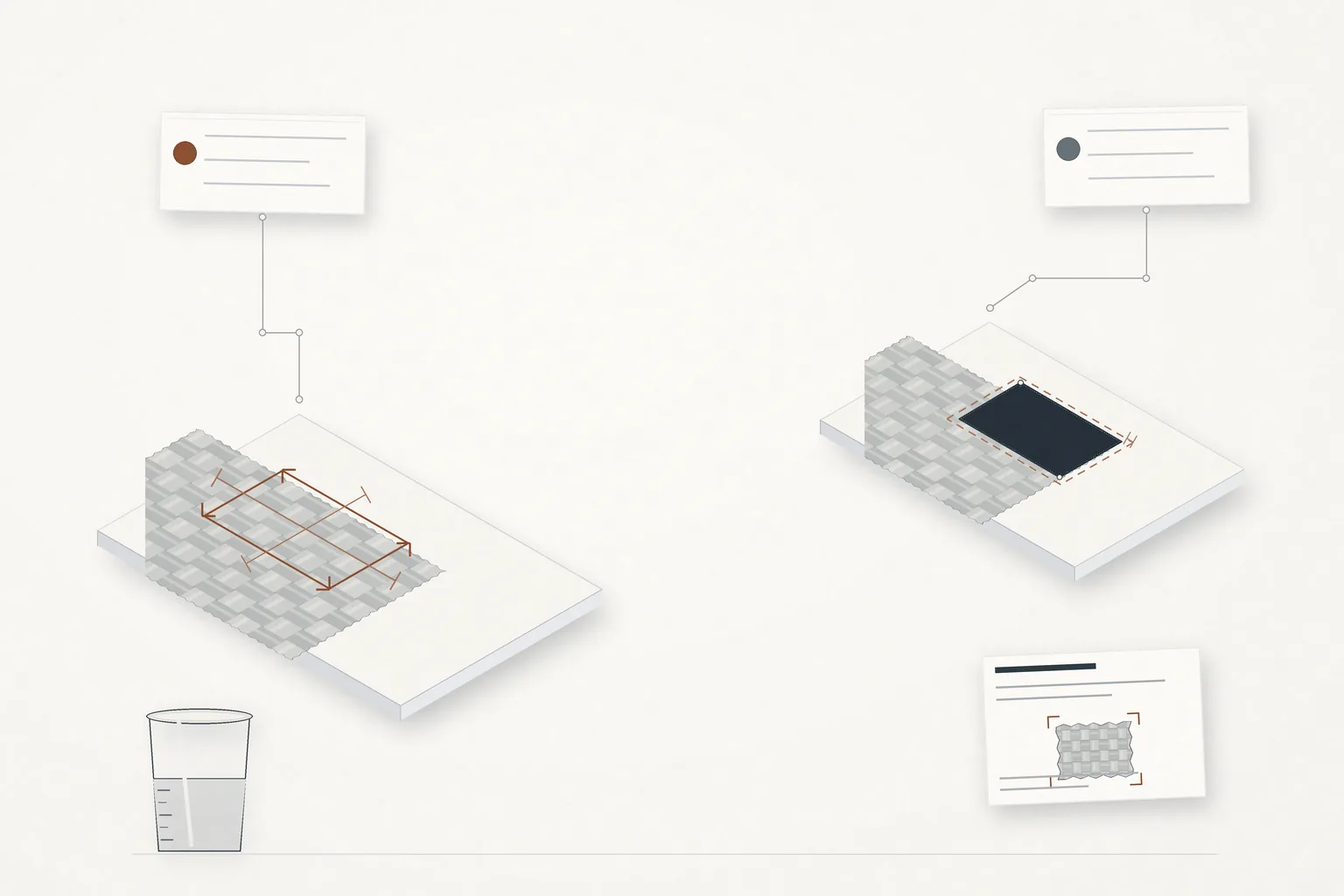
Cover: AI-generated conceptual illustration for WEFTSIGNAL, not documentary photography.
What dimensional change actually measures
Shrinkage names only half of the property. CottonWorks, the textile education platform published by Cotton Incorporated, defines dimensional change as any change in the dimensions of a fabric or garment, whether positive or negative: growth or shrinkage. A specification written around shrinkage alone answers a narrower question than the buyer is asking — how the product will fit after laundering.
Shrinkage belongs to a fabric-and-process combination
A fabric does not carry a shrinkage figure the way it carries a width; it carries a residual tendency to change dimension under a defined treatment. CottonWorks separates construction shrinkage, built in by structural parameters, from processing shrinkage, contributed by dyeing and finishing. Wet processing normally pulls length and reduces width, and where those forces exceed what the structure absorbs elastically, the relaxed dimensions change permanently, so the same greige cloth finished two ways is two different starting points.
Preparation comes before the treatment
A dimensional-change test is a before-and-after measurement, so the result rests on the before. Specimens must be prepared, marked and measured consistently, and the treatment applied without tension. CottonWorks makes the same point: the most reliable approaches prepare the sample properly, agitate the goods without restriction, and measure accurately. A marking scheme that slips shows up in the report as dimensional change.
Washing and drying are two decisions, not one
The ISO catalogue entry for ISO 6330:2021 states that a complete domestic washing and drying test consists of a washing procedure and a drying procedure, chosen separately. Its washing procedures are built around different types of reference washing machine, and each represents a single domestic wash, so a requirement for several washes means repeated single cycles. Its drying procedures include line dry, drip dry, flat dry, flat press and tumble dry. A specification that names a wash and leaves drying to the laboratory has left the more damaging variable open.
Specifying the test so someone else can run it
The ISO catalogue entry for ISO 5077:2007, the method for determining dimensional change in washing and drying, covers fabrics, garments and other textile articles subjected to an appropriate combination of specified washing and drying procedures — a combination that must be written down, not agreed verbally. Direction is the part most often assumed and most often disputed: warp and weft, or course and wale, do not behave alike. Skew is separate again. CottonWorks describes it as the tendency of some fabrics and garments to twist after laundering, showing up as displaced seams, sleeves or legs, and it will not appear in a length-and-width figure at all.
The acceptance basis is a separate decision
Once the test is defined, what result is acceptable remains open. This explainer gives no numeric limit: a defensible one depends on the construction, the end use and the treatment. CottonWorks argues the point directly: rigid and arbitrary fabric shrinkage specifications are not the answer, and mills and their customers need to work as partners so that products are engineered to control shrinkage while meeting other requirements. The wider pattern for stating a measurable property is set out in our fabric specification checklist.
What a laboratory report does and does not tell you
A report answers one question well: how the submitted specimen behaved under the stated treatment. It does not say how production cloth will behave, unless the specimen came from production. Nor does it say how the garment will behave, because sewing, pressing and trim introduce further stresses. A report is evidence about a sample, produced by a method, at a time.
An illustrative example, not a recommendation
Suppose, illustratively, a buyer requires a dimensional-stability test on a knitted fabric. The mill submits a specimen finished on one line and relaxed on a relaxation dryer, and the result sits inside the band stated. Production is then finished on a different line with a different width profile. The report was accurate; it described another fabric-and-process combination. The example is hypothetical, and the control that catches it is unglamorous: name the finishing route the figure was approved on, and reopen the approval when that route changes.
What the approval record should carry
What is written at approval makes the number checkable later, once the people who agreed it have moved on.
- Treatment: the washing and drying procedures, named by designation.
- Cycles: how many, and what each represents.
- Direction: which axes are measured, and whether skew is assessed.
- Preparation: how specimens are marked and measured.
- Acceptance basis: whether the limit applies to a mean or to every specimen.
- Finishing route: the process the approved figure belongs to.
- Change control: who re-approves when that route changes.
Source and further reading
Sources consulted 16 October 2026: ISO — ISO 5077:2007, Textiles: determination of dimensional change in washing and drying; ISO — ISO 6330:2021, Textiles: domestic washing and drying procedures for textile testing; CottonWorks — Shrinking and Skewing. Cited by designation and catalogue page only. The framework, checklist and illustrative example in this explainer are WEFTSIGNAL editorial material, not requirements issued by those organisations.
Continue exploring textile industry coverage, quality control coverage and our editorial standards.
