
Introduction
Fabric sourcing is where many apparel orders are won or lost before cutting begins. A garment factory can sew well and still miss the brief if the fabric is wrong: the hand feel is off, the colour shifts in bulk, the width forces a new marker, or the minimum order quantity makes a small order uneconomic. Buyers who treat fabric as a line on a purchase order, rather than as a specification to be approved, inherit those risks.
This guide explains fabric sourcing from the buyer’s side. It does not name a single “best” source, because no mill, trader, or stock supplier is right for every product. Instead, it sets out what to specify, how the main sourcing routes differ, what to check in a sample, and which decisions must be locked before bulk production. Where a term is industry usage rather than a formal standard, this guide says so.
What Fabric Sourcing Actually Covers
Fabric sourcing is not simply finding a fabric that looks right. It is the work of turning a design and a target price into a repeatable material: fibre content, construction, weight, width, colour, finish, and performance, supplied in the quantity and timing the order needs.
A useful way to think about it is in three layers. First, the material itself: what it is made of and how it is built. Second, the supply arrangement: who makes it, who holds stock, who carries the risk if a dye lot varies, and how quickly more can be produced. Third, the evidence: samples, test results, and approvals that show bulk fabric will match what was sold.
Buyers often under-specify the first layer and over-trust the third. A swatch that looks correct in a meeting room is not evidence that bulk fabric will behave the same way after washing, cutting, and sewing. That evidence comes from a written specification, a lab dip or bulk lot approval where colour matters, and a fabric test where performance matters. For colour approval in particular, the process matters as much as the shade: our guide to the textile dyeing process explains how buyers should specify dye method, colour approval, and risk before dyeing begins.
Start With a Specification, Not a Swatch
A swatch answers one question: does this look and feel close to what you want? A specification answers the questions a factory and a mill actually need to quote and produce.
At minimum, a fabric specification should state:
- Fibre content and blend, in the terms that will appear on the label
- Construction: knit or woven, and the relevant structure, such as jersey, rib, twill, or plain weave
- Weight, usually in grams per square metre (GSM), with a tolerance
- Usable width, not just nominal width, because selvedge and usable width decide the marker
- Colour reference and the approval method for that colour
- Finish and hand feel, described in observable terms where possible, such as brushed, peached, or compacted, rather than by adjectives alone
- Performance requirements that matter for the end use, such as shrinkage, colour fastness, pilling, or stretch recovery, each tied to a test where one is specified
- Care and labelling implications, including any restriction the fabric places on washing or ironing
Weight deserves a caution. A GSM figure alone does not describe a fabric. Two fabrics at the same GSM can differ in drape, opacity, and stability, and a GSM figure without a tolerance invites disputes when bulk fabric arrives a little lighter or heavier. State the tolerance and the condition under which weight is measured, and keep the same basis for the sample and for bulk.
Width deserves the same discipline. If the factory plans a marker on a 150 cm usable width and bulk fabric arrives at 145 cm usable, consumption rises and the quote no longer holds. Confirm usable width in writing, and check it against the consumption calculation before approving bulk. Our guide to fabric consumption calculation shows how marker length, width, and size mix turn into metres per garment.
Put the specification in the tech pack. A tech pack that lists a fabric by a trade name or a photograph alone leaves the factory to guess at the rest. Our guide to what a tech pack for clothing must contain before a factory can quote covers the fabric, trim, and measurement sections a buyer should complete first.
The Main Sourcing Routes, and What Each One Trades Away
Most buyers source fabric through one of four routes. Each route trades control, cost, speed, and risk differently, and the right route depends on order size, colour, and how distinctive the fabric must be.
Buying direct from a mill
Buying direct gives the buyer the most control over construction, colour, and finish, and the clearest line of accountability if bulk fabric varies. It also usually carries the highest minimum order quantity, because a mill must set up looms or knitting machines and dye in economic lots. Lead times are longer, because greige fabric must be woven or knitted, dyed, and finished in sequence.
Direct mill buying suits core fabrics that will repeat across seasons, or colours that must match exactly across styles. It suits buyers who can commit to the minimum and who have time to approve a lab dip, a bulk lot, and, where relevant, a test report before cutting.
Buying through a trader or agent
A trader or agent aggregates demand across buyers, which can make a mill minimum reachable for a smaller brand, and can shorten the search for a fabric that already exists. The trade-off is a second margin and a less direct line to the mill. If a problem arises in bulk, the buyer may need to work through the trader to reach the mill, and the trader’s own stock or allocation may decide what is actually available.
When using a trader, ask in writing who the mill is, whether the fabric is stock or made to order, and who holds responsibility for colour and quality if bulk varies. A trader who cannot answer those questions is not reducing risk; the trader is hiding it.
Buying stock or greige fabric
Stock fabric, already produced and held by a supplier, is the fastest route and often the only practical route for a small first order. Greige fabric, undyed and unfinished, can be dyed to order, which gives colour flexibility without a full mill minimum for the base cloth.
The limits are choice and repeatability. Stock may not repeat next season, a stock colour may not match a brand colour, and a stock fabric’s test history may be thinner than a made-to-order fabric’s. For a one-off style, that may be acceptable. For a core programme that must repeat, it is a risk to price into the decision, not a detail to discover after the first reorder fails.
Letting the garment factory source the fabric
Many factories offer to source fabric as part of a full-package price. This can simplify buying and can use the factory’s existing mill relationships. It also moves the fabric decision inside the factory’s margin and schedule. The buyer should still require the same written specification, the same sample and bulk approvals, and the same test evidence, and should know whether the factory is buying direct, through a trader, or from stock.
The sourcing route is a commercial choice, not a quality guarantee. A good fabric bought badly — without a specification, without a bulk approval, or without a width and consumption check — is still a bad buy.
| Route | Best for | Main trade-off | Buyer must still lock |
|---|---|---|---|
| Direct from a mill | Core, repeat fabrics; exact colours | Highest minimums; longest lead time | Specification, lab dip, bulk lot, tests |
| Trader or agent | Smaller orders; finding existing fabric | Extra margin; indirect mill accountability | Mill identity, stock vs made-to-order, responsibility for variation |
| Stock or greige | Small first orders; speed | May not repeat; thinner test history | Availability for reorder, colour match, test evidence |
| Factory-sourced, full package | Simplicity; factory mill relationships | Fabric decision sits inside factory margin | Same specification and approvals as direct buying |
How to Compare Fabric Offers Like With Like
Fabric offers are easy to miscompare because the price per metre is rarely the whole cost. A cheaper fabric that is narrower, heavier, or less stable can cost more per garment once consumption, cutting waste, and defect rates are counted.
Before comparing prices, align the offers on the same basis:
- Same specification. Fibre, construction, GSM with tolerance, usable width, colour, and finish must match, or the price difference is meaningless.
- Same quantity basis. Compare the price for the same order quantity, including whether the minimum is per colour, per fabric, or per order.
- Same delivery basis. State whether the price includes dyeing, finishing, testing, packing, and freight to the factory, and who pays if a lot is rejected.
- Same consumption. Rework the consumption calculation on each offer’s usable width. A narrow fabric at a lower metre price can still produce a higher garment cost.
- Same approval evidence. A price that assumes no lab dip, no bulk approval, and no testing is not comparable with a price that includes them.
Ask each supplier the same set of questions: What is the minimum per colour and per fabric? What is the lead time from approval to delivery, not from order to delivery? What happens if bulk colour or width differs from the approved sample? What test reports exist for this exact fabric, not for a similar fabric? How much extra should be ordered to cover cutting waste and defects, and who carries the cost of short shipment?
A supplier who answers in writing, with numbers and dates, is easier to hold to account than a supplier who answers verbally. Keep those answers with the specification, so the next buyer on the same style does not have to reconstruct them.
Sampling: What Each Sample Proves, and What It Does Not
Fabric sampling is often compressed into a single swatch sent by courier. That single swatch cannot prove everything a buyer needs. It helps to separate the stages.
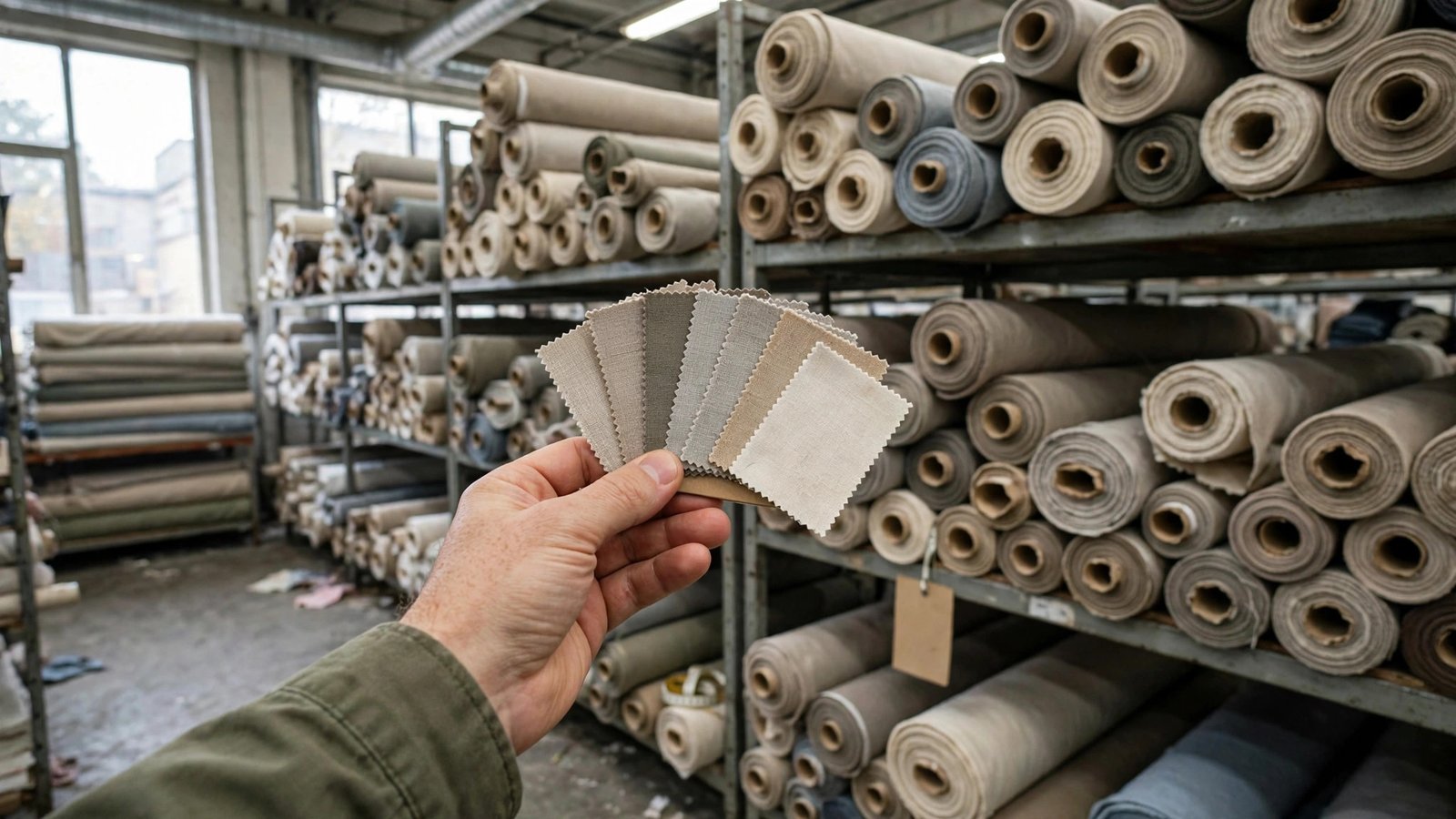
A development swatch shows look, hand feel, and approximate colour. It does not prove bulk colour, width, shrinkage, or performance. A lab dip, where colour matters, shows whether the dye recipe can hit the target shade on the actual fabric. A bulk lot sample, taken from production fabric, shows what will actually be cut. A test report, where performance is specified, shows measured results against the stated test, for the fabric as produced.
None of these stages replaces the others. Approving a development swatch and skipping a bulk lot approval is the most common way a colour or width problem reaches cutting. Approving a lab dip and skipping a test report is the most common way a shrinkage or fastness problem reaches the customer.
Set the approval sequence in advance: specification, then development sample, then lab dip where colour is critical, then bulk lot and test evidence, then cutting. If the schedule cannot fit that sequence, say so explicitly and record what was skipped, rather than letting a skipped approval look like a passed one. The same discipline applies to cost: our guide to reading a garment factory quote shows how fabric, trims, and other cost lines should be compared before an order is placed.
MOQ, Lead Time, and the Small-Order Problem
Minimum order quantities are not a single number. A fabric minimum may be set by the loom or knitting setup, by the dye lot, by the finishing line, or by the supplier’s stock policy, and each of those minima can differ. A buyer who asks only “what is your MOQ?” may receive the smallest of those numbers and discover the largest one later.
Break the minimum down: minimum per fabric, per colour, and per dye lot, and whether the minimum is measured in metres, kilograms, or pieces. Then check the minimum against the order: does the garment quantity, multiplied by consumption and waste allowance, actually reach the fabric minimum? If not, the buyer has three honest options: increase the order, accept a surcharge or a stock fabric, or change the fabric to one whose minimum fits. Each option has a cost. Pretending the minimum does not exist is not a fourth option.
Lead time needs the same breakdown. A quoted lead time that starts at order placement is not comparable with one that starts at colour approval, and neither is useful without the approval sequence. Ask for the lead time from final approval to delivery at the factory, and add the approval time separately. That is the date the factory can actually plan cutting around.
Small brands face a genuine constraint here, not a failure of negotiation. Mills set minimums because setup and dyeing have fixed costs, and a small order that ignores those costs will simply be quoted higher or declined. The practical response is to design around the constraint: use stock fabric for a first order, share a fabric across styles to reach a minimum, or choose a colour that already exists in the mill’s range. Our guide to finding a clothing manufacturer covers the parallel question of how to judge whether a factory can actually make the product, which is the other half of a small-order plan.
Chemical, Labelling, and Responsibility Checks
Fabric sourcing also carries responsibility questions that a price comparison will not surface. Fibre content must be supportable on the label, colour and chemical claims must have evidence behind them, and the mill’s working conditions are part of the buyer’s supply chain, not a separate matter.
Do not let a fabric claim travel further than its evidence. A claim that a fabric is organic, recycled, or certified needs a certificate that covers that fabric, that supplier, and that quantity, not a certificate for a different product or a general statement about a mill’s capabilities. The same rule applies to chemical safety claims: a test report for a similar fabric is not a test report for the fabric being bought.
For labour and working conditions in textile and garment production, Better Work, a programme of the International Labour Organization jointly managed with the International Finance Corporation, publishes guidance for brands and retailers on working with factories and supply chains. Its guide is a useful starting point for buyers who want to understand what factory engagement involves, rather than treating a single audit as proof of good conditions. See the Better Work guide for brands and retailers.
Finally, keep fabric sourcing records with the order, not in individual inboxes. The specification, the supplier’s written answers on minimums and lead time, the approved samples, and the test reports are the evidence that the next order can repeat the first. Without them, every reorder is a new sourcing exercise, with new risks.
A Buyer Checklist Before Bulk Fabric Is Approved
- Specification written and in the tech pack, including GSM with tolerance and usable width
- Route chosen deliberately: mill, trader, stock, or factory-sourced, with its trade-off recorded
- Offers compared on the same specification, quantity, delivery basis, and consumption
- Minimums broken down per fabric, per colour, and per dye lot, and checked against garment quantity
- Lead time counted from final approval, with the approval sequence fitted into the schedule
- Lab dip approved where colour is critical, and bulk lot approved before cutting
- Test evidence for the exact fabric where performance is specified
- Fibre, certification, and chemical claims supported by documents covering that fabric and quantity
- Responsibility evidence filed with the order, not held as a verbal assurance
- Reorder risk noted: will this fabric and colour repeat next season, and if not, what replaces it?
Fabric sourcing rewards buyers who write things down early. The specification, the comparison, and the approval sequence cost a little time at the start, and they prevent the most expensive kind of fabric problem: the one discovered after cutting, when the only remaining choices are to remake, to accept, or to delay.
Sources and further reading
- Better Work, Guide for Brands and Retailers (International Labour Organization / International Finance Corporation programme): https://betterwork.org/wp-content/uploads/Better-Work-A-Guide-for-Brands-and-Retailers-Apr-2026.pdf
- WEFTSIGNAL, Textile Dyeing Process: How Buyers Should Specify Colour, Method, and Risk: https://appareldispatch.online/textile-dyeing-process-buyer-guide/
- WEFTSIGNAL, Fabric Consumption Calculation: https://appareldispatch.online/fabric-consumption-calculation-garment-quote/
- WEFTSIGNAL, Tech Pack for Clothing: https://appareldispatch.online/tech-pack-clothing-factory-quotation-checklist/
- WEFTSIGNAL, How to Find a Clothing Manufacturer: https://appareldispatch.online/how-to-find-clothing-manufacturer-buyer-evaluation-guide/
