
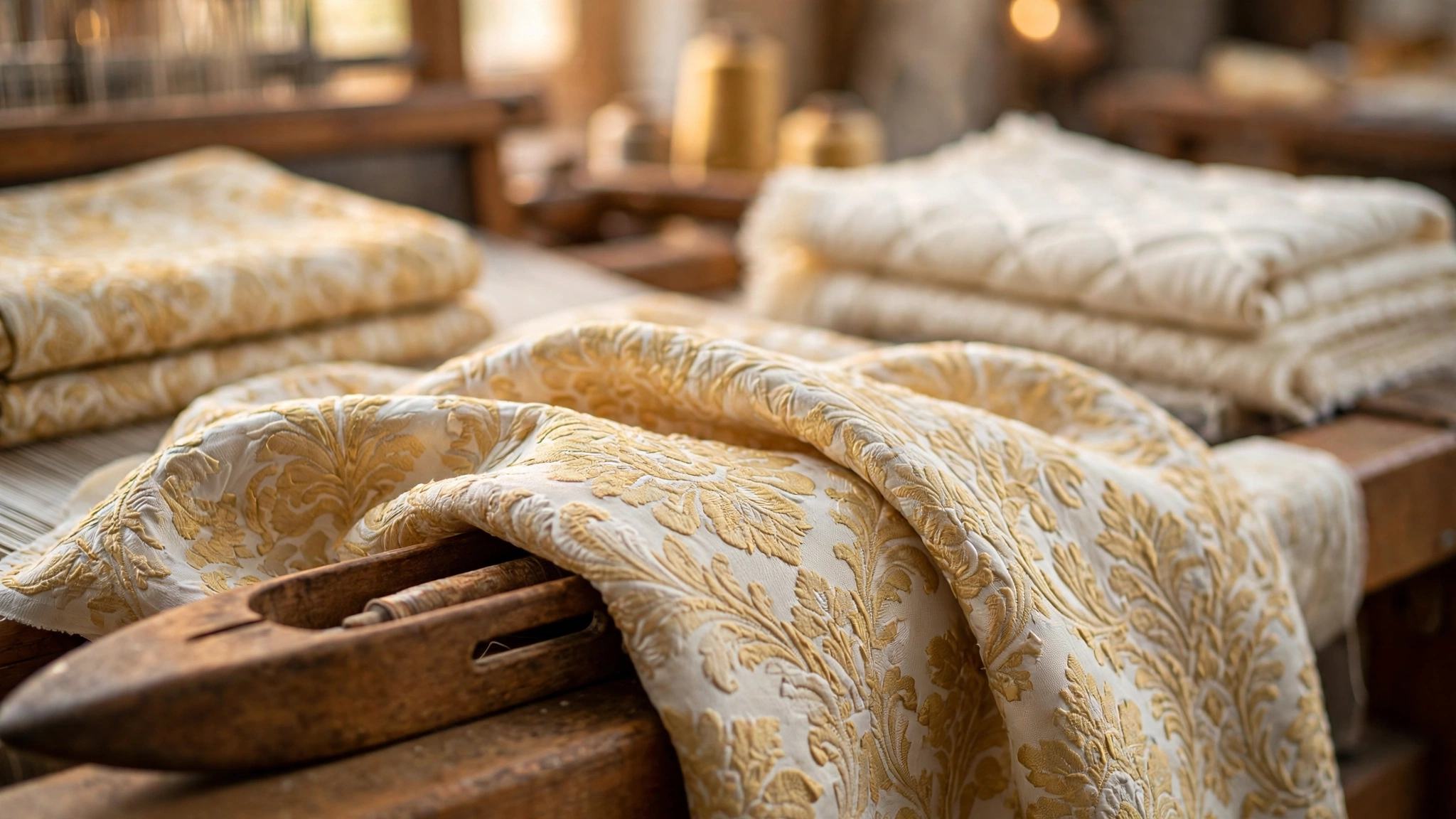
A woven jacquard pattern is formed by the interlacing of yarns rather than by applying a printed design to the fabric surface. That single fact explains why jacquard has survived two centuries of change in looms, fibres and fashion: it is one of the main ways of putting a large, detailed design into a woven fabric without printing, embroidery or any other applied decoration. For a buyer, the distinction matters commercially — a printed motif is only as durable as the ink behind it, while a woven motif lasts as long as the yarns that carry it. Understanding the different types of jacquard fabric helps apparel buyers distinguish between woven constructions, choose the right specification and avoid paying for a look that will not survive its end use. This guide covers how jacquard weaving works, how its six types differ, which specifications to ask for, and what changes when the cloth is cut and sewn into a garment.
What makes a fabric jacquard
A jacquard is not a fibre and not a finish. It is a way of weaving. On an ordinary loom, warp threads — the lengthwise yarns — are raised and lowered in groups, which limits the weave to simple repeating structures such as plain, twill or satin. A jacquard loom controls each warp thread, or small groups of them, individually, so the weaver can build large, detailed designs directly into the cloth: flowers, medallions, damask scrolls, geometric repeats and even pictures. As Textile Learner notes, a jacquard controls warp yarns individually, not in groups as on a dobby loom, where whole shafts lift together and the pattern is limited by the number of shafts.
The idea dates to the early 1800s, when the French inventor Joseph Marie Jacquard built a loom attachment that selected warp threads from a chain of punched cards — one card per weft insertion. Modern looms have replaced the cards with electronic controls, but the principle is unchanged. Jacquard weaving is slower and more expensive to set up than plain weaving, which is why the cloth is used where the pattern itself is the selling point.
One caution: “jacquard” is also used in knitting, where jacquard knits carry coloured patterns through selective needle control — a different technology from woven jacquard. Where a supplier says simply “jacquard”, ask whether the cloth is woven or knitted. For the basic distinction, see our guide to knit versus woven fabric.
Six common types and design variations of jacquard fabric
The following six categories illustrate common jacquard fabric constructions and design approaches. They are not mutually exclusive, and they mix different kinds of distinction — construction (damask, brocade, matelassé), yarn and surface character (chenille), pictorial effect (tapestry) and design approach (tone-on-tone and two-colour) — so a single cloth can belong to more than one of them: a chenille jacquard can also be tone-on-tone, and a tapestry-style design can be woven with a brocade structure.
| Type | What defines it | Typical use |
|---|---|---|
| Damask | Traditionally a single-colour figured weave; pattern commonly formed through contrasting weave structures | Table and bed linen, curtains, evening wear |
| Brocade | Supplementary pattern wefts, often metallic, floating on the face | Festive attire, structured blazers, heavy drapery |
| Matelassé | Compound double cloth; bound and loose areas create quilted relief | Bedspreads, cushions, structured jackets |
| Tapestry jacquard | Many coloured wefts woven densely for pictorial designs | Heavy upholstery, wall hangings, tote bags |
| Chenille jacquard | Chenille yarn woven into a jacquard pattern | Sofa covers, armchair upholstery, throws |
| Tone-on-tone / two-colour | Design approach, not a construction; one colour family or two colours | Daily wear, office shirts, dress fabrics |
The table above is an illustrative summary for buyers, not a formal industry classification.
1. Damask: the reversible tone-on-tone classic
Damask is the most widely recognised jacquard, and its pattern is made from nothing but the cloth’s own threads. Traditional damask commonly uses contrasting warp-faced and weft-faced figured areas — often a glossy satin figure against a duller plain ground — in a single colour of yarn for warp and weft. The satin areas reflect light and the plain areas scatter it, so the pattern appears and disappears with the viewing angle. Both sides use the same threads, so the pattern usually appears on the reverse in negative, with sheen and matte swapped, though the exact reverse appearance depends on the construction. Damask is flat, smooth and fully reversible, and is the standard choice for formal table linen, bed linen, curtains and luxury evening wear.
2. Brocade: the raised, often metallic showpiece
Brocade works on the opposite principle. Instead of rearranging the ground weave, it adds extra weft yarns — supplementary wefts — that float across the face of the cloth only where the motif needs them. Supplementary wefts form the pattern by appearing on the fabric face where required. Depending on the construction, unused pattern yarns may be carried on the back, bound in, or cut. The pattern yarns are often silk or metallic thread, worked in satin or twill over a plain or twill ground. The result is raised, embossed and richly coloured — and not reversible, since the back carries the unused pattern yarns. Brocade is heavy and firm in drape. Typical uses: festive traditional attire, structured blazers, theatrical costume, heavy drapery and accent upholstery.
3. Matelassé: the quilted look without quilting
Matelassé gives the visual impression of a padded, hand-stitched quilt — raised geometric or floral relief, soft hollows between the motifs. Matelassé is a compound woven fabric that creates a quilted or puckered appearance through its layered construction: it is woven as a double cloth — two sets of warp and weft woven simultaneously — and the jacquard mechanism binds the layers tightly in some areas and leaves them loose in others, so the loose areas pucker and bubble into relief. Some matelassé constructions include wadding (filling) yarns between the layers; lighter versions do without. Used for bedspreads, coverlets, cushions, structured jackets and summer outerwear. The relief is structural: pressing it flat crushes the very feature the buyer paid for.
4. Tapestry jacquard: the pictorial fabric
Tapestry jacquard is the most ambitious use of the mechanism: a dense, heavy cloth designed to reproduce the look of a hand-woven wall tapestry. Tapestry-style jacquards use multiple coloured weft yarns and figured weaving structures to create pictorial or highly detailed designs, so they can carry scenic landscapes and figures. The cloth is thick, durable, relatively low-stretch and rich in colour, and its weight confines it to heavy upholstery, cushion covers, wall hangings, tote bags and winter coats. How much it stretches depends on the yarn, weave structure and fibre — woven cloth gives little along the grain but more on the bias. Its dense construction limits its flexibility, and its many weft colours make shade matching harder than on a single-colour damask.
5. Chenille jacquard: the soft, textured alternative to velvet
Chenille jacquard combines the pattern-making power of the jacquard loom with the fuzzy, velvety texture of chenille yarn. Chenille yarn is generally produced by securing short pile fibres between two highly twisted core yarns, creating a soft, fuzzy yarn; woven into a jacquard pattern, the contrasting fuzzy and smooth areas accentuate the design. Soft, plush and warm, chenille jacquard can be durable in upholstery weights, but durability depends on the construction — check a washed sample, not only the loom-state piece. Common uses are sofa covers, armchair upholstery, heavy drapes, throws and cushions. The buying risk is specific to chenille: the short pile fibres can shed, and on loosely constructed versions the pile can work loose from the core yarn — so check a washed sample, not only the loom-state piece.
6. Tone-on-tone and two-colour jacquards: design variations
Tone-on-tone and two-colour jacquards are design variations rather than separate constructions. These jacquards rely on a single colour family (tone-on-tone) or just two complementary colours, and the pattern stands out through subtle shifts in thread direction, texture and light reflection. The effect is clean and understated, suiting daily wear, office shirts, dress fabrics and lightweight curtains — and fewer colours mean simpler dyeing and easier shade continuity across lots.
Quick identification: damask vs brocade vs matelassé
The three types buyers most often confuse can be separated in seconds by turning the cloth over and touching it.
| Check | Damask | Brocade | Matelassé |
|---|---|---|---|
| Reverse side | Clean reverse; the pattern usually appears in negative, sheen and matte swapped | Pattern yarns on the back — loose floats, bound-in yarns or cut ends, depending on construction; design visible only on the face | Reverse shows the same relief in reverse; no loose pattern yarns |
| How the pattern is made | Contrast between satin figure and plain ground, using the cloth’s own threads | Supplementary weft yarns added during weaving, often metallic or multicoloured | Double-cloth binding: layers joined tight in places, loose and puckered elsewhere; wadding yarns optional |
| Hand feel | Flat, smooth, fluid | Raised, embossed, firm and stiff | Soft, thick, padded feel (wadding yarns may or may not be present) |
| Reversible? | Yes | No | Effectively yes — both sides are presentable, though the face is the intended side |
Specifications that matter
The abrasion figures below are widely quoted trade guidance, not thresholds written into a standard — see the note under the table.
| Property | What it tells you | What to ask for |
|---|---|---|
| Composition | Fibre content drives hand feel, drape, care and cost | For products marketed in the EU, verify fibre composition labelling against Regulation (EU) No 1007/2011, including how metallic yarns are declared |
| Mass per unit area (g/m²) | The mass of a square metre of the cloth; upholstery jacquards are normally denser and heavier than curtain jacquards | Mass per unit area determined using EN 12127:1997, specifying the conditioning or oven-dry basis and specimen sampling, with tolerance; compare like with like — see our guide to fabric GSM and specifications |
| Abrasion resistance: ISO 12947 series, specifying the relevant part, specimen breakdown endpoint, test pressure, cycles and end use | How much rubbing the cloth survives before showing wear | Cycles to specimen breakdown to ISO 12947-2:2016, stating the test load — (795 ± 7) g, nominal 12 kPa, for workwear, upholstery, bed linen and technical fabrics; (595 ± 7) g, nominal 9 kPa, for apparel and household textiles excluding upholstery and bed linen — and the end use. A cycle count without the method and pressure is not comparable. |
| Colour fastness to light (EN ISO 105-B02) | Whether the colour survives sunlight | Report the applicable blue wool reference system and grade: ISO 105-B02:2014 permits European blue wool references 1–8 and American references L2–L9, which are not interchangeable; essential for curtains and sunlit rooms |
| Pilling (EN ISO 12945-2, modified Martindale) | Whether small fuzzy balls form on the surface | Report the pilling grade using ISO 12945-2:2020, stating the agreed evaluation stage and test conditions |
| Seam slippage (EN ISO 13936-2) and tear force (EN ISO 13937-3:2000, wing-shaped specimen, single tear method) | Whether the cloth holds at seams under strain, and whether it tears once nicked | Results in mm of slippage and Newtons of tear force, warp and weft separately; tear force is the force required to propagate a previously started tear |
| Maximum force and elongation at maximum force (EN ISO 13934-1:2013, strip method) | Maximum force the fabric withstands before breaking, and how far it extends at that force | Maximum force in Newtons and elongation at maximum force in percent, warp and weft separately |
| Usable width | How much cloth a sofa, curtain or garment gets from each metre | Usable width, not loom width; it drives consumption and cost |
On Martindale numbers — read this before quoting them. The figures most often quoted in trade are around 15,000 cycles for light domestic use, 25,000 cycles or more for an everyday sofa, and 30,000 cycles or more for commercial use. These bands are consistent across several independent sources — F. Schumacher, for example, gives 15,000–25,000 cycles as general domestic use, 25,000–30,000 as heavy-duty use and 30,000 and above as commercial, while Kvadrat cites 10,000–15,000 rubs for private and low-traffic areas, 15,000–25,000 for high-traffic private and office spaces, and 25,000–45,000 for public spaces and transport. But they are trade guidance, not a standard’s requirements. EN 14465:2003, together with amendment A1:2006, specifies performance properties and test methods for indoor furniture upholstery fabrics — it does not cover seats of road or railway vehicles, boats or aeroplanes, or fabrics with a coating on the wear face — and it does not set 15,000 or 25,000 as pass marks; it classifies flat woven fabrics by abrasion level — level A at 35,000 rubs or more, level B at 12,000–30,000, level C at 4,000–10,000. Specify by naming the end use and the test method (EN ISO 12947, the Martindale method), the test load (12 kPa or 9 kPa) and the breakdown endpoint, and agreeing the level with the mill. A Martindale count measures abrasion only, and cannot be converted into Wyzenbeek double rubs, the North American test.
Weight deserves a similar warning. GSM is a useful shorthand, but it says nothing about how the weight is distributed: a heavy brocade’s weight sits in the raised pattern yarns, which wear first, while a damask’s weight is spread through the ground. Compare GSM only within the same type, and read it together with the construction.
Choosing by end use
Family sofa. For upholstery, establish the required abrasion performance through the intended use and the applicable contract specification — the 15,000/25,000/30,000 bands quoted above are trade guidance, not pass marks — and check pilling resistance and seam slippage. Fibre content alone does not guarantee abrasion resistance; a polyester-rich cloth is not automatically hard-wearing.
Curtains. Choose for light fastness and drape first, and for abrasion last — a curtain is rarely rubbed. A tone-on-tone or damask jacquard gives pattern without blocking light the way a dense tapestry would. Ask for the light fastness grade.
Hotels and offices. Choose the abrasion level the contract requires — 30,000 cycles or more on the trade guidance bands, and the top EN 14465 level where the contract specifies it — and check the flammability standards required in the market — a separate specification from abrasion. Chenille and dense tapestry jacquards are common here; metallic brocades are usually reserved for accent pieces.
Formal and evening wear. This is where the specification logic flips, and it is the part the upholstery-focused guides leave out. Abrasion resistance matters far less in a jacket or an evening dress than drape, hand feel, seam behaviour and appearance after pressing. A silk or silk-blend damask at a modest weight will outperform a heavy commercial upholstery jacquard on every property the wearer actually notices — and it will fail every upholstery abrasion target, which is irrelevant for a garment. Specify for the garment: fibre content and handle, pattern scale against the garment’s panels, seam slippage on long satin floats, and colour fastness to light and to dry cleaning — not to Martindale cycles.
The apparel buyer’s view: cutting and sewing jacquard
This is where most jacquard garment orders incur avoidable production costs. The pattern is structural — it cannot be moved, hidden or printed over — so every cutting and sewing decision shows in the finished garment.
Floats are the first problem. Brocade’s supplementary wefts float on the back of the cloth, and damask’s long satin floats sit on the face. Both snag. In the garment, never leave a brocade float exposed on an unlined edge: line the garment, bind the edge, or choose a construction that keeps the reverse inside.
Pattern matching is the second problem, and it costs fabric. A damask medallion or a brocade motif has a repeat — often 30 cm or more — and on a matched garment the motifs must meet at the side seams, the centre back and across a pocket or placket. That means cutting single-ply or in small spreads, aligning each piece to the repeat, and accepting the extra consumption. Budget for it in costing: large-repeat jacquards can increase fabric consumption because pattern matching may require additional allowance, so ask the factory to confirm the repeat size and the matching plan before approving the cost.
Seam slippage is the third problem. Long floats can increase the risk of yarn displacement and snagging, depending on yarn characteristics, weave structure and finishing, so they slide more readily than tightly interlaced yarns. On a damask with long satin floats, a seam under strain — an armhole, a seat seam, a tight skirt — can open as the yarns slip away from the stitch line. Three defences work in practice: select the seam construction according to fabric thickness, fraying behaviour, yarn slippage, seam allowance and garment design, and test it on the actual cloth; test seam slippage to EN ISO 13936-2 on the actual cloth before bulk; and avoid placing a high-strain seam across the longest floats where the pattern allows. For seam options, see our guide to types of seams in garments. Run a sewing trial with the exact thread, needle and stitch density that bulk will use.
Pressing and shrinkage are the fourth problem. Matelassé’s relief is the product — press it flat and the garment loses the feature the buyer paid for, so establish pressing temperature, pressure, dwell time and steam conditions through testing on the actual fabric, and write them into the tech pack. Chenille’s pile crushes the same way, and metallic-effect yarns and coatings may be sensitive to heat, moisture and pressure — confirm the manufacturer’s care instructions and test before bulk pressing, because the pressing temperature must follow the most heat-sensitive yarn in the cloth, not the majority fibre. Test shrinkage on the finished sample and record it in the fabric specification.
None of this makes jacquard a difficult fabric — it rewards a buyer who asks the factory three questions before cutting: what is the repeat, what is the seam slippage result on this cloth, and what pressing does the mill recommend?
Buyer inspection checklist
Use this checklist on the pre-production sample and again on bulk. Select the mandatory tests according to the garment or upholstery end use, customer specification and applicable regulation — Martindale abrasion, for example, is not a mandatory test for every apparel jacquard, and neither is light fastness.
- Martindale abrasion (EN ISO 12947): result in cycles to specimen breakdown (ISO 12947-2:2016), with the method, test load and end use stated; match the band to the end use.
- Colour fastness to light (EN ISO 105-B02): grade on the applicable blue wool reference system (1–8 or L2–L9), checked on the actual colourway. Mandatory for curtains and sunlit rooms.
- Pilling (EN ISO 12945-2): grade on the 1–5 scale, stating the agreed evaluation stage and test conditions (ISO 12945-2:2020). Pilling should be assessed independently of abrasion resistance because the two tests measure different aspects of fabric performance.
- Seam slippage (EN ISO 13936-2) and tear force (EN ISO 13937-3): warp and weft separately. If the mill cannot supply these, do not accept the cloth for a sewn product on trust.
- Pattern and shade: check the repeat size, pattern alignment across the width, and shade continuity between rolls and against the approved sample.
- Floats and reverse: run a hand over the back of a brocade and the face of a damask; look for loose floats, pulled threads and broken pattern yarns. Evaluate a finished sample after the applicable care treatment specified for the garment, including washing or professional dry cleaning as appropriate, not only the loom-state piece.
- Defects: inspect for broken ends, weft bars, stains and misweaves — harder to spot in a busy jacquard pattern. See our guide to fabric defects.
- Sample approval: approve a lab dip and a bulk sample in the actual colourway, on the actual cloth, before bulk cutting — and check it under the lighting the product will actually be seen in.
Keep the approved sample, test reports and specification sheet together, filed by style and colourway.
Common misconceptions
Jacquard is not a print. A printed motif sits on the surface and can wear, crack or wash away, while a woven motif is the cloth. The trade-off is that a woven pattern cannot be changed after weaving. For how printing actually works, see our guide to textile printing methods.
Expensive does not mean hard-wearing. A silk brocade can cost several times a polyester damask and still fail an upholstery abrasion test, because price pays for fibre, metallic yarn and loom time, not for rub resistance. Judge durability by the test results.
Martindale cycles are not the only number. A cloth can survive 40,000 rubs and still pill badly, fade in sunlight or split at the seams. Read the full test report before deciding.
Reversible does not mean identical. A damask is reversible in the sense that both sides are presentable, but the two sides are not the same: the pattern inverts, and the sheen and matte areas swap. Using both sides must be a design decision, agreed with the factory, not a cutting-room improvisation.
Sources
All sources below were read on 10 November 2026. Standard editions were verified against the standards bodies’ catalogue pages on the same date.
- Online Clothing Study, “Jacquard Fabrics: Types, Structure and Specifications”, by Adnan AlYassin (Deebtex), 29 October 2026 — onlineclothingstudy.com/jacquard-fabrics-types-structure-specs/ — manufacturer-authored competitor guide; used for structure and trade practice, not as independent technical verification.
- Textile Learner, “Jacquard Design: Working Principle, Types & Construction” — textilelearner.net/jacquard-design-working-principle-types-construction/
- Kvadrat, Hallingdal 65 product page, performance data citing EN ISO 12947 — kvadrat.dk — Hallingdal 65 — single-product performance example, not a general threshold.
- F. Schumacher, “Fabric Abrasion 101”, 11 January 2023 — fschumacher.eu — Fabric Abrasion 101 (the double slash is part of the live URL)
- EN 14465:2003/A1:2006, “Textiles — Upholstery fabrics — Specification and methods of test”, standard preview — standards.iteh.ai — EN 14465 preview; BSI catalogue page — knowledge.bsigroup.com — BS EN 14465:2003+A1:2006
- ISO 12947-2:2016, “Textiles — Determination of the abrasion resistance of fabrics by the Martindale method — Part 2: Determination of specimen breakdown” — iso.org
- ISO 12945-2:2020, “Textiles — Determination of fabric propensity to surface pilling, fuzzing or matting — Part 2: Modified Martindale method” — standards.iteh.ai
- ISO 105-B02:2014, “Textiles — Tests for colour fastness — Part B02: Colour fastness to artificial light: Xenon arc fading lamp test” (sixth edition, 2014; last reviewed and confirmed in 2025) — iso.org
- ISO 13937-3:2000, “Textiles — Tear properties of fabrics — Part 3: Determination of tear force of wing-shaped test specimens (Single tear method)” — knowledge.bsigroup.com — BS EN ISO 13937-3:2000
- ISO 13934-1:2013, “Textiles — Tensile properties of fabrics — Part 1: Determination of maximum force and elongation at maximum force using the strip method” — committee.iso.org
- EN 12127:1997, “Textiles — Fabrics — Determination of mass per unit area using small samples” — standards.iteh.ai
