
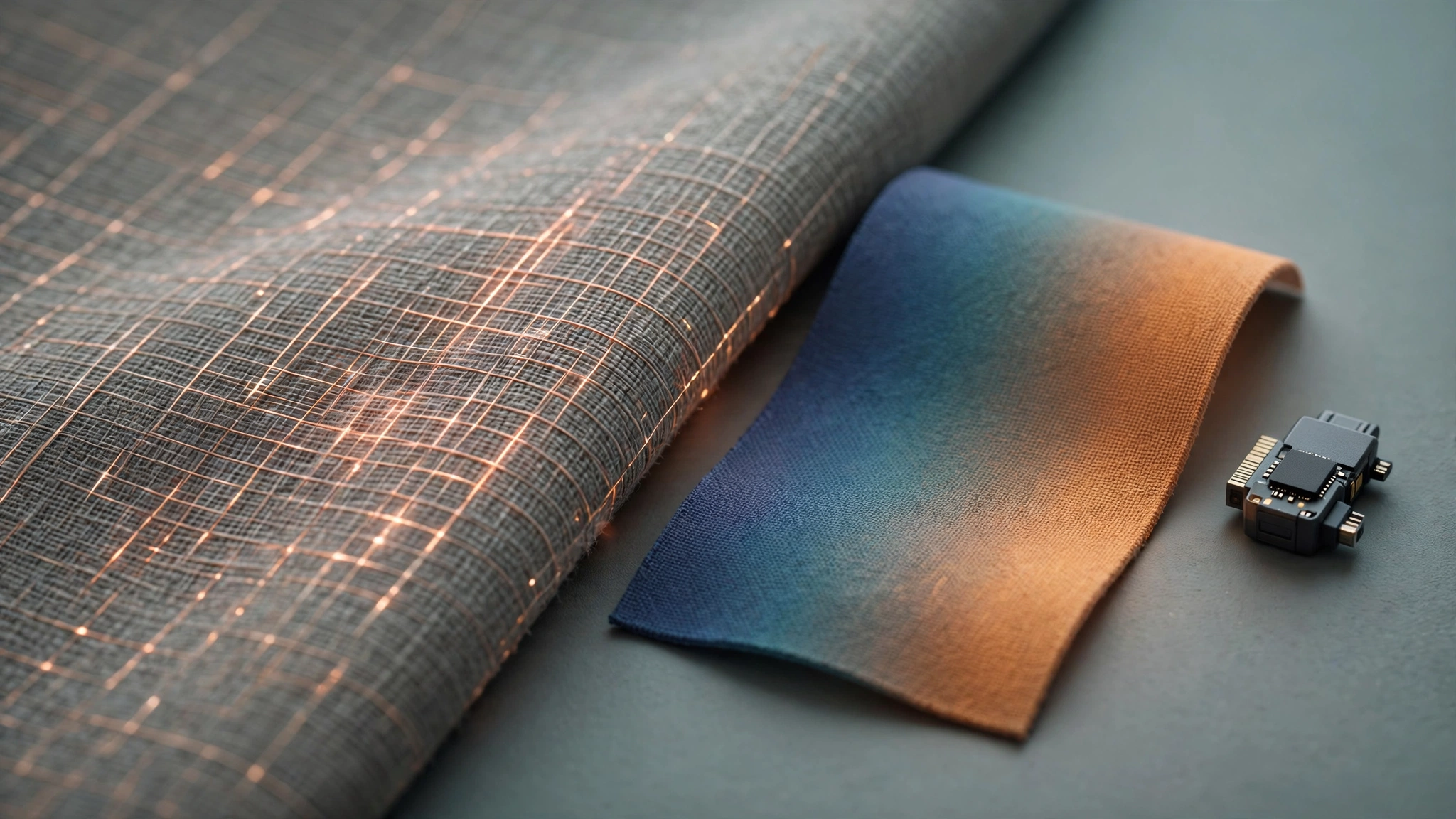
Some garments marketed as smart use conventional fabric with a separate sensor or electronic module. This article tests them at textile level: it asks what the fibre, yarn or fabric itself does, as distinct from what the finished garment system does. Industry definitions vary — some count any garment with integrated electronics as a smart textile — but the textile-level test is the point of this article: once you can tell what the textile itself does, as opposed to the module or the app attached to it, you have a clearer basis for evaluating product claims.
What are smart textiles?
A smart textile is a fibre, yarn or fabric whose properties change in a useful way in response to a stimulus: mechanical, thermal, chemical, electrical or magnetic. The response may be a signal (a sensor), a physical change (an actuator: colour, heat flow, shape, light or vibration), or both under some form of control. ISO/TR 23383:2020 gives definitions, categorisation, applications and standardisation needs for “smart (intelligent) textiles”, replacing CEN/TR 16298:2011; ASTM D8248-20 is a separate terminology standard.
Smart and intelligent are used as synonyms; the ISO title puts “intelligent” in brackets after “smart”. Where authors separate them, “intelligent” means the top level, which also processes information and adapts. E-textiles are the subset carrying electrical circuits: a phase-change fabric is smart with no electronics, while a heated jacket has electronics but its fabric does nothing.
Smart is also not the same as functional: a waterproof membrane or an antibacterial finish does one fixed job whatever happens around it, while a smart textile’s behaviour changes with conditions — a thermochromic print is one colour below a temperature and another above it. A fabric that behaves the same in every condition may be a good functional textile, but it is not a smart one.
The three types of smart textiles
The three-level scheme used in this article goes back to Xiaoming Tao’s Smart Fibres, Fabrics and Clothing (Woodhead, 2001), as summarised in later literature. It is one widely used classification, not a universal regulatory or standards classification: ISO/TR 23383:2020 uses its own definitions, and other authors draw the lines differently. In one peer-reviewed summary of Tao’s scheme, passive textiles “can only sense the environment, as they are just sensors”; active ones add “an actuator function”; ultra smart textiles “sense, react, monitor, and adopt themselves according to the stimuli” (Çelikel, 2020). The table sorts products that are, or were, on sale by what the textile does. Availability is stated per product and as of 18 October 2026, the date the product pages were last checked; several claims below rest on the maker’s own pages and are labelled as such where they do.
| Type | What the textile does | Commercial example | Maturity, Oct 2026 |
|---|---|---|---|
| Passive | Senses only | Hexoskin shirt; Sensoria and Siren socks; Levi’s Jacquard jacket | On sale, niche; Jacquard discontinued |
| Active | Senses and reacts | Outlast; HeiQ Smart Temp; Matsui Chromicolor; CuteCircuit | Widely sold to niche, by product |
| Very smart | Senses, reacts and adapts | System-level examples: Wearable X Nadi X yoga leggings and PROETEX responder garments; neither demonstrates textile-only adaptive processing. | On sale, niche; PROETEX research, closed |
Passive smart textiles: only sensing
A passive smart textile is a sensor and nothing more. The best-known example is the Hexoskin smart shirt. Textile electrodes record a single-lead ECG, two breathing bands (respiratory inductance plethysmography) record breathing rate, tidal volume and minute ventilation, and a 3-axis accelerometer records movement. A small battery-powered recorder in a pocket logs the data and sends it by Bluetooth to a phone or computer.
Sensoria’s smart socks work the same way at a smaller scale: textile sensors record foot strike, and a detachable Core module sends cadence and foot-landing data by Bluetooth to a phone app. Siren’s socks take the idea into health care: sensors measure foot temperature continuously — a rise can signal inflammation before a diabetic foot ulcer forms — in a monitored programme where nurses alert the patient’s provider.
The most famous passive example is also a warning. The Levi’s Commuter Trucker Jacket with Jacquard by Google (2017) wove conductive yarn into the cuff on standard looms; a removable tag read swipes and taps to control the phone. Google ended support for the Jacquard app on 24 April 2023, and the jackets’ smart functions stopped with it. The fabric still works as denim — but when the intelligence lives in an app, the garment’s life is set by the app’s owner, not the weaver.
Active smart textiles: sensing and reacting
An active smart textile adds an actuator: something in the fibre, yarn or finish changes in response to the stimulus — in the clearest commercial case, with no power at all. Outlast fabrics carry microencapsulated wax that melts as skin warms, storing heat, and solidifies as it cools, releasing it. It began with a 1987 NASA Small Business Innovation Research contract, under which Triangle Research and Development worked on phase-change materials for spacesuit glove insulation; Gateway Technologies later acquired the patent rights and became Outlast Technologies in 1997. Today it is sold in clothing, shoes and helmets, needing no battery.
HeiQ Smart Temp uses different chemistry for the same idea: hydro-functional polymers that reversibly change behaviour with temperature and moisture, raising evaporative cooling as sweat builds, with fabric surface temperature up to 2.5°C (4.5°F) lower under test conditions — a maker’s figure, not an independent guarantee.
Colour-changing prints are the most visible active textiles. Matsui’s Chromicolor is a reversible leuco-dye microcapsule print: colour appears below one temperature and clears above another. Its Type 37 grade is listed by Matsui as showing colour below 32.0°C and losing it above 41.0°C — the manufacturer’s published figures; the test conditions are not stated on the product page, so buyers should confirm the measurement method before specifying a transition temperature. No sensor, no battery, no app: as an explanatory analogy, the print acts as both sensor and actuator — a textbook active smart textile with no electronics. See our companion guide to colour-changing fabric for the mechanisms in depth.
Light is another actuator: CuteCircuit builds light sources into garments, including its Galaxy Dress and Graphene Dress. Electrochromic textiles, which change colour under a low voltage, remain at research and pilot stage — no textile product was found on sale, though EN IEC 63203-301-1:2024 now gives a test method for electrochromic films.
Very smart textiles: sensing, reacting and adapting
Very smart (ultra smart) textiles add a processing unit that works like a brain: they sense, react and adapt. The clearest consumer example is the Wearable X Nadi X yoga legging — with an important qualification. Sensors in the leggings read the wearer’s pose, an app analyses it, and gentle vibrations through the leggings guide the wearer’s movement. Sensing is textile, decision is software, feedback returns through the garment. At textile level the leggings are therefore passive: the sensors only sense. The very-smart behaviour belongs to the garment system as a whole, and the adaptive processing resides in the app’s software, not in the textile. Nadi X is best described as an intelligent wearable garment system, not as a very smart textile in the strict textile-level sense used in this article. Prices have varied widely, so none is quoted here.
The research landmark is PROETEX, a European project launched in February 2006, led by the Italian National Research Centre (CNR) with 23 European partners, which built integrated garments for emergency and disaster workers that monitor vital signs and surrounding hazards. The project is closed and its garments never reached the consumer market, but it remains the reference case for a full sense-decide-act loop in protective clothing. A separate requirement applies where the garment’s intended protection demands it: EN 1149-5 covers electrostatic properties of protective clothing, not smart-textile sensing, monitoring or adaptive functionality, and is relevant only where the garment’s intended protection requires electrostatic performance.
Why sewing a sensor into a shirt is not the whole story
Many products marketed as smart textiles are ordinary textiles with an electronic device attached. The test is simple — ask which part senses, which part decides, and which part acts. If the textile only carries a sensor while a clip-on module or a phone decides, then at the level of the fabric the product is passive, even if the complete system senses and responds. A Hexoskin shirt, Sensoria socks and the Jacquard cuff are all passive at fabric level. The same test reclassifies Nadi X: at fabric level its leggings are passive sensors, and the very-smart behaviour is a property of the garment-plus-app system, not of the textile alone.
Contrast that with a thermochromic print, where microcapsules do the whole job: the textile senses the temperature and changes its own colour unaided. By this test, a printed T-shirt that changes colour in the sun is more of a smart textile than a shirt with a sewn-in heart sensor wired to a phone — the first product’s intelligence is in the cloth, the second’s in the electronics carried by the cloth.
This decides three practical questions. Durability: a capsule or finish is washed with the fabric, while a sewn-in circuit is a failure point washing attacks. Dependence: if the smart behaviour needs an app, the garment stops being smart when the app is withdrawn, as Jacquard owners discovered. Responsibility: ask a supplier not “is it smart?” but “which part senses, decides and acts — and what test proves each part works?” A supplier that cannot answer is selling a slogan, not a specification.
How a smart textile is built
A smart textile system may combine up to five parts, and only the first two need to be textile: sensor (a stimulus becomes a signal); actuator (a signal becomes a change — capsules, prints, heating tracks, LEDs, vibration motors); conductor (plated yarns, carbon, polymers, printed inks). Power is usually a small rechargeable battery in a detachable module; in common commercial configurations, processing sits on a rigid chip in that module, with Bluetooth to a phone as the usual link — a typical arrangement, not a rule for every architecture. Not every smart textile has all five: a passive textile sensor needs no actuator, power supply or processing unit of its own.
Circuits reach cloth in three ways: conductive yarn woven or knitted in as the fabric is made (Google’s Jacquard team engineered a yarn for industrial looms, so only a patch needed to be interactive); embroidery or sewing afterwards (MIT’s “e-broidery” patterned conductive textiles by numerically controlled sewing — Post et al., IBM Systems Journal, 2000); or printed stretchable inks (DuPont’s Intexar, launched July 2017, garments said to “endure over 100 washes” in DuPont’s 25 July 2017 launch announcement — a maker’s claim). See our guides to fabric construction types and 3D weaving.
The choice of route matters, because conductive yarns are resistors, not wire: silver-plated polyamide, the commonest choice for sewn circuits, conducts far worse than copper, and resistance climbs as a trace is washed and flexed. The calculation below is a simplified resistive-load illustration, not a design calculation: it assumes a constant 20 mA LED current, ignores the LED’s forward-voltage requirement and any driver circuitry, and takes the thread resistance as a fixed 100 ohms per metre, although real thread resistance varies with construction, batch and washing. Take an LED drawing 20 mA from a 3.3 V supply, wired with 0.5 m of thread rated at 100 ohms per metre (an illustrative assumption): the trace is 50 ohms, the drop is 1.00 V (30.3% of the supply), only 2.30 V reaches the LED, and the longest trace inside a 5% budget would be about 8 cm. Treat the 8 cm figure as an order-of-magnitude illustration of why long conductive traces fail, not as a generally applicable design limit. The fixes are the usual ones: shorter runs, parallel stitches, a heavier thread, a higher voltage, a lower current.
Smart textiles, wearable technology and functional finishes: what is the difference?
Wearable technology is any electronics worn on the body: a smartwatch, a fitness band, a chest strap. Smart textiles are the cases where the fabric itself does part of the job; smart clothing means a finished garment built on smart textiles, usually with a small detachable module for battery and radio. The overlap is large and the terms are used loosely, but the distinction shows up in three places for the wearer.
First, a garment touches far more skin than a watch, so it can read signals a wrist cannot, such as breathing from chest expansion. Second, it has to survive laundering, which a watch never does. Third, in fashion the fabric itself becomes the display. Confusing the categories means asking the wrong questions: a watch is judged on battery life and software support, a smart garment on wash life and on whether the textile or the module does the work.
Standards and test methods
There is no single “smart textile standard”: there are vocabularies and a growing family of IEC test methods for e-textiles, published in Europe as EN IEC 63203. The standards below do not collectively form a smart-textile compliance framework: each covers a specific property or vocabulary, and the EN IEC 63203 methods test individual e-textile properties rather than qualifying a complete garment. See our guide to garment inspection vs textile testing for how inspection and testing responsibilities split in practice.
| Standard | What it covers |
|---|---|
| ISO/TR 23383:2020 | Smart (intelligent) textiles: definitions, categorisation, applications and standardisation needs. A technical report, not a test method |
| ASTM D8248-20 | Standard terminology for smart textiles |
| EN IEC 63203-201-1:2022 | Electronic textiles: measurement methods for basic properties of conductive yarns |
| EN IEC 63203-201-2:2022 | Electronic textiles: basic properties of conductive fabrics and insulation materials |
| IEC 63203-204-1:2023 | Domestic washing durability of e-textiles within the specified scope; not a safety or heat-generation test. |
| BS EN IEC 63203-204-2:2025 | Resistance change in a knee and elbow bending test (bending resistance of conductive textiles only) |
| EN IEC 63203-301-1:2024 | Test method for electrochromic films for wearable equipment (electrochromic films only) |
| EN 1149-1 / EN 1149-5 | Protective clothing, electrostatic properties: surface resistivity test and garment requirements (a protective-clothing requirement, not a smart-textile test) |
A smart garment must also meet the ordinary standards for its base textile and its electronics: a certificate for the fabric says nothing about the electronics, and vice versa.
Washing, care and durability: the main barrier
A 2021 review by Rotzler and colleagues identified the lack of e-textile-specific washing methods as a barrier. That historical finding should not be read as the current position: IEC 63203-204-1:2023 specifies a domestic washing durability method for e-textiles incorporating conductive components and user-data sensors. It replaced the 2021 edition and does not cover safety, heat generation or products outside its stated scope. Buyers should check whether a claimed wash result follows the relevant method and whether the test measures the function needed in use.
Care instructions vary by product and are the maker’s own claim: Siren describes its socks as machine washable and needing no charging; DuPont claimed over 100 washes for Intexar garments (launch announcement, 25 July 2017); the Jacquard tag had to be taken off before washing. Before buying, look for a wash count, the test behind it, and whether the electronics come out. Non-electronic smart textiles need no module removed, but their smart function can still degrade: microencapsulated materials and functional finishes may lose performance through laundering, so buyers should test retention of the smart function after the agreed wash cycles rather than assuming the base fabric’s care instructions apply. See our guide to textile ageing testing methods for how aged-fabric performance is measured.
A checklist for buyers and developers
Ask for the answers in writing, with the test method named, before approving a sample.
- Which part senses, decides and acts? Name textile, module and software separately.
- What is the specification of the sensing or reacting part? Sensor: range, accuracy, test standard. Finish: temperature range, test conditions.
- What is the wash life, and how was it measured? Cycles, method, whether electronics come out first. No method, no claim. See our garment quality control guide for small orders for how to set up the inspection around a sample.
- What happens when the app or the service ends? Jacquard shows a garment can lose its function overnight: does it work without its app?
- How is power supplied and charged? Battery type, charging method, life per charge, replaceable?
- What standards apply? Terminology (ISO/TR 23383, ASTM D8248), relevant IEC 63203 methods, base textile and electronics standards.
- What are the limits? Temperature and humidity range, skin contact, allergy notes, unsuitable uses.
- Who is responsible when it fails? Textile supplier, electronics supplier and brand rarely share one warranty — get the split in writing.
- Can the claim be verified independently? A maker’s figure is a starting point, not evidence: ask for an independent laboratory report. Remember that acceptance sampling (AQL) only shows whether a lot meets an agreed defect limit — it cannot prove a performance claim; see our guide to AQL in garment inspection.
- Is the market claim honest? Published market estimates disagree sharply for the same year. This article quotes no figure; ask a supplier that does what its figure counts.
Frequently asked questions
What is a smart textile?
A fibre, yarn or fabric that senses a stimulus such as heat, moisture, pressure or a body signal, and in the more advanced kinds reacts or adapts to it — the textile itself doing the sensing or reacting.
What are the types of smart textiles?
Three: passive only sense; active sense and react, with an actuator; very smart (ultra smart) sense, react and adapt, with a processing unit. The scheme dates from Tao’s 2001 book.
What are some examples of smart textiles?
Shirts with knitted ECG electrodes, socks that track foot strike or foot temperature, phase-change fabrics, cooling finishes, thermochromic prints, light-emitting dresses and pose-correcting leggings.
What is the difference between smart textiles and wearable technology?
Wearable technology is any electronics worn on the body; smart textiles are the cases where the fabric itself does part of the job. A smartwatch is wearable technology but not a smart textile; a shirt with textile ECG electrodes is both.
How should buyers validate wash life and sensor accuracy?
Agree the wash cycles, the test method and the acceptance limit in writing before approving a sample, and test the smart function itself after washing — not just the fabric. For a sensor garment, that means the accuracy of the signal after the agreed number of washes, measured against a reference device; for a thermochromic print, the transition temperature after washing; for a conductive trace, the resistance after washing and flexing. The supplier owns the test data; the buyer owns the acceptance decision. Applicable standards are the terminology and e-textile methods listed above (ISO/TR 23383, ASTM D8248, the EN IEC 63203 series); IEC 63203-204-1:2023 provides a washing durability method for products within its scope. Agree the appropriate method, functional measurements and acceptance limits for the particular order.
Can smart textiles be washed?
Non-electronic ones may follow the base fabric’s care procedure, but retention of the smart function must be tested separately after the agreed wash cycles — a thermochromic print or a phase-change finish can lose performance even when the fabric itself washes fine. Electronic products vary; follow the manufacturer’s instructions for removing any detachable module. Check the reported wash cycles, the relevant test method (including IEC 63203-204-1:2023 where applicable) and the retained functionality.
Sources
- Textile School, “Smart Textiles: What They Are, Types and Real Examples”, published 2 March 2025, fully rewritten and last verified 18 October 2026. Read 16 November 2026. https://www.textileschool.com/10005/what-are-smart-textiles/
- Çelikel, D.C., “Smart E-Textile Materials”, in Advanced Functional Materials, IntechOpen, 2020. https://doi.org/10.5772/intechopen.92439
- Tao, X. (ed.), Smart Fibres, Fabrics and Clothing, Woodhead Publishing, 2001. (Cited via Çelikel 2020 and Textile School; the book itself was not re-read for this article.)
- ASTM D8248-20, Standard Terminology for Smart Textiles.
- ISO/TR 23383:2020, Smart (intelligent) textiles: terminology and categorisation.
- IEC 63203-204-1:2023, washing durability test method for e-textile products; scope and publication date checked 29 November 2026.
- Hexoskin, “Placement of Hexoskin Sensors” and “Technical description of Hexoskin data channels”, Hexoskin Support. Read 16 November 2026. https://support.hexoskin.com/placement-of-sensors-hexoskin-smart-shirts-proshirts
- NASA Spinoff 2009, “Phase Change Fabrics Control Temperature”. NASA Technical Reports Server. Read 16 November 2026. https://ntrs.nasa.gov/citations/20090039423
- HeiQ, “Redefining the Future of Cooling Textiles with HeiQ Smart Temp”, webinar, 6 June 2024. Read 16 November 2026. https://www.heiq.com/news/webinars-2024/
- Matsui International, “Thermochromic — Chromicolor”. Read 16 November 2026. https://www.matsui-color.com/thermochromic/
- 9to5Google, “Jacquard: Google shutting down smart fabric app in April”, 28 March 2023. Read 16 November 2026. https://9to5google.com/2023/03/28/google-shutting-down-jacquard-app/
- Rotzler, S., von Krshiwoblozki, M. and Schneider-Ramelow, M., “Washability of e-textiles: current testing practices in the absence of e-textile-specific standards”, Textile Research Journal 91(19–20), 2021, pp. 2401–2417. https://doi.org/10.1177/0040517521996727
- Magenes, G. et al., “Smart garments for emergency operators: the ProeTEX project”, Conference Proceedings IEEE Engineering in Medicine and Biology Society, 2010. https://pubmed.ncbi.nlm.nih.gov/20371413/
- Poupyrev, I. et al., “Project Jacquard: Interactive Digital Textiles at Scale”, Proceedings of CHI 2016. https://doi.org/10.1145/2858036.2858176
- Post, E.R., Orth, M., Russo, P.R. and Gershenfeld, N., “E-broidery: Design and fabrication of textile-based computing”, IBM Systems Journal 39(3–4), 2000, pp. 840–860. https://doi.org/10.1147/sj.393.0840
- DuPont, “DuPont Unveils Newest Smart Clothing Technology at Outdoor Retailer Show”, 25 July 2017 (PRWeb). https://www.prweb.com/releases/dupont_unveils_newest_smart_clothing_technology_at_outdoor_retailer_show/prweb14541954.htm
- Maker pages read 16 November 2026 (home pages verified HTTP 200; product detail claims attributed to the maker or to Textile School’s maker-page citations): Hexoskin https://www.hexoskin.com/ ; Sensoria https://www.sensoriafitness.com/ ; Siren https://siren.care/ ; Outlast https://www.outlast.com/ ; Wearable X https://www.wearablex.com/ ; CuteCircuit https://www.cutecircuit.com/
Illustrative image note: this article uses an AI-generated cover. It is an illustration, not a photograph of a real product or a news scene.
