
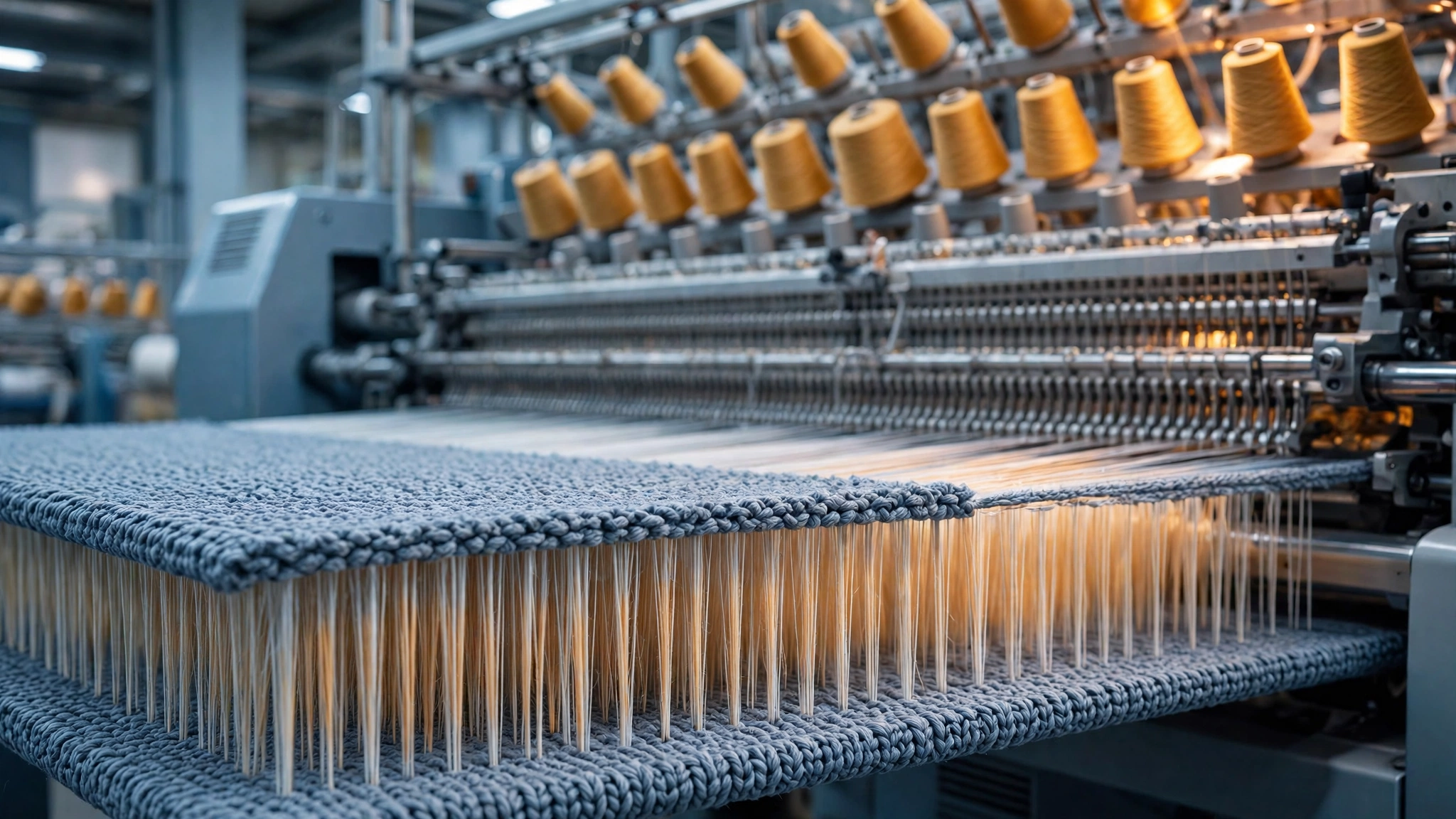
Four days before ITMA ASIA + CITME 2026 opens in Shanghai, Karl Mayer has put its cards on the table. In an interview released by Karl Mayer on 10 November 2026 and republished by Indian Textile Journal on 16 November 2026, Kay Hilbert, the company’s Global Head of Design Fabrics & Specials, set out what its two new Jacquard double needle bar raschel machines — the RDJ 7/3 and the RDJ 6/2 — are meant to do for spacer fabrics in footwear and sportswear. The machines will be shown at Karl Mayer’s in-house Product Show in Changzhou, running alongside the Shanghai exhibition, rather than on the main show floor. Karl Mayer claims up to 70% higher productivity for the new machines — a figure this article tests against the wireless Jacquard technology behind it. For buyers of Karl Mayer spacer fabric, the interview offers a detailed account of how the two machines differ — and of what still needs to be verified before specifying.
What a spacer fabric is, and why footwear cares
A spacer fabric is a three-dimensional knit: two separate face layers held apart by a middle layer of pile yarns, usually monofilament, knitted in a single pass on a double needle bar machine. The pile yarns act like tiny columns. When the fabric is compressed, their resilience pushes the two faces back apart, which is what can give spacer fabrics their combination of cushioning, breathability and compression recovery without foam or lamination. How much of each property a given fabric actually delivers varies considerably with pile geometry, yarn selection, construction and finishing, so performance must be verified against the intended application rather than assumed from the structure alone.
That structure explains why the footwear industry is the main customer. A shoe upper needs several things at once: a stable outer face that holds its shape and carries a design, a comfortable inner face against the foot, and airflow and cushioning in between. A spacer fabric can deliver all three in one knitted piece, with no bonding step. The same logic applies to sportswear and athleisure, where ventilation zones, padding and stretch can be knitted into a single fabric instead of assembled from layers. And because the fabric’s performance depends on the geometry of the pile layer and on how precisely each face can be patterned, every extra degree of patterning freedom on the machine is, in principle, an extra degree of freedom in the fabric. That is the context for both new machines.
Two machines, two different jobs
The RDJ 7/3 and the RDJ 6/2 share the same platform — Jacquard double needle bar raschel machines with wireless Jacquard control — but they are aimed at different ends of the spacer fabric range. Machine specifications in this section come from Karl Mayer’s own published information and the interview with Kay Hilbert published by Indian Textile Journal on 16 November 2026; commercial references, such as the Long John commissioning, come from independent trade reporting (Textile Focus) and are attributed where they appear.
The RDJ 7/3 is the patterning machine. Karl Mayer describes it, in the interview and in its published machine information, as its three-Jacquard-bar machine for complex, differentiated fabrics: functional zones and integrated patterns for improved stability or breathability with more intricate contours than before, hole designs with nearly round and larger openings, multidimensional surfaces, embossed effects and a wide range of colour variations. In practical terms, this is the machine for a shoe upper where the heel zone needs stability, the midfoot needs ventilation, and the design needs a visible pattern — all knitted in one piece, with the transitions placed exactly where the designer wants them.
The RDJ 6/2 is the fineness-led machine in Karl Mayer’s account. According to the company’s machine information, it runs in gauge E 32 — a fine gauge by warp knitting standards — and produces spacer fabrics with an exceptionally fine appearance, smooth surfaces and a soft handle. Hilbert points to a clear market trend behind it: customers want finer fabrics and finer yarns, particularly where appearance, comfort and performance have to work together. The RDJ 6/2 is also the machine with the broader application story. Karl Mayer presents its fine-gauge warp knits as a cost-effective alternative to circular knits for garments, opening new possibilities in outerwear — a claim about market boundaries as much as about machinery.
The two machines are being demonstrated with a new generation of shoe fabrics developed by Karl Mayer’s globally networked Textile Innovation Center, so visitors to Changzhou see finished fabrics alongside the machines that made them. There is already one commercial reference point: the Long John Group, a Taiwan-based manufacturer of performance footwear fabrics, was the first customer to put the RDJ 7/3 into operation, commissioning the machine at its Indonesian plant on 20 August 2026, according to Textile Focus.
Readers who want the wider exhibition context can find it in our ITMA ASIA + CITME 2026 preview. Spacer fabrics are also worth comparing with the other route to three-dimensional textiles: OneWeave 3D weaving at Arvind builds 3D structure by weaving rather than warp knitting, which gives a different balance of stability, drape and design freedom.
Wireless Jacquard, explained
The central technology in both machines is wireless Jacquard control, and it is worth understanding properly, because most early coverage treats it as a maintenance improvement. It is more than that.
In a conventional Jacquard double needle bar raschel machine, each Jacquard bar is driven by piezo elements connected through extensive cabling. Hilbert gives a concrete sense of the scale: retrofitting a machine could involve managing up to 240 cable strings, each containing 17 ribbon cables. That is thousands of individual connections to route, check and maintain, and any fault means tracing cables through a crowded machine.
According to Karl Mayer, the wireless system replaces the cables with conductive tracks embedded in the bars themselves. The piezo elements are simply plugged in. Installation becomes faster, replacing a faulty element becomes a straightforward swap, and operators get better access to the yarns running into the knitting zone. Those are real operational gains, and they are the easiest part of the story to verify on a show floor: watch a changeover, ask how long it takes, and compare it with the machine it replaces.
But Hilbert is explicit that handling is not the main point. In the interview published by Indian Textile Journal on 16 November 2026, Hilbert explains that removing the cable systems frees physical space inside the machine, and that this space is what allows the next two things: more than two Jacquard bars — the RDJ 7/3 carries three, according to Karl Mayer — and split Jacquard systems operating with counter-lapping movements, where the two halves of a split Jacquard bar move in opposite directions. This chain — wireless architecture, additional Jacquard bars, split counter-lapping, expanded patterning capability — is Karl Mayer’s own technical explanation as given in that interview; no independent technical documentation of the mechanism beyond the interview and the trade-press coverage cited below has been published. The article therefore does not claim these capabilities are exclusive to the wireless architecture, or established beyond the configurations Karl Mayer has described. On Karl Mayer’s account, both expand the patterning vocabulary: more independently controlled bars mean more yarns can be placed independently, and counter-lapping means the pile and face yarns can be arranged in ways that were previously difficult or impossible to achieve.
This is the part of the announcement that deserves the most attention from fabric developers. A third Jacquard bar is not a specification for its own sake. It is what lets a designer place a functional zone — a ventilation opening, a stability band, a colour block — with a contour that follows the shape of a shoe upper rather than the rectangular limits of the machine’s patterning grid. Hilbert’s own summary is that customers will be able to bring ideas to life that, in some cases, have not even been conceived yet. That is marketing language, but the mechanism behind it is concrete and checkable: ask which structures the new bar configuration can produce that the previous generation could not, and ask to see them in the sample fabrics at Changzhou.
Karl Mayer also says the technology will be extended to its Rascheltronic models in the near future, which suggests the company sees wireless Jacquard as a platform rather than a feature of two machines.
E-32 and the circular-knit question
The RDJ 6/2’s gauge deserves a closer look, because it carries the article’s second commercial claim. Karl Mayer lists the RDJ 6/2 in gauge E 32. In warp-knitting gauge convention, E 32 denotes 32 needles per inch — a measure of needle spacing, not yarn fineness directly. A fine gauge makes fine, dense, smooth fabrics possible, but yarn count, machine configuration, stitch construction and finishing also decide a fabric’s weight, handle and surface quality. The RDJ 6/2’s fine gauge is therefore a precondition for the fine appearance Karl Mayer promises, not a guarantee of it. For footwear, that translates into uppers that look refined rather than technical — if the yarn and finishing deliver. For garments, it is the precondition for competing with circular knits, which have traditionally owned the fine, soft, next-to-skin end of the market.
Karl Mayer’s argument is cost. If a warp-knitted fabric in E 32 can deliver the fineness and hand feel of a circular knit, while keeping the dimensional stability and patterning precision of warp knitting, it becomes a credible substitute for outerwear and sportswear garments — and, the company argues, a cheaper one to produce at scale. Whether that holds depends on factors the interview does not address: yarn costs at fine counts, the machine’s running speed on fine-gauge constructions, and the finishing required to achieve the promised soft handle. None of those figures has been published.
Buyers should therefore treat the circular-knit comparison as a direction of travel, not a settled fact. The useful test is a side-by-side one: take a target garment fabric currently made as a circular knit, ask for the RDJ 6/2 equivalent in the same weight and hand feel, and compare not just appearance but stretch, recovery, pilling behaviour and cost per metre.
Reading the 70% claim
The productivity figure is the number most likely to be quoted from this announcement, and it is the one that needs the most careful handling. Karl Mayer states that the RDJ 7/3 and RDJ 6/2 are “up to 70% more productive than comparable machines on the market”. Three things about that sentence matter.
First, it is a manufacturer claim, not an independently verified result. No test data, no named comparison machine and no test conditions have been published alongside it. The comparison baseline has not been disclosed. Second, “up to” does the heavy lifting: it describes the best case, not the typical case, and the best case will depend on the fabric construction, the yarn and the run length. A machine that is 70% faster on a simple mesh may show a much smaller gain on a complex three-bar Jacquard pattern. Third, productivity is not the same as cost per metre. A faster machine that needs more expensive yarn, longer setup times or more maintenance can still lose on unit cost.
None of this means the claim is wrong. Karl Mayer is a leading warp knitting machinery builder with decades of double needle bar raschel experience, and the wireless Jacquard changes are mechanically plausible sources of speed: faster changeovers, less downtime for cable faults, and shorter runs made economical. The Long John commissioning in August 2026 shows at least one major footwear fabric manufacturer has committed capital on the strength of the technology. But a plausible mechanism is not a verified number, and a single early adopter is not a market verdict.
The right response from a buyer is to ask for the missing pieces. Which machine was the new model compared against — Karl Mayer’s own previous generation, or a competitor’s current model? On which fabric construction was the comparison run? What were the running speed, efficiency and yarn consumption in that test? And what does the gain look like on the specific fabric the buyer wants to produce, at the run lengths they actually order? A supplier that can answer those questions with data has a credible claim.
What buyers should check before specifying
For sourcing managers and fabric developers evaluating spacer fabrics from these machines, the following checklist turns the announcement into a workable qualification process.
Ask for the reference fabric, not the brochure. Request physical samples of the exact construction you would buy — same gauge, same pile height, same face pattern — and test them against your current fabric using agreed methods. For example, measure thickness under a defined load using ISO 5084 or ASTM D1777 as the method framework — but agree the test pressure, specimen conditioning, measurement procedure and reporting conditions first, and record them in an agreed, documented measurement procedure with acceptance limits before supplier qualification, because thickness figures measured at different pressures are not comparable. Measure air permeability (ISO 9237 or ASTM D737) and dimensional stability after washing (ISO 6330 or AATCC TM135) the same way: the standards named here are candidate methods, not a complete protocol. For compression recovery there is no single off-the-shelf acceptance test in this article’s sources, so buyer and mill must agree an application-specific compression protocol — load, number of cycles, compression duration, recovery interval — and the acceptance limits, in the purchase specification before approval. A sample that looks right but loses its pile resilience after fifty compression cycles is not a production fabric.
Agree the tolerances in writing. Spacer fabric performance depends on pile height and face density, both of which vary with machine settings. Specify the acceptable range for thickness under a defined load, weight per square metre, and hole dimensions in mesh zones, and agree how they will be measured. Use AQL sampling (ISO 2859-1) only for agreed attribute inspection characteristics — it is a sampling plan for defects, not a substitute for functional performance testing. Classify defects as critical, major or minor, and set separate test methods and acceptance criteria for critical functional properties such as compression recovery and air permeability.
Price the whole run, not the machine speed. Ask the mill for a costed quotation at your real order quantities, including setup and changeover time. The new machines are presented as making smaller runs economical, which matters if your collections change quickly — but verify it against your own run lengths rather than assuming the headline gain applies to them.
Check the supply chain behind the fabric. Ask for the machine’s documented yarn and construction range — including which yarn counts the RDJ 6/2 supports — rather than assuming fine-count compatibility, and confirm yarn availability at those counts, the mill’s capacity on the new machines, and lead times for repeat orders. Ask what training and spare parts support Karl Mayer provides for the wireless Jacquard system, since a new control technology has a different maintenance profile from the cabled systems mills already know.
Agree who owns what. Buyers should agree the responsibility split contractually before ordering: ask Karl Mayer to confirm installation, operator training and spare-parts support for the wireless Jacquard system in writing; require the mill to own process control, production consistency and in-process testing; and keep buyer approval of the specification, the test methods and the acceptance criteria — including sign-off on corrective action when results fall outside them — as a buyer responsibility. None of these allocations is stated as an established contractual fact in the sources cited; each is a term the buyer should have confirmed in the supply agreement.
Frequently asked questions
What is the difference between the RDJ 7/3 and the RDJ 6/2?
The RDJ 7/3 is the patterning-led machine, with three Jacquard bars according to Karl Mayer, for complex functional zones, intricate contours, near-round hole designs and multidimensional surfaces. The RDJ 6/2 is the fineness-led machine, running in gauge E 32 for exceptionally fine, smooth spacer fabrics, and is positioned as an alternative to circular knits for garments and outerwear.
What does wireless Jacquard actually change?
It replaces the cable systems that drive the Jacquard bars with conductive tracks embedded in the bars, so piezo elements plug in directly. That simplifies installation and maintenance, but the larger effect is design freedom: according to Karl Mayer, the space freed by removing cables is what allows more than two Jacquard bars and split Jacquard counter-lapping, enabling spacer structures that were previously difficult or impossible to produce. That is the company’s stated technical explanation, not an independently established causal fact.
Are these machines on show at ITMA ASIA itself?
No. According to Karl Mayer’s published exhibition information, the RDJ 7/3 and RDJ 6/2 are shown at Karl Mayer’s in-house Product Show at its Changzhou facility, held alongside ITMA ASIA + CITME 2026. The same published information gives the Changzhou show dates as 19–21 and 23 November 2026, and Karl Mayer’s Shanghai presence as warp preparation in Hall 3, Booth A24, and warp knitting machinery in Hall 4.1, Booth C18.
Is the “up to 70% more productive” figure independently verified?
Not on the evidence published so far. It is Karl Mayer’s own claim, and the company has not disclosed the comparison machine, the reference fabric or the test conditions. Buyers should ask for those details before treating the number as a cost saving.
Who is already using the RDJ 7/3?
The Long John Group, a Taiwan-based manufacturer of performance footwear fabrics, was the first customer to put the RDJ 7/3 into operation, commissioning it at its Indonesian plant on 20 August 2026, according to Textile Focus.
Sources
- Indian Textile Journal, “Inside Karl Mayer’s breakthrough spacer fabric innovations at ITMA ASIA 2026”, interview with Kay Hilbert, published 16 November 2026. https://indiantextilejournal.com/inside-karl-mayers-breakthrough-spacer-fabric-innovations-at-itma-asia-2026/ (read 16 November 2026)
- Knitting Industry, “Karl Mayer innovations for the spacer fabrics sector”, published 12 November 2026. https://knittingindustry.com/karl-mayer-innovations-for-the-spacer-fabrics-sector/ (read 16 November 2026)
- Knitting Industry, “Karl Mayer unveils Changzhou machine innovations”, published 16 October 2026. https://knittingindustry.com/karl-mayer-unveils-changzhou-machine-innovations/ (read 16 November 2026)
- eTextileCommunications, “KARL MAYER to showcase new machines, textile innovations at Changzhou product show”, source: Karl Mayer. https://www.etextilecommunications.com/news/karl-mayer-to-showcase-new-machines-textile-innovations-at-changzhou-product-show/article_f49d756c-ae7c-4c03-91bc-789afc5bd07a.html (read 16 November 2026)
- Textile Focus, “Long John puts KARL MAYER’s RDJ 7/3 into operation and strengthens its position as a market leader”, published 7 October 2026. https://textilefocus.com/long-john-puts-karl-mayers-rdj-7-3-into-operation-and-strengthens-its-position-as-a-market-leader/ (read 16 November 2026)
- ScienceDirect Topics, “Spacer Fabric — an overview”, citing Knitting Technology, 3rd edition, 2001. https://www.sciencedirect.com/topics/engineering/spacer-fabric (read 16 November 2026)
- Karl Mayer (official), “More Freedom for New Spacer Fabrics”, interview with Kay Hilbert, dated 10 November 2026. Original manufacturer interview (verified 17 November 2026)
- WEFTSIGNAL, “ITMA ASIA + CITME 2026 Preview: AirOne Debuts as AI, Energy Saving and Circularity Set the Agenda” (WP 572). https://appareldispatch.online/itma-asia-citme-2026-preview-machinery-innovations/ (read 16 November 2026)
- WEFTSIGNAL, “OneWeave 3D Weaving at Arvind: What Yarn-to-Garment Manufacturing Means for Apparel Buyers” (WP 425). https://appareldispatch.online/oneweave-3d-weaving-arvind-unspun/ (read 16 November 2026)
Note on sources: no comparison data or test conditions for the “up to 70% more productive” figure were disclosed in the cited announcement and interview. The article does not claim an exhaustive search of all published information.
Illustrative image note: the featured image for this article is an AI-generated illustration of warp knitting machinery. It is not a photograph of the RDJ 7/3, the RDJ 6/2 or the Changzhou Product Show.
