
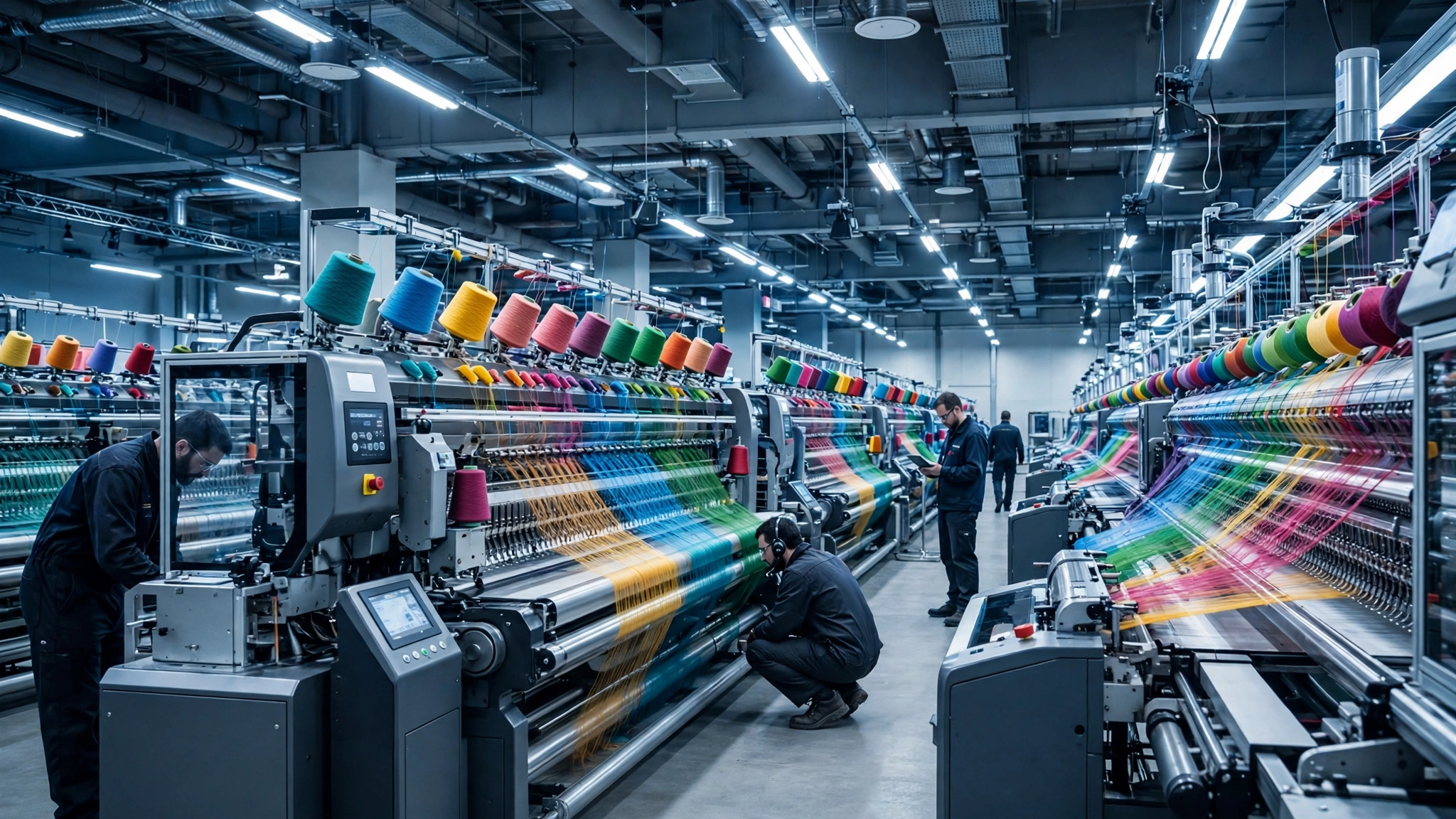
The textile machinery industry gathers in Shanghai for ITMA ASIA + CITME 2026, running from 20 to 24 November at the National Exhibition and Convention Center (NECC). Trade visitor pre-registration closes on 19 November. This preview brings together the exhibitor announcements published between 20 October and 9 November, checks each claim against what can be verified on the show floor, and sets out what buyers should ask before treating any launch as a purchasing decision.
At a glance
- Dates: 20–24 November 2026, National Exhibition and Convention Center (NECC), Shanghai
- Scale: Seven halls, about 180,000 square metres of gross exhibition area, expanded by 10% over the last edition, according to the organisers’ release of 31 July 2026
- Exhibitors: More than 1,800 companies had applied to take part, of which almost 90% are from China
- Pre-registration: Trade visitor pre-registration remains open until 19 November 2026, with a 40% discount on early-bird admission tickets, according to the organisers’ release of 31 July 2026
- Previous edition: The 2024 edition attracted more than 90,000 visitors from 111 countries and regions
- New sectors this edition: Equipment for textile-reinforced composites, textile recycling technologies, digital platforms and automation, plus a Research and Innovation sector
Weaving: Picanol gives AirOne its world premiere
The most prominent single launch of the show is Picanol’s AirOne, a new generation of airjet weaving machines for basic woven fabric production — a segment its existing airjet range had not previously addressed — shown to the world for the first time in Shanghai. It will stand alongside the established OmniPlus-i Connect.
At the Picanol booth — Hall 3, Booth F01 — three weaving machines will run live: the new AirOne weaving poplin, the OmniPlus-i Connect weaving ladieswear fabrics, and the Supermax weaving denim. The AirOne on display is the AirOne-4-E 190, set up for a cotton warp of Nm 54/1 and a polyester weft of 156f40 dtex, with features including a crank shedding motion, AirStream, EcoBoost, EcoWeft, WeavePilot and Twinjet.
Picanol says the machine combines high performance with low energy consumption and the most competitive cost per pick in its class. That cost-per-pick claim is the manufacturer’s own statement; no independent figure appears in the cited announcement, and buyers should ask what energy and air consumption figures sit behind it. Picanol will also demonstrate new AI-powered applications within PicConnect, its centralised digital platform for weaving mills, and five further Supermax machines will run at partner booths across the exhibition, weaving saree, shoe and label fabrics.
Spinning preparation and winding: productivity, waste recovery and AI
Two announcements address the front end of spinning, and they illustrate the two kinds of claim buyers will meet in Shanghai: a quantified productivity figure and a set of named digital functions.
Trützschler will exhibit in Hall 5.1, Booth D20. Its headline exhibit is the next-generation TC 30 card, which the company says can deliver up to 40% higher productivity in man-made fibre processing while maintaining or improving yarn quality. Its waste suction system separates different waste streams, and the company says more than 50% of card waste can be reused in higher-value applications, with integration to its WASTECONTROL system to prevent unnecessary fibre losses. Both figures are manufacturer claims. The 40% figure is at least testable — a mill can measure output and yarn quality on its own fibre — but this preview has not identified an independent test of it, and the announcement does not state the reference machine or fibre type used for the comparison.
Savio, part of the Vandewiele Group since 2021, will concentrate on automation, artificial intelligence and data connectivity in winding and spinning, with two platforms: the Proxima Smartconer winding machine and the Lybra Smartspinner air-jet spinning machine. The Proxima is available in several configurations, including fully automatic, manual feeding, cone-to-cone, Duo Lot and large bobbin feeding for the carded wool sector. Its named AI-driven functions include adaptive tension control, smart metering and intelligent bobbin flow management, supported by the Savio Insight web-based system for remote machine setup and real-time production monitoring.
The Lybra Smartspinner uses an original spinning technology aimed at knitting, home textiles and sunshades, with a Multi Blend System feeding two slivers directly into the spinning chamber for real-time blending. Savio states that this can streamline preparation lines and reduce processing costs — the manufacturer’s statement, not a measured result.
Knitting: a cheaper SES-R, seamless expansion and AI-assisted design
Knitting occupies Hall 4.1, where two of the largest exhibitors sit close together — Shima Seiki at Booth D11 and Santoni China Group at Booth C39 — and the two presentations point in different directions. Shima Seiki is widening access to an existing technology; Santoni is pushing design software further up the value chain.
Shima Seiki will show its latest R-generation machines under its continuing “Shima Seiki Reborn” concept. The centrepiece is the SES-R computerised flat knitting machine, with a newly developed sinker system for enhanced three-dimensional shaping. Alongside the existing SES-R, demonstrated in 14-gauge, the company will introduce a more economical SES-R Standard version in 16-gauge. Also on display is the N.SSR132, introduced at ITMA ASIA + CITME 2025 in Singapore and demonstrated here in 7-gauge with a 52-inch (132 cm) knitting width.
The company’s WHOLEGARMENT seamless knitting technology, in commercial use since 1995, will be represented by the MACH2XS153, demonstrated in 8-gauge, and the compact SWG061N2 Mini in 15-gauge. On the digital side, Shima Seiki will demonstrate APEXFiz 3D design software, which provides realistic fabric simulation and virtual sampling — a claimed saving mills can test against their own sampling costs, but for which no independent measurement appears in the cited announcement.
Santoni China Group will present under the theme “Machines Evolved · Intelligence Delivered” across its Santoni, Jingmei and Terrot brands. Its circular knitting line-up includes the Santoni INNOTAS-HS single jersey open-width machine, the Terrot UCC 672-ME mattress double electronic jacquard, and three Jingmei machines for double jersey, compound-needle single jersey and jacquard rib transfer. In seamless knitting, Santoni will show the TOP2 ST selective terry, the SM8 TR1S transfer machine for patented run-resistant mesh structures, and the TOP2 FAST fine-gauge machine, demonstrated with a collection of E40 seamless swimwear.
Santoni’s digital headline is SWS 3D, a next-generation AI-assisted design platform for seamless product development, offering three-dimensional visualisation and faster development iterations. As with other AI claims at this show, the verifiable part is the set of named functions; the productivity gain is a statement of intent, not a published measurement.
Components: Groz-Beckert covers six product areas
Groz-Beckert’s presentation in Hall 4.1, Booth D41, spans knitting, weaving, nonwovens, sewing, tufting and spinning. In circular knitting, the focus is the LCmax energy-saving needle, whose wave-shaped shank geometry is said to deliver energy efficiency, reduced friction and easy handling. Flat knitting brings two special-application needles: the SAN TT, designed for particularly tight loops in technical and medical textiles, and the new SAN FY, engineered for uneven effect yarns. Legwear presents the durable dur needles for sock and fine hosiery machines, and warp knitting presents the patented compound needle Spec. 51/43.36 G 101 for fine-gauge elastic fabrics. The company will also introduce an AI-powered WeChat chatbot for knitting customers in China.
In weaving, the focus is on PCB and glass fibre weaving. Nonwovens brings the Litespeed felting needle and the newly developed CB-Barb felting needle. Sewing highlights include the SAN 5.2 for technical textiles such as airbags and the SAN 6 for woven fabrics such as denim, while spinning introduces a new energy-saving, maintenance-free cylinder wire.
Finishing: Brückner bets on heat recovery
Brückner will exhibit in Hall 8.1, Booth C46, with a presentation built around a single argument: that sustainability and profitability can go together in textile finishing. The focus is its heat recovery and exhaust air purification systems, which recover energy from production processes, reduce overall energy demand and help manufacturers comply with environmental regulations. The latest generation of its POWER-FRAME stenter combines optimised airflow systems, efficient burner technology, intelligent control and automation, and energy-saving packages.
Notably, the announcement gives no quantified energy saving — no percentage, no kilowatt-hour figure and no baseline. A buyer comparing stenters cannot use it to rank Brückner against competitors; the comparison can only happen at the booth, by asking for measured consumption figures under stated conditions. Sales Director Alexander Mandel will attend the show in person, according to the announcement.
Testing and standards: AATCC brings the laboratory to the floor
The American Association of Textile Chemists and Colorists (AATCC) will exhibit in Hall 6.1, Stand A25, with interactive displays and tools supporting textile quality and performance evaluation, including colour evaluation scales, lightfastness testing materials and details on evaluating water resistance and repellency.
AATCC’s presence is a useful counterweight to the machinery launches: every performance claim made elsewhere in the halls ultimately has to be expressed in a test result, and the association’s stand is where buyers can check which test method applies before they accept a supplier’s figure.
Three threads to watch: what is verifiable and what is only claimed
Read together, the eight announcements repeat three themes — AI and automation, energy saving, and recycling and circularity. The themes are real, but the evidence behind them is not equal. That gap is the most useful thing a buyer can take into this show.
AI and automation are genuine exhibits, but the word “AI” is doing too much work. The verifiable part is a set of named functions that can be demonstrated live: Picanol’s AI applications inside PicConnect, Savio’s adaptive tension control and intelligent bobbin flow management, Santoni’s SWS 3D visualisation platform, Groz-Beckert’s WeChat chatbot. Each is a specific feature with a specific job. The weaker part is the label itself: several announcements use “AI-driven” or “AI-powered” as a headline adjective without saying what model, data or decision logic is involved. The test for a buyer is simple: ask to see the system make a decision on live production data at the booth.
Energy saving claims need a different test from productivity claims. Higher output per hour is not the same as lower energy per kilogram: a faster machine can consume more energy in total while using less per unit, or use less per unit only at a stated speed and fabric. Trützschler’s TC 30 figure — up to 40% higher productivity in man-made fibre processing — is a productivity claim, not an energy claim, and it should not be read as evidence of energy saving. It is at least testable, because a mill can measure output and yarn quality on its own fibre, but it says nothing about kilowatt-hours per kilogram until the energy is measured alongside the output. The energy tier that can be inspected is Groz-Beckert’s LCmax needle, whose wave-shaped shank is a physical design a buyer can examine and trial — though the announcement gives no published energy figure for it either. The weaker tier offers no number at all: Brückner’s announcement says its stenter “significantly” reduces energy consumption without giving a percentage, a baseline or a test condition.
Recycling and circularity are the weakest thread. Picanol describes the Supermax as “recycled yarn ready” and Trützschler says more than 50% of card waste can be reused in higher-value applications. Both are manufacturer statements with no published third-party verification. Contrast that with the standard of evidence in research: Liu et al., “Selective depolymerization of poly(ethylene terephthalate) for economical closed-loop recycling of mixed textiles” (Nature Communications, 7 November 2026), reports two separate laboratory results, presented as Figure 3 and Figure 4 in the paper. In the first experiment (Figure 3, panel e), a laboratory blend of commercial fabrics mixed to mimic post-consumer waste composition (PET 52%, cotton 24%, nylon 5%, PU 1%) yielded DMT at 91% recovery and 99.97% purity by HPLC after methanolysis, distillation and recrystallisation. In the second (Figure 4, panel d), a blind sample of industrially collected post-consumer textile waste yielded DMT at 99.92% purity by HPLC, with no yield reported for that sample. The paper’s abstract summarises the headline as above 99.92% purity at 91% yield; that combines the two experiments, so this article keeps each figure with the experiment that produced it. Purity is one measure only: it does not by itself establish recovery yield, process economics, commercial scalability or lifecycle impact, so the two results must not be combined into a single claim. That is what a verifiable result looks like — a named method, a measured result and an explicit limit — and it is still a laboratory result, not proof of industrial circularity. Our report on the study sets out the same distinction.
Finally, the timing matters. The announcements reviewed here were published between 20 October and 9 November 2026. The exhibition opens on 20 November, providing an opportunity to test the announced claims against running machinery.
What to ask on the show floor
A preview is only useful if it changes what a buyer does at the exhibition. Six questions cover most of the gap between announcement and evidence:
- For any productivity figure: which machine was the comparison against, on which fibre, and at what quality level? Trützschler’s 40% figure for the TC 30 needs all three answers.
- For any energy claim: what was measured, in kilowatt-hours per kilogram or per metre, and under what production conditions? Brückner’s stenter and Picanol’s AirOne both need this question. A bare kWh figure is not enough: ask for the measurement boundary — comparable machine configurations, the same fabric specification and output quality, the production speed, and whether auxiliary energy is included, notably compressed-air consumption for airjet weaving, heating and exhaust treatment. Without a stated boundary, two machines’ figures cannot be compared.
- For any AI function: can it be seen deciding on live data at the booth, or is the demonstration a recorded video? The answer separates a working system from a marketing label. Then ask what production data the system uses and what decision logic it applies, who holds decision authority when it acts, whether an operator can override it, what its error rate is, whether its decisions are traceable, and how it performs when fibre, speed or humidity change.
- For any recycling claim: what proportion of the input is recovered, at what purity, and who verified it? “Recycled yarn ready” is a compatibility statement, not a recycling result.
- For any cost claim: is the figure a measured production cost, a modelled cost or a list price? The distinction matters: a modelled cost is not a price anyone is paying today.
- For any purchase decision: what acceptance testing is agreed before the order is signed? Ask for factory and site acceptance tests (FAT/SAT) against measurable criteria, agreed production samples, quality tolerances, installation responsibility, commissioning, operator training, spare-parts supply, warranty terms and the remedies — price adjustment, rework or rejection — if guaranteed performance is not met.
Trade visitor pre-registration remains open until 19 November, with a 40% discount on early-bird admission tickets according to the organisers, and the seven halls are organised by production process, so a visitor can plan a route by segment — weaving in Hall 3, knitting and components in Hall 4.1, spinning preparation in Hall 5.1, testing in Hall 6.1, finishing in Hall 8.1. And for context on the demand side, United States apparel imports fell 8.1% in volume in the first nine months of 2026, a reminder that machinery investment decisions are being made in a contracting import market, not a growing one.
FAQ
When and where is ITMA ASIA + CITME 2026?
The exhibition runs from 20 to 24 November 2026 at the National Exhibition and Convention Center (NECC) in Shanghai, across seven halls. Trade visitor pre-registration remains open until 19 November 2026, according to the organisers.
What is the headline launch of the show?
Picanol’s AirOne, a new generation of airjet weaving machines for basic woven fabrics, receives its world premiere at the show. It will be demonstrated weaving poplin at Hall 3, Booth F01, alongside the OmniPlus-i Connect and the Supermax weaving denim.
Which exhibitors are showing AI-driven machinery?
Several. Picanol is demonstrating AI-powered applications in its PicConnect platform, Savio’s Proxima Smartconer includes adaptive tension control and intelligent bobbin flow management, Santoni is launching the SWS 3D AI-assisted design platform, and Groz-Beckert is introducing an AI-powered WeChat chatbot. Buyers should ask to see each system working on live data rather than accepting the label alone.
Are the energy saving and recycling claims independently verified?
The cited announcements present these as manufacturer claims; this preview has not identified independent comparative test results for them. The figures quoted — such as up to 40% higher productivity for the Trützschler TC 30 and more than 50% reuse of card waste — are manufacturer statements, including figures published in Trützschler’s official announcement and repeated in trade-media reports, and the Brückner announcement gives no quantified saving at all. An official manufacturer announcement establishes attribution — who said the figure — not independent validation. Treat all such claims as questions to put to the exhibitor, not as established facts. Trade-media repetition of a manufacturer figure is not independent technical validation.
How should buyers validate machinery performance claims?
Separate productivity from energy efficiency: a faster machine is not automatically a more energy-efficient one. Ask for the measurement in kilowatt-hours per kilogram or per metre, the boundary it covers (including compressed air and auxiliary energy), the fabric and speed it was measured at, and the reference machine it was compared with. Then agree acceptance testing — factory and site acceptance tests against measurable criteria, with samples, tolerances and remedies written into the order — so the claim is tested on the buyer’s own material before it becomes a purchasing decision.
How does this show connect to textile innovation elsewhere?
The week before ITMA opens, the first TIE-ITET Textile Innovation Expo closed in Dhaka, where — as our report on the closing ceremony records — the Best Innovation Award went to three smart textile research projects. Dhaka showcased university research; Shanghai showcases the production machinery that would have to make such products at scale.
Sources
- ITMA ASIA + CITME 2026 organisers (CEMATEX, CCPIT TEX, CTMA & CIEC), “ITMA ASIA + CITME 2026 Shanghai Showcases Intelligent and Sustainable Manufacturing”, press release, 31 July 2026. https://www.itmaasia.com/shanghai2026/contents/1272/670.html
- Indian Textile Journal, “Picanol to showcase innovations at ITMA ASIA + CITME 2026 in Shanghai”, 30 October 2026. https://indiantextilejournal.com/picanol-to-showcase-innovations-at-itma-asia-citme-2026-in-shanghai/
- Picanol (official), “Visit Picanol at ITMA ASIA + CITME to experience the world premiere of the brand-new AirOne weaving machine” — original manufacturer source for the AirOne debut, booth F01 in Hall 3, the three live machines and the PicConnect AI applications (accessed 15 November 2026; no publication date shown on the page). https://www.picanol.be/en/news/visit-picanol-itma-asia-citme-experience-world-premiere-brand-new-airone-weaving-machine
- Indian Textile Journal, “Groz-Beckert to showcase multi-sector innovations at ITMA ASIA + CITME 2026”, 3 November 2026. https://indiantextilejournal.com/groz-beckert-to-showcase-multi-sector-innovations-at-itma-asia-citme-2026/
- TEXtalks, “Trützschler to showcase high-productivity carding, spinning automation and nonwoven technologies at ITMA Asia 2026”, undated (no publication date shown on the page; read 15 November 2026). https://textalks.com/trutzschler-to-showcase-high-productivity-carding-spinning-automation-and-nonwoven-technologies-at-itma-asia-2026/
- Trützschler Group (official blog), “Meet Trützschler at ITMA Asia 2026: Innovations for efficient and intelligent fiber processing”, 22 October 2026 — original manufacturer source for the TC 30 productivity and waste-reuse figures and the T-CAN, STEELTOP and SUPERFLOW exhibits. https://blog.truetzschler.com/2026/10/22/meet-trutzschler-at-itma-asia-2026-innovations-for-efficient-and-intelligent-fiber-processing/
- Textile Technology, “Savio brings Proxima and Lybra to ITMA Asia 2026”, 5 November 2026 (page updated 9 November 2026). https://www.textiletechnology.net/news/savio-showcases-ai-driven-winding-and-spinning-at-itma-asia-citme-439748
- Knitting Industry, “Shima Seiki to unveil new knitting solutions in Shanghai”, 20 October 2026. https://knittingindustry.com/shima-seiki-to-unveil-new-knitting-solutions-in-shanghai/
- Textile Value Chain, “Santoni China Group to Showcase Advanced Knitting Machinery and AI-Powered Solutions at ITMA ASIA + CITME 2026”, 3 November 2026. https://textilevaluechain.in/santoni-china-group-to-showcase-advanced-knitting-machinery-and-ai-powered-solutions-at-itma-asia–citme-2026
- Textile World, “Brückner Showcases Sustainable Technologies For The Future Of Textile Finishing At ITMA ASIA 2026”, 9 November 2026. https://www.textileworld.com/textile-world/2026/11/bruckner-showcases-sustainable-technologies-for-the-future-of-textile-finishing-at-itma-asia-2026/
- Textile World, “AATCC Builds Global Textile Marketplace Presence”, posted 7 November 2026. https://www.textileworld.com/textile-world/2026/11/aatcc-builds-global-textile-marketplace-presence/
- Liu, C., Wang, J., Wan, H., et al., “Selective depolymerization of poly(ethylene terephthalate) for economical closed-loop recycling of mixed textiles”, Nature Communications (2026), published 7 November 2026, DOI: 10.1038/s41467-026-78713-4 — original research paper for the DMT purity and yield figures: 91% recovery and 99.97% HPLC purity from the laboratory blend experiment (the paper’s Figure 3, panel e), 99.92% HPLC purity from the blind sample of industrially collected post-consumer textile waste (the paper’s Figure 4, panel d; no yield reported for that sample). All three figures checked against the paper’s full text; the abstract’s combined headline (above 99.92% purity at 91% yield) summarises the two experiments and is not treated here as a single result. https://www.nature.com/articles/s41467-026-78713-4
- WEFTSIGNAL internal links verified live on 15 November 2026: TIE-ITET 2026 Textile Innovation Expo: Final-Day Award, Mixed Textile Waste Yields 99.92% Pure DMT from Blind Sample, US Apparel Imports Fall 8.1% in Volume in Jan–Sep 2026.
Source note: where an exhibitor’s own announcement was available (Picanol, Trützschler), it is cited alongside the trade-media report. Other exhibitor claims rest on trade-media reports of the exhibitor announcements, as listed; machine specifications for the AirOne-4-E 190 are from the Indian Textile Journal report, not the Picanol page. The TEXtalks Trützschler report is undated on its own page; the underlying manufacturer announcement is dated 22 October 2026.
Illustrative image note: the featured image for this preview is AI-generated editorial artwork. It is not a photograph of ITMA ASIA + CITME 2026, the exhibition venue or the actual machines described.
