
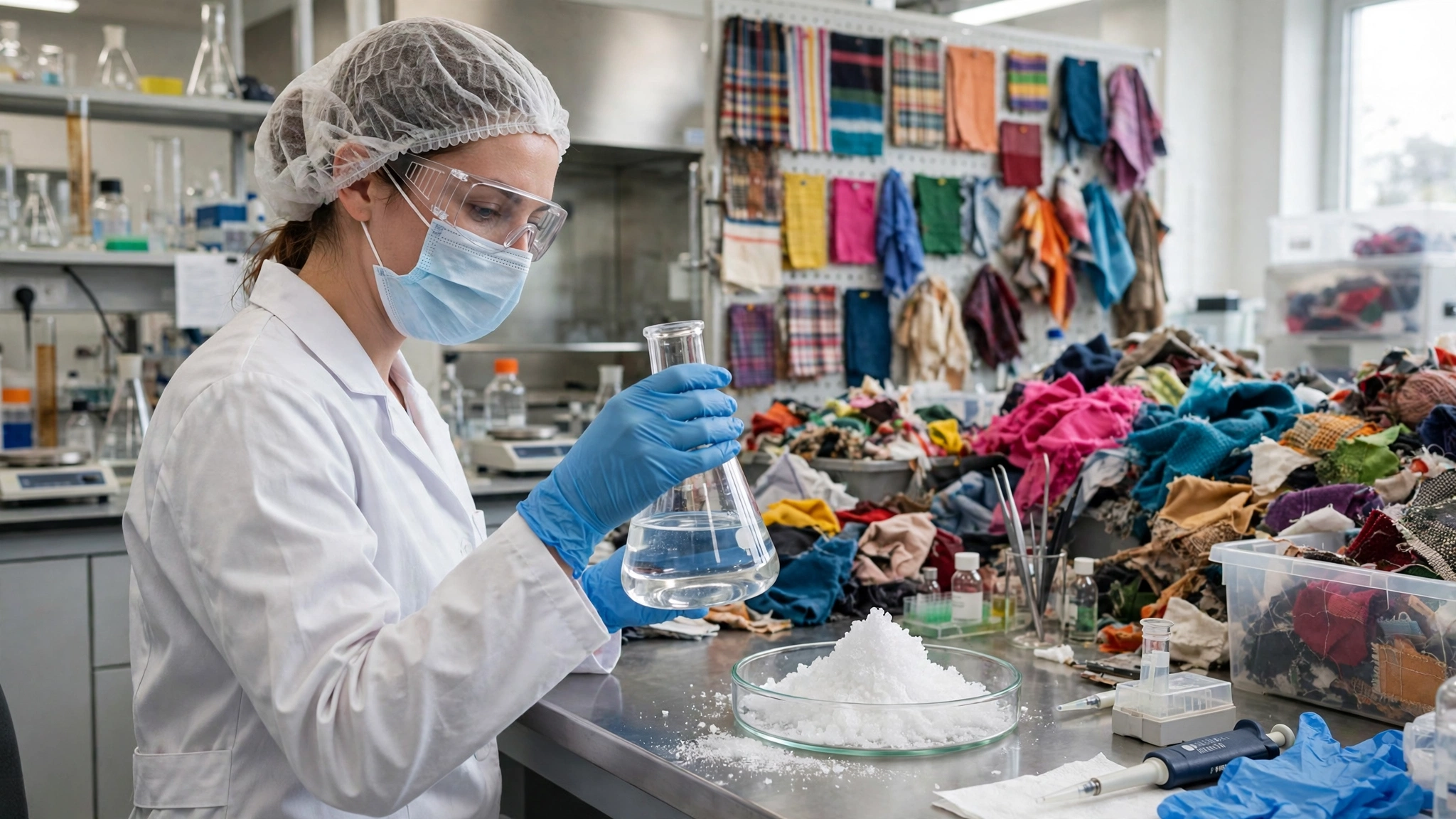
A team at Zhejiang University, working with Qingdao University, has reported a chemical recycling process that turns mixed textile waste into high-purity monomer for new polyester. The study, published in Nature Communications on 7 November 2026, recovers dimethyl terephthalate (DMT) — the monomer used to make PET polyester — at 99.92% purity from a blind sample of industrially collected post-consumer textile waste, and at a 91% yield with 99.97% purity in a parallel process using a laboratory-made blend.
The two headline numbers must not be combined. The paper reports no yield figure at all for the blind-sample process: the 91% yield belongs only to the parallel process on the laboratory-made blend. This article keeps purity and yield separate throughout for that reason.
The result matters, but it needs careful reading. This is a laboratory study, not a commercial plant. The cost conclusion comes from a techno-economic model, not from a market price. This article explains what the researchers actually did, why mixed textiles are hard to recycle, and what buyers should ask suppliers before treating any chemical recycling claim as a sourcing option.
What the researchers actually did
The paper, “Selective depolymerization of poly(ethylene terephthalate) for economical closed-loop recycling of mixed textiles”, was published online in Nature Communications on 7 November 2026 (received 2 June 2026, accepted 23 September 2026; DOI: 10.1038/s41467-026-78713-4). The authors are Cheng Liu, Jian Wang, Hong Wan, Lilong Gao, Haomiao Zhang, Bogeng Li, Ning Zheng and Tao Xie, from the State Key Laboratory of Chemical Engineering and Low-carbon Technology at Zhejiang University and the College of Material Science and Engineering at Qingdao University. Ning Zheng and Tao Xie are the corresponding authors. The work was funded by the National Natural Science Foundation of China and a Ministry of Education programme, and the authors declare no competing interests. The online version is an early-shared accepted manuscript that will be replaced by the final Version of Record; the figures quoted here are from that version.
The process has two stages. First, mixed textiles are thermally treated: melted, quenched in ambient water, and ground into a powder. This step reduces the crystallinity of the PET fibres, which is what makes the chemistry that follows possible. Second, the powder is subjected to methanolysis — depolymerisation in methanol — using the organic base catalyst TMG (1,1,3,3-tetramethylguanidine) under mild conditions: 100 mg of TMG and 5 mL of methanol per gram of PET, at 100 °C for one hour.
The team demonstrated two variants:
- Process I, with pre-separation. Solvent extraction (with DMF) first removes polyurethane and most dyes. Methanolysis then converts the PET to DMT, which is purified by distillation and recrystallisation. Cotton is recovered separately as cellulose pulp. The feedstock was a laboratory-made blend of commercial fabrics designed to mimic the composition of post-consumer mixed textile waste — PET 52%, cotton 24%, nylon 5%, polyurethane 1% — based on global production shares (a 2025 market report cited in the paper suggests slightly different shares: PET 59%, cotton 19%, nylon 5%, polyurethane 1%). In this process, DMT was recovered at a 91% yield with 99.97% purity by HPLC analysis.
- Process II, without pre-separation. A blind sample of industrially collected post-consumer textile waste — its composition unknown to the researchers — was shredded, melt-processed, water-quenched and milled to a 300–450 micrometre powder, then put directly through methanolysis with no separation step. Insoluble solids were filtered off, the filtrate was washed and dried, and vacuum distillation followed by recrystallisation yielded DMT at 99.92% purity by HPLC. The paper reports the purity for this process but no yield figure.
The distinction matters. The abstract’s headline figures — purity of at least 99.92% at a yield of 91% — combine the two processes. The 91% yield belongs to Process I; the 99.92% purity belongs to the blind sample in Process II; and no yield is reported for Process II at all. Reporting the two figures as a single experiment would overstate what either experiment showed.
Why mixed textiles are hard to recycle
The paper puts the scale in context: discarded textiles amount to about 92 million tonnes a year, and PET is the second most consumed polymer in the world, at more than 70 million tonnes a year, behind only polyolefins. Most of that PET in textiles is blended with cotton, nylon, polyurethane, dyes and finishes. Mechanical recycling cannot handle such mixtures, and chemical depolymerisation has historically struggled with them too: harsh conditions degrade several components at once, producing a complex mixture that is expensive to separate and purify.
Traditional methanolysis illustrates the problem. It typically requires high temperatures (around 280–310 °C) and high pressures (around 4 MPa), according to a 2024 review in Industrial Chemistry & Materials — conditions under which most components in a mixed textile would break down together. The Zhejiang team’s contribution is to make methanolysis selective at mild conditions: the low-activity TMG catalyst, combined with the reduction in PET crystallinity from the thermal pretreatment, depolymerises PET while leaving the other fibres largely untouched.
The selectivity figures are striking. Under identical conditions (100 °C, one hour), PET lost 99.4% of its mass, while polyurethane, cotton, nylon, wool, linen, polyacrylonitrile and silk remained mostly undegraded. Polyurethane lost only 5.7% of its mass — a small loss, but a loss, not zero: the other components are not all chemically untouched. That selectivity is what makes Process II possible: because the non-PET components stay largely solid, they can be separated by filtration rather than by expensive solvent separation. Filtration, however, only separates insoluble residues. It does not establish that every non-PET component remains chemically unchanged, or that those residues are recovered as usable materials. Dyes and additives, and the fraction of polyurethane that does degrade, still have to go somewhere — a waste-management question the paper addresses separately, as discussed below.
For the wider context of how textile-to-textile recycling works and where it stands, see our textile-to-textile recycling explainer. The chemical data problem that limits recycling at scale is also the subject of our report on the ZDHC circularity summit.
What 99.92% purity and 91% yield really mean
DMT and terephthalic acid (TPA) are alternative terephthalate feedstocks for producing PET polyester. Each can be reacted with ethylene glycol using a different production route. To make new polyester fibre from recycled monomer, the monomer must reach polymerisation-grade purity. The paper itself sets that bar: recycled PET monomers must achieve polymerisation-grade purity of at least 99.9%. That threshold is the reason the purity figure matters more than it might appear: earlier routes produced BHET (the glycolysis product) at only 98% purity after recrystallisation, and activated-carbon purification reached 99.7% — both below the threshold, according to work cited in the paper. A purity of 99.92% clears the paper’s threshold; 99.97% clears it with margin.
But HPLC purity alone does not establish polymerisation suitability. Whether the monomer can actually be repolymerised also depends on its impurity profile and on the specifications of the repolymerisation process. The paper calls its own recovered DMT polymerisation-grade; that description is the authors’, and it rests on the purity figures reported, not on a demonstrated repolymerisation run. A 99.92% HPLC purity figure should therefore not be read as proof of industrial-grade suitability on its own.
The 91% yield is the proportion of DMT recovered from the PET in the feedstock in Process I. It is a laboratory yield on a prepared blend, not a plant-wide recovery rate, and it does not include the PET that may be lost in the thermal pretreatment or in handling. That is normal for a study at this stage, but it means the figure should not be quoted as the efficiency of a commercial recycling line. And it must never be quoted as the yield of the blind sample: the paper reports no yield figure for Process II, so the yield of the blind-sample process is unknown, not 91%.
The term “polymerisation-grade” is used in the paper itself for the recovered DMT. Ecotextile’s report of the study, published on 9 November 2026, describes the product as polymerisation-grade polyester monomer at a cost “well below the market price of virgin monomer”. Only the headline and summary of the Ecotextile report were readable for this article — the full text sits behind a subscription wall — so the cost claim is assessed here against the paper’s own techno-economic analysis, not against the trade report’s wording.
The cost claim: model, not market price
The paper’s techno-economic analysis models a plant producing 150,000 tonnes of DMT a year. On that basis, the recovery cost of recycled DMT is $835–1,123 per tonne, against a commercial price of $1,530–1,878 per tonne for virgin DMT. When the methanol recovered during repolymerisation is taken into account, the adjusted cost falls further to $743–1,022 per tonne, which the authors describe as competitive with petroleum-based TPA at $890–1,106 per tonne.
Three qualifications belong with those numbers. First, they are model outputs, not prices at which anyone is selling DMT today. No DMT is on the market at this process’s modelled cost, because no plant using this process exists. Second, the analysis assumes a 150,000-tonne annual scale; costs at pilot scale would be higher. Third, the economics are not uniformly favourable: the cotton recovered as cellulose pulp costs $1,048–1,301 per tonne to produce, against a market price of $1,100–1,300 per tonne — little to no profit margin. Energy use is dominated by distillation to recover solvents (29.3% of energy in pretreatment, 35.0% in purification), while the depolymerisation step itself accounts for only 6.0%. The catalyst is recovered at 95% by distillation, and the solvents are recoverable too — but reducing solvent use would cut costs further, the authors note.
The remaining polyurethane, dyes and additives are technically recyclable, the paper says, but doing so would require large amounts of solvent and is economically unattractive; because they make up only small percentages of the feedstock, incineration may be the most economical way to treat them. That is an honest limitation, and it should be part of any assessment: the process recovers PET and cotton, not everything in the waste stream.
For buyers, the practical conclusion is that “cheaper than virgin” is a modelled result at industrial scale, not a quotation. The right question to a supplier is not “is your recycled DMT cheaper?” but “at what scale, with what feedstock, and with what third-party verification?”
What is still missing before buyers can buy it
Several gaps separate this study from a purchasable recycled polyester:
- Scale. The work is laboratory-scale. No pilot plant, demonstration plant or commercial facility using this process has been reported.
- Repolymerisation proof. The paper establishes monomer purity, but the recovered DMT has not yet been shown in this study to be spun into fibre at commercial quality. Purity is necessary for repolymerisation, not sufficient proof of it.
- Feedstock variability. The blind sample is a single sample. Real waste streams vary by season, region and collection route, and the process has not been shown across that variability.
- Full energy and waste accounting. Solvent recovery dominates energy use. A full life-cycle assessment has not been published for this process.
- Certification and traceability. This article found no published certification assessment or documented chain-of-custody arrangement for material from this process. That is a statement about what has been published, not a claim that certification is impossible or unavailable: whether a scheme such as GRS or RCS could assess such material depends on the material, the process and the scheme’s requirements.
None of this diminishes the study. It is a genuine advance in selectivity and in cost modelling. But the distance between a laboratory result and a purchase order is measured in years and in pilot plants, and buyers should plan on that basis. Our report on Syre’s Vietnam recycling plant shows the other side of the same story: even a well-funded commercial recycling project can struggle to secure enough feedstock, which is a reminder that the bottleneck in textile recycling is often supply, not chemistry.
How this compares with other chemical recycling routes
The stages and notes in the table below are summaries drawn from the paper’s own discussion of prior work and from the trade and academic coverage cited in the Sources. They are not measurements from this study.
| Route | Product | Stage | Note |
|---|---|---|---|
| Methanolysis (this study) | DMT, ≥99.92% purity | Laboratory | Selective at 100 °C with TMG catalyst; blind-sample validated (purity 99.92%; yield for the blind sample not reported — the 91% yield is Process I only) |
| Glycolysis | BHET | Laboratory to pilot | BHET is hard to purify; recrystallisation reached only 98% in work cited in the paper |
| Enzymatic depolymerisation | TPA and ethylene glycol | Laboratory to pilot | Selective in principle, but slow and sensitive to feedstock |
| Acid hydrolysis (concentrated HCl) | Glucose + polyester monomer | Demonstration plant reported as planned for 2026 | Separates cotton and polyester; yields and plant details as reported in October 2026 coverage (not independently verified for this article) |
| Acetolysis (NLR/Tereform) | Mixed monomers | Laboratory | Platform reported at ACS autumn 2026 meeting |
The comparison shows that high-purity monomer from mixed waste is not unique to this study. Zhejiang Jiaren New Materials, a Chinese recycler unrelated to the Zhejiang University team, produces recycled DMT at 99.9% purity from waste textiles at commercial scale — its Paojiang base processes about 40,000 tonnes of waste textiles a year — according to a trade-press report on the company. That is a different process and a different feedstock stream from the study, and the two should not be confused: Jiaren’s material is produced from its own established waste-textile supply, not from the unknown mixed waste in the study’s blind sample. What is new here is achieving that purity from an unknown mixed waste sample without pre-separation, at mild conditions, with a cost model that competes with virgin monomer. That is a narrower claim than “chemical recycling is solved”, and a more credible one.
What buyers should ask suppliers now
- Was the purity measured on a known sample or on unknown mixed waste? A figure from a prepared blend and a figure from a blind sample are not comparable — and ask what yield was reported for the sample in question, since purity without yield is only half the result.
- What is the purity test method, and which laboratory performed it? Ask for HPLC or equivalent data, the method and calibration used, whether the laboratory is accredited to ISO/IEC 17025 for the relevant testing, and the chromatograms, impurity profiles and test reports behind the headline figure.
- What is the yield, and on what basis? Yield as a share of PET in the feedstock is the meaningful figure; a plant-wide recovery rate is a different number.
- What happens to the non-PET components? Cotton, polyurethane, dyes and finishes all have to go somewhere. Ask for the full mass balance, not just the monomer.
- Has the recovered monomer been repolymerised and spun? Purity data alone do not prove a fibre can be made.
- What is the energy and solvent footprint of the whole process? Distillation for solvent recovery dominates energy use in this study’s model; ask for a life-cycle assessment, not just a monomer price.
- What certification and traceability apply? This article found no published certification assessment for material from this process; do not put recycled-content claims on products based on laboratory data.
FAQ
Can mixed textile waste be chemically recycled?
Yes, in the laboratory. This study shows that mixed textile waste can be converted to high-purity DMT monomer by selective methanolysis after thermal pretreatment, without pre-sorting the components. The paper reports a laboratory demonstration; it does not report commercial deployment of this specific process.
What purity of DMT can be recovered from waste textiles?
In this study, 99.92% purity was achieved from a blind sample of industrially collected post-consumer waste, and 99.97% from a laboratory-made blend. Polymerisation-grade purity is at least 99.9%, according to the paper itself. The paper reports no yield figure for the blind-sample process; the 91% yield applies only to the laboratory-made blend.
Has the recovered DMT been turned into fibre?
Not in this study. The paper establishes monomer purity, but the recovered DMT has not been shown in this study to be repolymerised and spun into fibre at commercial quality. Purity is necessary for repolymerisation, not sufficient proof of it.
Is recycled DMT cheaper than virgin DMT?
In the study’s techno-economic model at 150,000 tonnes a year, recycled DMT costs $835–1,123 per tonne against a virgin commercial price of $1,530–1,878 per tonne. That is a modelled cost, not a market price — no plant using this process is selling DMT today.
What is methanolysis in textile recycling?
Methanolysis is a chemical recycling method that breaks PET polyester down into its monomer, DMT, using methanol. Traditional methanolysis needs high temperatures and pressures; this study achieves it at 100 °C using a TMG catalyst after a thermal pretreatment that reduces the PET’s crystallinity.
Sources
- Liu, C., Wang, J., Wan, H., et al. “Selective depolymerization of poly(ethylene terephthalate) for economical closed-loop recycling of mixed textiles.” Nature Communications (2026). Published 7 November 2026. https://www.nature.com/articles/s41467-026-78713-4
- DOI: https://doi.org/10.1038/s41467-026-78713-4
- Ecotextile News, “Mixed textile waste yields high-purity monomer”, 9 November 2026 (headline and summary only; full text behind a subscription wall). https://www.ecotextile.com/2026110967144/news/materials-production-news/mixed-textile-waste-yields-high-purity-monomer/
- Industrial Chemistry & Materials (Royal Society of Chemistry), review of PET chemical recycling conditions, 2024. https://pubs.rsc.org/en/content/articlehtml/2024/im/d4im00081a
- ADSALE Plastics Network, trade-press report on Zhejiang Jiaren New Materials (recycled DMT at 99.9% purity; publication date not verified). https://www.adsalecprj.com/en/news/article_details/90626.html
- WEFTSIGNAL, “Textile-to-Textile Recycling: How the Process Works and Where It Stands”, 29 October 2026. https://appareldispatch.online/textile-to-textile-recycling/
- WEFTSIGNAL, “Syre’s Vietnam Recycling Plant Faces a Feedstock Gap: What the Numbers Mean for Recycled Polyester Buyers”, 13 November 2026. https://appareldispatch.online/syre-vietnam-recycling-feedstock-gap-recycled-polyester/
- WEFTSIGNAL, “ZDHC Circularity Summit: Speakers Say Missing Chemical Data Is Holding Back Textile-to-Textile Recycling”, 10 November 2026. https://appareldispatch.online/textile-to-textile-recycling-chemical-data-zdhc-summit/
