
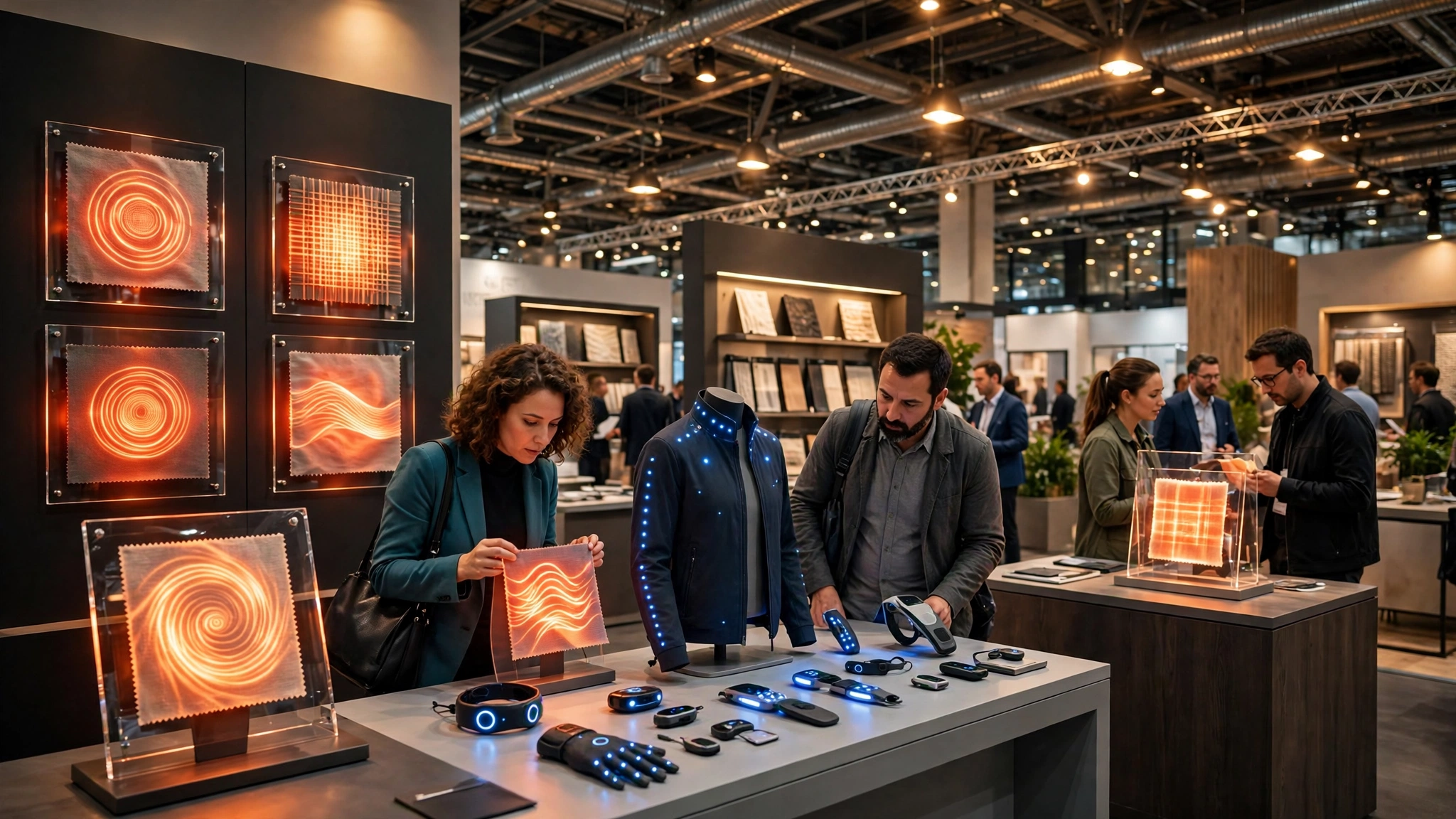
The first TIE-ITET Textile Innovation Expo 2026 reaches its final day in Dhaka today, 14 November, and its most concrete outcome so far is a single award. Textile Today reported on 12 November that the Best Innovation Award had gone to Dr. Md. Shamim Alam of the Department of Textile Engineering, Southeast University, Dhaka, for three smart textile projects — a self-charging heating textile, a foetal monitoring textile system, and a fluorine-free waterproof breathable textile — and published a follow-up report on the award on 14 November. The project names and their one-line descriptions in this article are as reported by Textile Today; no technical details beyond those descriptions have been published.
One clarification matters before anything else. The full winners’ list for the Textile Innovation Awards 2026 — the eight-category awards presented at the awards night on 13 November — had still not been published as of 16:00 on 14 November. The Best Innovation Award and the eight-category awards are two different selections, and this article does not present the first as the second.
At a glance
- Expo: TIE-ITET Textile Innovation Expo 2026 (first edition), 12–14 November, International Convention City Bashundhara (ICCB), Dhaka; exhibition in Hall 8.
- Awards night: Textile Innovation Awards 2026, 13 November, 18:30–20:30, Hall 5, ICCB. Eight categories. Full winners’ list not yet published as of 14 November 16:00.
- Best Innovation Award: Dr. Md. Shamim Alam, Department of Textile Engineering, Southeast University, Dhaka — for ThermoTex, FeMats and FLUOROVA, as reported by Textile Today. Announced 12 November at the Open Innovation Zone.
- Open Innovation Zone: organised by Centro; about 60 applications nationwide, 18 projects selected to exhibit.
- Still to come: the eight-category winners’ list and the official closing summary.
The award and the three winning projects
The Best Innovation Award was announced on 12 November at the Open Innovation Zone, an event held in Hall 8 (Expo Village) and organised by Centro. Textile Today reported the announcement the same evening, and published a follow-up report on the award at noon on 14 November.
The three winning projects, as named in Textile Today’s reports, are:
ThermoTex: a self-charging smart heating textile
ThermoTex is described in the reports as a self-charging smart heating textile. No technical details have been published about how the self-charging mechanism works, what power it delivers, how long it operates, or how it performs after washing. Those questions remain open, and any buyer evaluating the technology should ask for them before treating it as a production-ready product.
FeMats: a foetal monitoring and smart textile system
FeMats is described in the reports as a foetal monitoring and smart textile system. Again, only the name and a one-line definition have been published. Its monitoring accuracy, clinical validation status and intended users have not been disclosed in any public source found so far.
FLUOROVA: a sustainable fluorine-free waterproof and breathable textile
FLUOROVA is described in the reports as a sustainable fluorine-free waterproof and breathable textile. No chemical route, performance figures (such as water pressure or moisture vapour transmission) or test standards have been published for it. What can be said is that the direction of travel is significant: fluorine-free waterproof breathable fabrics are exactly the category buyers are being pushed toward as PFAS restrictions tighten in the European Union. Our PFAS-free waterproof breathable fabrics guide sets out the rules, membrane options and finishes buyers need to understand before specifying such fabrics — but its general guidance should not be read as measured performance data for FLUOROVA itself.
The honest summary is that the award recognises three research directions, not three finished products. That is normal for a university research award, and it is the reason this article keeps each project to its reported definition rather than expanding into specifications that have not been published.
The Open Innovation Zone: 60 applications, 18 projects
The Open Innovation Zone, organised by Centro Tex Limited, invited innovation proposals from across Bangladesh. About 60 applications were received, and a judging panel mentored and selected 18 projects to exhibit at the expo. All 18 innovators received participation certificates.
The judging panel was Prof. Dr. Md. Reajul Islam of the Bangladesh University of Textiles (BUTEX), Jaidur Rahman, assistant general manager at Centro Tex Limited, and Abdullah Al Mahmud, managing director of Dysin Group. Guests at the event included Tareq Amin, member secretary of the Textile Innovation Exchange; Fazlee Shamim Ehsan, president of the Bangladesh Employers’ Federation; Nafis-Ud-Doula, a director of BGMEA and of Impress-Newtex Composite Textiles Ltd.; Engr. Abdus Sobhan, managing director of Aukotex Group; and Nicolas Anton, chief operating officer of Centro Tex Limited.
According to the judging panel, the 18 projects covered wearable textiles, alternative yarns to cotton, and industrial automation equipment. That mix is itself a signal: the innovation on show was weighted toward technical textiles and production technology rather than conventional apparel manufacturing.
One remark from the event deserves attention. Abdullah Al Mahmud said publicly that the top winners should receive funding and sponsorships so their work can reach industrial scale. In other words, the award as announced carried no published commercialisation route. For buyers and factory managers, that is the practical gap to watch: an award is not a supply agreement, and the path from a prize to a trial order still needs funding, pilot production and certification.
The selection funnel — about 60 applications to 18 projects, roughly a 30% acceptance rate — describes this event’s application process only. It is not a measure of Bangladesh’s national innovation capacity, and it should not be read as one: 18 projects from a single event cannot establish an industry-wide direction.
Two awards, not one
English-language coverage of the expo has so far treated the awards as a single story. They are not. The table below separates them. Details of the eight-category programme — organiser, presenting entity, categories, criteria and jury — are as published on the official awards page; that page describes the programme by its eight innovation areas, and this article does not assert any eligibility restriction beyond what the page publishes.
| Best Innovation Award | Textile Innovation Awards 2026 | |
|---|---|---|
| Presented at | Open Innovation Zone event, 12 November, Hall 8 (per Textile Today’s report) | Awards night, 13 November, 18:30–20:30, Hall 5 (per the official awards page) |
| Organised by | Centro, within the expo’s Open Innovation Zone | Textile Innovation Exchange, presented by Dongyi Sourcing Limited (per the official awards page) |
| Who competes | Researchers and innovators submitting proposals (about 60 applications, per Textile Today’s report) | Entrants across eight innovation areas (per the official awards page) |
| Winner | Dr. Md. Shamim Alam, Southeast University — one researcher, three projects | Not yet published in full |
| Status as of 14 November 16:00 | Announced and confirmed in Textile Today’s reports | Full winners’ list not yet published |
The eight areas of innovation run from process and manufacturing through technology, product development, marketing and market development, environmental sustainability and people development. The awards site states that not every area is awarded every year. The judging criteria are impact, scalability, creativity, sustainability and market relevance, and the jury was chaired by Prof. Dr. Engr. Ayub Nabi Khan, vice-chancellor of BGMEA University of Fashion & Technology (BUFT), according to the awards site’s jury list as of September 2026.
Readers searching for “Textile Innovation Awards 2026 winners” should therefore expect a partial answer for now: one award is confirmed, eight categories are not. This article will be followed up when the official list is published.
What it means for buyers
For a buying or production manager, the expo’s outcome is best read as a maturity checklist rather than a celebration. Three questions matter for each winning project:
- ThermoTex: has the heating performance been verified after repeated washing, and what power source and safety certification does it need before it can be specified in a garment?
- FeMats: has the monitoring system been validated in clinical settings, and which regulatory pathway would apply before it could be sold as a medical or wellness product?
- FLUOROVA: what are its measured waterproof and breathable performance figures, under which test standards, and at what cost relative to existing fluorine-free finishes?
None of those questions can be answered from the published reports today. That is not a criticism of the research — it is the normal distance between a university prototype and a factory trial. What the award does show is that at least some of Bangladesh’s university research is now aimed at exactly the areas where buyers face the most pressure: smart and functional textiles, and fluorine-free performance fabrics.
Before specifying any of the three technologies, a buyer should ask for the following evidence — and treat the absence of any item as a reason to wait, not as a detail to assume:
- Test reports that name the test method and standard used, not just a headline result.
- Sample-stage and repeatability data, including performance after washing where relevant.
- Evidence of production scalability — pilot runs, yield data and quality consistency, not a single laboratory sample.
- Regulatory responsibility stated in writing — who certifies the product, and under which pathway.
- Supplier documentation covering material composition, care and safety information.
The FLUOROVA angle connects directly to procurement. For buyers sourcing for markets where PFAS restrictions are tightening — notably the European Union, as set out in our PFAS-free guide — a domestic research project in fluorine-free waterproof breathable textiles is worth watching as a potential future source. But until performance data and pricing are published, FLUOROVA should be treated as a research signal, not a sourcing option.
More broadly, the expo itself was positioned as a showcase for Bangladesh’s shift from low-cost manufacturing toward higher-value, technology-led production. The preview published by this site before the event set out the format — four themed zones covering dyeing and printing, textile materials, garment automation, and green and sustainable technology — and the organiser’s pre-event expectations of about 50 factories, about 200 technology suppliers, about 5,000 visitors and about 100 brand buyers. Those were pre-event expectations, not confirmed results; the actual attendance figures have not been published. For the background to the event, see our TIE-ITET 2026 preview.
What is still to come
Three items remain unpublished as of 16:00 on 14 November:
- The full winners’ list for the eight categories of the Textile Innovation Awards 2026.
- The official closing summary for the expo, including confirmed attendance and exhibitor figures.
- Any technical detail on the three winning projects beyond their names and one-line definitions.
The expo’s final day included scheduled afternoon programming in Hall 8. The organisers listed the final closing time as 18:00 Dhaka time (20:00 Beijing time) on 14 November; that closing time had not yet been reached when this article was published. No closing summary had been published as of 16:00 on 14 November. This article is based on public information available up to 16:00 on 14 November and will be followed up when the official list is published.
FAQ
Who won the Best Innovation Award at TIE-ITET 2026?
Dr. Md. Shamim Alam of the Department of Textile Engineering at Southeast University, Dhaka, for three projects: ThermoTex (self-charging smart heating textile), FeMats (foetal monitoring and smart textile system) and FLUOROVA (sustainable fluorine-free waterproof and breathable textile). The award was announced on 12 November at the Open Innovation Zone, as reported by Textile Today.
What are ThermoTex, FeMats and FLUOROVA?
They are three university research projects recognised at the expo. Only their names and one-line definitions have been published; no performance data, test standards or commercialisation details have been disclosed yet.
Are the Best Innovation Award and the Textile Innovation Awards 2026 the same thing?
No. The Best Innovation Award is a single award presented in the Open Innovation Zone on 12 November to one researcher for three projects. The Textile Innovation Awards 2026 are a separate programme covering eight categories, presented at the awards night on 13 November; their full winners’ list had still not been published as of 16:00 on 14 November. The two should not be confused: the first is one confirmed result, the second is a wider programme whose results are still to come.
Have the Textile Innovation Awards 2026 winners been announced?
Only in part. The Best Innovation Award (a single award presented in the Open Innovation Zone) is confirmed. The full winners’ list for the eight categories presented at the awards night on 13 November had still not been published as of 16:00 on 14 November.
Sources
- Textile Today, “Open Innovation Zone by Centro highlights 18 research projects at Textile Innovation Expo 2026”, 12 November 2026, 23:47. https://textiletoday.com.bd/open-innovation-zone-by-centro-highlights-18-research-projects-at-textile-innovation-expo-2026
- Textile Today, “Dr. Md Shamim Alam wins Best Innovation Award for smart textile projects”, 14 November 2026, 12:00. https://textiletoday.com.bd/dr-md-shamim-alam-wins-best-innovation-award-for-smart-textile-projects
- Textile Innovation Awards 2026 (official awards page). https://innovationaward.textiletoday.com.bd/
- The Business Standard, “Textile Innovation Expo 2026 to spotlight Bangladesh’s shift to higher-value manufacturing”, 13 October 2026. https://www.tbsnews.net/bangladesh/textile-innovation-expo-2026-spotlight-bangladeshs-shift-higher-value-manufacturing
- bjournal.net, “Bangladesh Opens Textile Expo to Showcase 85 Factory Innovations Today”, 12 November 2026. https://bjournal.net/bangladesh-textile-innovation-expo-2026/
- WEFTSIGNAL, “TIE-ITET Textile Innovation Expo 2026: What Buyers Should Watch in Dhaka”, 11 November 2026. https://appareldispatch.online/tie-itet-textile-innovation-expo-2026/
- WEFTSIGNAL, “PFAS-Free Waterproof Breathable Fabrics: Rules, Membranes and Finishes Buyers Need to Know in 2026”, 13 November 2026. https://appareldispatch.online/pfas-free-waterproof-breathable-fabrics-guide/
