
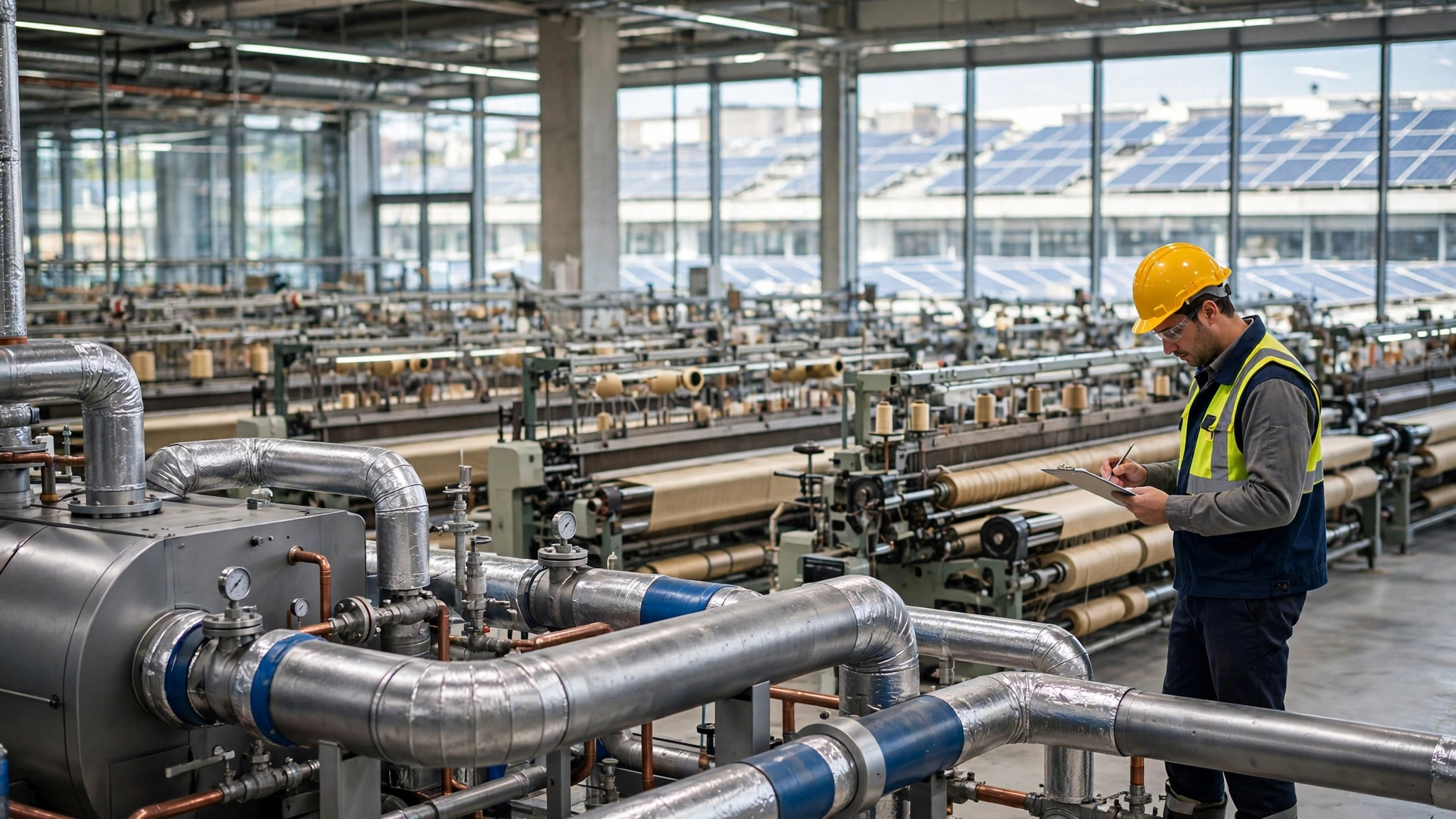
On 10 November 2026, Inditex and the International Finance Corporation (IFC) launched the Decarbonization of Textile, Apparel, & Footwear Suppliers (D-TAFS) Fund, a blended-finance vehicle aiming to mobilise up to $400 million for cleaner production in emerging-market supply chains. The IFC project disclosure identifies Social Investment Managers & Advisors (SIMA) as the fund manager and, according to the launch release, has already reached a first close of $232 million.
Ask whether the factories that make your orders can borrow on workable terms for projects such as a boiler replacement, solar power or wastewater treatment. Check eligibility and what the supplier can show about the work completed.
The fund at a glance
| Item | Detail |
|---|---|
| Name | Decarbonization of Textile, Apparel, & Footwear Suppliers (D-TAFS) Fund |
| Launched | 10 November 2026 |
| Managed by | Social Investment Managers & Advisors (SIMA) |
| Launched with | International Finance Corporation (IFC), part of the World Bank Group |
| Target size | Up to $400 million |
| First close | $232 million, announced 12 November 2026 |
| Largest investors | IFC up to $60 million; FMO $50 million; Inditex up to $50 million |
| Other investors | Proparco, British International Investment, Global Environment Facility, MetLife, Apparel Impact Institute |
| Who it serves | Textile, apparel and footwear manufacturers in emerging markets, mainly small and medium-sized enterprises (SMEs) |
| Regions | Asia, the Middle East, North Africa and Latin America |
| What it finances | Energy efficiency, renewable energy, water saving, wastewater treatment, cleaner production, improved chemicals use |
| Expected reach | Around 60–80 borrowers, according to IFC expectations reported by trade media |
Two points in that table deserve emphasis. First, $400 million is a target, not money in the bank: $232 million has closed and further fundraising rounds are planned. Second, the fund lends; it does not give grants to brands or place orders with factories. Its effect on any given buyer depends entirely on whether that buyer’s suppliers borrow, invest, and can show measured results.
Why this fund exists
The financing gap it addresses is well documented by the parties involved. More than 60 million people in emerging markets — the majority of them women — work in textile and apparel manufacturing, according to the launch release. Many of the SMEs that make up brand supply chains cannot access the financing needed to invest in new technologies that would reduce their environmental impact.
Inditex chief executive Oscar Garcia Maceiras described the initiative as a first-of-its-kind public-private partnership, and said emissions were connected to “all of the processes” across the fashion supply chain. IFC regional vice president Sarvesh Suri framed the problem in the same terms: small and medium-sized suppliers need access to affordable, appropriately structured financing to stay competitive.
That framing matters because it defines what D-TAFS is for. It is not a brand sustainability programme, and it is not a certification. It is a lending vehicle designed to make specific factory investments bankable — the kind of projects that, as SIMA chief executive Asad Mahmood put it, “can languish as paper studies only” without customised loan structuring, appropriate terms and implementation support.
How the money is structured
D-TAFS is a blended-finance fund, which means it combines commercial capital with development capital to offer debt on preferential terms. The structure has two sub-funds:
- Direct loans to manufacturers. One sub-fund lends directly to textile and apparel manufacturers for projects at their own sites.
- Finance for energy providers. The second sub-fund finances energy service companies and distributed energy developers working with those suppliers — for example, a developer that installs and operates rooftop solar for a cluster of factories.
The largest investors are IFC (up to $60 million), FMO, the Dutch development bank ($50 million), and Inditex (up to $50 million). Other participants include France’s Proparco, British International Investment, the Global Environment Facility (GEF), MetLife and the Apparel Impact Institute (AII). The GEF is also providing $13.8 million in concessional financing to reduce investment risk, alongside a $917,000 technical-assistance grant for chemical and waste management, according to trade reporting of the launch.
To apply, each company must submit a structured plan identifying its factories’ needs, planned investments and related environmental targets. Each project is assessed for viability, and indicators are established to measure progress and the results of the investments. Financing is paired with technical assistance to help borrowers identify, structure and implement projects.
Accountability is built into the design on a four-month cycle: reporting on and analysis of the environmental results achieved through the financed measures, with a specific focus on measuring emissions reductions. That cadence is the feature buyers should watch most closely — it is what turns a loan into verifiable evidence.
What the fund will pay for
Eligible investments, as set out in the launch release, cover the practical core of factory decarbonisation:
- Installing renewable energy systems
- Replacing or upgrading machinery
- Improving boilers and other equipment
- Optimising production processes
- Reusing water and treating wastewater
- Improving the use of chemicals in textile production
The list is deliberately unglamorous. Boilers, motors and wastewater plants can be significant sources of factory energy and water consumption, depending on the manufacturing process, and where the payback case for investment is usually strongest — but also where the upfront cost most often blocks action. A preferential loan changes the arithmetic on exactly these items, which is why the fund’s backers describe it as addressing a financing barrier rather than a technology barrier.
Inditex says it has been working for more than two years with its suppliers to understand factory needs and develop tailored transformation plans through independent engineering consultancy. D-TAFS, in the company’s words, is intended to take the next step: turning already identified improvements into investments and measurable results.
What it means for apparel buyers
1. A cheaper retrofit is now a realistic negotiating point
If a supplier tells you it cannot afford to replace an ageing boiler or install heat recovery, D-TAFS is now a concrete counter-question: has the factory assessed whether it qualifies? The fund is aimed at SMEs, a category that includes many Tier 1 and Tier 2 apparel suppliers in Asia — but whether any specific supplier qualifies requires confirmation from SIMA. Buyers who raise the question early — during supplier onboarding or annual business reviews — can move the conversation from “we cannot afford it” to “what would the project cost, and what would it save?”
2. Expect an average envelope, not a blank cheque
The arithmetic is worth doing, with its limits stated plainly. A $232 million first close spread across an expected 60 to 80 borrowers implies an average envelope of roughly $2.9 million to $3.9 million per borrower if the money were allocated evenly. It will not be allocated evenly, and the $400 million target has not yet been reached, so treat that range as an illustration of scale, not a commitment. The implication is still useful: this fund is sized for mid-scale retrofits — a boiler, a solar array, a wastewater upgrade — not for rebuilding a whole factory. Buyers should not expect a single D-TAFS loan to transform a supplier’s entire footprint.
3. A loan is not a compliance certificate
This is the distinction buyers most need to hold. A supplier that borrows from D-TAFS has obtained finance; it has not thereby passed an audit, met a restricted-substance limit, or satisfied a due-diligence obligation. The launch release describes the accountability process as reporting on and analysing “the environmental results achieved through the measures financed” — that is, the results of the financed project. Whether that reporting also covers the factory’s wider operations is not stated in the published material, and buyers should not assume it does. Project-level monitoring is not the same as independent factory-wide assurance, and the two should be verified separately. Buyers should keep D-TAFS evidence in its own lane and continue to verify chemical management, labour and safety performance through the usual channels, such as the audit and due-diligence evidence described in our guide to supplier codes of conduct and the comparison of supplier audits versus due diligence.
4. Timelines will be slower than the headlines
First close does not mean first disbursement. According to the application process described in the launch release, each company must submit a structured plan identifying its factories’ needs, planned investments and related environmental targets; each project is then assessed for viability, and indicators are established to measure progress. Those are the steps the published process describes — the release does not state them as universal conditions for every borrower, and the usual due-diligence steps a lender applies in practice may add further requirements. Buyers who build D-TAFS into 2027 sourcing plans should treat it as a pipeline: ask suppliers whether they have applied, what project they proposed, and what the assessment timetable is — and keep a fallback plan if the answer is “not yet”.
5. It connects to rules buyers already face — but not all buyers face the same rules
The fund does not operate in a vacuum. European buyers are working through a set of requirements that make factory-level energy, water and chemical data commercially valuable — but the instruments differ in legal status, scope and timing, and they do not apply identically to every buyer:
- Chemical restrictions already in force. The EU PFHxA restriction under Regulation (EU) 2024/2462 applies from 10 October 2026 to clothing, accessories and footwear for the general public. The ZDHC MRSL v4.0 sets new substance limits, including PFAS limits, with a stock-clearance deadline of 1 June 2028. Our explainers on the ZDHC MRSL v4.0 substance groups and PFAS limits and EU apparel compliance in 2026 set out what these require.
- Green claims: the proposal is going, the binding rules remain. The proposed Green Claims Directive — which would have required prior independent verification of explicit environmental claims — was listed by the European Commission in its 2027 Work Programme on 4 November 2026 among the proposals it intends to withdraw within six months; as of 9 November 2026 the formal withdrawal had not yet been published. What does apply is the Empowering Consumers for the Green Transition Directive, Directive (EU) 2024/825, which member states must apply from 27 September 2026 and which turns the most common unsupported green claims into banned practices. Our explainer on the EU Green Claims Directive tracks this distinction.
- Due diligence depends on company size and scope. EU due-diligence duties do not fall on every buyer equally; applicability turns on the company’s size, sector and place in the chain, and the framework itself was reopened by the Omnibus I package in 2026. Buyers should check the scope that applies to their own company rather than assuming a single standard — our guide to supplier codes of conduct sets out the evidence buyers are typically asked for.
The textile-to-textile recycling and chemical data discussion from the ZDHC summit shows why chemical data is becoming a precondition for circularity claims. D-TAFS helps pay for the underlying improvements; it does not remove the need to evidence them.
Risks and open questions
A careful reading of the launch leaves several questions unanswered, and buyers should not fill the gaps with assumptions:
- Eligibility criteria are not public in detail. The release describes the application process but not the thresholds — which factories, in which countries, at what size, qualify. Until SIMA or IFC publishes criteria, buyers cannot confirm whether a specific supplier is eligible.
- Pricing is undisclosed. Loans are described as being on preferential terms, but no interest rates, tenors or grace periods have been published. A buyer cannot judge whether the finance is genuinely cheaper than a local bank loan without those terms.
- The $400 million target is not yet reached. Further fundraising rounds are planned. If they fall short, the fund will be smaller than the headline figure, and the per-borrower arithmetic above shrinks with it.
- Results are not yet measurable. The four-monthly accountability process is a design promise. Whether it produces trustworthy evidence will depend on questions the published material does not yet answer: what measurement methodology is used, what baseline the reductions are measured against, what emissions boundary is covered, who is responsible for reporting, and whether results are independently verified. Reporting frequency alone does not establish measurement quality or verification independence. The first reports should be judged on those points, not on how often they appear.
- Geographic concentration is a risk. Asia is the centre of gravity for apparel production, and the fund’s regions include Asia, the Middle East, North Africa and Latin America. How the money is distributed between those regions will determine whether it reaches the factories that make most of the world’s clothing.
None of these points undermines the fund. They define what to monitor: published eligibility criteria, loan terms, the first accountability reports, and the first named borrowers.
Buyer checklist: seven questions to ask suppliers
- Has the factory assessed whether it qualifies for D-TAFS finance, and for which project?
- What specific investment is proposed — boiler, solar, wastewater, machinery — and what would it cost with and without the fund?
- What energy, water or chemical savings does the project forecast, and how will they be measured? Ask for the baseline data, the project assumptions and the measurement boundary, and whether the figures are forecast savings or measured reductions — and whether results are reported per unit of production rather than as absolute totals. A projection is not a result, and a reduction that falls when output falls is not the same as an efficiency gain.
- Who verifies the results — the fund’s four-monthly reporting, an independent engineer, or the factory itself? Where available, ask for independent verification evidence rather than self-reported figures.
- How does the investment change the factory’s cost base, and will any saving be shared through pricing or capacity?
- If the factory does not qualify, what is its alternative plan for the same upgrade, and on what timetable?
- What does the buyer have to do? D-TAFS lends to the supplier, not to the buyer — but the supplier’s investment case may depend on the buyer’s own commitments, such as order volumes or contract length. Ask who bears the investment risk if forecast savings or order volumes do not materialise, who owns the upgraded equipment, and what the payback assumptions are.
Suppliers that can answer these questions are already treating decarbonisation as an operational plan rather than a marketing statement. Those that cannot are telling you something too.
Frequently asked questions
What is the D-TAFS fund?
The Decarbonization of Textile, Apparel, & Footwear Suppliers Fund is a blended-finance fund launched on 10 November 2026 by the IFC and SIMA, aiming to mobilise up to $400 million in preferential loans for textile, apparel and footwear manufacturers in emerging markets.
How much has the fund raised so far?
It reached a first close of $232 million, announced on 12 November 2026. Further fundraising rounds are planned to reach the $400 million target.
Who can borrow from D-TAFS?
The fund is intended for textile, apparel and footwear manufacturers in emerging markets — mainly SMEs — across Asia, the Middle East, North Africa and Latin America. That is the intended borrower population described in the launch material, not confirmed eligibility: detailed criteria, including which countries, company sizes and project types qualify, have not yet been published and require confirmation from SIMA.
What can the money be used for?
Renewable energy, energy-efficient machinery, boiler upgrades, water reuse, wastewater treatment, process optimisation and improved chemicals use. According to the application process described in the launch release, each applicant submits a structured plan identifying its factories’ needs, planned investments and related environmental targets, and indicators are established to measure progress.
Does a D-TAFS loan prove a supplier is sustainable?
No. It proves the supplier obtained finance for a specific project. Buyers should still verify chemical management, labour and safety performance separately, and should ask for the fund’s four-monthly results reporting on the financed project.
How does this affect apparel prices?
Not directly, and not immediately. If financed upgrades cut a factory’s energy and water costs, they may ease cost pressure over time — but no price effect has been announced or should be assumed.
Sources
- SIMA / IFC launch release, “First fund of its kind to finance the transformation of textile industry supply chains, with up to $400 million”, 12 November 2026 (issued by SIMA; syndicated via IssueWire). https://www.issuewire.com/first-fund-of-its-kind-to-finance-the-transformation-of-textile-industry-supply-chains-with-up-to-400-million-1881679679700387
- Ecotextile News, “Inditex backs $400m supplier fund”, 10 November 2026 (secondary trade reporting). https://www.ecotextile.com/2026111067179/news/shows-events/inditex-backs-400m-supplier-fund/
- TheIndustry.fashion, “Inditex backs $400m fund to cut fashion supply chain emissions”, 11 November 2026 (secondary trade reporting). https://www.theindustry.fashion/inditex-backs-400m-fund-to-cut-fashion-supply-chain-emissions/
- TEXtalks, “Inditex backs $400 million fund to finance textile decarbonisation across global supply chains”, 11 November 2026 (secondary trade reporting). https://textalks.com/inditex-backs-400-million-fund-to-finance-textile-decarbonisation-across-global-supply-chains/
- Loyens & Loeff, “ESG Update: Green Claims Directive set to be withdrawn, but anti-greenwashing rules remain”, 5 November 2026. https://www.loyensloeff.com/insights/news–events/news/esg-update-green-claims-directive-set-to-be-withdrawn-but-anti-greenwashing-rules-remain/
- tese.io, “The ECGT Directive explained: the EU’s new rules on green claims and sustainability labels”, November 2026. https://www.tese.io/resources/ecgt-directive-explained
- WEFTSIGNAL, “Textile-to-Textile Recycling and Chemical Data: What the ZDHC Summit Showed”. https://appareldispatch.online/textile-to-textile-recycling-chemical-data-zdhc-summit/
- WEFTSIGNAL, “EU Apparel Compliance in 2026: A Map for Exporters”. https://appareldispatch.online/apparel-exporter-compliance-eu-2026-map/
