
TIE-ITET Textile Innovation Expo 2026: What Buyers Should Watch in Dhaka
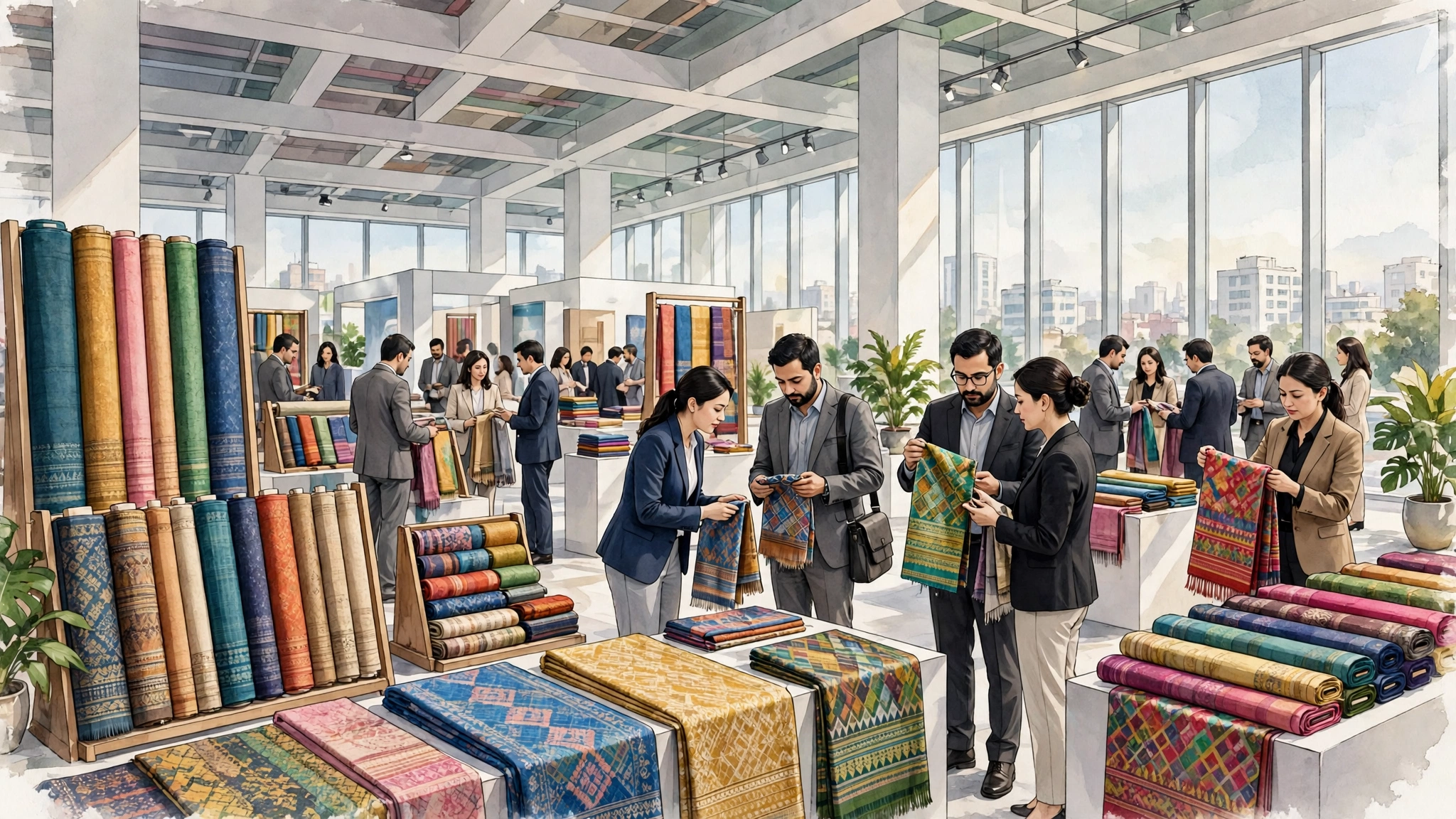
The TIE-ITET Textile Innovation Expo 2026 opens tomorrow. The expo — billed by its organisers as the inaugural edition — runs from Thursday 12 November to Saturday 14 November at the International Convention City Bashundhara (ICCB) in Dhaka. It is a small event by the standards of the big machinery fairs, and its format is what makes it worth a buyer’s attention: alongside some 200 technology and solution providers, factories present improvements they have already implemented on the shop floor, in a dedicated pavilion, and technology providers are asked to prove that their solutions work on Bangladeshi fabrics, in Bangladeshi conditions, at Bangladeshi volumes.
For sourcing and procurement professionals, the question is not whether the expo exists. It is what to look at, what to ask, and what to verify before treating anything seen in a hall as a sourcing decision. This preview sets out the essentials, the programme, and a practical checklist for the three days.
The essentials
| Item | Detail |
|---|---|
| Event | TIE-ITET Textile Innovation Expo 2026 (inaugural edition) |
| Dates | 12–14 November 2026 (Thursday–Saturday) |
| Hours | Opens 11:00 on 12 November; closes 18:30 on Day 01 (check the official site for Days 2–3) |
| Venue | International Convention City Bashundhara (ICCB), Kuril Bishwa Road, Dhaka, Bangladesh |
| Organiser | Textile Innovation Exchange (TIE), co-organised by the Textile Innovation Center (TIC) in collaboration with the Institution of Textile Engineers and Technologists (ITET), in association with BKMEA and BGBA; implemented by the Textile Today Innovation Hub |
| Official site | textileinnovationexpo.com (visitor registration available on the site) |
The organisers expect around 50 textile, apparel and accessories factories, some 200 technology and solution providers, about 5,000 visitors, roughly 100 brands and buyers, and more than 200 international delegates from over 30 countries. Those are the organisers’ expectations, not confirmed attendance figures, and they should be read as such. What matters more than the headcount is the format: four theme zones, a pavilion where factories present their own improvements, six technical seminars, and an awards night.
Why this expo is different: from low cost to value
The expo’s framing is blunt. Its organisers describe it as part of a shift from Bangladesh as a “cheap product manufacturer” to a “value-product manufacturing” base. The numbers behind that framing, as reported from Eurostat figures cited at the expo’s press briefing on 12 October, are uncomfortable: between January and July 2026, the average import value per kilogram of Bangladeshi apparel entering the European Union fell by 8.47% from a year earlier, while Vietnam’s rose by 11.76%. TEXtalks puts the average EU unit value at about €13.80 per kilogram for Bangladesh, against roughly €29 per kilogram for Vietnam. Ready-made garment exports earned US$38.70 billion in fiscal year 2025/26, 1.64% less than the US$39.35 billion of the year before. Two caveats apply to all of these figures. First, neither the trade-press reporting nor the briefing names the Eurostat dataset, the product classification or the calculation method behind the unit values, so this article reports them as briefing figures rather than as its own analysis. The TEXtalks reporting also gives no comparison period or calculation basis for the €13.80/kg and €29/kg unit values themselves. Second, product mix can exaggerate the gap between two countries’ unit values, as the Textile Today commentary itself notes.
None of those figures is a WEFTSIGNAL measurement; they are reported figures, attributed to the briefing and to Eurostat via the trade press. But they explain why an innovation expo — rather than another capacity showcase — is the event Bangladesh’s industry bodies have chosen to stage now. The context has also shifted in the last two weeks: the UN LDC Portal now lists Bangladesh as scheduled to graduate from the least-developed-country category on 24 November 2029, rather than 24 November 2026, attributing the revised date to developments following draft resolution A/81/L.8, which proposed extending the preparatory period by three years. That gives exporters more time, but it does not remove the underlying pressure on unit value. The expo is, in effect, a three-day test of whether the industry can show a credible route to higher-value products.
Readers tracking the broader Bangladesh picture can follow our coverage of the Bangladesh garment wage board process, which shapes the same cost-and-value equation from the labour side.
Four theme zones: what each means for a buyer
The expo is organised around four theme zones. Each maps to a different buying decision.
Dyeing and Printing Innovation. The zone to watch for wet-processing cost and compliance. Water, energy and chemical use are where dyeing costs and environmental risk concentrate, and where European buyers now ask the hardest questions. Look for processes that change the chemistry or the water balance, not just the shade card.
Textile Materials Innovation. New, recycled and blended fibres, and the materials that decide whether a garment can be recycled at end of life. This is the zone most directly connected to the textile-to-textile recycling work buyers are already being asked to support.
Garment Automation Innovation. Sewing, cutting and handling automation aimed at productivity and consistency. For buyers, the test is not whether a machine is fast in a demonstration, but whether it holds tolerance across a full production run — the same discipline covered in our fabric sourcing buyer guide.
Green and Sustainable Technology Innovation. Energy, water and waste solutions, and the evidence behind them. Treat every sustainability claim in this zone as a question to be answered with data: what was measured, on which fabric, against which baseline.
The Factory Innovation Pavilion: factories showing what they changed
The most distinctive feature of the expo is the Factory Innovation Pavilion, where manufacturers present implemented improvements and best practices rather than equipment for sale. Three groups have been confirmed as participants.
Ha-Meem Group signed its agreement to join the pavilion on 31 October 2026. Ha-Meem is one of Bangladesh’s largest garment groups: as reported by Textile Today on 31 October, it employs around 50,000 workers and has 26 garment factories consisting of 300 production lines and seven washing plants, producing seven million pieces a month across garment manufacturing, denim, spinning, woven fabrics, washing and finishing. Those figures are the publication’s reporting, not figures WEFTSIGNAL has verified independently. What to watch is not the scale, but which specific improvements Ha-Meem chooses to present — and whether the results are quantified.
Modern Syntex Limited also joined the pavilion on 31 October 2026. The company brings 30 years of manufacturing experience, according to the pavilion announcement, and its focus is manufacturing excellence and practical innovation. Separately, The Business Standard reported in September 2026 that the company built an integrated facility at the National Special Economic Zone in Mirsharai, Chattogram, with around Tk1,700 crore of investment using German technology, producing PET chips, fully drawn yarn, draw-textured yarn and polyester staple fibre — a facility that, according to The Business Standard’s reporting, meets nearly 21% of the country’s demand for polyester products. The investment and product figures come from that reporting, not from the pavilion announcement, which does not mention them; the demand measure behind the 21% figure is The Business Standard’s reported estimate, and its calculation has not been independently established.
Jamuna Group, the diversified group with interests spanning textiles, garments, chemicals and engineering, has also been announced as a pavilion participant by the organisers.
The pavilion format is the right one for buyers, but it carries an obvious risk: a showcase can present a single improved line as though it represented the whole factory. The buyer questions in the checklist below are designed for exactly that gap.
Day one: what to see on 12 November
The first day’s programme, as published on the official expo site, is as follows (all times local, +06:00):
| Time | Session | Hall |
|---|---|---|
| 11:00 | Expo opens | Hall 8 |
| 12:20–13:00 | Technical Seminar 01 — Advancing Innovation & Sustainability Management | Hall 8 |
| 13:30–14:10 | Opening ceremony | Hall 5 |
| 15:00–15:30 | Opening and certificate handover, Open Innovation Zone (by Centro) | Hall 8 |
| 16:30–17:10 | Launch and strategic collaboration announcement of HAMS CITT | Hall 5 |
| 17:30–18:10 | Technical Seminar 02 — Innovation in the Use of Synthetic, New Fibers, Recycled & Blended Fibers | Hall 8 |
| 18:30 | Expo closes | Hall 8 |
Two sessions deserve particular attention. The HAMS CITT launch (16:30–17:10, Hall 5) introduces the HAMS Center of Intelligence for Textile Transformation, described as a factory-integrated “innovation engine” incubated and implemented by TIE, with a panel on data-driven innovation for textile transformation. The panel includes representatives from CHT Asia-Pacific, H&M, Next Sourcing, Archroma and HAMS Garments. The announcement was made on 10 November, two days before the expo.
Technical Seminar 02 (17:30–18:10, Hall 8) covers synthetic, new, recycled and blended fibres, with a keynote by Md. Azhar Ali, Chief Operating Officer of Salma Group, and a panel including S A Mondal, Plant Head at Modern Syntex. Note that this is a fibre seminar, not a dyeing technology session — the CHT PIGMENTURA showcase discussed below is a separate exhibitor presentation, not this seminar.
Six technical seminars are scheduled across the three days, covering sustainability management, synthetic and new fibres, digital product passports and traceability, textile recycling and blended products for circularity, productivity improvement, and energy conservation and green technology, plus a plenary seminar on strategy for systemic innovation implementation. Exact times for seminars three to five were not confirmed from the published programme at the time of writing; visitors should check the official site’s programme board on the day. Readers following the traceability thread can refer to our guide on digital product passports for textile and apparel suppliers.
The Innovation Awards Night: 13 November
The Textile Innovation Awards 2026 ceremony takes place on Friday 13 November, 18:30–20:30, in Hall 5 at ICCB. It is an invitation-only evening, presented by Dongyi Sourcing Limited, and the second edition of the awards — the first was held on 26 October 2024 at the Dhaka Regency.
Eight categories are judged: process innovation, manufacturing innovation, technology, product development, marketing and market development, environmental sustainability, social sustainability, and human resources and organisational development. The awards site describes the judging panel as “an independent Jury Board”, chaired by Prof. Dr. Engr. Ayub Nabi Khan, Vice-Chancellor of BGMEA University of Fashion and Technology (BUFT), and lists the five published assessment criteria as impact, scalability, creativity, sustainability and market relevance. Readers should note that two of the published jury members are organisers of the expo and awards themselves — Tareq Amin, founder and chief executive of the Textile Today Innovation Hub, and Ehsanul Karim Kaiser, chairman of TIE — so “independent” here is the organisers’ own description, not an independently verified fact.
Awards are useful signals, not verdicts. A winning entry tells a buyer that the awards site’s designated jury found the innovation credible; it does not tell the buyer whether the innovation works on their fabric, at their volume, at their price. The right response to an award is a trial, not an order.
Technology to watch: CHT PIGMENTURA
The most concrete technology story at the expo is CHT Group’s PIGMENTURA, a pigment-based dyeing process that the company will showcase as an exhibitor. According to CHT’s own product documentation, the process uses no water for soaping and rinsing and no energy-intensive heating of process water; CHT states that water consumption can be reduced by up to 96% and energy by up to 60% compared with other continuous dyeing processes. CHT describes the process as particularly suitable for cotton and cotton blends and usable on all substrates. The process won the German Federal Ecodesign Award 2024 in the Product category, and the German Sustainability Award 2026 in the Products category (presented at the award ceremony in Düsseldorf on 4 December 2025).
Those percentages are CHT’s “up to” claims, not independent measurements: no test conditions — fabric construction, shade depth, machine type or trial scale — have been published for them, and buyers should treat them as the starting point of a conversation rather than a specification. The questions to ask at the stand are specific: on which fabric constructions were the savings measured, what colour fastness results were achieved, and what does the process cost per metre at production volume. Readers who want the background on dyeing processes before the show can consult our textile dyeing process buyer guide.
A buyer’s checklist for the three days
Most expo coverage tells readers what is on show. For a buyer, the useful document is a list of questions. This checklist is the part of this preview that competing coverage has not provided.
At the Factory Innovation Pavilion, ask for numbers. Which line was improved, what was the baseline, what was measured, and over how many production runs? A single improved line is a pilot; a measured improvement across a factory is a capability. Ask whether the improvement is already running on export orders, and whether the factory will share the data under a non-disclosure agreement.
At every technology stand, ask for the test conditions. Water and energy savings, colour fastness, and productivity gains are meaningless without the fabric, the shade depth, the machine settings and the baseline. Ask for a named reference customer and a trial protocol, not a brochure.
At the seminars, collect the follow-up, not just the slides. The value of Seminar 02 on fibres and the later seminar on digital product passports is in the contacts and the documents that follow. Ask speakers what they will share after the session, and by when.
At the Awards Night, note the winners — then verify. An award is a reason to start a trial. It is not a reason to change a supplier, a specification or a price.
Before leaving Dhaka, fix the next step in writing. A trial order, a sample run, a data request with a date. Expos generate goodwill; only written follow-ups generate orders.
Use a verification framework, not a feeling. For every technology or factory claim that interests you, fix five things before you leave: the agreed specification (what exactly was demonstrated, on which fabric and shade); the applicable test method and who runs it; the sample-approval step (a physical sample in bulk materials, approved in writing); the production-lot sampling and AQL agreed in the contract, with the inspection gates and who owns corrective action if a trial fails; and a dated trial sign-off — who signs, by when, and what happens if the trial does not meet the agreed numbers. A claim without those five is a brochure; a claim with them is a sourcing decision.
What happens after the expo
The honest assessment of this expo will not be available on 14 November. Textile Today’s own editorial on 9 November put it plainly: before Bangladesh sells its future, it must build the ecosystem behind it — and the expo’s value will be judged after the halls close, by trials, adoption and orders. That is the right standard, and it is the one this publication will apply.
WEFTSIGNAL will follow up after the show with a post-show assessment: which pavilion claims held up, which technologies moved to trial, and what the awards winners did next. The next date on the Dhaka calendar is already set: BATEXPO, the BGMEA exhibition in its silver jubilee edition and the first since 2013, runs on 18–19 November at the Bangladesh-China Friendship Conference Center.
For buyers attending this week, the expo is worth a day. For the industry, it is worth watching as a signal of intent. Whether it becomes more than a signal depends on what happens in the weeks after the stands come down.
Frequently asked questions
When and where is the TIE-ITET Textile Innovation Expo 2026?
12–14 November 2026 at the International Convention City Bashundhara (ICCB), Kuril Bishwa Road, Dhaka. The expo opens at 11:00 on 12 November and closes at 18:30 on the first day (check the official site for the closing times on Days 2–3).
How should a buyer validate a technology saving or factory improvement claim seen at the expo?
Ask for the test conditions behind the number — fabric, shade, machine, baseline and trial scale — then agree a written trial with a specification, a test method, a sample-approval step, sampling and AQL terms, inspection gates, corrective-action ownership and a dated sign-off. Savings quoted as “up to” figures without published test conditions, such as CHT’s PIGMENTURA claims, are a reason to start a trial, not a specification to write into a contract.
What is the Factory Innovation Pavilion?
A pavilion where manufacturers — including Ha-Meem Group, Modern Syntex Limited and Jamuna Group — present improvements they have already implemented in their own factories, rather than equipment for sale.
When is the Innovation Awards Night?
Friday 13 November 2026, 18:30–20:30, Hall 5 at ICCB. It is invitation-only, with eight award categories judged by the jury board described as independent by the awards organisers.
Is CHT PIGMENTURA a seminar at the expo?
No. PIGMENTURA is an exhibitor showcase by CHT Group. The 17:30 seminar on 12 November is Technical Seminar 02, on synthetic, new, recycled and blended fibres.
Sources
- TIE-ITET Textile Innovation Expo 2026 — official site and Day 01 programme: textileinnovationexpo.com (accessed 11 November 2026)
- Textile Innovation Awards 2026 — awards night, categories and jury: innovationaward.textiletoday.com.bd (accessed 11 November 2026)
- The Business Standard, “Textile Innovation Expo 2026 to spotlight Bangladesh’s shift to higher-value manufacturing”, 13 October 2026: tbsnews.net
- Textile Today, “Ha-Meem Group joins Factory Innovation Pavilion at TIE–ITET Textile Innovation Expo 2026”, 31 October 2026: textiletoday.com.bd
- Textile Today, “Modern Syntex Limited joins Factory Innovation Pavilion at TIE–ITET Expo 2026”, 31 October 2026: textiletoday.com.bd
- TexSPACE Today, “CHT Group to showcase award-winning PIGMENTURA sustainable dyeing process at Textile Innovation Expo 2026”, 1 November 2026: texspacetoday.com
- CHT Group, PIGMENTURA product page: solutions.cht.com; and “PIGMENTURA by CHT” at PERFORMANCE DAYS Autumn, Munich, 29–30 October 2025: cht.com
- German Environment Agency (Umweltbundesamt), “13th German Ecodesign Award honours ten outstanding ideas for the future”, press release, 2 December 2024: Umweltbundesamt.de
- UN LDC Portal, “Bangladesh graduation status”: un.org/ldcportal; UN General Assembly draft resolution A/81/L.8, “Extension of the preparatory period preceding the graduation of Bangladesh and Nepal from the least developed country category”, 20 October 2026: documents.un.org
- The Business Standard, “Imported chips to integrated production: Modern Syntex now meets 21% of local demand”, 17 September 2026: tbsnews.net
- TEXtalks, “Bangladesh Textile Innovation Expo targets shift from low-cost to higher-value”, accessed 11 November 2026: textalks.com
- Textile Today, “Before Bangladesh sells its future, it must build the ecosystem behind it”, 9 November 2026: textiletoday.com.bd
- Textile Innovation Expo — official LinkedIn posts (Modern Syntex, Seminar 02, HAMS CITT launch, Seminar 06), 4–10 November 2026: linkedin.com/company/textile-innovation-expo
- bjournal, “Textile Innovation Expo 2026 by TIE”: bjournal.net
All facts in this preview were checked against the sources above on 11 November 2026. Figures attributed to organisers, to CHT or to trade-press reporting are labelled as such. No Eurostat dataset, product classification or calculation method is named in the reporting cited, and no comparison period or calculation basis is given for the unit values; the unit-value figures are briefing figures as reported. Seminar times for sessions three to five were not confirmed from the published programme at the time of writing.
