
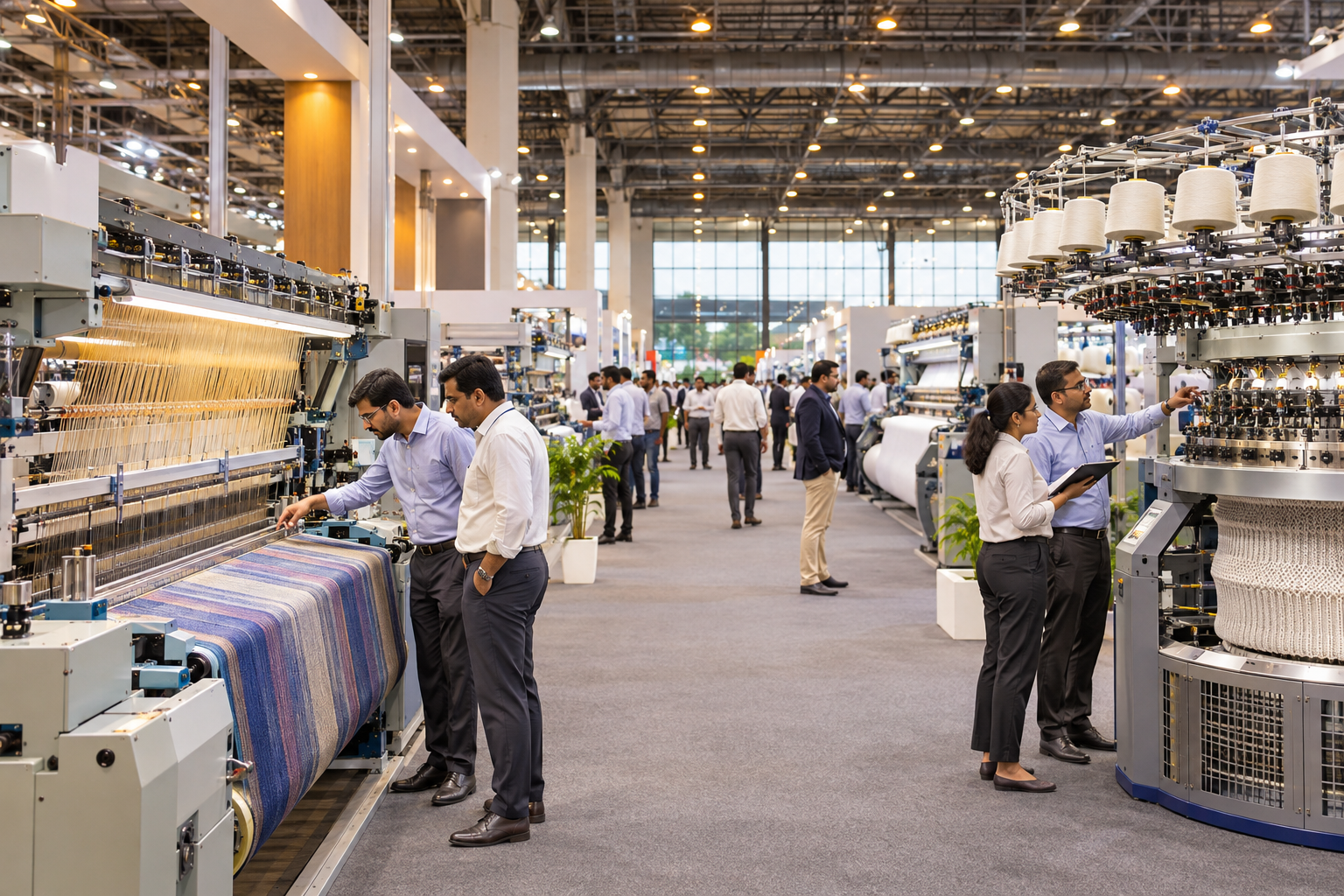
The 12th India International Textile Machinery Exhibition (India ITME 2026) runs from 4 to 9 December at India Exposition Mart Limited (IEML) in Greater Noida, Uttar Pradesh. The organiser’s official event website forecasts more than 1,800 exhibitors across 20 chapters and more than 150,000 visitors. A separate press preview published by the Indian Textile Journal (ITJ) on 19 November gives a lower exhibitor figure of more than 1,000. It is backed by the Ministry of Textiles and aligned with national initiatives including Make in India, Atmanirbhar Bharat, PM MITRA Parks and the National Technical Textiles Mission. For a machinery buyer, the show is worth attending for a practical reason: it gives buyers an opportunity to compare equipment and service arrangements in one venue. This preview explains the published forecasts and the technical and commercial checks worth making on the show floor.
The show at a glance
India ITME Society, a non-profit apex body for the textile engineering industry established in 1980, will host the six-day exhibition. The venue is IEML in Greater Noida, an integrated exhibition and convention centre spread across 57 acres, according to IEML Chairman Rakesh Kumar, speaking at the press conference in New Delhi reported by the Indian Textile Journal (ITJ). The exhibition will cover the full textile manufacturing value chain: spinning and yarn manufacturing, weaving, knitting, man-made fibres and filament processing, dyeing, printing and textile processing, finishing and fabric treatment, garment manufacturing, technical textiles and nonwovens. It will also feature developments in automation, digitalisation, smart manufacturing, textile testing, quality control, recycling and sustainability, ITJ reported.
The day-by-day programme, as published by ITJ, runs as follows. Day 1 (4 December) opens with the inauguration and lamp-lighting ceremony. Day 2 (5 December) features product launches, two sessions of Textile Horizons 2026 and a technical symposium by VJTI. Day 3 (6 December) includes the Technical Textiles Conference by TIT Bhiwani, Textile Horizons 2026, the Top Textile CEOs Conclave, the India ITME Technical Awards and a networking dinner. Day 4 (7 December) features sessions by Sweden-India Textile Innovation and SDC International (UK), a programme by the British Textile Machinery Association and the JDIET alumni meet. The final two days feature cultural activities and networking dinners. The detailed itinerary is published through the official India ITME 2026 channels.
The official India ITME 2026 website forecasts more than 1,800 exhibitors across 20 chapters and more than 150,000 visitors, with 15 halls and 235,000 square metres of exhibition space. The 19 November ITJ press preview gives a lower threshold of more than 1,000 exhibitors and mentions 91 countries, without specifying how that country count was calculated. Both exhibitor estimates are lower bounds, not confirmed attendance totals; the difference in reporting basis remains unexplained. Buyers should consult the organiser’s exhibitor directory for specific suppliers.
Textile Horizons: the boardroom inside the exhibition
Alongside the machinery halls, India ITME 2026 will host Textile Horizons on 5 and 6 December, a programme built around senior decision-makers rather than equipment. It will feature a Top Textile CEOs Conclave, the India ITME Technical Awards and a networking dinner with CEOs and managing directors, and is expected to host more than 250 decision-makers and delegates alongside more than 15 global leaders, according to ITJ. The named participants, as listed in ITJ’s 19 November preview as expected participants, include Jason Kent, CEO of the British Textile Machinery Association; Christian P. Schindler, Director General of the International Textile Manufacturers Federation (ITMF); Anton Hofmeier, Group CEO of Textiles Solutions Group; Jan Bogaert, CEO of BMSvision; Mark Smith, Deputy Vice President of Karl Mayer; Davide Maccabruni, CEO of Uster Technologies; Chetan Gautam, CEO of Fine Lines; and Alagesan, Executive Vice President of Eastman Exports Global Clothing. The preview lists them as part of the programme; attendance had not been confirmed at the time of writing.
For a buyer, the conclave matters because it is where the demand side of the machinery market talks in public. The questions on that stage — which technologies Indian mills are actually buying, what automation is expected to save in labour, how sustainability requirements are changing specifications — are the same questions a buyer should be asking exhibitors in the halls. If the CEOs and the exhibitors give different answers, the gap is itself information.
What the exhibitor mix signals
The most useful way to read a machinery exhibition is not as a catalogue but as a signal of where capital may be going. Twenty chapters spanning spinning to garment making means the show covers the whole chain; the balance between those chapters is worth noting on the floor, because it will show whether the machines on offer are still concentrated upstream, in spinning and weaving, or are moving downstream into garment manufacturing, technical textiles and recycling. That balance is a signal to observe, not proof of where buyers are investing: the exhibitor mix shows what suppliers are offering, and only orders, capital expenditure or equipment import data — none of which this preview has — could show what buyers are actually buying. Treat the chapter balance as a question to carry onto the floor, not as a conclusion.
Two exhibitor announcements illustrate the range. Strayfield will showcase a new-generation 40 kW radio-frequency dryer for textiles at the show; the company says it has a 30 per cent smaller footprint and up to 15 per cent higher energy efficiency than its previous model at the same production output, according to Fibre2Fashion on 24 November, reporting the company’s announcement. Mariplast, an Italian yarn-carrier manufacturer with a production facility in India established in 2025, will exhibit its latest spinning and dye tubes at Hall 10, Stand G19; the company says local manufacturing gives shorter delivery times, competitive pricing and dedicated support, according to Fibre2Fashion on 25 November. Both are the kinds of exhibits that repay a specific technical question rather than a general look — what energy does the dryer use per kilogram of fabric, under which conditions, and what does the local facility mean for spares and service response times in India? The energy, delivery and service figures in this paragraph are the suppliers’ own claims, not independently verified performance; buyers should ask for the test conditions behind them and for written service commitments.
Service deserves attention alongside the purchase price. Spare-parts availability, response times and operator training can affect lifetime costs and machine uptime. India ITME Society has conducted roadshows across India ahead of the show, including in Erode, Tiruppur, Salem, Coimbatore, Indore, Surat, Ahmedabad, Ichalkaranji, Kanpur, Lucknow, Delhi and Noida, ITJ reported. The roadshows show where the organisers promoted the show; they do not by themselves show who will attend, and this article draws no conclusion about the share of visitors who will be small and medium-sized manufacturers.
The policy backdrop buyers should understand
The show does not take place in a policy vacuum. ITJ reports that India’s ₹44.45 billion PM MITRA scheme is expected to catalyse significant textile investments. The scheme’s official aim, as stated by the Ministry of Textiles in a written reply in the Rajya Sabha, is to attract ₹70,000 crore (₹700 billion) in investments and create nearly 2 million direct and indirect jobs — so the ₹700 billion figure measures investment attracted, not industry output or growth. ITJ’s preview describes the same figure as “₹700 billion in industry growth”; this article follows the Ministry’s wording, not ITJ’s, and does not repeat the “industry growth” description. The ₹44.45 billion is the scheme’s approved outlay, as stated in the same ministerial reply. ITJ also mentions “ZLD compliance mandates” — zero-liquid-discharge requirements — among the factors shaping the moment, without specifying which states, facilities or discharge rules they apply to; this article does not present zero-liquid-discharge compliance as a general requirement. What is concrete is the calendar: under Round 4 of the Production Linked Incentive (PLI) Scheme for Textiles, the Ministry of Textiles reopened the application portal from 1 November to 31 December 2026 for man-made fibre apparel, MMF fabrics and technical textiles, cutting the Part 2 minimum turnover requirement from ₹200 crore to ₹100 crore (Press Information Bureau, 28 October 2026). The exhibition therefore falls inside the last month of the Round 4 window — but only for manufacturers of the notified products who meet the scheme’s investment and turnover conditions, and the window is an application deadline, not a purchasing deadline.
India ITME Society Chairman Ketan Sanghvi put the competitive pressure plainly at the New Delhi press conference, as reported by ITJ: “To scale the sector further amid intense competition from countries such as China, Bangladesh and Vietnam, textile manufacturers must continually invest in technology to improve operational efficiency, maintain product quality and meet evolving market requirements.” He added that the textile and apparel industry is entering a transformative era driven by Industry 4.0, sustainable manufacturing, advanced materials and circular economy principles, and that India stands “at the crossroads of tradition and innovation”. His remarks set out the organiser’s view of the competitive pressures facing Indian manufacturers; they are not evidence of comparative investment levels.
After Shanghai: the exhibition baton passes
India ITME 2026 opens ten days after the close of ITMA ASIA + CITME 2026 in Shanghai, which ran from 20 to 24 November with more than 1,950 exhibitors across seven halls and about 180,000 square metres, according to Textile Technology’s opening report of 20 November 2026. Readers should know what this publication has and has not been able to verify about that show’s outcome: as of the reporting cutoff, no official closing release or visitor figure from CEMATEX or ITMA Services had been found, and no closing figure for the Shanghai show is stated here.
What is confirmed about the Shanghai show’s aftermath is structural, not numerical. On 22 November, CEMATEX and its Chinese partners — CTMA, CCPIT TEX and CIEC — jointly announced the end of their 20-year collaboration as co-owners and co-organisers of ITMA Asia + CITME in China (CEMATEX announcement of 22 November 2026, as reported by Ecotextile News and Textile World). CEMATEX will stage ITMA Asia in Singapore in 2029, from 23 to 26 October, under its sole organisation and management, with ITMA Services as organiser. Separately, CITME 2028 has been confirmed for 20 to 24 November 2028 in Shanghai, marking the 40th anniversary of the first CITME in 1988 (CTMA, CCPIT TEX and CIEC, via Fibre2Fashion, 24 November 2026). The machinery exhibition calendar is therefore splitting into distinct tracks — a Singapore-based ITMA Asia and a Chinese CITME — and India ITME, opening ten days after Shanghai, is the next major date on that calendar. For buyers planning 2027 capital expenditure, the Greater Noida event offers another opportunity to compare equipment and discuss local installation and support.
Our preview of ITMA ASIA + CITME 2026 set out the Shanghai show’s technology themes — intelligent and sustainable production — and Karl Mayer’s spacer fabric machine was one of the exhibits that illustrated them. The India show is the place to ask how those themes translate into machines that Indian mills can buy, install and service. The India–EU free trade agreement is part of the same picture: as India’s market access changes, the machinery its mills buy today determines what they can sell tomorrow.
A buyer’s checklist for the halls
Five questions, to be asked of every serious exhibitor — and, for any machine shortlisted for purchase, an acceptance checklist to agree before signing. First, energy: what does the machine consume per kilogram of output, measured under which conditions, and how does that compare with the machine it replaces? Second, labour: how many operators does it need, what skills do they need, and what training is included? Third, service: where are spares held in India, what is the guaranteed response time, and who trains the buyer’s technicians? Fourth, evidence: can the exhibitor show test reports or reference installations running the buyer’s own materials, not just demonstration fabric? Fifth, commercial terms: what is the delivery schedule, what acceptance test will be written into the contract, and what happens if the machine does not meet it?
For the acceptance test itself, agree the following in writing before ordering. Trial materials: the test must run the buyer’s own materials, named in the contract, not the exhibitor’s demonstration stock. Target output: a stated production rate for those materials. Stable run: a stated continuous run duration at that rate, long enough to show the machine holds its output. Energy: specific energy consumption per kilogram of output, with a stated permitted deviation. Acceptance stages: a factory acceptance test before shipment and a site acceptance test after installation, each with a written record and a named person who signs it off. Failure: retest and rectification terms if the machine misses the agreed figures, including who pays for the retest and how long the supplier has to fix it. Sampling: if acceptance is by sampling rather than by a full run, the contract must state the lot or batch definition and the pass criteria; do not apply a generic AQL table to machinery acceptance. A demonstration on a show floor proves that a machine can run; it does not prove that it can run a buyer’s product, at a buyer’s volume, at a buyer’s cost. The difference between those two things is what the six days in Greater Noida are for.
Frequently asked questions
When and where is India ITME 2026?
From 4 to 9 December 2026 at India Exposition Mart Limited (IEML), Greater Noida, Uttar Pradesh. It is the 12th edition, organised by India ITME Society, and runs for six days.
How big is the show?
The official event website forecasts more than 1,800 exhibitors across 20 chapters and more than 150,000 visitors. ITJ’s 19 November press preview gives a lower threshold of more than 1,000 exhibitors. These are forecasts, not final counts; the difference in reporting basis remains unexplained.
What is Textile Horizons?
A programme for senior decision-makers held on 5 and 6 December alongside the exhibition, featuring a Top Textile CEOs Conclave, the India ITME Technical Awards and a networking dinner, with more than 250 decision-makers and more than 15 global industry leaders expected. The named participants are those listed in ITJ’s 19 November preview as expected participants.
Which technologies will be on show?
The full value chain — spinning, weaving, knitting, man-made fibres, dyeing, printing, finishing, garment manufacturing, technical textiles and nonwovens — with an emphasis on automation, digitalisation, smart manufacturing, testing and quality control, recycling and sustainability.
How does India ITME relate to ITMA ASIA + CITME 2026?
ITMA ASIA + CITME 2026 closed in Shanghai on 24 November. As of the reporting cutoff, no official closing visitor figure had been found. India ITME opens ten days later and is the next major machinery exhibition on the calendar; CEMATEX has announced that ITMA Asia will move to Singapore in 2029, while CITME 2028 will be held in Shanghai.
Sources
- CEMATEX, official announcement, 24 November 2026 — Singapore ITMA ASIA, 23–26 October 2029, announced at the 22 November event in Shanghai.
- Confederation of Indian Textile Industry, Circular 088/2026, 29 October 2026 — corroborates the Round 4 application window and Part 2 turnover criterion. Consult the ministry’s scheme guidelines for eligibility.
- Indian Textile Journal, “Reimagining Machinery at ITME 2026”, 19 November 2026 — 12th edition, 4–9 December 2026, IEML Greater Noida; 1,000+ exhibitors across 20 chapters (ITJ’s preview also gives “91 countries”; it publishes no breakdown, so the counting basis is unstated), 150,000+ visitors expected; Textile Horizons 5–6 December with 250+ decision-makers and 15+ global leaders; Ministry of Textiles backing and national initiatives; PM MITRA figures; roadshows; day-by-day programme; Sanghvi and Kumar quotes. Read 25 November 2026 (full text re-read for rev2). https://indiantextilejournal.com/reimagining-machinery-at-itme-2026/
- India ITME Society, India ITME 2026 official event website — 4–9 December 2026, 15 halls, 235,000 square metres, more than 1,800 exhibitors in 20 chapters and more than 150,000 visitors expected. Checked 25 November 2026.
- Press Information Bureau (Government of India), Ministry of Textiles, “Ministry of Textiles to open PLI Scheme portal for new applications from 1 November 2026”, 28 October 2026 — PLI Scheme for Textiles Round 4, applications 1 November to 31 December 2026, portal pli.texmin.gov.in, MMF apparel / MMF fabrics / technical textiles, Part 2 minimum turnover cut from ₹200 crore to ₹100 crore, tenure extended to FY 2033–34 for Round 4 approvals. https://www.pib.gov.in/PressReleseDetailm.aspx?PRID=2329667®=48&lang=2
- Press Information Bureau (Government of India), Ministry of Textiles, written reply in the Rajya Sabha (PRID 2151231) — PM MITRA Parks at 7 sites with an outlay of Rs. 4,445 crore for seven years up to 2027–28; the scheme “aims to attract Rs. 70,000 crore in investments and create nearly 20 lakh direct and indirect jobs”. Read 25 November 2026. https://www.pib.gov.in/PressReleasePage.aspx?PRID=2151231®=48&lang=2
- Fibre2Fashion, “Strayfield to showcase next-gen 40 kW RF dryer at India ITME 2026”, 24 November 2026 — Strayfield 40 kW radio-frequency dryer, Hall 1, Booth H12B; company claims 30% smaller footprint and up to 15% higher energy efficiency than its previous model at the same output. Read 25 November 2026 (full text read for rev2). https://www.fibre2fashion.com/news/textile-news/strayfield-to-showcase-next-gen-40-kw-rf-dryer-at-india-itme-2026-315251-newsdetails.htm
- Fibre2Fashion, “Mariplast to showcase yarn carriers at India ITME 2026”, 25 November 2026 — Mariplast spinning and dye tubes, Hall 10, Stand G19; Indian facility established 2025; company claims shorter delivery times, competitive pricing and dedicated support from local manufacturing. Read 25 November 2026 (full text read for rev2). https://www.fibre2fashion.com/news/textile-news/mariplast-to-showcase-yarn-carriers-at-india-itme-2026-315291-newsdetails.htm
- Ecotextile News, “ITMA Asia leaves China for Singapore”, 22 November 2026 — CEMATEX ends its 20-year co-ownership of ITMA Asia + CITME in China; ITMA Asia to move to Singapore in 2029. Read 25 November 2026 (lede re-read for rev2; full text paywalled). https://www.ecotextile.com/2026112267463/news/shows-events/itma-asia-leaves-china-for-singapore/
- Textile World, “CEMATEX Charts New Chapter For ITMA ASIA With Singapore 2029 Launch”, 24 November 2026 (source: CEMATEX / ITMA Services) — ITMA ASIA Singapore 23–26 October 2029, organised by ITMA Services under CEMATEX’s sole organisation and management; joint announcement with CTMA, CCPIT TEX and CIEC on 22 November ending the 20-year collaboration. Read 25 November 2026. https://www.textileworld.com/textile-world/2026/11/cematex-charts-new-chapter-for-itma-asia-with-singapore-2029-launch-and-reinforces-itma-2027-as-the-definitive-global-platform-for-textile-innovation/
- Fibre2Fashion, “China gears up for landmark 40th anniversary of CITME in 2028”, 24 November 2026 — CITME 2028 confirmed for 20–24 November 2028 at the National Exhibition and Convention Center, Shanghai; 40th anniversary of the first CITME in 1988 (CTMA, CCPIT TEX, CIEC). Read 25 November 2026 (full text read for rev2). https://www.fibre2fashion.com/news/textile-news/china-gears-up-for-landmark-40th-anniversary-of-citme-in-2028-315254-newsdetails.htm
- Textile Technology, “ITMA ASIA + CITME 2026 opens in Shanghai”, 20 November 2026 — 10th edition, 20–24 November 2026, National Exhibition and Convention Center, Shanghai; about 180,000 sq. m. across 7 halls, more than 1,950 exhibitors; jointly owned by CEMATEX, CTMA, CCPIT-Tex and CIEC. Read 25 November 2026. https://www.textiletechnology.net/news/itma-asia-citme-highlights-intelligent-sustainable-production-661374 ; closing figures: as of the reporting cutoff, no official closing release or visitor figure from CEMATEX or ITMA Services had been found.
- Technical Textiles / Textile Technology / Textile Insights / Textile Value Chain previews of India ITME 2026 (18–19 November 2026) — 1,000+ exhibitors, 150,000+ visitors expected, 12th edition; consistent with the ITJ preview. Read 25 November 2026 (search summaries).
