
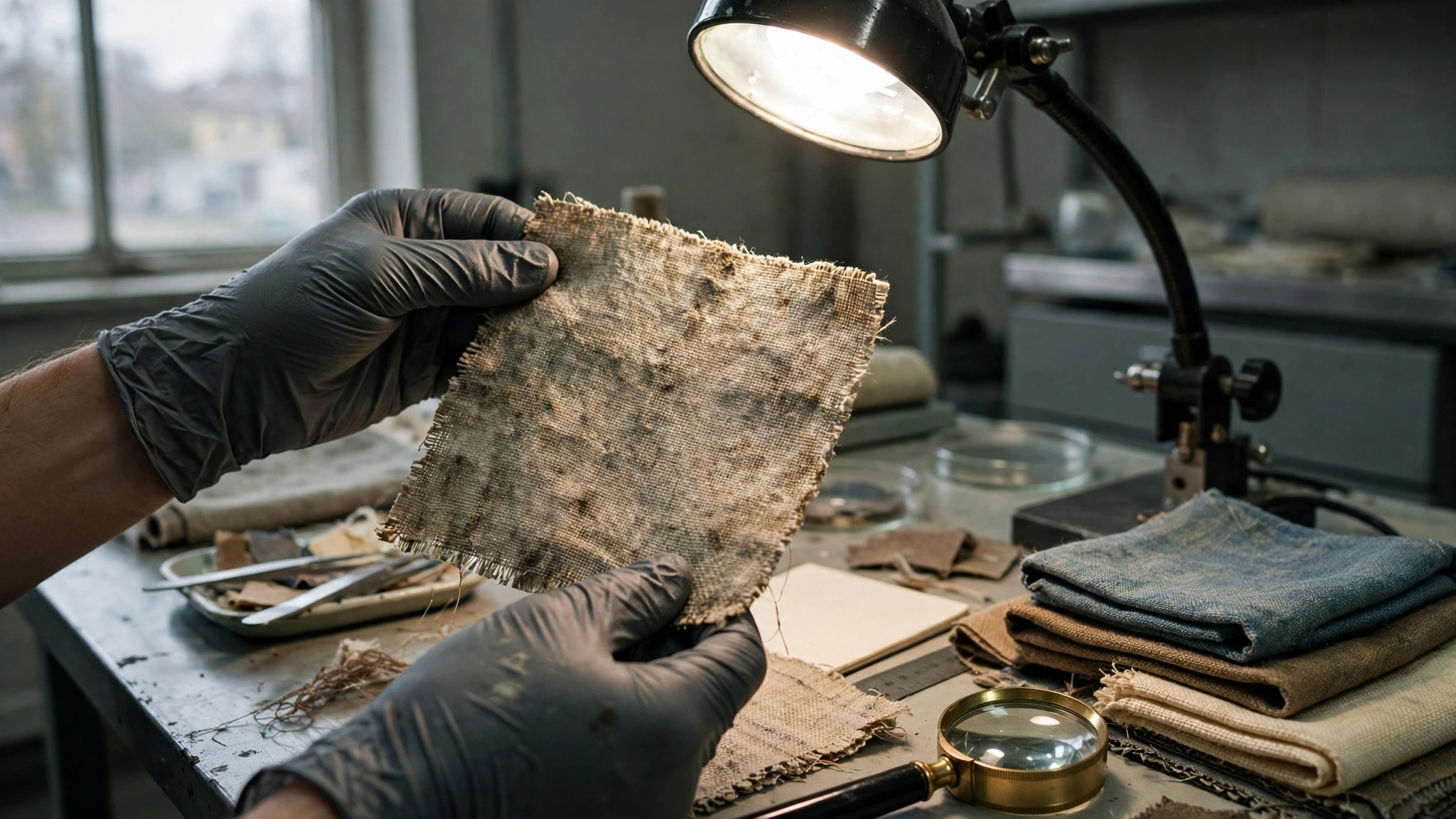
A fabric can look perfectly serviceable and still be unsafe. That is the central problem of textile aging: the properties that matter most — tensile strength, tear resistance, thermal protection, flame resistance — can fall below acceptable levels before any visible sign appears. For a buyer or quality controller, the question is therefore not only “what does this fabric look like now?” but “what can it still do, and how do I prove it?” This guide explains what aging is, what causes it, and which standardised textile aging testing methods measure performance after aging.
What textile aging and degradation mean
Aging, in the general sense used by textile researchers, is the accumulation of all changes in a system with the passage of time. The changes are irreversible and usually cause a decline or loss of functionality, although a few features — a softer hand, for example — may improve. Degradation is the destructive consequence of aging: the weakening and loss of the properties a textile needs to perform satisfactorily.
Degradation does not wait until a garment is in use. It can begin during production, dyeing and finishing, and during storage — heat, humidity, light and time act on a folded fabric in a warehouse just as they act on one in service. In practice, though, the degradation that matters most to buyers happens after the textile enters use, which is where this article focuses.
Four causes of textile degradation
For protective clothing, researchers group the causes of degradation into four categories. The same four kinds of exposure are relevant to everyday apparel, but their relative importance and how they show up differ — heat, for example, is a far bigger factor for firefighters’ protective clothing than for an ordinary cotton shirt, and the difference is one of degree and consequence, not only of mechanism.
1. Mechanical action
Abrasion is the most familiar cause. Garments rub against other surfaces, layers within a clothing system rub against each other, and laundering itself is mechanical. Research has shown that real abrasion cannot be fully reproduced in a laboratory: field abrasion comes from varied forces in many directions over a long period, while laboratory abrasion applies intensive force in specific directions.
2. Environmental exposure: UV, weathering and moisture
Ultraviolet radiation breaks down polymer chains in fibres, and the damage accumulates with exposure. Weathering adds moisture, temperature cycling and pollutants to the UV load. In everyday apparel the visible result is fading and a gradual loss of strength in sun-exposed areas. For protective fabrics the same mechanism attacks the outer shell, and because UV damage is concentrated at the surface, it can weaken a fabric that still looks intact.
3. Cleaning and maintenance
Repeated washing and drying degrade both appearance and performance, and an incorrect wash programme can damage some garments or reduce their protection — the risk is greatest for flame-resistant finishes, which the wrong temperature, detergent, bleach or softener can strip, while inherently flame-resistant fibres are less affected by the same mistake. Laundering is therefore both a cause of aging and a variable that aging tests must control: some test methods specify laundering or other conditioning of specimens before testing, to remove surface contamination and factory finishes, and the laundering procedure has to be standardised or the results are not comparable.
4. High temperatures and heat fluxes
Heat ages textiles through prolonged exposure to elevated temperature and through short exposure to high heat flux, as in a flash fire. Intensity, temperature, duration and frequency all influence the result, and the changes include dye loss and thermal-chemical changes in the fibre structure. For firefighters’ protective clothing, heat exposure is one of the most important aging factors; for ordinary apparel it appears in gentler form — heat setting, pressing, tumble drying.
Functional degradation vs visual degradation: why looking is not enough
Two thresholds matter, and they rarely coincide. The functional level is the point below which a fabric becomes functionally unacceptable — its strength or protection no longer meets the requirement. The visual level is the point at which deterioration such as colour fade or tears becomes visible to the naked eye. Performance can fall below the applicable acceptance threshold before visible deterioration appears.
The evidence is direct. In a study reported in the textile aging literature, visual inspection — or pulling on the fabrics by hand — could not determine whether exposed specimens had suffered significant deterioration in mechanical strength. Measured tensile and tear strength values of the aged fabrics were, however, lower than those of new fabrics. Discolouration and manual inspection for rips, tears, cuts and other visible fabric defects, seam integrity, broken stitches, charring and burn holes may therefore miss an unacceptable level of deterioration entirely — which is why visual checks need to be backed by a structured defect classification and by laboratory testing, not treated as a verdict on their own.
The same gap shapes retirement rules. Under NFPA 1850 (2026 edition), the care-and-maintenance standard for firefighters’ protective ensembles, many retirement criteria are mainly based on visual indicators — rips, tears, severe discolouration — or a service-life limit set by the manufacturer or the standard. For structural firefighting ensemble elements the hard backstop is retirement no more than 10 years after the date of manufacture, but other elements have different limits — open-circuit self-contained breathing apparatus (SCBA), for example, is generally retired 15 years after the year of manufacture, but units upgraded by at least two editions of the SCBA product standard (NFPA 1981, now consolidated into NFPA 1970) may remain in service until 20 years after the year of manufacture; whether a given unit qualifies depends on its original certification edition and the manufacturer upgrades available for it — so the 10-year figure must not be quoted as a universal retirement rule. Between inspections a garment can pass a visual check while its functional performance has already fallen.
Textile Aging Testing Methods: A Two-Phase Testing Framework
How fast a fabric ages depends on the material, the exposure conditions, the wear pattern and the maintenance procedures — so an aging claim that does not state the exposure behind it is not a complete claim. Evaluating textile aging generally involves two phases. First, either sample textiles already in use, or use laboratory tests to simulate the expected aging processes. Second, evaluate the performance of the aged textile and compare it with the same textile when new, or with a performance standard.
The comparison with the new fabric is the point most often skipped in commercial practice, and the most important part of the method. An absolute test value on an aged sample tells a buyer little on its own: the same number could represent a fabric that started strong and lost 10% of its strength, or one that started weak and lost half. Without the new-fabric baseline, there is no retention rate, and without a retention rate, no defensible pass or fail.
There is also a gap between laboratory and field exposure. Field conditions expose a fabric to repeated and combined degradation factors — UV plus abrasion plus washing plus heat, all at once, over months — while many laboratory procedures test only one specific type of exposure. A buyer should treat any single-factor laboratory result as a controlled comparison, not as a prediction of field life.
The test matrix: matching a method to the question
| Property to check | Test method | Applicable test method or product standard | What it tells the buyer |
|---|---|---|---|
| Pilling and surface change | Random tumble pilling; brush pilling | ASTM D3512/D3512M-22(2026); ASTM D3511/D3511M-16 (2022) | Surface durability; graded 5 (no pilling) to 1 (very severe) |
| UV and weathering resistance | SPHERE device; xenon-arc exposure | Method-dependent; machine-to-outdoor conversion varies | Whether sun and weather weaken the fabric before it fades |
| Effect of laundering | Controlled wash cycles, then test performance after washing per the applicable laundering guide | ASTM F2757-20(2026) (home); ASTM F1449-20(2026) (industrial); NFPA 2113 (2025) — laundering guides, not pass/fail tests; F2757 does not apply to firefighter turnout gear | How much performance survives repeated cleaning |
| Heat transfer performance | Combined convective and radiant exposure | ASTM F2700-26 (HTP) | Heat transfer through the fabric under a standardised 84 ± 2 kW/m² combined convective and radiant exposure |
| Radiant heat resistance | Continuous radiant exposure | ASTM F1939-26 (RPP) | Non-steady-state thermal resistance under continuous radiant heating at 21 or 84 kW/m² |
| Garment and ensemble thermal protection | Instrumented manikin, flame engulfment | ISO 13506-1:2017; ASTM F1930-23 | Protection of the complete garment, including fit and closures |
| Mechanical strength after aging | Tear strength; breaking force | ASTM D2261-13(2024) (tongue tear); ASTM D5034-21(2025) (grab test, breaking force) | Whether the aged fabric still meets the new-fabric minimum |
| Flammability after aging | Vertical flame test | Test method: ASTM D6413/D6413M-22 (afterflame time, afterglow time, char length); product/ensemble requirements: NFPA 1970 (2025); EN 469:2020 | Whether flame resistance survives washing and heat |
Abrasion and pilling tests
Two procedures dominate experimental work on mechanical aging. ASTM D3512/D3512M-22(2026) covers pilling resistance using the random tumble pilling tester, generally applicable to woven and knitted apparel fabrics: specimens tumble in a chamber lined with an abrasive material, and the surface is graded against visual standards from 5 (no pilling) to 1 (very severe pilling). ASTM D3511/D3511M-16(2022) uses a brush pilling tester. Its scope says it is generally intended for upholstery, automotive, luggage and heavy-duty uniform fabrics because it is highly abrasive — but that does not preclude its use for other fabrics. The distinction matters when a supplier quotes a “pilling grade” without naming the method.
Both standards carry the same caution: neither method is recommended for acceptance testing. ASTM states this explicitly for D3512 because between-laboratory precision is poor, and for D3511 because interlaboratory data are not available. A pilling grade is therefore best used as a comparison between fabrics tested in the same laboratory under the same procedure, rather than as an absolute pass/fail number quoted between different labs.
UV, weathering and environmental aging tests
Laboratory UV simulation needs specialised weathering equipment, such as a Simulated Photodegradation via High Energy Radiant Exposure (SPHERE) device or a xenon-arc lamp. The conversion between machine exposure and real outdoor exposure varies from machine to machine; one published conversion for firefighting protective clothing expresses exposure in days, but there is no universal exchange rate between “hours in the chamber” and “months in the sun”.
For general apparel, the consequence is straightforward: colour change is the visible part of UV aging, and strength loss is the invisible part. A fabric specified only by weight and construction gives a buyer no information about either. Where UV exposure is part of the end use, the specification should name a weathering test and a minimum retained strength, not just a colour-fastness grade.
Cleaning and laundering effects
Repeated washing and drying can damage both the appearance and the performance of a garment, and an incorrect wash programme can have an immediate destructive effect on some types of clothing — above all on flame-resistant finishes, which the wrong temperature, detergent, bleach or softener can strip. The care framework for flame-resistant industrial garments is NFPA 2113, Standard on Selection, Care, Use, and Maintenance of Flame-Resistant Garments, current edition 2025 (issued 22 April 2024, effective 12 May 2024), covering hazard assessment, selection, inspection, laundering, repair, storage and removal from service.
The laundering guides behind it are ASTM F2757-20(2026) (home laundering) and ASTM F1449-20(2026) (industrial laundering) for flame-resistant or arc-rated clothing. Two boundaries matter. First, the industrial guide states that it does not apply to specialised firefighter turnout gear, which follows its own care standard (now NFPA 1850). Second, both guides are recommendations for a laundering programme, not pass/fail product tests — proof comes from testing the garment after the specified number of wash cycles.
Thermal aging tests for protective fabrics
Bench-scale tests are cheaper and more widely available, but they test only a small fabric sample and do not account for garment features such as zips, ties, loops and stitching. Full-scale tests can assess entire protective clothing ensembles, but they cost more and need significant facilities.
Two bench-scale procedures are used to thermally age fabrics. The first is the heat transfer performance test under ASTM F2700, now in its 2026 edition (ASTM F2700-26): it measures unsteady-state heat transfer through flame-resistant materials exposed to a continuous, combined convective and radiant heat source, at a standardised 84 ± 2 kW/m². Note the terminology — this is a heat transfer performance (HTP) test, not a “TPP” test. The TPP method belonged to ASTM D4108, which has been withdrawn; when NFPA 2112 was revised in 2012, it replaced D4108 with ASTM F2700. Older documents citing “TPP per ASTM F2700-08” use a retired name and a superseded edition.
The second is the radiant heat resistance (RPP) procedure under ASTM F1939, now ASTM F1939-26. It rates the non-steady-state thermal resistance of flame-resistant clothing materials under continuous radiant heating, at either 21 kW/m² or 84 kW/m², from a burner, quartz tubes, or a combined source. Both F2700 and F1939 state plainly that they do not predict skin burn injury; they measure heat transfer under controlled conditions.
Full-scale testing uses instrumented thermal manikins. ISO 13506-1:2017 specifies a test method for complete garments exposed to short-duration flame engulfment, measuring the heat transferred to a full-size manikin at a nominal heat flux of 84 kW/m² over 3 to 12 seconds, with the results used to characterise thermal protection and — under Part 2 — to calculate predicted skin burn injury. Another established instrumented-manikin method is ASTM F1930-23, which likewise evaluates single-layer garments or protective ensembles using an instrumented manikin, at an average exposed heat flux of 84 kW/m² for up to 20 seconds. Named facilities in the literature include DuPont’s Thermo-Man, the PyroMan facility at the Textile Protection and Comfort Centre, and the instrumented manikin at the University of Alberta. Full-scale manikin testing evaluates the complete garment, including fit and closures — something no bench-scale fabric test can do — and it is the most expensive and least available to an ordinary buyer.
How to evaluate aged textile performance
Destructive tests used to evaluate new textiles can be adapted to evaluate aged textiles: the performance standard for new textiles supplies the test methods and the minimum values, and the aging question is how much of the new performance remains. Aged firefighters’ protective fabrics are typically tested for thermal protection, flammability, thermal shrinkage, heat resistance, water resistance, dimensional stability and tear strength. The list of destructive methods behind NFPA 1971 — now consolidated into NFPA 1970 — runs to more than 50 procedures, including tear tests under ASTM D2261 and breaking-force (grab) tests under ASTM D5034 and flammability tests under ASTM D6413/D6413M-22. The same principle applies outside protective clothing: a flammability requirement means little unless it is tested after aging, as our guide to children’s sleepwear flammability standards shows for a regulated product category.
Two supporting techniques help interpret the results. Thermogravimetric analysis (TGA) — a compositional analysis method for measuring volatile content, combustible content and ash, described in ASTM E1131 (current edition E1131-25) — heats a known mass of material at a controlled rate in a controlled atmosphere and records mass change; the temperatures at which mass is lost reveal physical and chemical changes in the textile structure. Microscopy shows microstructural changes — fibre surface damage, finish loss, coating cracks — that explain why a strength number moved. TGA is a supplementary diagnostic, not an aging test in itself: it characterises what changed in the material, but does not by itself pass or fail a fabric. Neither technique replaces a performance test, but both help a buyer distinguish “the fibres degraded” from “the finish washed off”.
Buyer framework: inspecting and accepting aged samples
This section is the original contribution of this article. The published literature describes test methods; it does not tell a buyer how to use them at goods-in. The framework below is an editorial procedure, not a standard: no standard prescribes universal retention percentages, so the thresholds must be agreed in writing between buyer and supplier before production, recorded in the specification sheet, and applied by the same laboratory, using the same methods, on new and aged samples alike.
Step 1 — Fix the baseline before aging begins. Test the new fabric and record the values: tensile and tear strength, pilling grade, dimensional change after a defined wash cycle, colour change, and — for protective fabrics — heat transfer performance and flammability after laundering. The baseline is the denominator of every retention calculation that follows.
Step 2 — Define the aging condition in the specification. State the exposure that counts as “aged” for this order: a number of wash cycles to a named laundering guide, a UV dose or chamber exposure, a heat exposure, or a period of field wear. An aging claim without a defined exposure is not testable.
Step 3 — Agree retention thresholds in advance. A retention rate is the aged value divided by the new value, expressed as a percentage — and it is meaningful only for quantitative, ratio-scale properties such as tensile or tear strength. Dimensional change is reported as a percentage change from the original size, and ordinal grades such as pilling grades or grey-scale colour change cannot be expressed as a percentage retention. Every retention figure must state the denominator (the new-fabric result), the units, the warp and weft direction, the number of specimens, the conditioning procedure, the method edition and the aging exposure or number of cycles. The buyer and supplier agree, before production, which properties carry a threshold and what it is — for example, a minimum retained tensile strength and a maximum permitted dimensional change. Because no standard sets these numbers, the agreement itself is the acceptance criterion.
Step 4 — Split the checks between goods-in and the laboratory. Some checks are practical at the warehouse; others are not, and pretending otherwise produces false confidence.
| Check | Where | Why it belongs there |
|---|---|---|
| Visual inspection: rips, tears, discolouration, seam integrity, charring | Goods-in | Fast and cheap — but it only catches the visual level |
| Pilling grade against photographic standards | Goods-in or factory QC | Graded visually on a 1–5 scale; needs the standard photographs and consistent lighting. Report the grade, not a percentage retention — pilling grades are ordinal. |
| Dimensional change after a defined wash cycle | Factory QC | Needs a controlled wash and measurement, but no specialist equipment. Report as a percentage change from the original size. |
| Colour change (grey scale) | Factory QC | Quick visual grading; lighting and operator judgement matter. Grey-scale grades are ordinal, not percentage retention. |
| Tensile and tear strength retention | Laboratory only | Destructive; needs calibrated equipment and the new-fabric baseline |
| Heat transfer (F2700) and radiant heat (F1939) retention | Laboratory only | Specialist thermal test rigs; neither predicts burn injury on its own |
| Flammability after laundering | Laboratory only | Needs controlled flame exposure; a treated fabric can pass when new and fail after washing |
| TGA and microscopy | Laboratory only | Diagnostic tools that explain why a performance value moved |
Step 5 — Decide what happens when a threshold is missed. Agree the consequence before the first shipment: hold the lot, re-test a second sample, downgrade the goods to a lower-risk end use, or reject. A retention framework without a pre-agreed consequence is a report, not a control.
Two practical notes. When no new-fabric baseline exists — for example, when sampling garments already in service — compare the result with the minimum value in the applicable product standard, and record that. And for ordinary apparel the same logic applies at lower stakes, using general apparel test methods: the firefighter methods in this article must not be copied into a general-apparel specification without checking applicability.
Common mistakes and limits
- Treating a single-factor lab result as a field-life prediction. A fabric that survives a UV chamber may still fail in service, where UV, abrasion, washing and heat act together.
- Quoting a pilling grade as an absolute pass/fail. ASTM D3512 and D3511 are not recommended for acceptance testing, and grades from different laboratories are not directly comparable.
- Using retired names and editions. “TPP per ASTM F2700-08” combines a withdrawn method name with a superseded edition; the current method is the HTP test under ASTM F2700-26. NFPA 1971 and NFPA 1851 have likewise been consolidated into NFPA 1970 (2025) and NFPA 1850 (2026).
- Accepting a flame-resistance claim without a wash count. A treated fabric can pass when new and fail after laundering. Ask for the result after the specified number of wash cycles.
- Confusing a manikin result with a fabric result. ISO 13506 and ASTM F1930 evaluate complete garments, including fit and closures. A fabric that passes a bench-scale test can still perform poorly as a garment.
- Retiring on appearance alone. The 10-year limit in NFPA 1850 applies to structural ensemble elements — it is a backstop for that category, not a universal guarantee: a garment can be within its service life and still have fallen below its functional level. Where safety depends on it, test — do not only look.
Textile aging is not a single test but a programme: define the exposure, simulate it, test the aged material against its own new baseline, and decide in advance what counts as a pass. Done that way, aging testing stops being a catalogue of methods and becomes what a buyer actually needs — a way to know, before the goods are accepted, whether a fabric that looks fine is still fit for the job it was bought to do. That is what textile aging testing methods are for: not a list of procedures, but a way to prove, before acceptance, that an aged fabric still performs.
Sources
- Fulton, M., Rezazadeh, M., & Torvi, D. (2018). Tests for Evaluating Textile Aging. In P. I. Dolez, O. Vermeersch, & V. Izquierdo (Eds.), Advanced Characterization and Testing of Textiles (pp. 93–125). Woodhead Publishing. Chapter listing verified via ScienceDirect (chapter 5; full text paywalled): sciencedirect.com
- Textile Learner. Textile Aging: Causes, Degradation and Testing Methods (published 8 November 2026): textilelearner.net
- ASTM D3511/D3511M-16(2022) — Standard Test Method for Pilling Resistance and Other Related Surface Changes of Textile Fabrics: Brush Pilling Tester: store.astm.org
- ASTM D3512/D3512M-22(2026) — Standard Test Method for Pilling Resistance and Other Related Surface Changes of Textile Fabrics: Random Tumble Pilling Tester: store.astm.org
- ASTM D5034-21(2025) — Breaking Strength and Elongation of Textile Fabrics (Grab Test): store.astm.org
- ASTM D6413/D6413M-22 — Flame Resistance of Textiles (Vertical Test): store.astm.org
- ASTM F2700-26 — Unsteady-State Heat Transfer Evaluation of Flame-Resistant Materials for Clothing: store.astm.org
- ASTM F1939-26 — Radiant Heat Resistance of Flame Resistant Clothing Materials: webstore.ansi.org
- ASTM F1930-23 — Standard Test Method for Evaluation of Flame-Resistant Clothing for Protection Against Fire Simulations Using an Instrumented Manikin: store.astm.org
- ASTM F2757-20 — Home Laundering Care and Maintenance of Flame Resistant or Arc Rated Clothing: store.astm.org
- ASTM F1449-20 (reapproved 2026) — Industrial Laundering Care and Maintenance of Flame Resistant or Arc Rated Clothing: store.astm.org
- ASTM E1131-25 — Compositional Analysis by Thermogravimetry: store.astm.org
- ISO 13506-1:2017 — Protective clothing against heat and flame, Part 1: Test method for complete garments: iso.org
- NFPA 1970 (2025 edition) — Standard on Protective Ensembles for Structural and Proximity Firefighting, Work Apparel, Open-Circuit SCBA for Emergency Services, and PASS (NFPA official document): docinfofiles.nfpa.org
- NFPA 1850 (2026 edition) — Standard on Selection, Care, and Maintenance of Protective Ensembles for Structural and Proximity Firefighting and Open-Circuit SCBA (NFPA official document): docinfofiles.nfpa.org; MSA Safety explainer on the 10-year retirement rule and SCBA service life: assetlibrary.msasafety.com; NFPA Correlating Committee meeting minutes and attached SCBA retirement and upgrades presentation (meeting held 22–23 July 2025; presentation dated 18 September 2025): docinfofiles.nfpa.org
- NFPA 2113 (2025 edition) — selection, care, use and maintenance of flame-resistant garments: tyndaleusa.com
- ASTM F2700 — Heat Transfer Performance (HTP) test, and the replacement of the withdrawn TPP method (ASTM D4108): tyndaleusa.com
