
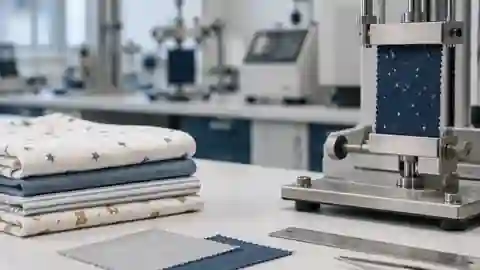
Children’s sleepwear flammability is a product-classification decision before it is a laboratory-testing decision. For US-bound pajamas, robes and sleep-related loungewear, the buyer first needs to establish whether the item is children’s sleepwear under federal rules, which size range it falls into, and whether a narrowly defined exclusion applies. A generic fabric flammability report is not a substitute for that analysis.
The two dedicated standards are 16 CFR Part 1615, covering sizes 0 through 6X, and 16 CFR Part 1616, covering sizes 7 through 14. The US Consumer Product Safety Commission (CPSC) guidance explains how the standards apply to garments sold for sleeping and related activities.
Start with intended use, not the name on the purchase order
Calling a garment “loungewear” or “comfortwear” does not automatically remove it from the sleepwear rules. CPSC considers construction, suitability for sleeping, likely use, and how a product is advertised, distributed and displayed. A matching set promoted for bedtime may require a different compliance assessment from visually similar daytime athletic clothing.
Ask the merchandising and compliance teams to preserve product listings, hangtag copy, packaging artwork and catalogue descriptions alongside the technical file. If the intended use changes during marketing, a test plan drafted solely from the factory’s original product name may no longer be adequate.
Which standard applies: 1615 or 1616?
| Question | Relevant rule | Practical action |
|---|---|---|
| Sleepwear in sizes 0–6X? | 16 CFR Part 1615 | Check whether an infant-garment or tight-fitting exclusion actually applies before ordering tests. |
| Sleepwear in sizes 7–14? | 16 CFR Part 1616 | Assess the applicable size-specific definitions and production-unit testing. |
| Diapers, underwear, qualifying infant garments or qualifying tight-fitting garments? | Excluded from the dedicated sleepwear definitions when all conditions are met | Document the reason; assess the general clothing-textile flammability rule instead. |
| Ordinary daywear, rather than sleepwear? | Generally 16 CFR Part 1610 for clothing textiles | Confirm the classification and other product-specific obligations. |
The size boundary is not permission to ignore fabric behaviour. The standards have related test structures, but each applies to its own size range. Section 1616.1(c) also provides that children’s sleepwear meeting all requirements of the Part 1615 standard complies with Part 1616. This is a legal provision, not a blanket exemption from documenting what was tested.
Three exclusions that buyers often misread
Diapers and underwear
These are excluded from the definition of children’s sleepwear in the dedicated standards. The exclusion does not mean the goods are free of all US apparel safety requirements. Assess the relevant general clothing-textile flammability provisions and any other applicable rules.
Qualifying infant garments
The Part 1615 definition is specific. A garment sized nine months or smaller must also satisfy the prescribed one-piece or two-piece length limits, labelling and applicable general flammability requirements. Merely printing “infant” on a size label does not establish eligibility. CPSC guidance states a maximum length of 25¾ inches for a one-piece infant garment, and no piece longer than 15¾ inches for a two-piece garment, together with the required age-in-months label and other conditions. Use the current regulatory measurements when evaluating an actual product. Measure the actual finished product against the regulatory definition.
Qualifying tight-fitting garments
“Slim fit” is a marketing phrase; “tight-fitting” under Parts 1615 and 1616 is a defined regulatory category. The garment must satisfy size-specific maximum dimensions at the specified body locations, including chest, waist, seat, upper arm, thigh, wrist and ankle as applicable, together with construction, trim, labelling and other conditions. The standards’ tables differ by size. Do not copy measurements from an unrelated size or assume that fabric stretch compensates for an oversized finished measurement.
For the decision file, record the size designation, measurement method, measured finished dimensions, applicable table and pass/fail comparison for every relevant point. A separate measurement protocol is useful because measurement tolerances mean little without an agreed method. CPSC explains that qualifying infant and tight-fitting garments remain subject to 16 CFR Part 1610, rather than the dedicated sleepwear testing requirements.
How fabric and garment production-unit testing fit together
For in-scope sleepwear, the dedicated standards address finished fabric, garment prototypes and production garments. CPSC’s current guidance distinguishes a Fabric Production Unit (FPU) from a Garment Production Unit (GPU). A standard FPU may cover up to 5,000 linear yards of finished fabric, while a GPU may cover up to 500 dozen finished garments, subject to the applicable grouping and sampling rules. Those figures describe regulatory unit limits, not a universal number of samples to take for every order.
Fabric testing evaluates the material intended for sleepwear. Prototype testing examines relevant design features such as seams and trims before production. Production-garment testing checks specified seams on finished garments. Changing fabric construction, trim or other characteristics can alter what can legitimately be grouped in a unit. The supplier should show how its unit definitions match the actual production lot, rather than attaching an unrelated laboratory certificate to the purchase order.
What the test report and production file should identify
Request the applicable CFR part and test procedure; product and fabric descriptions; colour or print grouping rationale; FPU/GPU identifiers and quantities; specimens and sampling basis; test results and disposition; laboratory identity; and dates. Where testing or certification obligations apply, retain the supporting records and the relevant children’s-product compliance documentation. For a useful distinction between checking individual finished goods and evaluating properties under controlled conditions, see our guide to garment inspection versus textile testing.
Do not reduce the test method to the “3.5-second” classification used in some discussions of general clothing textiles. The dedicated sleepwear standards specify their own vertical-flame procedure, char-length criteria and acceptance-sampling requirements. The laboratory must follow the applicable part, not a buyer’s shorthand.
Do the test reports support a Children’s Product Certificate?
For sleepwear subject to Parts 1615 or 1616, the US Consumer Product Safety Commission says manufacturers and importers must certify compliance using testing by a CPSC-accepted laboratory. The Children’s Product Certificate (CPC) should cite the applicable part and be supported by the relevant test evidence. A certificate is not a CPSC product approval, and the manufacturer or importer remains responsible for the accuracy of the certification. See CPSC’s business guidance on children’s sleepwear and CPCs.
Before shipment, a buyer should compare the CPC’s product description, manufacturing location, test dates, laboratory and cited standards with the actual purchase order and the FPU/GPU records. Where an infant-garment or tight-fitting exclusion applies, the file still needs evidence supporting that classification and compliance with the relevant general-apparel requirements. A supplier’s unqualified statement that a style is “exempt” is not an adequate substitute for the product-specific analysis.
Labels, traceability and records still matter
CPSC guidance identifies production-unit identification, applicable care precautions to preserve flame resistance, and children’s-product tracking-label obligations among the relevant requirements. A qualifying exclusion from the dedicated sleepwear test does not automatically remove other marking, tracking or documentation duties. Align labels with the actual fabric, finish, size and test strategy before printing packaging. The site’s separate guide to US apparel care-label requirements addresses the FTC’s care-instruction regime, which serves a different purpose.
Keep the technical file connected to purchase-order revisions, fabric lots, production units and the finished sizes shipped. If a lot is split or reworked, traceability should still allow the team to retrieve the corresponding records; our lot-traceability guide explains the underlying record problem.
Five questions to settle before approving a US sleepwear order
- How will the product be sold? Obtain the intended-use and merchandising evidence, not just a style name.
- Which size rule applies? Map each marketed size to Part 1615 or Part 1616.
- Is an exclusion claimed? Request the complete infant or tight-fitting dimensional and construction evidence, not a supplier declaration alone.
- What exactly was tested? Tie fabric, prototypes, seams, trims and production units to the goods on order.
- What will travel with the goods? Confirm identification, tracking, care instructions and applicable certification and recordkeeping.
A buyer who resolves those five questions before bulk cutting has a much stronger compliance file than one who discovers the wrong test standard after shipment. When the classification is genuinely uncertain, seek product-specific guidance from a qualified US compliance specialist or CPSC rather than assuming a borderline item is exempt.
Primary sources and scope
- eCFR: 16 CFR Part 1615, sizes 0–6X.
- eCFR: 16 CFR Part 1616, sizes 7–14.
- CPSC: Children’s Sleepwear FAQ, including scope, exclusions, production units and labels.
- eCFR: 16 CFR Part 1610, general clothing textiles.
Editorial review updated 23 October 2026: This is a general US regulatory explainer, not a determination that a particular garment is compliant. Check the current rule text and product facts before placing goods on the market.
