
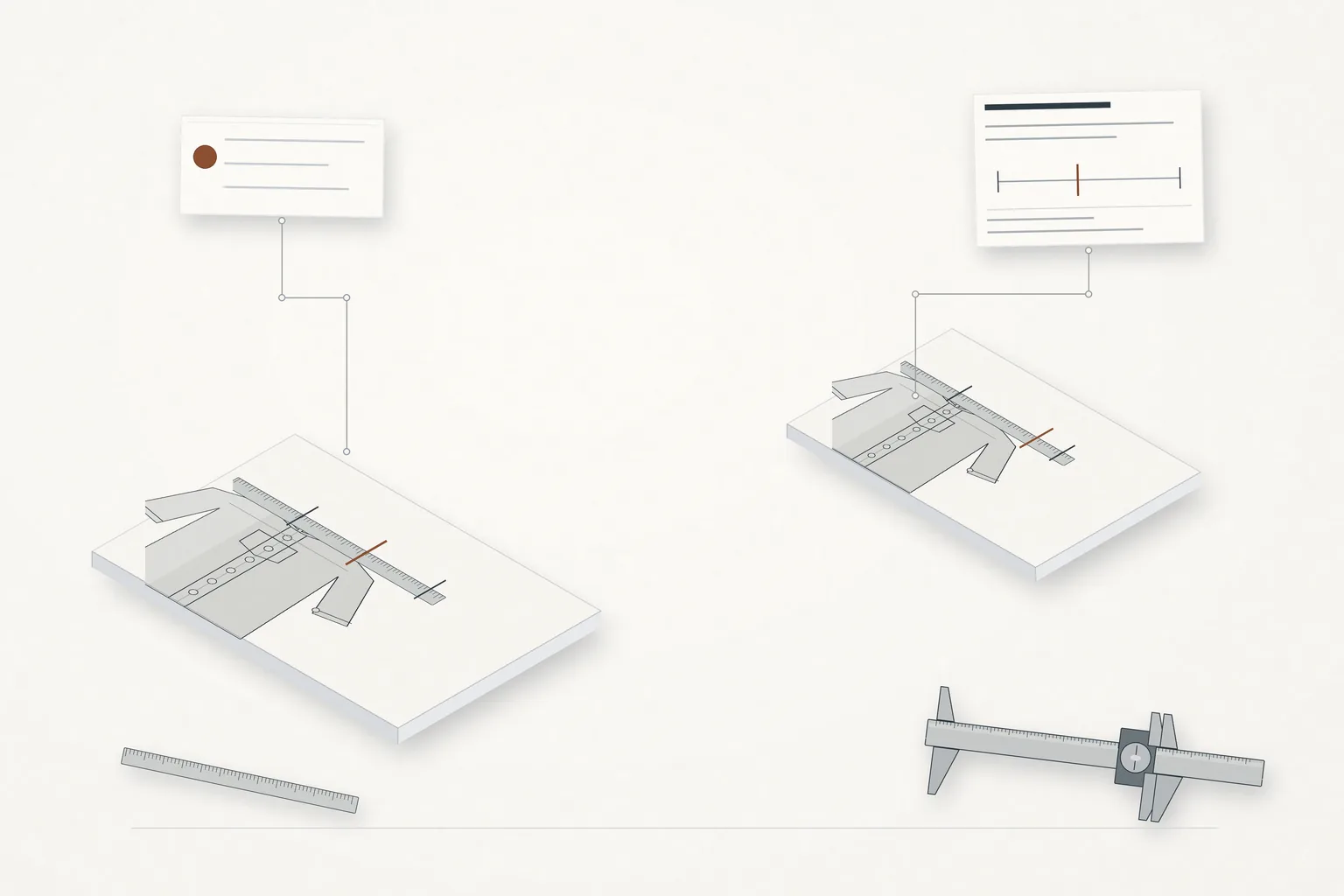
Cover: AI-generated conceptual illustration for WEFTSIGNAL, not documentary photography.
A tolerance without a method is half a specification
Two laboratories measure the same garment and report different chest dimensions. Both followed their own procedure correctly, and unless the specification said how the garment is measured, neither is wrong. A tolerance is a permitted range around a nominal figure, and it describes nothing until the act that produces the measurement is fixed.
The specification has to carry both halves
A complete dimensional requirement states the point of measure, the nominal value, the permitted deviation, and the method by which the measurement is taken. Remove any one and the requirement cannot be tested, because a garment can only be shown to fail if examiner and maker agree on what was measured. ISO 18890:2018 defines the main measurement points and the method used to measure garment dimensions, and notes that additional points can be agreed between interested parties.
Points of measure are agreed landmarks
A point of measure is a defined place, described precisely enough that two people arrive at the same spot. Chest, on a flat-measured garment, is not a location until someone states where the tape sits relative to the armhole seam and whether the garment is fastened. The disputed points are the derived ones: a raglan armhole, a dropped shoulder, a curved hem whose length shifts with where the tape is dropped.
How the garment is laid changes the number
Measurement is a physical act on a physical object, and the object’s state is part of the method. A knitted garment placed on a table relaxes; how long it rests, and whether it was pressed first, changes what the tape finds. Leaving resting period, surface, closure state and tape tension unstated leaves the most variable parts of the procedure to whoever holds the tape.
Who measures, and with what
People vary: two trained inspectors can differ systematically, one reading to the nearest graduation and one estimating between graduations. The instrument matters too — a tape stretched by use, a rigid rule where a tape was intended, a measurement taken over a bulky seam rather than beside it. Naming the instrument, the reading convention and the recording unit removes most of that variation before it reaches the numbers, and ISO 5725-1:2023 sets out the conditions and resources needed to evaluate a measurement method or a result.
Why two laboratories can both be right
The case is ordinary rather than scandalous. One laboratory follows its documented method and reports the chest flat, seam to seam, after a stated rest; another follows a different documented method and reports another figure. Each result is valid for the procedure that produced it; they diverge because the procedures differ. Where the specification does not choose between them, the dispute is settled by whoever wrote the order last.
The danger of narrowing a tolerance
A common response to disagreement is to tighten the range until the two results overlap. That treats a method problem as a limit problem and makes it worse: the variation sits in the procedure, so a narrower band still varies and now rejects goods identical to those being accepted.
An illustrative example: the same chest, three results
Suppose, illustratively, one garment is measured three ways: flat immediately after unpacking, flat after it rests, and over a light press. If the specification gives only a nominal value and a permitted range, all three can fall outside each other while each is defensible. Add the point of measure, the resting condition, the closure state and the reading convention, and they converge, leaving only a real difference in the garment.
What the method statement needs to settle
Before a tolerance means anything, these are fixed in writing:
- Point of measure: the landmark, described precisely, with a diagram where words are ambiguous.
- Garment state: flat or on body, relaxed or extended, pressed or not, and the resting period.
- Closure and presentation: fastened or open, and how bulky seams are handled.
- Instrument and reading: the tool, its condition, and whether readings are taken to graduation or estimated.
- Nominal and deviation: the target figure and permitted range, in the unit the factory works in.
- Measurement system: how examiners are trained and compared, and how disagreement is resolved.
- Record: who measured, when, with what, and where the result is filed.
Writing it into the order
None of this is exotic or expensive. It is a page attached to the specification, referenced by the inspection plan and cross-checked against the shrinkage requirement, because a garment that meets its tolerance out of the bag and misses it after care has failed a specification nobody wrote down properly. A working template for that page would carry a separate field for each point of measure, its method and its permitted deviation.
Source and further reading
Sources consulted 16 October 2026: ISO — ISO 18890:2018, Clothing: Standard method of garment measurement; ISO — ISO 3759:2011, Textiles: Preparation, marking and measuring of fabric specimens and garments in tests for determination of dimensional change; ISO — ISO 5725-1:2023, Accuracy (trueness and precision) of measurement methods and results, Part 1. Standards are cited by designation and official catalogue page only, and no tolerance value is reproduced here. The illustrative example and the method checklist are WEFTSIGNAL editorial material. WEFTSIGNAL and NOVITA are separate businesses. However, the operator of WEFTSIGNAL also works on NOVITA’s digital marketing. This relationship is disclosed for transparency. Continue exploring quality control coverage and our editorial standards.
