
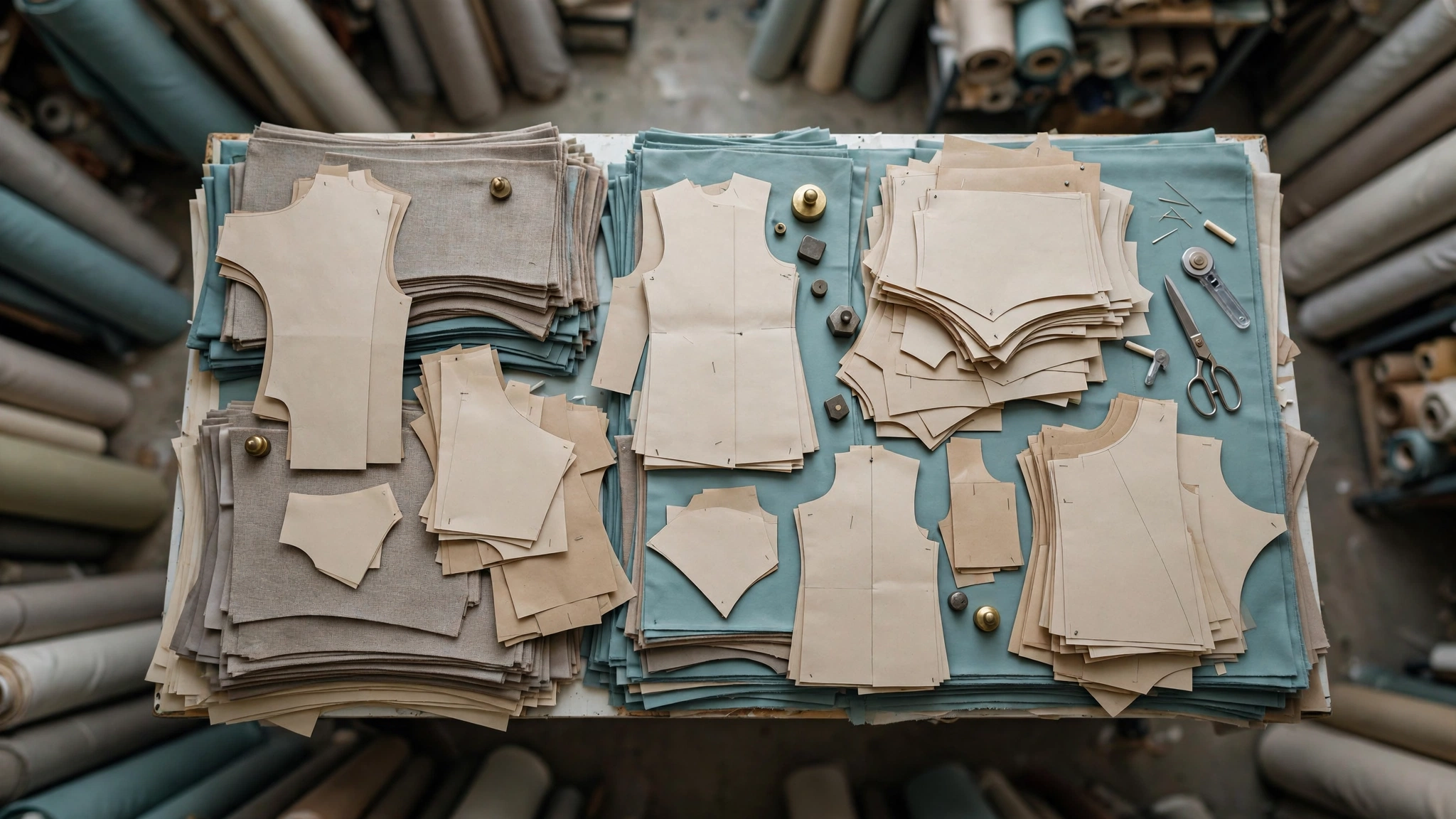
Fabric is the single biggest cost in a garment — often estimated at well over half of the total manufacturing cost. That makes fabric waste one of the largest, and most controllable, cost leaks in apparel production. Yet in many factories, waste is treated as an unavoidable by-product of cutting rather than a measured, managed variable.
This article breaks down where fabric waste comes from in garment manufacturing, why it happens, and the practical methods factories use to reduce it — written for buyers who want to understand what sits behind the fabric consumption figures in a quote, and for factory teams looking to tighten control.
The main types of fabric waste
1. Marker waste (cutting waste)
The marker is the layout of pattern pieces on the fabric before cutting. No marker uses 100 percent of the fabric; the gaps between pieces become waste. Marker efficiency — the percentage of fabric actually used by pattern pieces — is the single most important number in cutting-room economics. Complex shapes, striped or checked fabrics that require pattern matching, and small order quantities all push efficiency down and waste up.
2. End-of-roll and end-of-piece waste
Fabric arrives in rolls, and pattern pieces rarely divide roll lengths evenly. The leftover ends, plus the extra length needed for spreading alignment, become waste. Poor roll planning — cutting small orders from full rolls without combining markers — multiplies this loss.
3. Defective panels
Panels cut from fabric that contains defects — holes, stains, shade bands, barre — are rejected after cutting. This is the most expensive kind of waste because the fabric has already consumed cutting labour and, in many cases, the defect could have been found before the blade ever touched it.
4. Sampling and development waste
Proto samples, fit samples, size sets, and pre-production samples each consume fabric. Development waste is legitimate, but factories that do not track it separately often discover it is larger than expected — especially when buyers request multiple rounds of revisions.
5. Overproduction and excess inventory
Cutting more than the order requires “just in case,” or holding fabric ordered against forecasts that never materialise, creates waste further downstream. Excess fabric and finished garments that never sell are waste with the full cost of manufacturing already embedded in them.
Why waste happens: the root causes
- Marker planning done late or in isolation. When markers are planned after fabric is ordered, roll widths and quantities cannot be optimised around the marker. The cheapest time to reduce waste is before purchasing.
- Fabric inspected after cutting, not before. Cutting uninspected fabric converts correctable problems (a shade band that could have been segregated) into rejected panels.
- Shade and shrinkage discovered too late. Fabric that varies in shade between rolls, or shrinks more than expected, forces re-cuts. Both are preventable with incoming inspection and shrinkage testing.
- Order changes after cutting starts. Size-ratio changes, colour cancellations, and quantity revisions turn cut work into waste. Clear pre-production approval discipline prevents most of this.
- No measurement, no accountability. Many cutting rooms track total fabric issued and total garments produced, but not waste by cause. Without that breakdown, improvement efforts have no baseline.
How factories measure fabric waste
The two numbers that matter:
- Marker efficiency (%) — the share of fabric area covered by pattern pieces. CAD nesting software reports this automatically; manual markers should be measured the same way.
- Cut waste (%) — fabric issued minus fabric embodied in accepted cut panels, divided by fabric issued. Tracking this by style, by fabric, and by cause turns a vague “we waste too much” into actionable data.
Buyers can ask for both figures. A factory that knows its marker efficiency by product category is a factory that manages waste; one that cannot produce the number is worth a follow-up question.
Practical ways to reduce fabric waste
Plan the marker before ordering the fabric
Marker efficiency should be estimated during costing, not discovered in the cutting room. CAD systems allow virtual nesting on the actual roll widths available, and combining small orders into shared markers (“combo markers”) can lift efficiency materially. This is also why accurate fabric consumption calculation matters — the consumption figure and the waste figure are two sides of the same marker.
Inspect fabric before it is cut
A fabric inspection programme — checking rolls against agreed standards for defects, width, shade, and shrinkage before bulk cutting — moves defect discovery to the cheapest possible point. Panels rejected after cutting cost far more than rolls rejected at goods-in. (See our guides to fabric sourcing discipline and AQL-based inspection sampling.)
Control shade and shrinkage up front
Shade bands across rolls and unexpected shrinkage are classic re-cut triggers. Approving lab dips and bulk lots against a defined standard, and testing shrinkage before cutting, removes two of the most common causes of post-cut rejection.
Tighten pre-production approval
Most order-change waste traces back to approvals that were vague or skipped. A disciplined pre-production approval process — with size ratios, colours, and quantities locked before cutting — is a waste-reduction measure as much as a quality measure.
Segregate and route offcuts
Not all waste is equal. Clean cutting waste, sorted by fibre content, is feedstock for textile-to-textile recycling and downcycling markets. Mixed or contaminated waste is landfill. Segregation at the cutting table costs little and preserves the value of what cannot be avoided.
Digitise sampling where possible
3D sampling and digital prototypes cannot eliminate physical samples entirely, but they can cut the number of physical rounds — and the fabric each round consumes.
What this means for buyers
When you review a factory quote, the fabric consumption figure already contains an assumption about waste. Understanding that assumption helps you ask better questions: What marker efficiency is built into this consumption? Is the fabric inspected before cutting? How are shade and shrinkage controlled? The answers tell you as much about a factory’s management discipline as about its price.
Waste reduction is also increasingly a compliance and brand story, not just a cost story. As extended producer responsibility for textiles spreads and recycled-content claims face scrutiny (see our EU Green Claims and recycled content claims guides), factories that measure and minimise waste will find it easier to evidence their position — and buyers who understand waste will find it easier to choose them.
Related reading: Fabric Consumption Calculation · Fabric Sourcing for Apparel · Apparel Inspection Sampling: How AQL 2.5 Works · Recycled Content Claims in Apparel
