
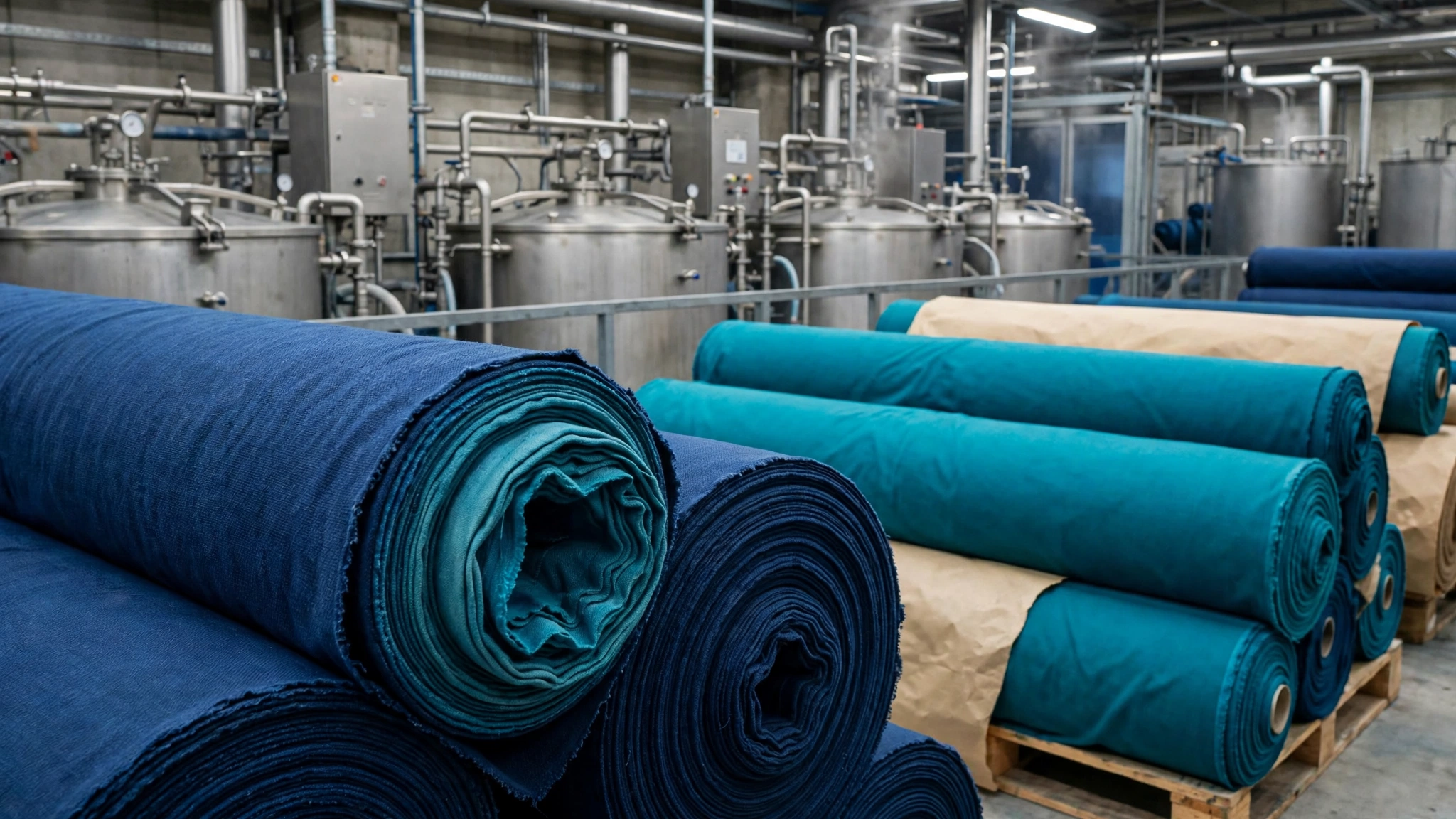
Colour is often approved from a small swatch, then produced at scale in a dyehouse the buyer never visits. When the bulk shade is off, when colour fades after washing, or when a chemical limit is exceeded, the problem is rarely a single mistake. It is usually a specification that left the dye method, the approval standard, or the chemical requirement unstated.
This guide explains the textile dyeing process from a buyer’s point of view: which method fits which fibre, what to specify before dyeing starts, how to approve colour in a way that survives bulk production, and which risks to check before shipment.
1. Dyeing is not one process
The word dyeing covers several different operations, and the right one depends on fibre, fabric form, and end use.
Common approaches include:
- Fibre and yarn dyeing, where colour is applied before weaving or knitting. This is often used for stripes, checks, and heather effects, and for fibres that need deep, even colour.
- Piece dyeing, where finished fabric is dyed in a jet, winch, or beam machine. This is common for solid colours and for orders where the final shade is decided after fabric production.
- Garment dyeing, where finished garments are dyed after sewing. This can give a soft, washed look, but it also introduces risks around shrinkage, seam puckering, and trim compatibility.
- Printing, which is sometimes confused with dyeing, but applies colour to specific areas of a fabric rather than colouring the whole piece.
A buyer who simply writes dye to shade on a purchase order has not specified a process. The factory and dyehouse must then choose a method, a machine, and a chemical system, and any of those choices can change cost, shade, fastness, and compliance.
2. Matching dye class to fibre
Dye chemistry must match fibre chemistry. The table below summarises the usual pairings at a general level. Exact dye selection depends on the specific fibre blend, fabric construction, and required fastness, and should be confirmed by the dyehouse for each order.
| Fibre | Commonly used dye classes | Buyer note |
|---|---|---|
| Cotton and other cellulosics | Reactive, direct, vat, sulphur | Reactive dyes are widely used for wash fastness; vat dyes can offer high fastness but at higher cost and complexity. |
| Polyester | Disperse | Disperse dyes are designed for synthetic fibres; shade and fastness depend heavily on heat-setting and reduction clearing. |
| Wool and silk | Acid, reactive | Protein fibres need careful pH and temperature control to avoid damage and felting. |
| Nylon | Acid, disperse, pre-metallised | Dye choice depends on end use, including light fastness and stain resistance. |
| Blends | Combination systems | A cotton-polyester blend may need two dye systems. Ask how each fibre will be dyed and what happens to the other fibre in the process. |
Blends deserve extra care. A blend that looks simple on a label can require two dye baths, different temperatures, or a compromise on fastness. If a blend is dyed as if it were a single fibre, one component may be under-dyed, over-dyed, or damaged.
3. What to specify before dyeing starts
A complete dye specification should include, at minimum:
- The fibre and fabric to be dyed, including construction, weight, and any prior treatment such as scouring or bleaching.
- The target shade, with a physical reference standard, not only a name or a photograph.
- The dye method and, where relevant, the machine type, if the buyer has a requirement or a restriction.
- The required colour fastness levels, by test type: washing, rubbing, light, perspiration, and water, as relevant to the garment’s end use.
- Chemical requirements, including any restricted substance list that applies to the order, and whether the dyehouse must follow a manufacturing restricted substances list such as the ZDHC MRSL.
- The approval process: lab dip, bulk approval, and what happens if the bulk shade falls outside the agreed tolerance.
- The handling of trims, labels, and elastics, which may dye differently, shrink, or be damaged in the dye bath.
Colour fastness is not a single number. A fabric can have good wash fastness and poor light fastness, or good dry rubbing fastness and poor wet rubbing fastness. Specifying fastness without naming the test is like specifying a size without naming the measurement point.
4. Colour approval that survives bulk production
Lab dips are small-scale dye trials made to match a reference shade. They are useful, but they do not prove bulk production. A practical approval sequence is:
- Agree the reference standard and the light source for judging shade. Colour looks different under daylight, shop lighting, and fluorescent light, so the light source must be stated.
- Approve a lab dip against that standard, with a stated tolerance, such as a colour difference limit, and a visual assessment by an agreed method.
- Approve a bulk or first-production sample, because machine, liquor ratio, water quality, and fabric lot can all shift shade.
- During bulk production, check shade across lots and across the width and length of the fabric, not only from the first roll.
Metamerism is a common trap: two fabrics that match under one light source may not match under another. If a garment will be worn and sold under varied lighting, the approval should check shade under more than one light source, or at least record the light source used for approval.
Colour approval should also be tied to fabric colour approval as a separate gate. A shade approved on a lab dip is not the same as a shade approved on bulk fabric, and a bulk fabric approval is not the same as a garment approval after washing or finishing.
5. Water, effluent, and chemical risk
Dyeing is a wet process, and its environmental and compliance risks are part of the buyer’s responsibility, not only the dyehouse’s.
Key questions to ask include:
- What chemicals will be used, and are they screened against the buyer’s restricted substances list and any applicable manufacturing restricted substances list?
- How is wastewater treated, and what evidence is available, such as treatment records or third-party testing, without overstating what a single report proves?
- What happens to dye bath leftovers, salt, and auxiliaries, and how are they handled or disposed of?
- For dark shades or deep blacks, what is the expected water and energy use, and is there a lighter-shade or lower-impact alternative that meets the design intent?
Buyers should be careful with claims here. A dyehouse that says it is chemical-free or zero-discharge should be asked what that claim covers, over what period, and what evidence supports it. A single test report does not prove ongoing compliance, just as a single lab dip does not prove bulk shade.
6. Common dyeing failures and how to prevent them
| Failure | Likely cause | Prevention |
|---|---|---|
| Shade variation between lots | Different fabric lots, water, or dye batches | Lot control, bulk shade approval, and shade sorting before cutting |
| Poor wash fastness | Wrong dye class, incomplete fixation, or inadequate washing off | Specify fastness by test, confirm dye class for the fibre, and test washed samples |
| Staining of trims or linings | Trims dyeing or bleeding in the bath | Test trims separately and specify whether trims are dyed, undyed, or protected |
| Shrinkage after garment dyeing | Heat, agitation, or finishing change | Test shrinkage on dyed garments, not only on undyed fabric |
| Colour fading in light | Dye class unsuitable for the end use | Specify light fastness for the intended exposure, such as outdoor wear |
| Chemical non-compliance | Unscreened dyes or auxiliaries | Screen chemicals before production against the applicable restricted list |
Many of these failures are cheaper to prevent at the lab dip and bulk approval stages than to correct after cutting, sewing, or shipment.
7. Buyer checklist before dyeing starts
- Fibre, fabric, and prior treatment are specified and confirmed by the dyehouse.
- Dye method and dye class are stated for each fibre in a blend.
- Reference shade, light source, and tolerance are agreed in writing.
- Fastness requirements are specified by test type, not as a general claim.
- Chemical screening against the applicable restricted list is confirmed before production.
- Lab dip, bulk approval, and in-production shade checks are scheduled, with a rule for what happens if bulk shade is out of tolerance.
- Trims, labels, and elastics are checked for dye compatibility and shrinkage.
- Water and effluent handling is documented at a level the buyer can actually review.
Colour is a design decision, a technical process, and a compliance risk at the same time. When buyers specify the method, the standard, the fastness, and the chemical screen before dyeing starts, they give the dyehouse a testable target — and they give themselves a way to approve bulk production without relying on a single swatch.
