
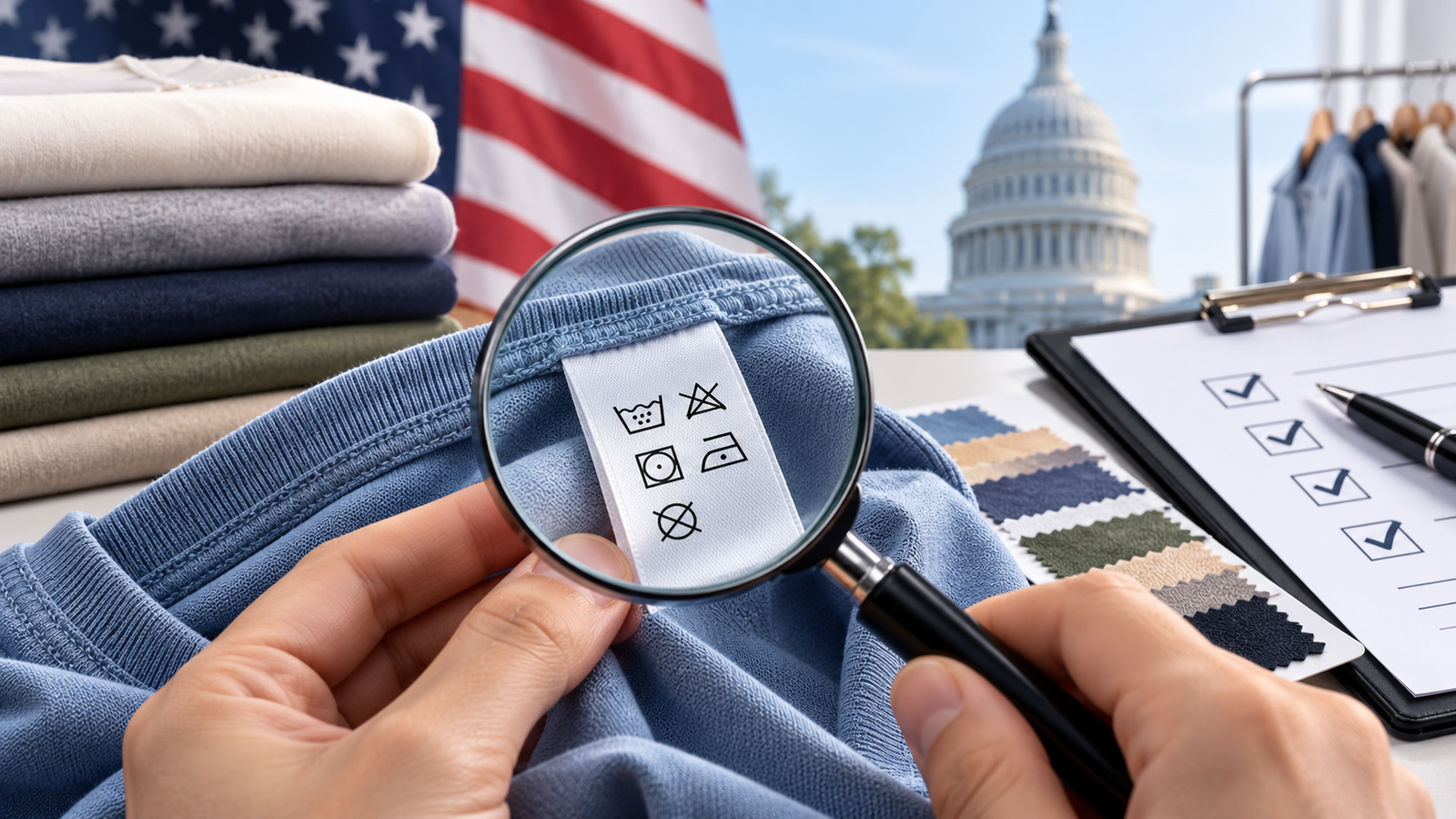
A US apparel care label is a supported instruction, not a decorative symbol strip. Under the Federal Trade Commission’s 16 CFR Part 423 Care Labeling Rule, manufacturers and importers of covered textile garments must provide suitable regular-care instructions and have a reasonable basis for them before sale. The challenge for buyers is to check the whole finished garment, not simply copy the washing symbols supplied with a roll of fabric.
This guide separates three questions that often get mixed together: what information the US rule requires, when symbols can replace words, and what evidence makes an instruction defensible. The governing source is the FTC’s published text of 16 CFR Part 423, reviewed on 19 October 2026.
Which products and businesses are covered?
The Care Labeling Rule applies to manufacturers and importers of textile wearing apparel and certain textile piece goods intended for home sewing. It also covers parties that direct or control the relevant manufacturing or importation. The rule’s definition of textile wearing apparel excludes footwear, gloves, hats and articles used exclusively to cover or protect the head or hands; these products may have other requirements.
For most covered finished garments, the care label must remain attached and legible throughout the useful life of the product. If packaging or folding makes the label hard to find at the point of sale, the information must also appear on the package exterior or on a hangtag. Certain narrow exemptions exist, but “our design has no room for a label” is not itself an exemption.
What does the care label have to tell the buyer?
The instruction must give at least one suitable method of regular care needed for ordinary use. Depending on that method, it needs clear directions on washing or professional dry cleaning and the relevant conditions, including drying, bleaching and ironing when applicable. It must also warn about parts of the recommended process that could harm the garment or other items being cleaned.
That does not mean every label must prescribe every conceivable washing method. A garment may have more than one safe care method, but the rule requires a reliable basis for the instructions actually provided. Where no cleaning procedure can be used without damage, the manufacturer or importer must make that limitation clear.
| Approval question | Evidence worth requesting | Common failure |
|---|---|---|
| Can the finished garment tolerate the prescribed wash? | Garment-level wash and appearance assessment or other reliable substantiation | Only the shell fabric was checked |
| Are drying, bleaching and ironing directions supportable? | Documented care procedure, restrictions and relevant performance evidence | Generic symbols copied from a template |
| Do trims, prints, interlinings and linings remain acceptable? | Evidence for components together with the garment as a whole | Buttons, coatings or colour combinations react differently |
| Can shoppers see the care information before purchase? | Placement and packaging review | Label hidden inside sealed packaging |
When specifying a garment, include care performance in the fabric and product specification. A label is only as credible as the approved construction and finishing it describes.
Can symbols replace words on US care labels?
Yes, but not every internationally familiar symbol set is automatically interchangeable. The FTC rule expressly permits the ASTM D5489-96c care-symbol system to be used in place of written terms when the symbols satisfy the rule. Appropriate symbols may also accompany words. The historic 18-month explanatory-label condition attached to the 1997 adoption is no longer an ongoing requirement.
European-market labels commonly use symbols associated with ISO 3758 and GINETEX. Their appearance may be familiar, but the US rule’s specific symbols-only permission refers to ASTM D5489-96c. Do not assume that a European artwork file is automatically sufficient for the US market. A buyer can use clear written instructions where appropriate, or verify that a proposed symbols-only label uses the system the FTC rule permits.
In 2012, the FTC proposed considering additional symbol standards, but a proposal is not a change to the governing rule. The FTC rule page is the place to check current amendments, rather than relying on an undated care-symbol chart.
What counts as a reasonable basis?
Under § 423.6(c), the manufacturer or importer must possess reliable evidence before sale. The rule recognises several possible forms: appropriate testing of the product or a representative sample, evidence of successful cleaning, reliable evidence of harm from warned-against methods, relevant technical literature, industry experience, and evidence concerning components together with the finished garment.
There is no universal instruction that every SKU must undergo the same laboratory test. But a bare supplier assurance, with no explanation of why the instruction fits the actual garment, may leave the importer unable to substantiate its label. Keep a traceable link among the approved fabric lot, trims, finished style, care decision and evidence. A later change in coating, print, dye or trim should trigger a fresh review.
Exceptions are narrower than many label templates suggest
Under § 423.8, a totally reversible textile garment without pockets is exempt from the permanent care label requirement, but the required care information still has to be provided conspicuously before purchase. Another exemption concerns products proven safe under all of the harshest specified cleaning procedures, with a required statement on a hangtag or package. Other exemptions may require a written FTC request.
The difference between a permanent-label exemption and an exemption from providing care information is critical. A product should not be released with no care directions merely because its design is reversible.
Practical care-label sign-off checklist
- Confirm coverage. Record the finished product category and responsible manufacturer or importer.
- Approve the care method. Write a complete instruction with the relevant restrictions and warnings.
- Substantiate it. Link tests or other reliable evidence to the finished garment, including trims and finishing.
- Check symbol compliance. For a symbols-only US label, verify the permitted ASTM system rather than assuming ISO artwork is sufficient.
- Inspect placement. Ensure the permanent label is legible and accessible; add point-of-sale information when packaging hides it.
- Control revisions. Recheck the label when fabrics, dyes, prints or construction change.
The care-label sign-off is a quality-control gate, not merely an artwork approval. Our pre-production approval guide explains how to keep such decisions tied to the production version that actually ships.
Primary sources
Reviewed 19 October 2026: FTC, Care Labeling Rule, 16 CFR Part 423; FTC rule status and amendments; and FTC’s 2021 decision to retain the rule. This article is general compliance information, not a product-specific legal determination.
