
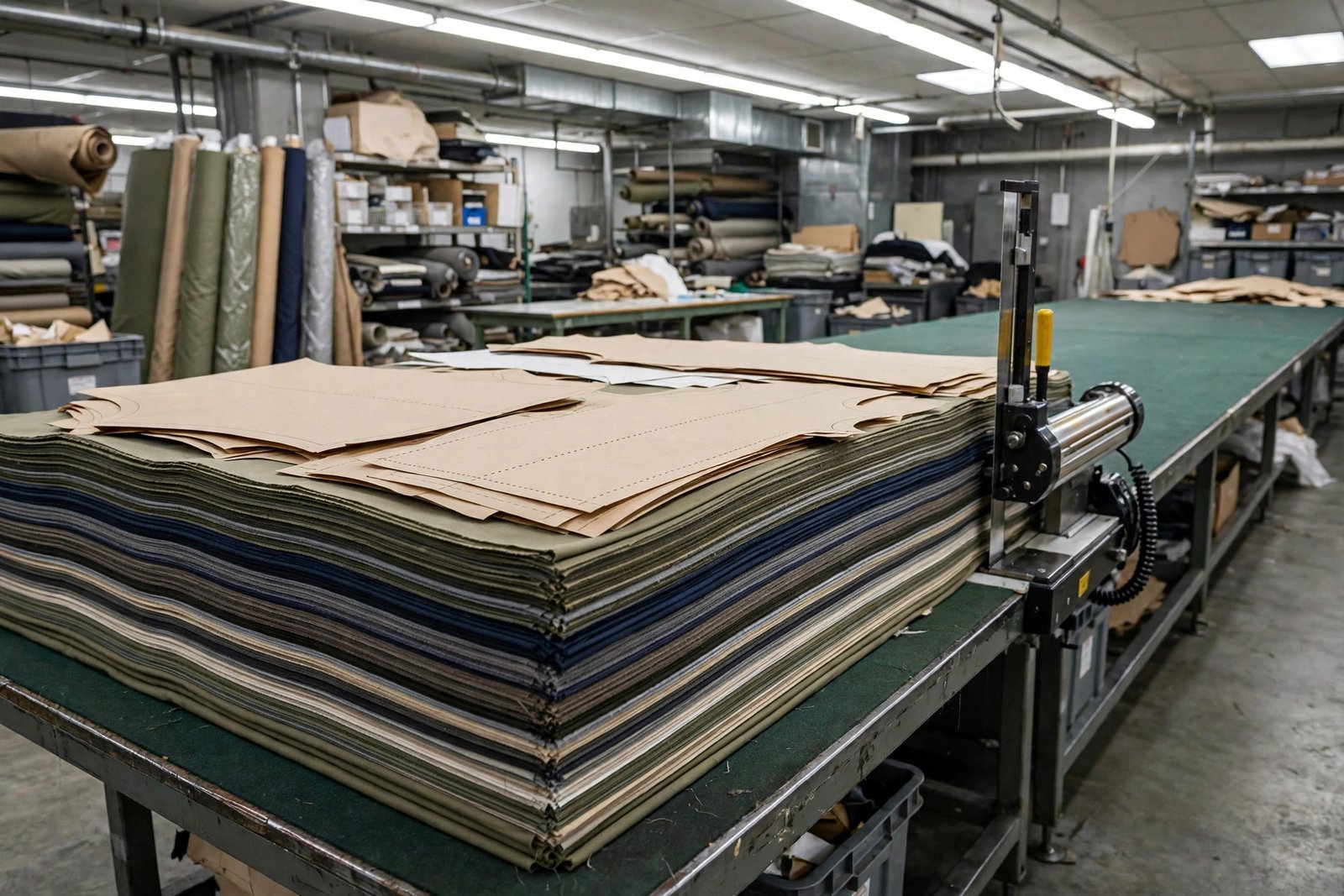
Fabric is usually the largest cost in a garment — often 60 to 70 percent of the total — and the cutting room is where most of it is won or lost. Yet when buyers audit factories, they check the sewing lines, the finishing tables, and the packing area, and walk straight past the cutting tables where the spreading decisions are made. Those decisions have names: nap one way or nap either way, face one way or face to face. Get them wrong and you get shade bands, upside-down prints, and marker waste that no amount of sewing skill can fix.
This guide explains the four fabric spreading modes used in apparel cutting, when each one applies, what each one costs in fabric and time, and the decision logic a buyer or factory auditor can use to check whether the cutting room made the right call.
What Spreading Is — and Why Direction Matters
Spreading is the process of laying plies of fabric in a stack — the lay — to the length of the marker, aligned in length and width and without tension, so that many garment panels can be cut in one pass. The marker is the paper (or digital) layout of all pattern pieces for a style; its width matches the fabric’s cuttable width, and its efficiency — the percentage of fabric actually used in garment parts — is the main lever on material cost.
Direction matters because most fabrics are not the same in every orientation. A velvet looks darker brushed one way than the other. A one-way print has an up and a down. A twill’s diagonal runs one way. If the plies in a lay face different directions, the finished panels will not match: one sleeve will look darker than the other, or the print will run upside down on half the garments. Spreading modes are the formal system for preventing exactly that.
The Two Axes: Nap Direction and Face Direction
Every spreading mode is a combination of two independent choices:
Nap direction — NOW vs NEW. Nap One Way (NOW) means every ply is laid with the fabric’s “up” direction pointing the same way: all naps brushed the same direction, all prints upright. Nap Either Way (NEW) means plies may alternate direction, because the fabric has no directional character — a plain poplin, a symmetric dobby, a solid twill with no visible diagonal all qualify. The classification depends on the fabric, not the garment: asymmetric fabrics (napped, brushed, piled, one-way prints, one-way designs) require NOW; symmetric fabrics allow NEW.
Face direction — F/O/W vs F/F. Face One Way (F/O/W) lays every ply face-up. Face to Face (F/F) alternates plies face-up and face-down. F/F exists for two reasons: it lets mirrored pairs (left and right fronts, for example) be cut together from one marker, and on some fabrics it improves lay stability. But it can only be used where turning the fabric over does not change its appearance — which is why F/F is almost always paired with NEW.
The Four Modes and When Each Applies
1. NOW, F/O/W — Nap One Way, Face One Way
The strictest and slowest mode, used for napped, piled, and one-way printed fabrics where every panel must show the same face in the same direction. Each ply is laid face-up with the nap running the same way, and the marker is drawn for one-way placement only. Fabric consumption is highest here — typically several percentage points above the other modes — because pattern pieces cannot be interlocked by turning them. This is the correct mode for velvet, corduroy, brushed flannel, and any directional print, and any factory proposing a cheaper mode for these fabrics is proposing a quality failure.
2. NEW, F/F — Nap Either Way, Face to Face
The most economical mode, used for symmetric fabrics: plain weaves, balanced twills, solid knits. Plies alternate direction and face, mirrored pairs cut together, and marker efficiency is at its maximum. Most basic woven and knit production should run in this mode. If a factory runs plain shirting in a stricter mode, the buyer is paying for fabric that the marker cannot use — a costing question, not a quality one.
3. NOW, F/F — Nap One Way, Face to Face
The compromise mode: the nap runs one way (for directional fabrics) but plies alternate face-up and face-down so mirrored pairs can still be cut together. It applies where the fabric has a directional character but the pattern needs pairs — a one-way stripe that must match at the side seam, for instance. The constraint is physical: face-to-face spreading on a napped fabric means half the plies show the fabric’s back, so this mode only works where the face/back difference does not affect the panel appearance or where the pattern pieces are placed accordingly. Misapplied, it produces the classic defect: garments that match on the table but shade differently on the body.
4. NEW, F/O/W — Nap Either Way, Face One Way
The special-case mode: the fabric is symmetric, so plies may run either direction, but every ply is laid face-up. It is used where all panels must show the fabric face for reasons other than direction — some coated or finished fabrics, or markers where the CAD placement assumes face-up only. It is the least common of the four in everyday production, and its appearance on a cutting plan should prompt the question of why F/F was not suitable.
Deadheading: The Hidden Cost of One-Way Spreading
There is a cost to one-way spreading that never appears on the marker. In F/O/W spreading, the spreading machine lays a ply from one end of the table to the other, the fabric is cut across the width, and then the machine and operator must travel back to the starting end — empty, without laying fabric — to begin the next ply. This empty return trip is called deadheading, a term borrowed from the trucking industry for travelling without a load. Every deadheaded return is lost time: the table is occupied, the operator is working, and no ply is being laid.
Deadheading is why NOW/F/O/W is not just a fabric-consumption penalty but a labour and throughput penalty as well. A buyer comparing cutting-room costs between two factories should know which modes each one uses as standard practice — a factory that defaults to one-way spreading on symmetric fabrics is slower and more wasteful than one that does not, and the difference compounds across thousands of lays.
The Buyer’s Decision Tree
When you audit a cutting room or review a production plan, run through this sequence:
- Classify the fabric. Is it symmetric or asymmetric? Napped, brushed, piled, one-way print, or directional design means asymmetric — NOW is mandatory, and the discussion ends there.
- Check the mode against the classification. Asymmetric fabric in NEW/F/F is a defect waiting to happen; symmetric fabric in NOW/F/O/W is money left on the table. Either mismatch is a finding.
- Ask why, where the mode is unusual. NEW/F/O/W and NOW/F/F are legitimate but uncommon — the cutting manager should be able to explain the fabric or pattern reason in one sentence.
- Look at the lay, not just the plan. Plans say F/F; tired operators sometimes lay F/O/W out of habit. A quick look at ply edges on the table confirms what the paperwork claims.
- Connect the mode to the marker. Ask for the marker efficiency figure and the mode it was planned for. If the efficiency was calculated for NEW/F/F but the lay was spread NOW/F/O/W, the consumption estimate and the actual consumption will not agree — and the variance will surface as a fabric shortage two weeks later.
This sequence takes ten minutes on the cutting-room floor and catches the most expensive class of cutting errors: the ones made before the knife ever touches the fabric. It pairs naturally with the garment production workflow view of where cutting sits in the order cycle, and with seam construction knowledge when you trace a finished-garment complaint — shade bands, mismatched prints — back to its origin on the cutting table.
The Bottom Line
Spreading modes look like a cutting-room technicality, but they are really a commercial decision expressed in fabric direction: the strictest mode protects appearance at the cost of material and time, the loosest maximises efficiency, and the two in between exist for the fabrics that need both. Buyers who understand the four modes can read a cutting plan the way they read a cost sheet — and can spot, before a single panel is cut, whether the factory’s spreading choices match the fabric in hand. (Technical framework follows Harold Carr and Barbara Latham, The Technology of Clothing Manufacture; spreading-mode terminology per standard cutting-room practice.)
