
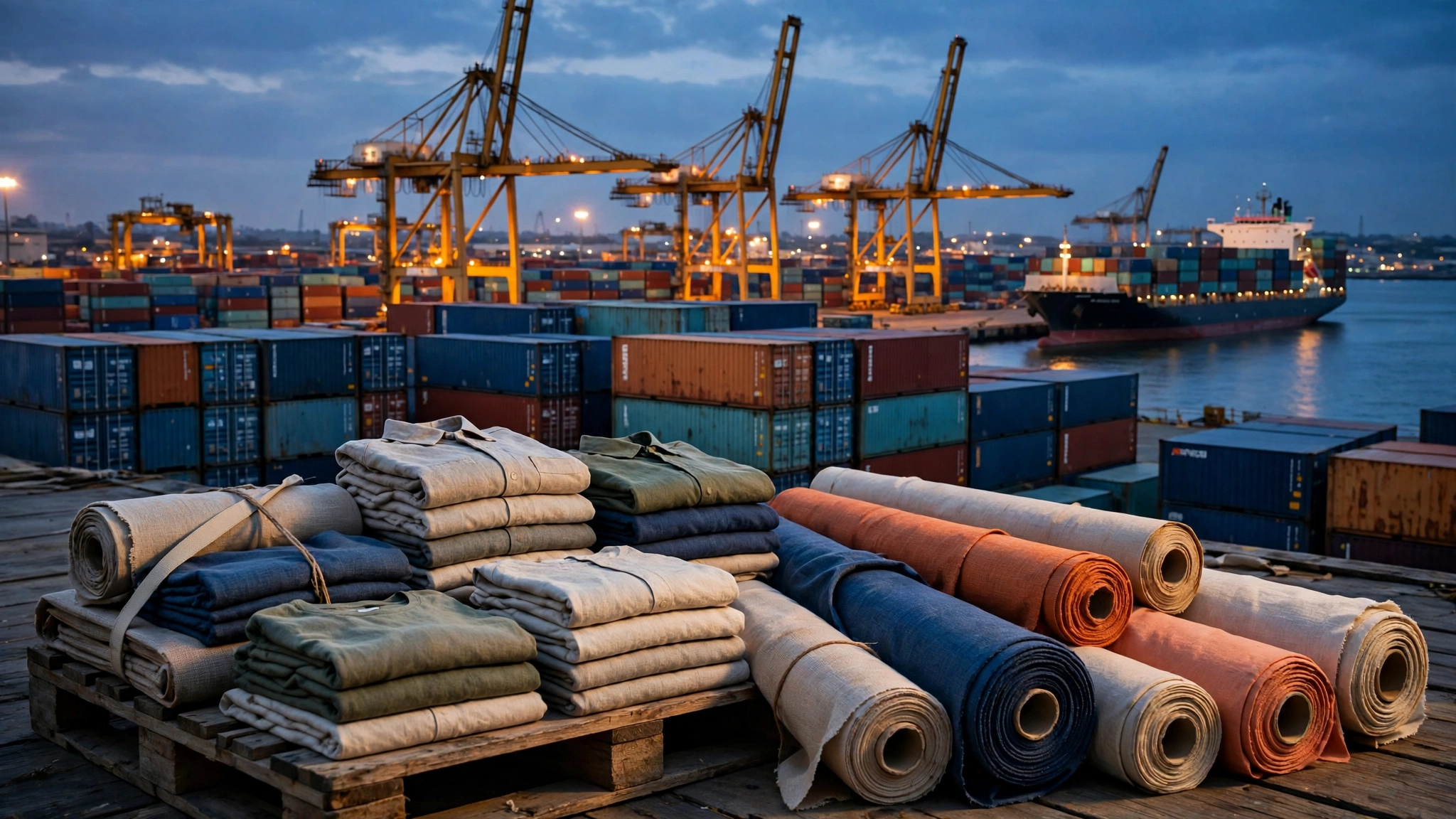
For years, Indian apparel exporters have sold into Europe at a tariff disadvantage. Rivals in Bangladesh shipped duty-free under the EU’s Everything But Arms scheme, and Vietnam under its own EU free trade agreement, while Indian garments generally benefited from the EU’s standard GSP preference. For apparel tariff lines carrying a 12% most-favoured-nation rate, the 20% GSP reduction produced a 9.6% preferential rate — a rate apparel still pays today. What changed at the start of 2026 was upstream: the EU suspended GSP preferences for Indian textiles — yarns and fabrics — under Regulation (EU) 2025/1909, so those now pay full MFN rates, while apparel kept its preference. That gap is now close to closing — and the sourcing map of European apparel may shift with it.
India and the European Union concluded negotiations on their Free Trade Agreement at the 16th India–EU Summit on 27 January 2026, in the presence of Prime Minister Narendra Modi and European Commission President Ursula von der Leyen. On 11 September 2026, the European Commission submitted two proposals to the Council: one for the signature of the agreement (COM(2026) 483, 2026/0278 (NLE)) and one for its conclusion (COM(2026) 482, 2026/0277 (NLE)). What remains before the agreement can enter into force is a sequence, not a single step: the Council must authorise signature, the agreement must be signed, the European Parliament must give its consent, the Council must adopt the conclusion decision, and India must ratify. Media reports, citing European Council President António Costa, indicate that Mr Modi is likely to visit Brussels in December to sign it formally, and the Dutch Minister for Foreign Trade and Development Cooperation, Sjoerd Sjoerdsma, has suggested it could be signed in December 2026, with implementation expected by spring 2027. A statement from India’s Ministry of Commerce and Industry, reported on 3 November, puts full ratification and entry into force slightly later, targeted for mid-2027. Provisional application — which would bring parts of the agreement into effect before full ratification — has not been confirmed as agreed. As of 9 November 2026, the agreement is negotiated but not signed and not in force: no preferential tariff rate is available to any buyer yet.
Preparations are already under way. Commerce Secretary Rajesh Agrawal held meetings in Brussels with senior European Commission officials, including Ditte Juul Jørgensen, Director-General of the Directorate-General for Trade and Economic Security (DG TRADE), to discuss implementation, market access, customs cooperation and supply-chain resilience. Both sides reaffirmed their commitment to a fair, balanced and mutually beneficial agreement and agreed to address the remaining procedural and implementation-related issues.
The numbers: what changes, and how big the market is
Under the proposed agreement, the European Union’s concessions would cover 97% of tariff lines, accounting for 99.5% of the value of India’s exports to the EU, according to India’s Ministry of Commerce and Industry — and 70.4% of tariff lines, covering 90.7% of export value, would become duty-free on the first day the agreement enters into force, with apparel listed among the products that go duty-free at entry into force. The European Commission’s own public wording is more conservative: it speaks of about 90% of tariffs being eliminated or reduced, without the same breakdown. The often-quoted “99%” figure is therefore a measure of trade value covered, on the Indian side’s account — not a statement that 99% of tariff lines disappear. The tariff schedules themselves are public: the Commission posted the agreement texts, including Annex 2-A with the EU and Indian tariff schedules, on its trade portal on 27 February 2026, for information and subject to legal revision. For apparel, the central fact is that the tariff wall that made Indian garments more expensive than Bangladeshi or Vietnamese equivalents in the same European shops would largely disappear — once the agreement is in force.
The market at stake is substantial. India’s apparel exports to the European Union reached a record US$4.66 billion in FY26, up from US$4.55 billion in FY25 — and that was achieved while apparel still entered at the reduced GSP rate of 9.6%. The EU’s suspension of preferences for India, under Regulation (EU) 2025/1909, covers textiles — yarns and fabrics, GSP section S-11a — not apparel (section S-11b), which kept its preference. Apparel is a sensitive product under the GSP, so the 12% most-favoured-nation rate is cut by 20% to 9.6%. For apparel tariff lines that carry a 12% most-favoured-nation rate and enjoy the 20% GSP reduction, the current preferential rate is 9.6%, so the FTA saving on those lines is 9.6 percentage points, not 12; for textiles, which pay full MFN rates today, the saving is larger. The size of the saving depends on the tariff line — it is the gap between the rate that will apply when the agreement enters into force and the rate in force today. One think-tank estimate, that 87% of India’s exports to the EU would pay full MFN rates, is disputed by India’s commerce ministry, which puts the newly affected share at about 2.7% — €1.66 billion of trade newly graduated, with €11.24 billion still eligible. The regulation text, not either estimate, defines the scope. Ready-made garments accounted for the largest share of India’s textile and apparel exports to the EU at 60%, followed by cotton textiles at 17% and man-made fibre textiles at 12%. The FY26 export figures and product-category shares are reported by Apparel Resources (3 November 2026), citing Indian government data. The underlying DGCIS/AEPC statistical releases should be cited directly if subsequently obtained.
Those figures cut both ways. A record export year under a tariff disadvantage suggests real underlying competitiveness; it also means the upside from tariff elimination is genuine rather than theoretical. But it is worth keeping the comparison like-for-like: on a calendar-year basis, the EU imported US$92.56 billion of apparel in 2024 (Eurostat, via TextileFocus), of which US$4.52 billion came from India — about 4.9%. The much larger US$263.5 billion figure sometimes quoted is the EU’s total imports of textiles and apparel in 2024 (Indian Ministry of Textiles), and cannot be used as the denominator for an apparel share. The FTA does not hand India Europe; it hands India a fairer chance to compete for it.
Exporters are already moving
The prospect of improved market access already seems to be influencing corporate strategy. According to recent media reports, Gokaldas Exports is holding discussions with major European retailers in anticipation of improved access, and its vice-chairman and managing director, Sivaramakrishnan Ganapathi, told Reuters on 26 October 2026 that Europe accounts for around 15% of the company’s exports and that he expects that share to rise to approximately 25–30% over the next three to five years. The company also plans to invest ₹1.25 billion (about US$13.2 million) in fiscal 2027 to expand production capacity and upgrade facilities — a move the reports link to its growing focus on Europe and a broader effort to diversify beyond the US amid persistent trade-policy uncertainty.
Raymond Lifestyle is reported to be planning a similar shift, raising Europe’s share of its exports from around 17% currently to 20–25% over the next two years, while cutting the US share from 65% to 55–60% — a move its chief executive, Satyaki Ghosh, described to Reuters on 11 August 2026 as driven by US tariffs and by the India–UK free trade agreement, which entered into force on 15 July 2026, as much as by the EU deal. European buyers, for their part, were reported earlier to be stepping up factory evaluations and developing supplier relationships in India in anticipation of improved market access.
These are media reports of company intentions, not official commitments, and they should be read as such. But the direction is consistent: the industry is positioning before the ink is dry, not after.
The three-way sourcing map
The FTA’s real significance only becomes clear when India is placed alongside the two countries it competes with most directly for European orders.
Bangladesh still holds the strongest tariff position, and will do so for years. The UN General Assembly decided on 29 October 2026 to extend Bangladesh’s preparatory period before graduation from Least Developed Country status by three years, moving graduation from 24 November 2026 to 24 November 2029 (resolution A/81/L.8). Under the EU’s new Generalised Scheme of Preferences Regulation, Regulation (EU) 2026/1395, Article 17, duty-free access under Everything But Arms continues for three years from the date a country no longer fulfils the Least Developed Country condition — which, on the new graduation date, would run to about November 2032 — although the EU has not yet confirmed how it will apply the new date, and the regulation itself only applies from 1 January 2027. In other words, Bangladesh’s tariff advantage does not disappear when India’s arrives; the two will coexist for most of the next decade. What changes is that India’s disadvantage disappears. On product structure, Bangladesh remains concentrated in cotton-based basics — roughly 73% of its export value comes from cotton garments, according to a Financial Express analysis (which does not state the underlying dataset) — and its average unit values trail Vietnam’s: Eurostat data show Bangladesh averaging €13.80 per kg against Vietnam’s near €29 per kg in the first half of 2026. That is an average across all apparel, not a like-for-like product comparison, and the gap largely reflects product mix — so Bangladesh must now compete more on product mix and value addition than on tariff alone. On compliance depth, there is no published comparative study of the three countries, and this article makes no judgement there.
Vietnam already enjoys preferential access under the EU–Vietnam free trade agreement, in force since 1 August 2020, and its exporters have six years of practice in the origin documentation that agreement requires — EUR.1 certificates or origin declarations, with apparel generally needing Vietnamese or EU fabric. Its lesson for India is that a tariff advantage is only as useful as the systems behind it: Vietnamese exporters learned early that rules of origin, not headline tariff rates, determine whether a shipment actually qualifies. That is evidence of origin-documentation experience, not evidence that Vietnam’s compliance system as a whole is stronger than India’s.
India enters this map with scale, a deep domestic fibre base spanning cotton and man-made fibres, and — for the first time — tariff parity. Its relative weakness has been speed and compliance infrastructure, not cost. The FTA removes the tariff excuse; it does not remove the other gaps.
Four gates between the signature and the orders
Tariff relief alone will not guarantee lasting gains — a point the trade press itself has made. Four conditions will decide how much of the opportunity Indian exporters actually capture.
1. Rules of origin. Duty-free access applies only to goods that qualify as Indian under the agreement’s origin rules — and those rules are product-specific: for apparel they typically turn on where the fabric comes from and what processing takes place where, with cumulation, tolerances and documentation rules deciding the outcome for factories that import fabric. The agreement text, including the origin chapter, was published on the Commission’s trade portal on 27 February 2026 for information, subject to legal revision; this article does not quote product-specific origin rules, which turn on the final text. Buyers should ask suppliers, now, how they will evidence origin for each product category, not after the first shipment is held at customs.
2. Sustainability and traceability rules. European buyers operate in a regulatory environment that increasingly emphasises sustainability, traceability and circularity. Under the EU’s Ecodesign for Sustainable Products Regulation (Regulation (EU) 2024/1781, in force since 18 July 2024), textiles and apparel are a priority category for future Ecodesign requirements and Digital Product Passports — but the regulation is a framework: the delegated act for textiles has not yet been adopted, so a Digital Product Passport is not yet a current obligation for textiles. The Commission’s indicative timetable suggests a textile delegated act in 2027, with at least 18 months before application once adopted, so mandatory application would not be expected before around 2029. What is already in force is the ban on destroying unsold apparel, which has applied to large enterprises since 19 July 2026. An Indian factory that can offer a competitive price but cannot supply the product-level data a passport will eventually require will find the tariff saving irrelevant. The compliance work and the tariff work are the same project, not two.
3. Capacity and lead time. A surge of European orders will test Indian capacity in the same way it has tested every sourcing shift before it. Factories that expand on the strength of the FTA announcement, rather than on confirmed orders, risk the overcapacity that follows every trade-agreement boom. Buyers should treat capacity claims with the same scepticism they would apply anywhere else, and verify them on the ground.
4. Cost pass-through. The tariff saving accrues, in the first instance, to the importer. Whether it reaches the factory as better prices, the buyer as lower retail prices, or is split between them is a commercial negotiation, not an automatic outcome. Suppliers who assume the saving is theirs, and buyers who assume it is theirs, will both be disappointed.
What buyers should do now
- Map exposure. Identify which of your current European-bound styles could move to India under the new tariff terms, and what the saving would be per style. Nothing has changed yet — today’s rates still apply — but a sourcing map built only on today’s rates will be out of date the moment the agreement enters into force.
- Start supplier evaluation early. European buyers are already reported to be stepping up factory evaluations in India. The factories with the strongest compliance files will be booked first; waiting until signature means competing for the same shortlist.
- Ask about origin and data, not just price. For each prospective Indian supplier, ask two questions: how will you evidence rules of origin, and what product-level sustainability data can you already provide? The answers separate suppliers who are ready from suppliers who are merely cheap.
- Do not unwind Bangladesh or Vietnam yet. Bangladesh’s duty-free access runs for years, and Vietnam’s origin-documentation systems have six years of practice behind them. The FTA adds a third strong option to the map; it does not retire the other two. The buyers who gain most will be the ones who use the new leverage to improve terms across all three, not the ones who bet everything on one.
The India–EU FTA is one of the most consequential trade developments for European apparel sourcing in recent years — but its consequence will be decided not in Brussels in December, but in the factories, audit files and costing sheets of the months that follow.
Sources
- Apparel Resources, “India, EU Hold Brussels Meetings to Discuss FTA Implementation and Textile Trade”, 3 November 2026 — negotiations concluded 27 January 2026 at the 16th India–EU Summit; legal verification under way; signing proposed mid-December 2026; full ratification and entry into force targeted for mid-2027; apparel exports to the EU FY26 US$4.66bn (record) vs FY25 US$4.55bn (reported citing Indian government data); RMG 60%, cotton textiles 17%, man-made fibre textiles 12%. Read 6 November 2026. https://apparelresources.com/business-news/trade-business-news/india-eu-hold-brussels-meetings-to-discuss-fta-implementation-and-textile-trade/
- Fibre2Fashion, “Indian exporters gearing up for a bigger European play?”, 2 November 2026 — Modi likely to visit Brussels in December to sign (media reports citing European Council President António Costa); Dutch minister Sjoerd Sjoerdsma suggested December 2026 signing with implementation expected by spring 2027; Gokaldas Europe share reportedly 15% to 25–30% in three to five years, ₹1.25bn FY27 investment; Raymond Lifestyle Europe share reportedly 17% to 20–25% in two years; EU Ecodesign/Digital Product Passport context. Read 6 November 2026. https://www.fibre2fashion.com/news/apparel-news/indian-exporters-gearing-up-for-a-bigger-european-play–314670-newsdetails.htm
- European Commission, “The EU-India trade agreement” — next steps after the 11 September 2026 proposals: Council adoption, signature, European Parliament consent, Council conclusion decision; “Once India also ratifies the agreement, it can enter into force.” Read 9 November 2026. https://commission.europa.eu/topics/trade/eu-india-trade-agreement_en
- European Commission, COM(2026) 482 final, 11 September 2026 — proposal for a Council Decision on the conclusion of the EU–India FTA (2026/0277 (NLE)); the companion proposal for a Council Decision on the signing is COM(2026) 483 final (2026/0278 (NLE)); negotiations concluded politically on 27 January 2026 at the 16th India–EU Summit. Read 9 November 2026. https://www.riigikogu.ee/wp-json/riigikogu/v1/files/11ea219c-f670-4acf-bf1e-1b70883a7ebf/download
- European Commission, “Text of the agreements” (EU–India FTA) — agreement texts published 27 February 2026 for information, subject to legal revision (page updated 16 September 2026); Chapter 2, Annex 2-A: Schedules of tariff commitments (Appendix 2-A1: Tariff schedule of the EU; Appendix 2-A2: Tariff schedule of India). Read 9 November 2026. https://policy.trade.ec.europa.eu/eu-trade-relationships-country-and-region/countries-and-regions/india/eu-india-agreements/text-agreements_en
- Press Information Bureau, Government of India, “India–EU FTA” fact sheet and press release, 27 January 2026 — EU concessions cover 97% of tariff lines and 99.5% of trade value; 70.4% of tariff lines (90.7% of export value) duty-free on entry into force, including labour-intensive sectors such as textiles and apparel, which “will enter zero duty from entry into force of the FTA”. Read 9 November 2026. https://www.pib.gov.in/PressReleasePage.aspx?PRID=2219065®=3&lang=1
- European Parliament, Legislative Train, EU–India FTA — “On 11 September 2026, the European Commission put forward its proposals to the Council for the signature and conclusion of the EU-India free trade agreement (FTA).” Read 9 November 2026. https://www.europarl.europa.eu/legislative-train/theme-international-trade-inta/file-eu-india-fta-bit-and-gi-agreement
- PTI via Mathrubhumi, 27 January 2026 — Indian Commerce Ministry: EU concessions cover “99.5 per cent of the trade value”; “The EU will eliminate import duty on 90 per cent of Indian goods on the first day.” Read 9 November 2026. https://english.mathrubhumi.com/amp/news/money/india-eu-fta-zero-duty-apparel-chemicals-concessional-cars-wines-na2cllmk
- Regulation (EU) No 978/2012, Article 7(2) — GSP sensitive products: Common Customs Tariff ad valorem duties reduced by 3.5 percentage points; for products under GSP sections S-11a and S-11b (textiles) the reduction is 20%. Read 9 November 2026. https://eur-lex.europa.eu/legal-content/EN/TXT/?uri=celex%3A32012R0978
- Regulation (EU) 2026/1395, Article 17(2) — EBA transitional period of three years “from the date on which the EBA beneficiary country no longer fulfils that condition”; regulation applies from 1 January 2027 and repeals Regulation (EU) No 978/2012. Read 9 November 2026. https://eur-lex.europa.eu/eli/reg/2026/1395/oj/eng
- Commission Implementing Regulation (EU) 2025/1909 — suspension of certain GSP tariff preferences for 2026–2028; the Annex suspends preferences for India for GSP section S-11a (Textiles, HS Chapters 50–60) but not S-11b (apparel, HS Chapters 61–63); applies 1 January 2026 to 31 December 2028. Read 9 November 2026. https://eur-lex.europa.eu/legal-content/EN/TXT/?uri=CELEX%3A32025R1909
- NDTV Profit, “EU Trade Tweak Affects 2.7% Of Indian Exports, Not 87%, Commerce Ministry Clarifies”, January 2026 — commerce ministry: about 2.7% of India’s exports affected; €1.66 billion newly graduated, €11.24 billion still eligible; GTRI’s 87% estimate disputed. Read 9 November 2026. https://www.ndtvprofit.com/economy/eus-new-gsp-rules-affect-only-2-7-exports-says-commerce-ministry-10864183
- UN LDC Portal, Bangladesh graduation status — “Bangladesh is scheduled to graduate on 24 November 2029 (General Assembly resolution A/RES/76/8, A/81/L.8)… On 29 October, the General Assembly adopted a resolution extending Bangladesh’s preparatory period until 2029.” Read 9 November 2026. https://www.un.org/ldcportal/en/content/bangladesh-graduation-status
- UN General Assembly resolution A/81/L.8 — “Decides, on an exceptional basis, to extend by an additional period of three years, until 24 November 2029, the preparatory period for Bangladesh before graduation…” Read 9 November 2026. https://documents.un.org/doc/undoc/ltd/n26/268/67/pdf/n2626867.pdf
- TextileFocus (citing Eurostat), “EU apparel imports Jan–Dec 2024” — EU apparel imports US$92.56bn (+1.53% year on year); imports from India US$4.52bn (calendar-year basis). Read 9 November 2026. https://textilefocus.com/eu-apparel-imports-jan-dec-2024-saw-a-modest-1-53-value-increase-92-56bn/
- BusinessToday, 27 January 2026 — Indian Ministry of Textiles: “The EU’s total global imports of textiles and apparel stood at USD 263.5 billion in 2024” (textiles and apparel combined, not an apparel-share denominator). Read 9 November 2026. https://www.businesstoday.in/latest/economy/story/zero-duty-entry-into-eus-2635-bn-textile-market-to-lift-indias-exports-jobs-under-fta-513093-2026-01-27
- Reuters via The Economic Times, 26 October 2026 — Gokaldas Exports vice-chairman and managing director Sivaramakrishnan Ganapathi: “Europe accounts for around 15% of our exports. Over the next three to five years, we expect Europe’s share to increase to approximately 25%-30%”; FY27 investment ₹1.25bn (about US$13.2m). Read 9 November 2026. https://m.economictimes.com/industry/cons-products/garments-/-textiles/gap-apparel-supplier-gokaldas-eyes-doubling-europe-exports-share-to-cut-us-reliance/amp_articleshow/135202343.cms
- Reuters via MoneyControl, 11 August 2026 — Raymond Lifestyle chief executive Satyaki Ghosh: Europe share from about 17% to 20–25% in two years, US share from 65% to 55–60%; shift driven by US tariffs and the India–UK FTA (in force 15 July 2026). Read 9 November 2026. https://www.moneycontrol.com/news/business/companies/raymond-lifestyle-eyes-europe-for-25-of-exports-cuts-us-dependence-14001031.html
- Portia, ESPR Textile DPP Deadline Tracker (updated 2 November 2026) — ESPR Regulation (EU) 2024/1781 is a framework regulation; first working plan COM(2025) 187 (16 April 2025) lists textiles as a priority; textiles delegated act indicatively 2027, not yet adopted; at least 18 months before application once adopted; destruction ban for unsold apparel applies to large enterprises from 19 July 2026. Read 9 November 2026. https://www.portia.cloud/espr-textile-dpp-tracker/
- Herbert Smith Freehills Kramer, January 2026 — “Provisional application does not seem to be an option for the EU-India FTA since India does not have a practice of provisional application.” Read 9 November 2026. https://www.hsfkramer.com/notes/crt/2026-01/the-european-union-india-free-trade-agreement-who-will-be-liberalised-and-when
- VCCI / WTO Center — “On 1 August 2020, the landmark agreement entered into force” (EU–Vietnam FTA). Read 9 November 2026. https://wtocenter.vn/chuyen-de/17188-eu-vietnam-free-trade-agreement-and-investment-protection-agreement–unmatched-levels-of-market-access-and-legal-certainty–what-you-must-know
- The Financial Express, “Vietnam’s apparel export strategy: lesson for BD”, 24 December 2025 — “Approximately 73 per cent of Bangladesh’s export value comes from cotton garments”; Vietnam’s exports to the EU more than three-quarters non-cotton, Bangladesh’s less than one-third non-cotton. The article does not state the underlying dataset for the 73% figure. Read 9 November 2026. https://thefinancialexpress.com.bd/views/opinions/vietnams-apparel-export-strategy-lesson-for-bd
- ObserverBD — Eurostat data: Bangladesh apparel averaged €13.80/kg in the first half of 2026, Vietnam near €29/kg; averages across all apparel, not like-for-like product prices, with the gap largely attributed to product mix. Read 9 November 2026. https://observerbd.com/news/604107
