
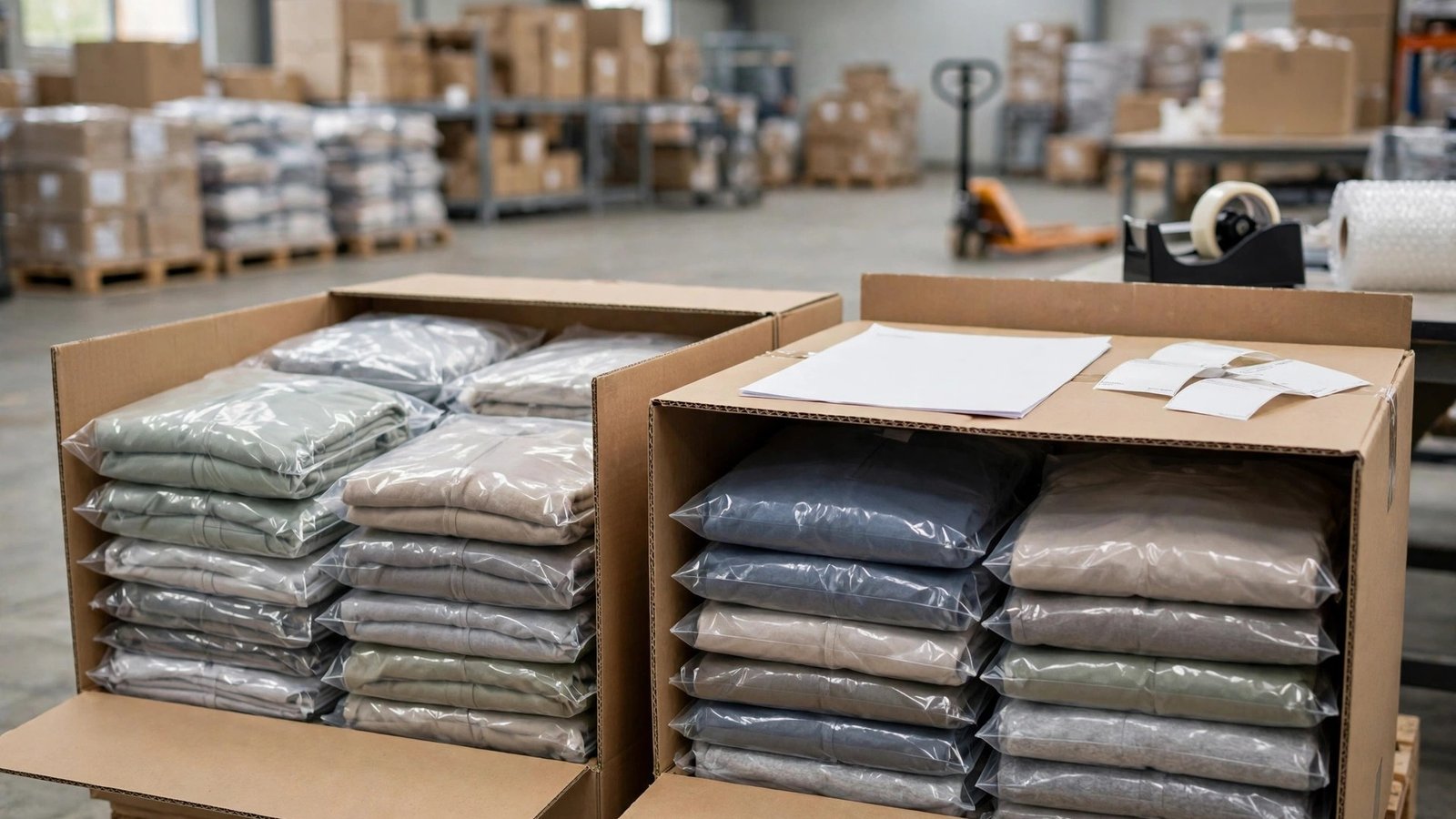
Apparel packaging is often treated as the last step before shipment: a bag, a box, and a label. In practice, packaging decisions are made far earlier, and they affect far more than appearance. Packaging protects garments in transit, determines whether a shipment can be checked quickly at arrival, decides whether a retailer can put stock straight onto the floor, and — in some markets — carries legal requirements of its own.
This guide is for buyers, merchandisers and product developers who need to specify packaging before a factory packs the first carton. It covers the three packaging levels, the details that cause most disputes, and the market rules that should be checked before shipment rather than discovered at the border or at the retailer’s warehouse.
1. Three levels, not one bag
Buyers often use the word “packaging” for everything from the bag around a single shirt to the pallet that leaves the factory. Keeping the three levels separate makes specification, costing and inspection much clearer.
The first level is individual packaging: the bag, wrap, tissue or box that holds one garment. It protects the garment, presents it for sale or for inspection, and usually carries the garment’s own labels and barcodes. The second level is inner packaging: the bundle, polybag group or small carton that holds a set of garments — for example, a size run or a colour assortment. The third level is export packaging: the master carton, and then the pallet, that travels from factory to warehouse.
Each level has a different job. Individual packaging must protect one garment without hiding its labels or damaging its finish. Inner packaging must make counting and sorting fast, so that a warehouse can verify a shipment without opening every garment bag. Export packaging must survive handling, stacking, humidity and long transit, and carry the marks that identify the shipment. When a buyer specifies only “good packaging” without separating these levels, the factory must guess at all three — and the guesses are usually discovered only when goods arrive damaged, uncountable or unidentifiable.
A packaging specification should therefore name each level separately: what material, what size, what closure, what labels, and how many garments per inner pack and per carton. Packaging belongs in the wider product specification, so it should sit alongside the tech pack rather than being agreed separately after production. Quantities per carton matter for costing as well as for handling: a carton that is too heavy damages garments and injures handlers; a carton that is under-filled wastes freight and invites crushing.
2. The individual pack: polybags, folding and presentation
The polybag is the most common individual pack for apparel, and the most common source of small disputes. Buyers should specify the bag, not just ask for “a polybag”.
Material and thickness should be named, because a bag that is too thin tears in handling and a bag that is unnecessarily thick adds cost and plastic waste. Closure should be named too: a self-seal bag, a heat-sealed bag and an open bag with a sticker behave differently in a warehouse, and a resealable closure matters when a retailer or customer needs to open and re-close the pack without damaging it. Vent holes, where used, should be specified by position and purpose — they reduce condensation in some climates, but they also change how a bag protects against dust and moisture.
Folding and presentation belong in the same specification. A folded shirt and a hung garment need different packs, labels and carton dimensions. Folded garments should be folded to a stated size, with tissue or backing board only where the buyer actually wants it. Hung garments need a hook specification and a cover that protects against dust without trapping moisture.
Labels inside the individual pack deserve the same care as labels on the garment. A barcode that is printed but not scannable, or a size label that cannot be read inside the bag, slows down every downstream step. Specify where each label goes, what it must show, and whether barcodes will be tested before shipment. A sample pack, approved before bulk packing, is the cheapest way to settle these details.
3. Inner packs and export cartons: counting, marks and protection
Inner packs exist to make a shipment countable. Specify how garments are grouped — by size, by colour, by size run, or by ratio — and how each inner pack is marked. A shipment in which inner packs are mixed without marking cannot be verified without opening every bag. The packing list, carton marks and inner-pack marks should all use the same product codes, sizes and quantities.
Export cartons carry the shipment. Specify the carton material and strength for the journey the goods will actually make, not for an ideal journey. A carton that survives a short domestic move may not survive stacked container transport, repeated handling and humidity. Specify the carton dimensions and the maximum weight, and specify how cartons are sealed — tape type, number of strips, and any strapping — because a carton that opens in transit is a loss, not a repacking job.
Carton marks should be specified in full: buyer and supplier names or codes, style and colour, size breakdown, quantity, carton number in the shipment, country of origin where required, and handling marks such as “keep dry” or “this way up” where they apply. Marks should be printed or labelled in a way that survives handling; a mark that rubs off in transit is as useless as no mark at all. Where a retailer or importer has its own carton-marking standard, that standard should be supplied to the factory as part of the packaging specification, not sent after packing has begun.
Protection inside the carton matters as much as the carton itself. Moisture protection, edge protection and separation between garments should be specified where the route or season requires them. A common failure is to specify a strong carton but no moisture protection for a sea shipment in a humid season, or individual polybags but no separation for dark and light colours packed together.
4. Warnings and market rules: check the destination, not just the bag
Some packaging requirements are set by law, and they differ by market. The most important discipline is to check the destination market’s rules before packing, because a warning or a label that is correct in one market may be missing, wrong or unnecessary in another.
Polybag suffocation warnings are a good example of why destination matters. There is no single worldwide rule for these warnings, and in the United States the requirements are set at state level rather than by one federal rule covering all polybags. The correct warning, and whether one is required at all, therefore depends on the destination state and on the bag’s size and use. Confirm the destination market’s position for the actual bag size and use before the bags are printed, and record the decision in the specification. Retailer and marketplace policies can add further requirements, so check those at the same time, not after the goods are packed.
Labelling on packaging should be checked in the same way. Care labels, fibre-content labels and origin marks are governed by the destination market’s textile labelling rules, and they are not the same as packaging marks. Our guide to US care labels explains the US position for garment labels themselves; packaging labels, barcodes and carton marks should be checked against the buyer’s own retailer and importer requirements as well, because a garment label that is correct does not make a carton mark correct.
5. The EU packaging rules that now frame the specification
For apparel sold in the European Union, packaging specification now sits inside a single EU framework. Regulation (EU) 2025/40 on packaging and packaging waste — the Packaging and Packaging Waste Regulation, or PPWR — sets sustainability and labelling requirements for packaging throughout its life cycle. According to the EUR-Lex summary of the regulation, it entered into force on 11 February 2025 and applies from 12 August 2026, and it covers all packaging and packaging waste regardless of material or origin.
Three points from that summary matter most for apparel buyers. First, packaging must be designed to minimise weight and volume while maintaining functionality, and packaging that aims to increase the perceived volume of a product — for example, through double walls or false bottoms — is prohibited unless protected by design rights or trademarks. Second, all packaging must be recyclable, meaning designed for material recycling and able to be collected, sorted and recycled at scale, with recyclability performance grades applying from 2030. Third, by 2030, grouped, transport and e-commerce packaging filled by economic operators must not exceed 50% empty space.
For an apparel buyer, the practical consequences are direct. An oversized individual box, an inner pack padded to look larger than its contents, or an export carton filled with void material should all be questioned against the minimise-weight-and-volume principle and the empty-space limit. The regulation also places life-cycle obligations on producers, including waste management and extended producer responsibility, and requires conformity assessment and technical documentation. An EU importer should therefore confirm, with its supplier and importer, who holds each packaging obligation — manufacturer, importer or brand — before the first shipment under the new framework, rather than assuming the factory’s standard pack already complies.
The PPWR is a framework, not a packaging specification. Its detailed requirements are phased in over time, and some depend on further EU measures. Buyers should therefore treat the EUR-Lex summary as the starting point, check the current position for their product and packaging types at the time of ordering, and record the applicable requirements in the specification for each season. A specification that simply says “EU-compliant packaging” without naming the requirements it relies on cannot be checked.
6. Inspection: checking packaging before it becomes a shipment problem
Packaging should be inspected at two points: at the sample stage, and during or after bulk packing. The sample pack settles the bag, fold, labels, inner pack and carton. The bulk check then verifies that the approved pack was actually used — that carton counts match the packing list, that marks match the specification, and that a sample of opened cartons contains the quantities the marks claim.
A packaging check should also include a transit test in miniature: lift a packed carton, stack it as it will be stacked, and open it after handling. The same handover discipline applies at shipment — our guide to logistics handoffs explains what to record when goods change hands. Cartons that crush under their own stack weight, bags that split at the seal, or labels that detach in handling will all fail in a warehouse, and they are cheaper to find in the factory than at the destination. Where goods will travel by sea, a moisture check — whether the chosen protection matches the route and season — belongs in the same inspection.
Damage found at arrival is often blamed on the carrier, but the packaging specification is where the carrier’s job was defined. Recording the specification, the approved sample pack and the bulk inspection result together gives the buyer, the factory and the carrier a shared record when a claim has to be settled.
Buyer checklist: before the factory packs
- Individual, inner and export packaging are specified separately, with material, size, closure and labels for each level.
- A sample pack — one complete individual pack, inner pack and carton — is approved before bulk packing.
- Quantities per inner pack and per carton, and maximum carton weight, are stated and match the packing list.
- Carton marks use the same product codes, sizes and quantities as the packing list and inner-pack marks, and survive handling.
- Polybag warnings and other market-specific packaging requirements are confirmed for the actual destination market and bag, before bags are printed.
- For the EU, the PPWR position for the buyer’s packaging types — minimise weight and volume, recyclability, and the 2030 empty-space limit for grouped, transport and e-commerce packaging — is recorded in the specification.
- Packaging is inspected at sample stage and again during bulk packing, including a handling and stacking check on packed cartons.
Packaging is not the end of production. It is the part of production that has to survive everything that happens after production — handling, transport, warehousing and retail. Buyers who specify it early, check it at sample stage, and record it alongside the product specification will find that fewer shipments arrive damaged, uncountable or unsellable, and that packaging disputes, when they happen, can be settled from a document rather than from memory.
