
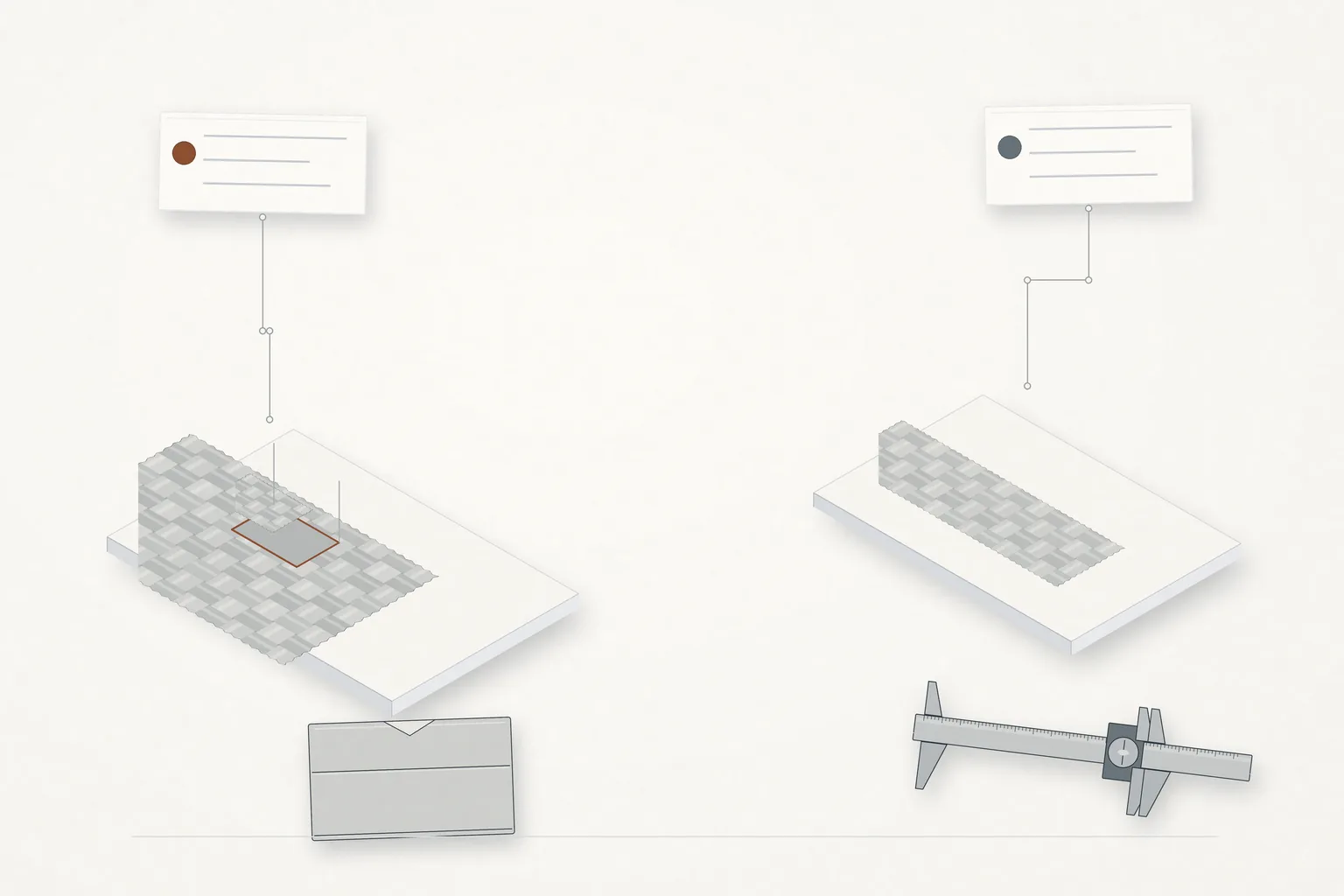
Cover: AI-generated conceptual illustration for WEFTSIGNAL, not documentary photography.
What a gram per square metre figure actually states
Everyday conversation treats a fabric’s quoted weight as a description of the cloth. It is not. It is the outcome of a measurement: which specimen, taken how and from where, conditioned in which atmosphere, measured by which method and averaged, or not, how. Change a condition and the number moves while nothing about the fabric has changed.
Why one figure is not a specification
A specification must be checkable by someone who was not present when it was agreed. A bare figure leaves every condition open: from where the specimen was cut, whether it was conditioned first, and whether the result is one reading or an average. A mill and a buyer can each believe they are meeting the same stated weight while measuring cloth that differs by more than either accepts. The disagreement is not about the fabric; it is about the instruction.
Mass per unit area and mass per unit length answer different questions
The ISO catalogue entry for ISO 3801:1977, the woven-fabric method for mass per unit length and mass per unit area, states the distinction directly: for some fabrics, mass per unit length and mass per unit area are related simply by the width of the fabric, but for other fabrics variations in structure may introduce an important distinction between the two. A mill selling by the metre may care about grams per linear metre, because that figure multiplied by length gives the weight of a shipment. A technologist cutting panels cares about grams per square metre, because that describes the cloth going into the panel. On a uniform plain construction the two track closely enough to convert between. Where structure varies across the width — ribs, cords, jacquard effects — the conversion becomes unreliable.
The specimen and the atmosphere are part of the method
Sampling is where a weight figure is most easily lost. CottonWorks, the textile education platform published by Cotton Incorporated, states that reliable testing depends on proper product sampling and conditioning, and that both must be monitored and maintained. Textiles take up and release moisture from the air around them, so the atmosphere a specimen has rested in changes what the balance reads. ISO 139:2005 defines a standard atmosphere for conditioning, for determining the physical and mechanical properties of textiles, and a standard alternative atmosphere that may be used if agreed between parties.
Stating weight with a method, a basis and a tolerance
A checkable statement carries four things: the quantity, the method and atmosphere it is measured under, the acceptance basis and the tolerance. The quantity must say whether it is mass per unit area, mass per unit length or both; the acceptance basis, whether the limit applies to one specimen or to a mean of several. This explainer gives no numeric tolerance, because a defensible one depends on construction, end use and what both parties can measure repeatably. The wider document is set out in our fabric specification checklist.
Where the tolerance applies, and to what
A tolerance is only useful if the sentence around it is complete. Applied to a mean, it accepts an average result inside the band while allowing individual specimens to sit outside it. Applied to every specimen, it says the opposite. Applied without saying which, it says nothing, and the two readings are argued out at inspection.
An illustrative example: one figure, two meanings
Suppose, illustratively, a buyer writes a single weight figure into a specification for a fabric whose structure varies across the width. The mill measures mass per unit length, because that is how the piece is sold. The buyer measures mass per unit area from a cut square, because that is how the panel was calculated. Both results are honest, both follow a recognised procedure, and they disagree. Nothing in the paperwork says which quantity was intended, so neither party can show the other is wrong. The example is hypothetical, but the missing word — area or length — is the whole dispute.
What an approval record should carry
What is recorded at approval is what makes the figure checkable later, once the people who agreed it have moved on.
- Quantity: mass per unit area, mass per unit length, or both.
- Method: the procedure the result is produced under, named by designation.
- Atmosphere: the conditioning applied before weighing.
- Sampling: where specimens come from, and how many.
- Acceptance basis: whether the limit applies to a mean or to each specimen.
- Tolerance and rounding: the agreed band, and the precision it is stated to.
- Change control: who re-approves the figure when construction, width or finishing changes.
Source and further reading
Sources consulted 16 October 2026: ISO — ISO 3801:1977, Textiles: Woven fabrics — determination of mass per unit length and mass per unit area; ISO — ISO 139:2005, Textiles: standard atmospheres for conditioning and testing; CottonWorks — Quality Testing. Cited by designation and catalogue page only. The framework, checklist and illustrative example in this explainer are WEFTSIGNAL editorial material, not requirements issued by those organisations.
Continue exploring textile industry coverage, quality control coverage and our editorial standards.
