
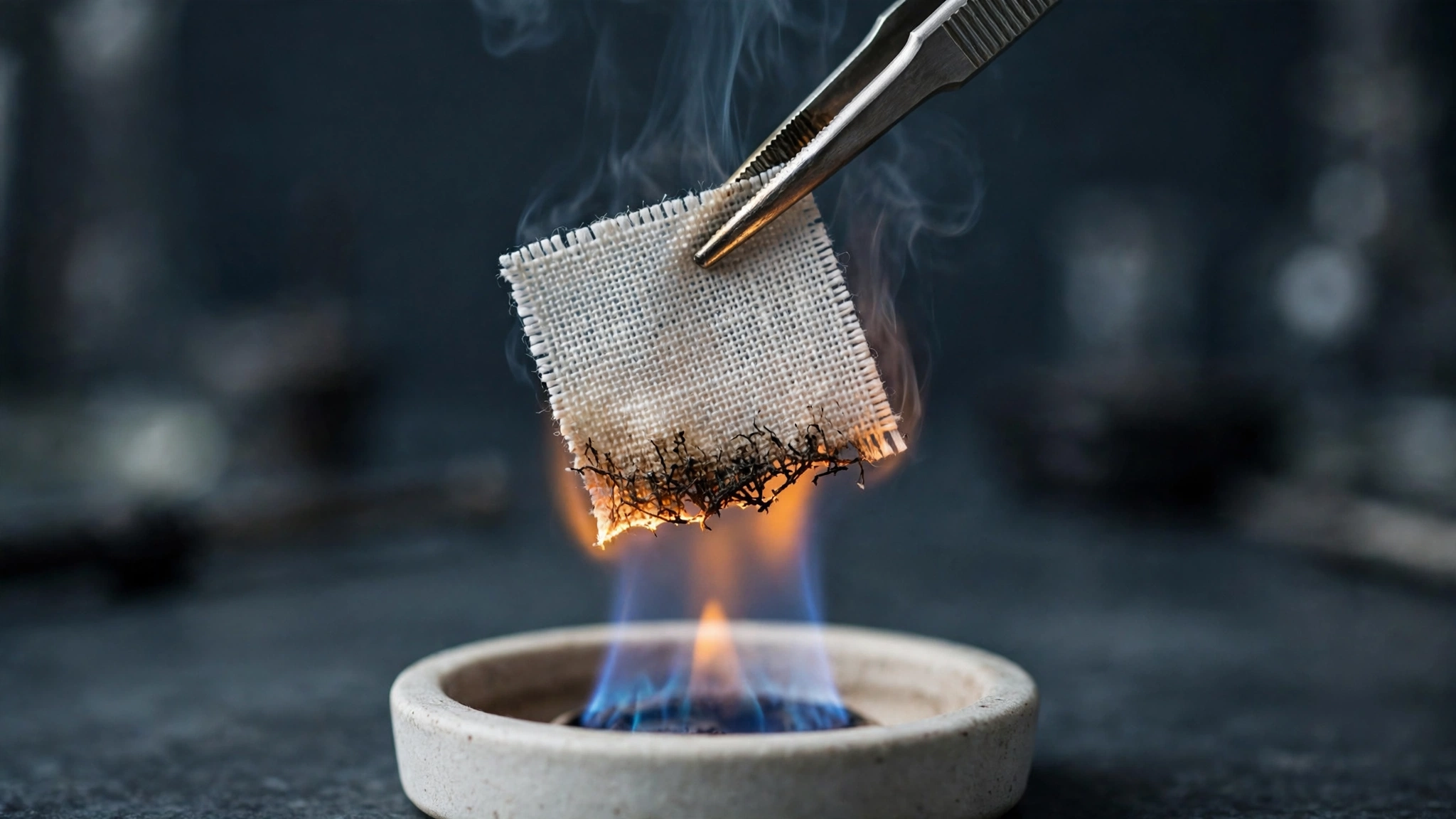
Why buyers still use the burn test
A fabric label says 100% cotton. The hand feel says otherwise. The supplier insists the blend is correct. A laboratory test will settle the question in a week — but the shipment decision is due tomorrow. This is the situation the burn test was made for: a fast, low-cost field screening method that tells a buyer whether the declared fibre content is plausible before committing to lab fees or accepting a delivery.
The burn test is one of the oldest fibre identification methods in textiles. It does not replace laboratory analysis, and it cannot quantify a blend. What it does well is flag obvious misdeclaration — polyester sold as cotton, acrylic sold as wool — at the warehouse, the inspection table, or the supplier’s cutting room, using nothing more than tweezers, a flame, and a trained eye.
What a burn test can and cannot tell you
Burning a fibre reveals how it behaves under heat: whether it burns or melts, how fast, what it smells like, and what residue it leaves. Because natural fibres, regenerated fibres, and synthetics decompose differently, these observations narrow the possibilities quickly.
The limits matter as much as the method. A burn test cannot reliably identify the exact ratio in a blend — a 60/40 cotton-polyester will show characteristics of both. Chemical finishes change behaviour: flame-retardant treatments suppress burning, and some softeners alter odour. Heavily dyed fabrics can mask the smell of the fibre itself. Treat every burn test result as a screening verdict — “consistent with the label” or “inconsistent, send to lab” — never as a certificate of composition.
Safety and equipment
The test uses an open flame, so basic precautions are non-negotiable: work in a ventilated area away from fabric rolls and flammable materials, keep water or a fire blanket within reach, and hold samples with metal tweezers — never fingers. Use small snippets, roughly 2–3 cm long. Synthetic fibres melt and drip; let the drips fall onto a ceramic dish or metal tray, not onto skin or the work surface.
The procedure, step by step
1. Prepare a representative sample
Cut snippets from several places across the fabric — edge, middle, and near the selvedge — because fibre content can vary across a roll. If the fabric is a garment, take yarns from an inside seam allowance rather than cutting the visible panel. Untwist woven yarns into loose fibres; the test reads fibre behaviour, not yarn structure.
2. Bring the sample slowly to the flame
Hold the snippet horizontally and approach the edge of a small flame. Note whether the fibre shrinks away from heat before igniting (typical of thermoplastics), ignites readily (typical of cellulosics), or resists ignition.
3. Observe in the flame
Watch the flame colour, burning speed, smoke colour and density, and whether the sample melts, curls, or drips. Synthetics generally melt; natural and regenerated fibres generally burn without melting.
4. Remove and observe
Withdraw the sample and note whether it continues burning, self-extinguishes, or glows. Smell the smoke carefully — odour is one of the most diagnostic signals. Finally, examine and crush the residue between your fingers: soft ash points to cellulose or protein fibres; a hard bead points to synthetics.
Burn characteristics of common apparel fibres
| Fibre | In flame | Removed from flame | Odour | Residue |
|---|---|---|---|---|
| Cotton | Burns quickly, yellow flame | Continues burning, afterglow | Burning paper | Fine grey ash, soft, no bead |
| Linen | Like cotton, slightly slower | Continues burning | Burning paper, woodier | Grey ash, soft |
| Viscose / rayon | Burns very quickly, yellow flame | Continues burning | Burning paper | Very little ash, soft |
| Wool | Burns slowly, sizzles, curls away | Self-extinguishes | Burning hair | Dark, crushable bead |
| Silk | Burns slowly | Self-extinguishes | Burning hair, milder | Dark crushable ash, less than wool |
| Polyester | Melts, shrinks from flame, black smoke | Burns with difficulty, melts | Sweet, chemical | Hard black bead, uncrushable |
| Nylon | Melts, white smoke | Self-extinguishes, melts | Celery-like, chemical | Hard grey bead |
| Acrylic | Melts and burns, black smoke, sputters | Continues burning, melts | Acrid, harsh | Hard black irregular bead |
| Polypropylene | Melts, burns with difficulty | Continues, drips | Waxy, paraffin-like | Hard tan bead |
| Acetate | Burns and melts, sputters | Continues burning and melting | Vinegar-like | Hard black irregular bead |
The table is a screening reference, not a laboratory standard. When two fibres behave similarly — cotton, linen, and viscose all smell of burning paper — the remaining signals (burn speed, ash quantity) separate them.
A buyer’s 5-minute field screening workflow
Most published burn test guides stop at the table. The part competitors rarely explain is how a buyer turns those observations into a decision during an inspection. Here is a field workflow designed for exactly that.
Step 1 — Decide what you are checking
State the hypothesis before lighting anything: “This roll is declared 100% cotton; I am checking for polyester substitution.” A burn test answers a yes-or-no question far better than an open-ended one.
Step 2 — Test the suspect against a reference
Burn a snippet of the suspect fabric and, alongside it, a snippet of a known fibre of the declared type — a verified cotton swatch from your reference library. Compare flame, odour, and residue side by side. Differences you can see in a paired test are easy to miss from memory.
Step 3 — Run the three-signal check
Score three signals independently: (a) melt behaviour — any bead formation fails a “100% natural” claim immediately; (b) odour — chemical or sweet smells in a declared natural fibre are a red flag; (c) residue — hard beads mean thermoplastic content. Two or more red flags mean the label is not credible.
Step 4 — Cross-verify with the blend declaration
For declared blends, check whether the observed behaviour matches the declared ratio qualitatively. A “cotton-rich” fabric that melts vigorously and leaves heavy black beads is not cotton-rich. Note that intimate blends can behave unpredictably — this is precisely when the test earns its keep as a trigger for lab work, not as a verdict.
Step 5 — Apply the decision rule
Consistent with the label: accept the batch, and record the test in your fabric specification checklist as supporting evidence. Inconsistent: quarantine the roll, photograph the residue, and escalate to laboratory analysis — qualitative fibre analysis (AATCC 20) for identification, or quantitative chemical analysis (ISO 1833) when the blend ratio itself is disputed. Never reject a shipment on a burn test alone; always let the lab confirm.
Common pitfalls
Testing only one spot on a roll, then generalising to the whole delivery. Testing finished fabric when the question is about the greige — finishes distort results, so test unfinished areas or wash the sample first where feasible. Confusing viscose with cotton — both cellulosic, both smelling of paper; viscose burns faster and leaves less ash. And the most expensive mistake: presenting a burn test result to a supplier as proof of fraud. It is evidence for further testing, not a verdict — frame it that way in every discussion.
When the lab is the right answer
Use the burn test for screening and the laboratory for decisions that carry contractual weight: blend-ratio disputes, care-label compliance, and any claim that will appear on a hangtag or in a customs declaration. The burn test tells you which rolls deserve the lab’s attention; used that way, it saves far more in avoided lab fees and rejected shipments than it costs in tweezers and matches.
