
Update, 25 November 2026: Bangladesh’s Minimum Wage Board voted 4–2 to recommend Tk 17,000 a month for entry-level garment workers, 36 per cent above the existing Tk 12,500 minimum. The chairman announced that the revised wage scale would apply from December, according to The Business Standard; the vote was also reported by Bangladesh Sangbad Sangstha. The final government gazette had not been independently verified at the time of this update. Buyers should use the board’s figure for revised cost scenarios and check the gazette before treating it as a legally effective rate. The original report below covers the third meeting and retains its 24 November reporting cut-off.
Bangladesh’s garment wage board finally has a proposal from factory owners on the table — but the board has not disclosed what it says. At its third meeting on 23 November, the Minimum Wage Board received the employers’ long-awaited written proposal, declined to disclose the figure, and adjourned without an agreement after a session that ran from late morning into the evening. The workers’ representative, Babul Akter, called the offer “not acceptable” and “nowhere near” the workers’ demand. Both sides will submit revised proposals, and the board reconvenes on Tuesday afternoon, 24 November. Reporting in this article is current to 24 November 2026, 14:00 Dhaka time; the reconvened session due that afternoon is not covered here.
For buyers, the headline is not a number. It is the absence of one. Three weeks into a wage round that has already closed factories and blocked highways, the one figure that would let a sourcing team price December’s labour cost remains undisclosed. This report sets out what is actually known after the third meeting, which reported figures can and cannot be trusted, and what buyers should be checking with suppliers this week.
What happened on 23 November
The board’s third meeting was held at its office in Segunbagicha, Dhaka, chaired by Syed Azad Subhani. The employers’ proposal had been due at the previous meeting on 16 November, which was postponed after the workers’ representative Anwar Hossain fell ill and was admitted to hospital, according to the board. According to BD Financial Review, Monday’s session ran from 11:45am to 8:30pm before the chairman adjourned it without an agreement.
At the press briefing afterwards, Subhani confirmed that the owners’ representative had submitted a wage proposal, but he did not disclose the amount. “Discussions are still ongoing. We are not disclosing it now to avoid creating any confusion,” he said, as reported by The Business Standard (TBS). He added that another meeting could be held the same day if no decision was reached — “We are holding three days’ worth of meetings in one day” — and stressed that the board would not make any decision that was unrealistic. The board will consider proposals from all sides and submit its final recommendation to the labour ministry, which will then determine the final wage.
Akter was blunt. “The owners have submitted their proposal. But we do not consider it acceptable, just as they do not find our proposal acceptable,” he said. “Under the circumstances, both sides will submit revised proposals, and we will discuss the matter.” He added: “The owners’ proposal is nowhere near our proposal. We will try to reach a mutually satisfactory position.” Dhaka Stream reported him saying the owners’ figure was “far lower than the workers’ demands” and had therefore been turned down, while adding that workers would be willing to lower their demands slightly in the interests of the industry. According to Agence France-Presse, Akter said “the offer … falls far short of what we have been demanding.”
The employers’ representative, ABM Shamsuddin, declined to comment further on the figure, but defended the pace of concessions with an analogy. “Mr Babul Akter says our proposal seems too low to them. A duck lays one golden egg every day. If the duck falls ill, would you still expect it to lay a golden egg?” he told TBS. The remark points to the financial strain many small and mid-sized factories say they are under.
The numbers: what is confirmed, what is reported, and what is not true
Several figures are now circulating and they do not carry equal weight. They fall into three groups, which should not be confused with each other.
First, the current statutory minimum. The minimum wage in force today is Tk 12,500 a month, set in 2023, when it was raised from Tk 8,000. That figure is confirmed by TBS, which restated it in its report of the third meeting and in its report of the second meeting.
Second, the workers’ formal proposal. At the second meeting on 9 November, the workers’ representatives formally proposed Tk 32,000 a month for the lowest regular grade, with Tk 48,000 for the highest grade. According to TBS’s report of that meeting, the proposed grades are Tk 48,000 for senior operators, Tk 43,000 for operators, Tk 38,000 for Grade 3 or junior operators, and Tk 30,000 for apprentice workers; other factory employees and staff were proposed at Tk 40,000 to Tk 55,000. Agence France-Presse likewise reports Tk 32,000 for the lowest regular grade and Tk 30,000 for apprentices.
Third, reported figures about the employers’ proposal — none of them confirmed. The board has not disclosed the owners’ figure, the chairman has declined to confirm any figure, and the owners’ representative has declined to comment on it. Against that silence, three reported figures are in circulation:
- “Above Tk 15,000.” TBS reported that, although no responsible representative has publicly disclosed the owners’ proposal, “discussions with several sources indicate that it exceeds Tk 15,000.” A workers’ leader, speaking to TBS on condition of anonymity, said the employers had proposed more than Tk 15,000. This is an anonymous-source report, not an official confirmation.
- Tk 15,000 rising to Tk 15,800, and workers coming down to Tk 22,000. BD Financial Review reported, citing “people close to the talks”, that factory owners raised their offer twice during the session, from an opening bid of Tk 15,000 to Tk 15,800 a month, while workers’ representatives came down from Tk 32,000 to Tk 22,000. The same article is explicit: “The Tk 15,800 number came from sources close to the negotiations rather than an official statement.” Until the board or the employers confirm them, these figures should be treated as reported, not settled.
- Tk 14,500 — reported, and rejected by the chairman. Some media outlets reported that the owners had proposed Tk 14,500. Asked about those reports, Subhani said: “That information is entirely unrealistic.” Dhaka Stream likewise reported the chairman saying that earlier speculation of a Tk 15,000 offer was unrealistic and that the actual offer was higher. AFP reported Subhani saying the proposed monthly minimum was above Tk 14,500. None of this makes Tk 14,500 the proposal; it makes it a figure the chairman has publicly dismissed.
One more figure should be retired. Tk 14,300, reported by the Daily Star and Kaler Kantho before the meeting as a “likely figure”, was pre-meeting speculation; no post-meeting report repeats it as the proposal.
There is also a conflict in the record of the last wage round. TBS’s post-meeting report says workers proposed Tk 23,000 in 2023; BD Financial Review puts the 2023 workers’ demand at Tk 20,393. The two accounts disagree, and this article adopts neither figure. What both agree on is the outcome: the 2023 round ended at Tk 12,500, which remains the current minimum.
Where each side stands
The gap is the story, and it is wide by any measure. The workers’ formal position is Tk 32,000 a month for the lowest regular grade — more than two and a half times the current Tk 12,500. On the streets, the demand most often chanted is Tk 30,000, and labour leaders outside the board office on Monday formed a human chain demanding exactly that. The Centre for Policy Dialogue (CPD) has said talks could be held within a range of Tk 18,578 to Tk 24,204 a month. The BGMEA responded that the CPD proposal contained errors in its data and methodology and asked the think tank to explain; CPD replied on 22 November that its estimates had hardly moved after the objections were taken into account. Akter has said a worker needs between Tk 45,000 and Tk 60,000 a month to support a family of four at a decent standard, factoring in rent, food, school costs and healthcare in Dhaka’s industrial belts, according to BD Financial Review.
The employers’ side has now put a number on the table for the first time, but has not put it in public. Its argument, as presented in the negotiation, is that factories cannot pay what they do not earn, and the BGMEA has warned that price competitiveness against rivals such as Vietnam and Cambodia is at stake. That argument is real, but it cuts both ways: the United Nations General Assembly extended Bangladesh’s preparatory period before graduation from least-developed-country status to 24 November 2029 (resolution A/RES/81/8, adopted 29 October 2026). Separately, under Regulation (EU) No 978/2012, Article 17(2), a country that stops qualifying as a least-developed country is removed from the EU’s Everything But Arms beneficiary list only after a three-year transition running from the entry into force of the delegated act removing it — so the graduation date alone sets no end date for Bangladesh’s duty-free access to the EU under Everything But Arms, which continues for now, while exporters are already pushing into non-traditional markets.
One item that was expected on Monday’s agenda remains unconfirmed. Before the meeting, the BGMEA and the Bangladesh Knitwear Manufacturers and Exporters Association (BKMEA) had said they planned to propose scrapping future wage boards altogether, replacing them with an inflation-linked formula for annual pay rises. No post-meeting report — from TBS, BD Financial Review, Dhaka Stream or AFP — confirms whether that second proposal was actually tabled. Until one does, it should be described as planned, not submitted.
The unrest did not pause for the meeting
The negotiation and the disruption ran in parallel on Monday. While the board sat in Segunbagicha, leaders of several labour organisations staged protests and formed a human chain outside its office, demanding a minimum monthly wage of Tk 30,000, according to TBS. During the meeting, a group of labour leaders entered the 13th floor of the board’s office and chanted slogans; labour leader Nazma Akter was among them and later handed a list of demands to the chairman, TBS reported.
In Savar and Ashulia, 33 garment factories declared general holidays following work stoppages, while production remained suspended at another 22 factories under Section 13(1) of the Labour Act, according to TBS, citing Industrial Police-1 Superintendent Mohammad Mominul Islam Bhuiyan. The 22 suspensions were continuing suspensions, not new closures announced that day: TBS’s wording is that production “remained suspended” at those factories. The number of factories on general holiday rose from 28 at around 1pm to 33 by 7:30pm. In Gazipur, workers briefly blocked the Dhaka–Mymensingh highway in the Bagherbazar area in the morning; according to TBS, police dispersed them, firing tear gas shells and charging with batons.
Closures and road blockades coincided with Monday’s meeting. This single observation does not establish a recurring pattern. Until more meeting days are observed, buyers should treat each scheduled session as a date to monitor closely, not as a confirmed disruption date.
What the third meeting meant for buyers
Most reporting on this wage round has chased the number. For a buyer, the more useful question is what the absence of a number does to pricing — and what the timing of the disruption does to delivery.
First, a secret figure cannot be priced as a settled cost — but it can be modelled. As long as the board refuses to disclose the employers’ proposal, no supplier can credibly quote a December labour cost as a decided figure, and no buyer can budget for one as a certainty. Three kinds of figure must not be confused here: media-reported figures (Tk 15,800, Tk 22,000), which are unnamed-source reports, not decisions; a supplier’s own scenario costings, which are the supplier’s own workings, not a settled rate; and the current statutory monthly minimum of Tk 12,500, which is a legal baseline, not a supplier’s labour cost. What suppliers can do now is scenario costing: ask the supplier to state its costing on the current Tk 12,500 baseline, show the effect of each plausible outcome on the per-unit cost, identify which processes and lines the increase would hit, and state how much capacity remains if those lines stop. Then agree in writing how a gazetted increase will be shared when it lands — the trigger (the gazette, not a press report), the orders it applies to, and who carries the cost of delivery slippage — and name in the same written agreement who is responsible for reporting and escalating delivery risk if a shipment slips. The Clean Clothes Campaign’s position is that brands should absorb higher labour costs in purchasing prices; whatever a buyer’s own policy, the conversation should happen before the gazette notification, not after it.
Second, treat each meeting date as a date to watch. Monday’s 33 factory holidays happened on a meeting day, and production remained suspended at 22 more factories, according to TBS, citing Industrial Police-1. The board reconvenes on Tuesday afternoon, and each subsequent session is a date on which the same pattern could repeat — though one day’s coincidence does not prove it will. A buyer whose shipment depends on a factory in Savar, Ashulia or Gazipur should be asking: what was the factory’s actual operating rate on Monday, not whether it is open today; how many production days have been lost to closures and protests so far, and how the factory plans to recover them; and which subcontractors in washing, printing or embroidery were affected, since disruption there does not show up in a sewing factory’s headcount but stops shipments just as surely. Our supplier code of conduct checklist sets out the evidence buyers should be asking for, and production lead-time planning is where lost days turn into missed delivery windows.
The background frames what happens next. The six-member wage board was formed on 1 November, after protests demanding a higher minimum wage began on 31 October in Ashulia. Subhani has chaired the board since the morning of 4 November, when he replaced Sheikh Ashfaqur Rahman, who had been named chairman at the board’s formation but never actually chaired a meeting. At its first meeting on 4 November, the board announced that the new wage structure would take effect from 1 December, with workers receiving their first pay under the new scale in January — a target the chairman has since repeated, while stressing that no figure has been decided and no gazette has been published. That 4 November announcement was reported the same day by The Bangladesh Today, which recorded that both sides had agreed to implement the new structure from 1 December and pay the increased wages with the January salaries for December. The second meeting, on 9 November, produced the workers’ Tk 32,000 proposal. The third meeting has now produced the employers’ proposal — and a refusal to disclose it.
What to watch next
Three things matter now. The first is Tuesday afternoon’s reconvened session, at 2pm Dhaka time, at which both sides are expected to submit revised proposals rather than repeat their Monday positions. Its outcome was not available when this article was written and will be covered in a follow-up. The second is the December timetable, which has three distinct layers that should not be collapsed into one. At the first meeting on 4 November, the board announced that the new structure would take effect from 1 December, with the increase reflected in January pay; that announcement was reported the same day by The Bangladesh Today, and the chairman has since repeated the aim — on 17 November he said whatever wage structure the board finalises will take effect from December, regardless of when the board completes its work. But that is the chairman’s stated aim, not a gazetted fact — the amount is still undecided, no draft gazette has been published, and the government, not the board, issues the final gazette after the board submits its recommendation: under Section 140(1) of the Bangladesh Labour Act 2006, the Government may, by notification in the official Gazette, declare the minimum rates recommended by the board. The third is the legal backstop. Under Section 139(2) of the same Act, the board must submit its recommendation to the Government within six months of receiving the Government’s direction to recommend a rate — and the Government may extend that period on the board’s request. The chairman said on 21 November that the board has six months under the Act. The Act counts those six months from the Government’s direction, not from the board’s formation, and no published document states the date on which the Government’s direction was received, so no end date can be calculated from the material available. No draft gazette or objection period has been announced, and the Act as read contains no 14-day objection period for the board’s recommendation.
Until the board discloses a figure or the two sides agree one, the honest summary is this: a timetable exists, a workers’ proposal of Tk 32,000 exists, an employers’ proposal now exists but its amount is undisclosed, the workers have rejected it, revised proposals are due on Tuesday, and factories closed on the day the proposal was tabled.
Frequently asked questions
What did factory owners propose at the third meeting?
They submitted a written wage proposal on 23 November, but the board has not disclosed the amount and the chairman has declined to confirm any figure. Media reports citing unnamed sources put it above Tk 15,000; one report, citing people close to the talks, put it at Tk 15,800. Neither figure is officially confirmed.
Why did workers reject the proposal?
Babul Akter, the workers’ representative, said the offer was “not acceptable” and “nowhere near” the workers’ formal proposal of Tk 32,000 a month. Both sides will now submit revised proposals.
When will the new wage take effect?
There is no gazetted date. At its first meeting on 4 November the board announced that the new structure would take effect from 1 December, with the increase paid in January — an announcement reported the same day by The Bangladesh Today — and the chairman has repeated that aim since. But the amount is still undecided and no gazette has been published, so 1 December remains a stated target, not a decided fact.
When should buyers re-cost their orders?
Not on the basis of any reported figure. Re-cost on scenarios: ask suppliers for costings on the current Tk 12,500 baseline and at plausible outcomes, and agree in writing that the gazette — not a press report — triggers any price adjustment, with the orders covered and the delivery consequences spelled out.
What should buyers ask suppliers this week?
Four things: the factory’s actual operating rate on Monday 23 November; how many production days have been lost so far and how they will be recovered; which subcontractors in washing, printing or embroidery were affected; and a written statement of the current-wage cost baseline and the per-unit effect of each wage scenario.
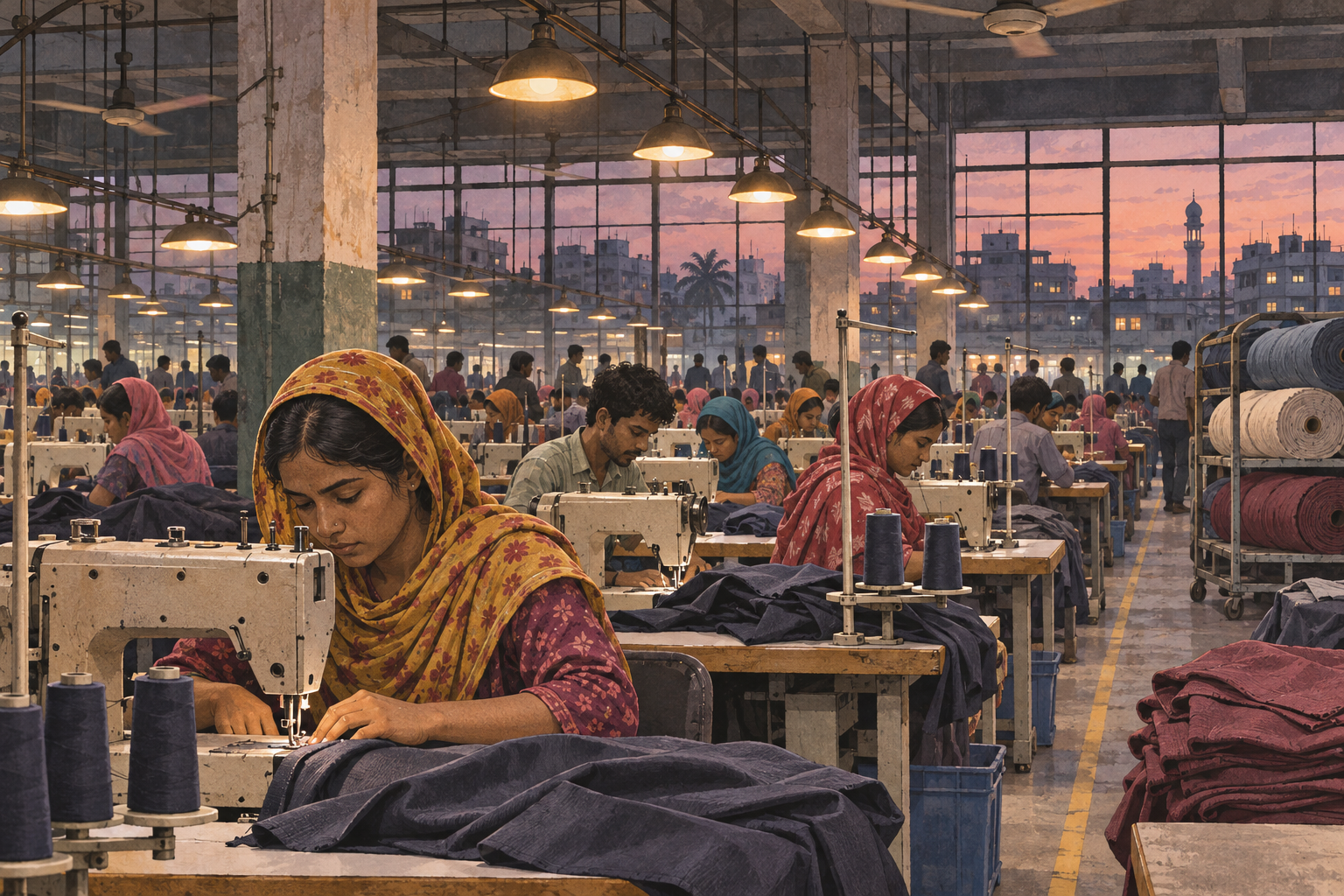
Image note: The cover is an AI-generated illustration, not a documentary photograph of the wage negotiations or a particular factory.
Sources
- The Business Standard, “RMG workers, owners agree to make concessions in bid to finalise wage”, 23 November 2026 (published 14:05, updated 22:07 Dhaka time) — third meeting outcome: owners submitted proposal, board did not disclose it; Babul Akter quotes; Subhani quotes; Shamsuddin “golden egg” remark; Tk 15,000-plus anonymous-source report; Tk 14,500 “entirely unrealistic”; 33 factories on general holiday, 22 with production remaining suspended under Section 13(1); Gazipur highway blockade at Bagherbazar, police firing tear gas shells and charging with batons; human chain and 13th-floor entry. Read 24 November 2026. https://www.tbsnews.net/economy/rmg/rmg-workers-demand-tk30000-minimum-wage-wage-board-holds-third-meeting-1611381
- The Bangladesh Today, “New RMG wage structure to take effect from Dec 1”, 4 November 2026 — first meeting outcome: owners’ and workers’ representatives agreed to implement the new wage structure from 1 December, with the increased wages paid in January along with the salaries for December; chairman Subhani said a six-month timeframe is usually allocated for determining minimum wages. Read 24 November 2026. https://thebangladeshtoday.com/bangladesh/2026/11/04/39057
- Bangladesh Labour Act, 2006 (Act No. XLII of 2006), Chapter XI — Section 139(2): the Wage Board shall submit its recommendation to the Government within six months of receiving the Government’s direction (extendable on the board’s request); Section 140(1): on receipt of the recommendation, the Government may, by notification in the official Gazette, declare the recommended minimum rates; Section 140(5): the declaration takes effect on the date specified in the notification, otherwise on publication. Text as reproduced in the 28 September 2015 gazette reprint; the 2026 amendment (Act 43 of 2026) changed the Section 139(6) review cycle from five years to three. Read 24 November 2026. https://compliancebangladesh.com/wp-content/uploads/2022/05/bangladesh-labour-act-2006-english.pdf
- United Nations General Assembly, draft resolution A/81/L.8 (adopted as resolution A/RES/81/8, 29 October 2026), “Extension of the preparatory period preceding the graduation of Bangladesh and Nepal from the least developed country category” — preparatory period for Bangladesh extended by three years, until 24 November 2029. Read 24 November 2026. https://documents.un.org/doc/undoc/ltd/n26/268/67/pdf/n2626867.pdf
- Regulation (EU) No 978/2012, Article 17(2) — where an EBA beneficiary country no longer fulfils the conditions for the special arrangement, the Commission may adopt a delegated act to remove it from the EBA beneficiary list following a transitional period of three years as from the date on which the delegated act entered into force; see also Commission Delegated Regulation (EU) 2024/1363 (Bhutan precedent: graduated 13 December 2023, removal with application from 1 January 2028 after the three-year transition). Read 24 November 2026. https://eur-lex.europa.eu/legal-content/EN/TXT/?uri=CELEX%3A32012R0978 ; https://eur-lex.europa.eu/eli/reg/2024/01363/oj
- BD Financial Review, “Bangladesh’s Garment Wage Board Stalls Again as Owners…”, 24 November 2026 — meeting ran 11:45am to 8:30pm; Tk 15,000 to Tk 15,800 and Tk 32,000 to Tk 22,000 figures attributed to “people close to the talks”, explicitly not an official statement; Akter’s Tk 45,000–Tk 60,000 family living-cost estimate; board resumes Tuesday 2pm; 2023 workers’ demand put at Tk 20,393. Read 24 November 2026. https://bdfinancialreview.com/articles/bangladesh-garment-wage-board-owners-offer-15800-workers-22000
- Dhaka Stream, “Wide gap in wage proposals stalls board talks”, 23 November 2026 — Subhani confirmed owners submitted a proposal without disclosing the amount; talks to resume after the briefing and continue Tuesday if necessary; Tk 15,000 speculation “unrealistic”, actual offer higher; Akter said the offer was far lower than workers’ demands. Read 24 November 2026. https://www.dhakastream.net/economy/wide-gap-wage-proposals-stalls-board-talks-201616
- Agence France-Presse (via Finwire), “Protesting Bangladesh garment workers reject pay offer”, 23 November 2026 — Akter: “the offer … falls far short of what we have been demanding”; chairman said the proposed monthly minimum was above Tk 14,500; workers formally proposed Tk 32,000 for the lowest regular grade and Tk 30,000 for apprentices. Read 24 November 2026. https://finwire.io/news/world-news/protesting-bangladesh-garment-workers-reject-pay-offer
- The Business Standard, “RMG workers’ representative propose Tk32,000 minimum wage; owners to submit counterproposal in 4 days”, 9 November 2026 (updated 11 November) — workers’ formal proposal: Tk 32,000 lowest regular grade, Tk 48,000 highest grade, Tk 30,000 for apprentices, Tk 38,000 Grade 3, Tk 43,000 operators, Tk 40,000–Tk 55,000 for other staff; current minimum Tk 12,500, in effect since 1 December 2023. Read 24 November 2026. https://www.tbsnews.net/economy/rmg/rmg-workers-propose-tk32000-minimum-wage-owners-get-4-days-submit-counterproposal
- The Business Standard, “Whatever new wage structure board finalises will take effect from Dec: Chairman”, 17 November 2026 — chairman: the implementation date would remain December regardless of when the board completes its work; the 16 November meeting was postponed because the permanent workers’ representative Anwar Hossain was ill and admitted to hospital; the meeting was rescheduled to 23 November. Read 24 November 2026. https://www.tbsnews.net/economy/rmg/no-pressure-behind-wage-board-meeting-postponement-says-chairman-1605716
- The Business Standard, “‘Cannot force them’: Wage board chairman hopes garment owners will submit proposal on 23 Nov”, 21 November 2026 — chairman: the board has up to six months under the Labour Act (his reading of the timetable); “We hope the new wages will take effect from December.” Read 24 November 2026. https://www.tbsnews.net/economy/rmg/cannot-force-them-wage-board-chairman-hopes-garment-owners-will-submit-proposal-23-nov
- Priyo News 24, “Garment wage board meets today; CPD answers BGMEA”, 23 November 2026 — CPD range Tk 18,578–Tk 24,204; BGMEA alleged data and methodology flaws and asked CPD to explain; CPD replied on 22 November that its estimates had hardly moved. Read 24 November 2026. https://priyonews24.com/en/news/garment-wage-board-meets-today-cpd-responds-to-bgmea-objections
- The Business Standard, “No more wage boards, RMG owners want yearly pay revisions”, 18 November 2026 — owners planned to propose an inflation-linked annual increment mechanism at the 23 November meeting alongside their wage offer; no post-meeting confirmation found. Read 24 November 2026. https://www.tbsnews.net/economy/rmg/no-more-wage-boards-rmg-owners-want-yearly-pay-revisions-1605976
- Background facts (committee composition, first and second meeting outcomes, 2023 precedent) per the wage article rev3 research file, 2026-11-06-article-2-wage-board-followup-rev3.md, verified 6–10 November 2026 against Reuters, TBS, bdnews24, Dhaka Tribune, TOB News, Prothom Alo, BSS and the Clean Clothes Campaign.
