
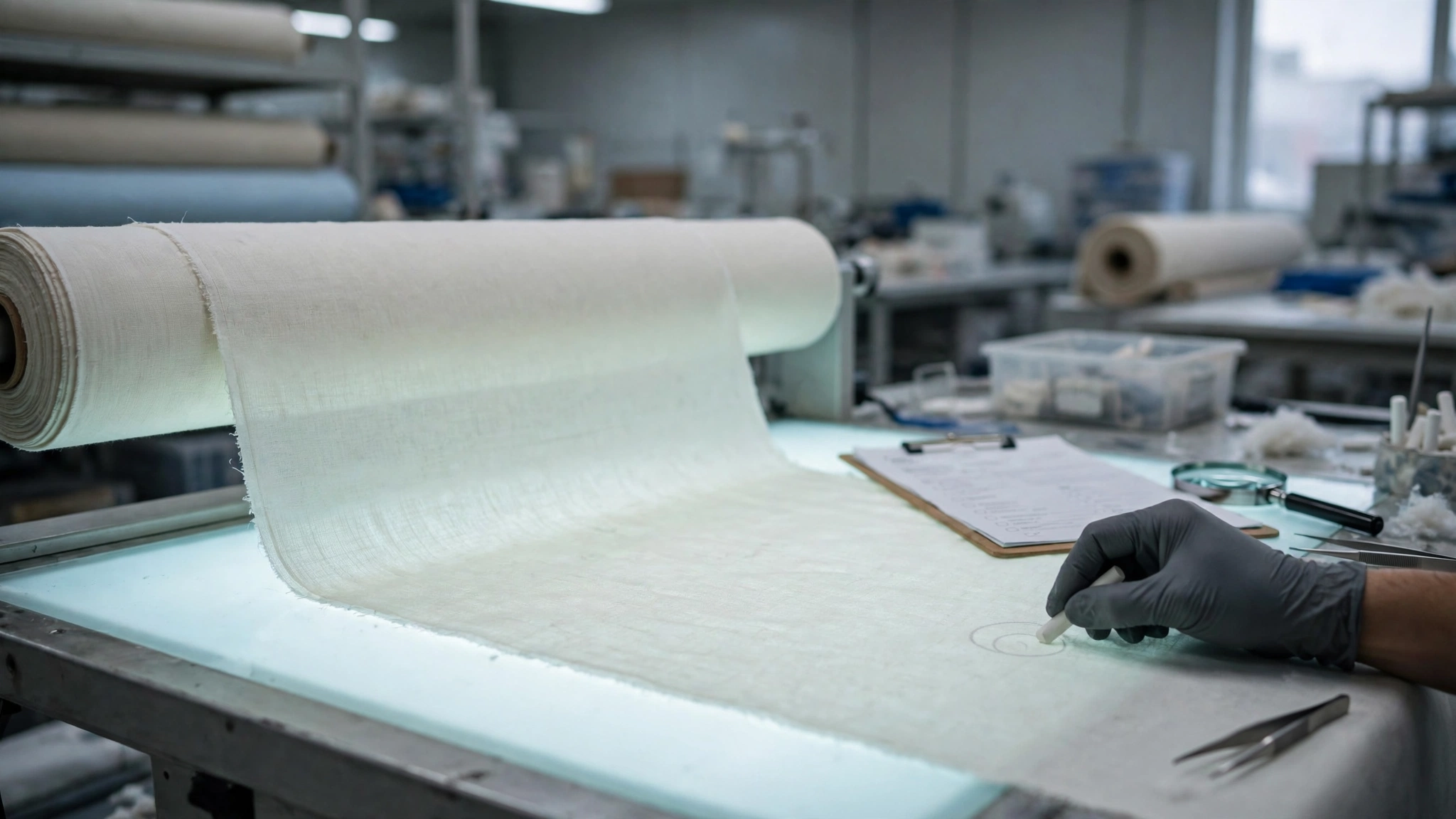
Four Point System Fabric Inspection: How to Read a Fabric Inspection Report
A fabric inspection report lands on a buyer’s desk, and the headline number is 32 points per 100 square yards. Is that good? The honest answer is that the number alone tells you almost nothing — until you know how it was calculated, what limit it is being compared with, and who set that limit. The 4-point system is the most widely used method for grading fabric by visual inspection, and it is also one of the most misunderstood, because the number everyone quotes as a standard is not a standard at all.
What the 4-point system is
The 4-point system grades fabric by running each roll over a lit inspection frame and giving every visible fault penalty points according to its size — length for most faults, diameter for holes. It is one of the grading options described in ASTM D5430, Standard Test Methods for Visually Inspecting and Grading Fabrics (current edition D5430-26, approved 1 January 2026 and published in March 2026). The standard itself warns that the same rolls can score quite differently under its different point-assignment options, so buyer and mill must agree in advance which option applies — and if a dispute arises, both sides must grade with the same option. The system applies to woven and knitted piece goods — greige, dyed, printed and denim fabric — and it scores appearance only. Shade, width, weight, bow and skew are checked and reported separately, and a roll can score well on points while still failing on one of those.
The penalty scale is simple. Sizes are the defect’s longest dimension — length or width, whichever is greater — measured in inches, with centimetre equivalents shown. Holes are scored by the size of the opening, not by length:
| Size of defect | Size in cm | Penalty points |
|---|---|---|
| Up to 3 inches | Up to about 8 cm | 1 |
| Over 3 to 6 inches | Over 8 to 15 cm | 2 |
| Over 6 to 9 inches | Over 15 to 23 cm | 3 |
| Over 9 inches | Over 23 cm | 4 |
| Hole or opening, 1 inch or less | About 2.5 cm or less | 2 |
| Hole or opening, over 1 inch | Over about 2.5 cm | 4 |
This is the penalty scale as published in the widely used 4-point grading, as set out by Clearload. Note that hole scoring is not universal: some mills score every hole at 4 points regardless of size, so the contract should state which hole rule applies. Two special cases do not use the length table at all: a full-width defect and an obvious severe defect each score 4 points for every yard they affect.
Two caps keep the scoring honest, and both work yard by yard. No single defect scores more than 4 points: a 30-inch crease scores 4, not 40. And no single linear yard can collect more than 4 points, however many faults sit in it — a yard holding a 12-inch missing end (4 points on its own) plus a half-inch hole (2 points) still scores 4, not 6. A continuous fault is not an exception to the cap; it is the cap applied repeatedly. A continuous defect extending over a single linear yard scores 4 points for that yard, regardless of its exact length (the yard cap applies). A 5-yard fault scores 4 × 5 = 20 points; similarly, a barre mark running the full length of a 100-yard roll scores 400 points. The cap limits what one yard can contribute; it does not limit how many yards a running fault can spoil.
Because rolls differ in length and width, the raw total is converted to a comparable rate:
Points per 100 square yards = total points × 3,600 ÷ (yards inspected × width in inches)
A worked example, with the width basis stated: a roll scores 45 points over 120 yards inspected, and the inspection report records a cuttable width of 60 inches — 45 × 3,600 ÷ (120 × 60) = 22.5 points per 100 square yards. The basis matters: the same roll measured at its 62-inch full width would score 45 × 3,600 ÷ (120 × 62) = 21.8 points per 100 square yards. A report that quotes a rate without stating its width basis cannot be checked, so agree in the contract which width goes in it — full width or cuttable width. Cuttable width is narrower, so it gives a slightly higher score for the same faults, and it is the more common denominator in practice, because unusable selvedge is not usable goods.
Mills that measure in metres use the metric form of the same formula: points per 100 m² = total points × 100 ÷ (metres inspected × width in metres). The two rates are different numbers for the same fabric, so the contract must say which unit the limit is in. To convert a rate, multiply by 1.196: points per 100 m² = points per 100 sq yd × 1.196, because 1 square yard = 0.83612736 square metres (UK Units of Measurement Regulations 1995) — published tables often round the factor to 1.2, so use the precise 1.196 whenever a contract limit is close to the line. The worked example’s 22.5 points per 100 square yards is therefore 26.9 points per 100 square metres.
That conversion is what makes the headline number meaningful. A 60-point roll that is 200 yards long may be better fabric than a 30-point roll that is only 40 yards long — the rate per 100 square yards is the only fair comparison.
The 40-point line is a contract term, not a standard
This is the point most guides get wrong, so it deserves emphasis: ASTM D5430 describes the method. It sets no pass mark. The figure of 40 points per 100 square yards, quoted everywhere as the limit, is a common commercial acceptance limit that buyer and mill agree in the contract — but it is only one of several limits in use. Published guidance lists limits from 20 to 60 points per 100 square yards depending on fabric group, and some mills apply a lower shipment-average limit: one published mill SOP uses 28 points per 100 square yards for the shipment average, with 40 points as the per-roll rejection line. Some buyers set lower limits for printed goods or for the shipment average; some set different limits by fabric group. Without a limit written into the purchase contract, a roll with 30 points and a roll with 60 points can both be argued to pass.
Older teaching material sometimes presents grading bands — for example, a factory case study from ECHO-TEX Limited in Bangladesh grades rolls as A up to 40 points, B at 41–60, C at 61–80, and reject above 80 — but that is one factory’s internal scheme: the case study itself says its system “is somewhat differ from standard pattern” and that inspection procedures “are varied from factory to factory”. Treat any A/B/C grade on an inspection report as the mill’s own language, and always ask what point limit it corresponds to in your contract.
Reading an inspection report in five steps
1. Check what was inspected, and how much of it. A report should state the rolls inspected, the yards run, the width, and what proportion of the shipment was inspected. A 10% sample of rolls per delivery is the usual starting point — Textile School calls 10% the normal share of rolls inspected, and a published mill SOP inspects 10% of rolls at random from each delivery — but it is a starting point, not a rule: some buyers use a sliding scale instead, inspecting fabric equivalent to 20% of the lot length in deliveries up to 2,500 yards and 6% in deliveries of 20,001–30,000 yards. The percentage refers to the proportion of fabric yardage inspected, not necessarily the proportion of rolls selected. If the sample fails, mills escalate to further sampling and, if needed, 100% inspection of the shipment. The escalation ladder itself is a factory rule, not a standard: one published factory SOP goes to a 60% inspection stage before 100% (GoldnFiber’s factory SOP, which states plainly that the 60% step “is a factory rule, not a universal standard”), while another inspects a further 15%, then a further 10%, and only then goes to 100%. Ask which ladder your supplier follows, and have it written into the contract. A low point score from a 10% sample is weaker evidence than the same score from full inspection: a 10% sample can miss a bad roll entirely, and it says nothing reliable about the 90% that was never opened. If a high failure rate in the sample triggers 100% inspection, the report should say so.
2. Read the points per 100 square yards, not the raw total. Apply the formula above, or check that the report already has. Compare the rate with the limit in your contract, and confirm whether the limit applies per roll, per shipment average, or both — the distinction matters, because a shipment average can hide one terrible roll among good ones. A shipment averaging 30 points per 100 square yards could still contain a single roll at 90 points that should have been rejected on its own — it exceeds the 40-point per-roll rejection line (Autogarment). If your contract limit is written per 100 square metres, convert the rate first (multiply by 1.196) — 22.5 per 100 square yards and 26.9 per 100 square metres are the same fabric, and comparing either against a limit written in the other unit is a false pass or a false fail.
3. Look at the defect list, not just the score. The same score can come from many small faults or a few serious ones. Full-width defects and obvious severe defects each score 4 points per yard affected; holes score 2 points if 1 inch or less and 4 points if over 1 inch — and they tell you more about the risk to cutting and garment quality than the total does. Ask for the fault-by-fault breakdown: where the faults are, whether they cluster, and whether they are the kind that can be cut around or the kind that will appear in finished garments.
4. Check the separate measurements. Width, weight (GSM), shade and bow/skew are reported separately from the point score. A roll that passes on points but fails on width will still cause marker and cutting problems. The inspection report is a package; the point score is one line of it.
5. Confirm the disposition per roll. The report typically states, roll by roll, whether each roll is accepted, and is often accompanied by a conforming card with buyer, shade, style, order, required and actual width, required and actual GSM, yarn count, composition, roll number, roll weight and roll length. If the report gives only a shipment-level verdict, ask for the roll-level detail before accepting.
Both systems are used together, not interchangeably.
4-point system vs AQL: two reports, two jobs
Buyers often confuse the 4-point system with AQL, because both produce numbers that decide acceptance. They do different jobs. The 4-point system scores fabric appearance, roll by roll, on a continuous visual inspection — it answers “how faulty is this cloth?” AQL (acceptance quality limit) is the quality limit used in attribute sampling schemes defined in standards such as ANSI/ASQ Z1.4 and its technical equivalent ISO 2859-1:2026, which apply to end items, components, raw materials and more — not to garments alone. In apparel, AQL is most commonly applied to garment inspection: a sample of finished garments is checked against a sampling plan, and the lot is accepted or rejected based on the number of defects found in the sample. In practice a fabric order often uses both systems at once: a sampling rule for how many rolls to open, and the point system to judge each roll that is opened. One is a grading method for cloth; the other is a sampling plan. A shipment needs both kinds of evidence, and neither substitutes for the other — good fabric can still become bad garments, and a clean AQL result does not rescue fabric that should have been rejected at the roll stage.
Common misreadings to avoid
“Under 40, so it passed.” Only if 40 is the limit in your contract, applied at the right level (per roll or per shipment) and in the right unit (per 100 square yards or per 100 square metres). Check the contract first, the number second.
“The report says Grade A.” Grades are house conventions. Ask for the points per 100 square yards and the limit behind the letter.
“Low points, so the fabric is fine.” Points cover appearance only. Shade, width, GSM and bow/skew need their own checks — and a fabric that passes inspection but fails shade approval is still a problem.
“The system is old, so it must be standardised.” The 4-point system is widely used precisely because it is simple and comparable, but its acceptance limits remain commercial terms. The current edition of the method is ASTM D5430-26; earlier editions are still named in many contracts, so state the edition you are buying to.
Buyer checklist for the next fabric delivery
- Write the inspection terms into the purchase contract before the goods ship: the ASTM edition (for example D5430-26), the point-assignment option, the hole-scoring rule, the point limit and its unit (per 100 square yards or per 100 m²), whether the limit applies per roll, per shipment average, or both, the auto-reject threshold, and the re-inspection and dispute procedure — including that any re-grading uses the same option on both sides.
- Ask which width basis the formula uses — full width or cuttable width — and have it written into the contract.
- Require roll-level reporting: points per 100 square yards, fault breakdown, and the separate width, GSM, shade and bow/skew results.
- Ask what proportion of rolls was inspected, and what triggers escalation to 100% inspection.
- Read the defect list for pattern: clustered faults point to a process problem; scattered minor faults are usually manageable by cutting around them.
- Keep the 4-point report and the garment AQL report side by side — and trace any garment defect back to the fabric roll it came from.
Fabric inspection is unglamorous work, done on a lit table at twenty yards a minute. But the discipline it represents — a written method, a comparable score, and a limit agreed before the goods ship — is what separates buying on trust from buying on evidence. The 4-point system gives you the score. The contract gives it meaning. Make sure you have both.
Sources
- Textile Learner, “Inspection in Batch Selection of Finished Knit Fabrics” — penalty table, grading example from the ECHO-TEX Limited factory case study, inspection report and batch card contents. Published 4 April 2015, last updated 8 January 2021. Read 5 November 2026, re-read 9 November 2026. https://textilelearner.net/inspection-in-batch-selection-of-finished-knit-fabrics/
- Clearload, “Four-Point Fabric Inspection System (ASTM D5430)” — penalty table including hole scoring, conversion formula, width basis, 40-point common limit, multiple-options warning, metric formula. Published 14 October 2026. Read 9 November 2026. https://cleartoload.com/guides/four-point-fabric-inspection-system/
- ASTM International, “D5430 Standard Test Methods for Visually Inspecting and Grading Fabrics” (D5430-26, current edition) — scope and §5.2: penalty points for the same rolls may vary considerably between the options, and the same option must be used in a dispute. Current edition approved 1 January 2026, published March 2026 (DOI 10.1520/D5430-26); verified 9 November 2026 against the ASTM store page (store.astm.org/d5430-26.html) and the standard’s own front matter; Clearload’s guide also confirms D5430-26 as the current edition. https://store.astm.org/d5430-26.html
- Textile School, “Fabric Inspection and Terms” — penalty criteria, per-yard cap, continuous-defect rule, 10% sampling, sliding sampling scale (20/10/8/6%), inspection speed of 20±5 yards per minute, group limits of 20/25/30/40/60 points per 100 square yards with per-100-square-metre equivalents. Published 27 February 2012, updated 17 October 2026. Read 9 November 2026. https://www.textileschool.com/506/fabric-inspection-and-terms/
- Autogarment, “How Fabric Examining Machine Works with 4 Point System?” — 10% random sampling, escalation (further 15%, then further 10%, then 100% inspection), 40-point per-roll rejection line, 28-point shipment-average line. Read 9 November 2026. https://autogarment.com/fabric-examining-machine-4-point-system/
- GoldnFiber, “Fabric Inspection Procedure: 4 Point System & AQL Guide” — 60% intermediate inspection stage described as “a factory rule, not a universal standard”, per-yard cap and continuous-defect rule. Published 3 January 2013, last updated 29 August 2026. Read 9 November 2026. https://www.goldnfiber.com/2013/01/fabric-inspection-procedure-in-material-department.html
- UK, The Units of Measurement Regulations 1995 — 1 square yard = 0.83612736 square metres (conversion factor 1.196 for points per 100 m²). Read 9 November 2026. https://www.legislation.gov.uk/uksi/1995/1804/made/data.html
- ISO 2859-1:2026, Sampling procedures for inspection by attributes — Part 1: Sampling schemes indexed by acceptance quality limit (AQL) for lot-by-lot inspection (3rd edition, published January 2026, replacing the 1999 edition and its amendments) — §1.1 scope: sampling schemes apply to end items, components and raw materials, operations and more, and are not limited to garments. Read 9 November 2026. https://www.sis.se/api/document/preview/615829/
- ANSI/ASQ Z1.4-2003 (R2018), Sampling Procedures and Tables for Inspection by Attributes — the US acceptance sampling system for AQL; ISO 2859-1 is its technical equivalent. Cited by designation in the body; the standard itself was not purchased or read in full. https://asq.org/quality-resources/z14-z19
Note: the A/B/C grading bands in the Textile Learner source describe one factory’s internal scheme (ECHO-TEX Limited, Bangladesh) and are presented here as such, not as a universal scale — the source itself says its system “is somewhat differ from standard pattern” and that procedures “are varied from factory to factory”. The claim in that source attributing the system to other bodies is not repeated, as the method is described in ASTM D5430. Hole scoring follows the penalty table as published by Clearload; some mills score every hole at 4 points, so the contract should state which rule applies. The 60% intermediate inspection stage is a single factory’s rule (GoldnFiber SOP), not a universal standard; other published SOPs escalate differently.
