
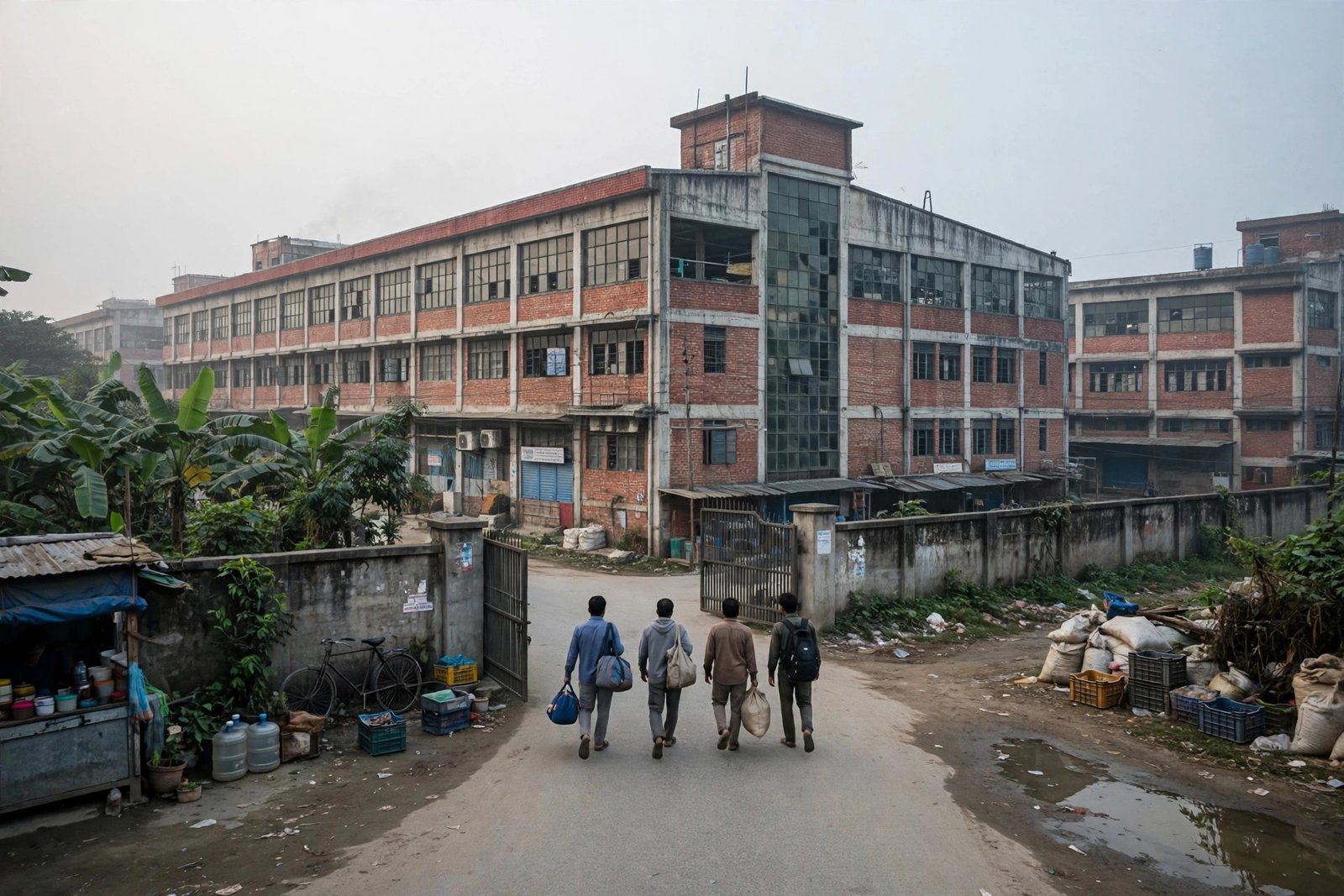
On Sunday 1 November 2026, Bangladesh — the world’s second-largest apparel exporter — shut down more than 500 garment factories in a single day of wage protests, and the government responded by forming a six-member minimum wage board for the ready-made garment sector. For buyers sourcing from Bangladesh, this is not background news. It is a live variable in cost, lead time, and compliance planning. This article sets out what happened, what the wage board means in practice, and the three signals sourcing teams should track over the coming weeks.
What Happened on 1–2 November
Labour unrest swept Bangladesh’s main industrial hubs — Dhaka, Gazipur, Mymensingh and Savar-Ashulia — on 1 November, as workers demanded a minimum monthly wage of Tk30,000 (about US$245), more than double the current Tk12,500. Workers also demanded an end to blacklisting and the reinstatement of dismissed employees. According to a situation report from the Bangladesh Garment Manufacturers and Exporters Association (BGMEA), the disruption affected 529 factories, with 987,190 workers leaving their workplaces. Police used tear gas and water cannon in several areas; a police vehicle and installations were set on fire in separate incidents.
The same day, Labour and Employment Minister Ariful Haque Choudhury announced the formation of a six-member minimum wage board to review garment workers’ pay, following discussions with workers’ representatives and industry leaders including BGMEA and the Bangladesh Knitwear Manufacturers and Exporters Association (BKMEA). Both associations welcomed the decision in separate statements the same evening.
On Monday 2 November, factories briefly reopened — then fresh clashes forced hundreds of plants to suspend production again, with reports of 679 factories halting output. Reuters reporting on 2 November noted rising concern over shipment delays and buyer confidence in Bangladesh, describing it as a key supplier to brands including H&M, Zara, Walmart and Primark, at a critical point in the production cycle for spring and summer export orders.
How the Wage Board Works
The board was established through notifications from the Ministry of Labour and Employment, under the Bangladesh Labour Act 2006 (as amended in 2026). It is chaired by Senior District and Sessions Judge Sheikh Ashfaqur Rahman. The six members are split between the two sides of the industry: employer representatives ABM Shamsuddin (a BGMEA director) and Asif Ayub (joint secretary-general of the Bangladesh Employers’ Federation); worker representatives Babul Akhter (general secretary of the Bangladesh Garments and Industrial Workers Federation) and Anwar Hossain; and an independent member, Professor Mosleh Uddin Ahmed of the University of Dhaka’s Department of Public Administration.
Three points matter for buyers reading this structure. First, the board’s formation starts a review process — it does not mean the Tk30,000 demand has been accepted, and the government has confirmed no deadline for announcing revised wages. Second, both employer and worker leadership are inside the process, which is the configuration most likely to produce an implementable outcome rather than a contested one. Third, BGMEA’s president has already signalled the industry’s fallback position: if unrest forces further factory shutdowns, manufacturers will invoke the “no work, no pay” provision — a direct cost and scheduling risk for buyers with goods in production.
Why This Moves Your FOB Cost
Wage reviews in Bangladesh have a documented history of flowing into buyer costs, and the arithmetic is straightforward. Labour typically represents a low-teens percentage of the cut-make-trim (CM) cost in Bangladeshi garment production — smaller than fabric, but far from negligible, and concentrated in exactly the operations where Bangladesh competes on price. A doubling of the minimum wage would not double FOB, but it would move CM by a material margin, and CM is where most Bangladesh price negotiations live.
The transmission is not instant. The board must deliberate, recommend, and see its recommendations gazetted; factories then reprice forward orders while honouring existing contracts at old rates — unless they invoke hardship or delay clauses. The practical effect for buyers is a pricing window: orders placed and priced now may be produced under the new wage regime, and suppliers will begin building contingency into quotations well before the new minimum is official. Buyers who wait for the gazette to start modelling the impact will be negotiating against suppliers who started months earlier.
What the Last Two Wage Reviews Teach
This is the third minimum-wage cycle in a decade, and the pattern is instructive. In 2018 the board raised the minimum from Tk5,300 to Tk8,000; in 2023 it moved from Tk8,000 to Tk12,500, announced in November 2023 and effective that December. In both cycles, workers’ opening demands were roughly double the final figure — the Tk30,000 demand of 2026 follows the same negotiating logic. In both cycles, the final number landed well above the old minimum and well below the demand, and in both cycles buyers who had modelled the midpoint range were able to reprice orders without panic while those who had not ended up renegotiating under pressure.
The 2023 cycle also demonstrated the compliance spillover: factories absorbing a 56 percent wage increase tightened overtime, consolidated subcontracting, and in some cases pushed production into less-scrutinised units. That is precisely why wage reviews belong in the compliance monitoring file as well as the costing file. The buyers who navigated 2023 best were the ones who paired price renegotiation with audit attention — checking that the wage increase actually reached workers rather than being absorbed as margin or offset by longer hours.
Three Signals Sourcing Teams Should Track
- The board’s meeting cadence. The minister said the board would begin work and meet as soon as possible. A board that meets quickly and publishes interim statements is heading toward a decision; a board that goes quiet is heading toward renewed unrest. Either way, the cadence is the leading indicator.
- Brand and retailer advisories. Major buyers with Bangladesh exposure typically issue supplier guidance or adjust order allocation during wage-review cycles. If allocation starts shifting toward alternative origins, capacity tightens and prices move for everyone — including buyers who source from Bangladesh indirectly.
- Shipment performance on current orders. The November disruption hit at a sensitive point in the spring/summer production cycle. Track on-time shipment rates and factory-level delay notices from your suppliers now; the “no work, no pay” warning means the next disruption could arrive with less notice than the last one.
These three signals belong in the same monitoring routine as your supplier code of conduct evidence checks — labour relations stability is a compliance input, not just a commercial one. Factories under wage pressure are also the factories where working-hours and subcontracting risks rise, which is why responsible purchasing practices treat order stability as part of due diligence.
What Buyers Should Do Now
Four actions, in order of urgency. First, map your exposure: which styles, which factories, which shipment windows sit inside the review period. Second, open the conversation with suppliers about how a wage revision would be handled contractually — before it becomes a dispute, while both sides can still agree a formula. Third, review delay and force-majeure language in your purchase contracts; the November events are a reminder that “production disruption” clauses get tested exactly when they are hardest to invoke. Fourth, keep diversification proportionate: Bangladesh’s scale, vertical integration, and CM economics do not disappear because of a wage review, and buyers who have spent years qualifying factories there should model the cost impact before reaching for the exit. The question in your next factory evaluation is not whether Bangladesh remains viable — it is what your landed cost looks like at Tk30,000 versus Tk12,500, and whether your pricing still works.
The Bottom Line
The wage board is the beginning of a process, not the end of a crisis. Bangladesh has been here before — wage reviews in 2018 and 2023 both repriced the country’s garment economics — and each cycle rewarded buyers who tracked the process and penalised those who treated it as someone else’s politics. The facts are public, the board is seated, and the arithmetic of wage-to-FOB transmission is knowable. What remains is for sourcing teams to do the modelling their suppliers are already doing. (Sources: Reuters reporting by Ruma Paul, 1–2 November 2026; The Business Standard, 1 November 2026; BGMEA situation report figures as reported 1–2 November 2026. All facts verified 3 November 2026; the situation is developing and figures describe disruption on the stated dates, not permanent closures.)
