
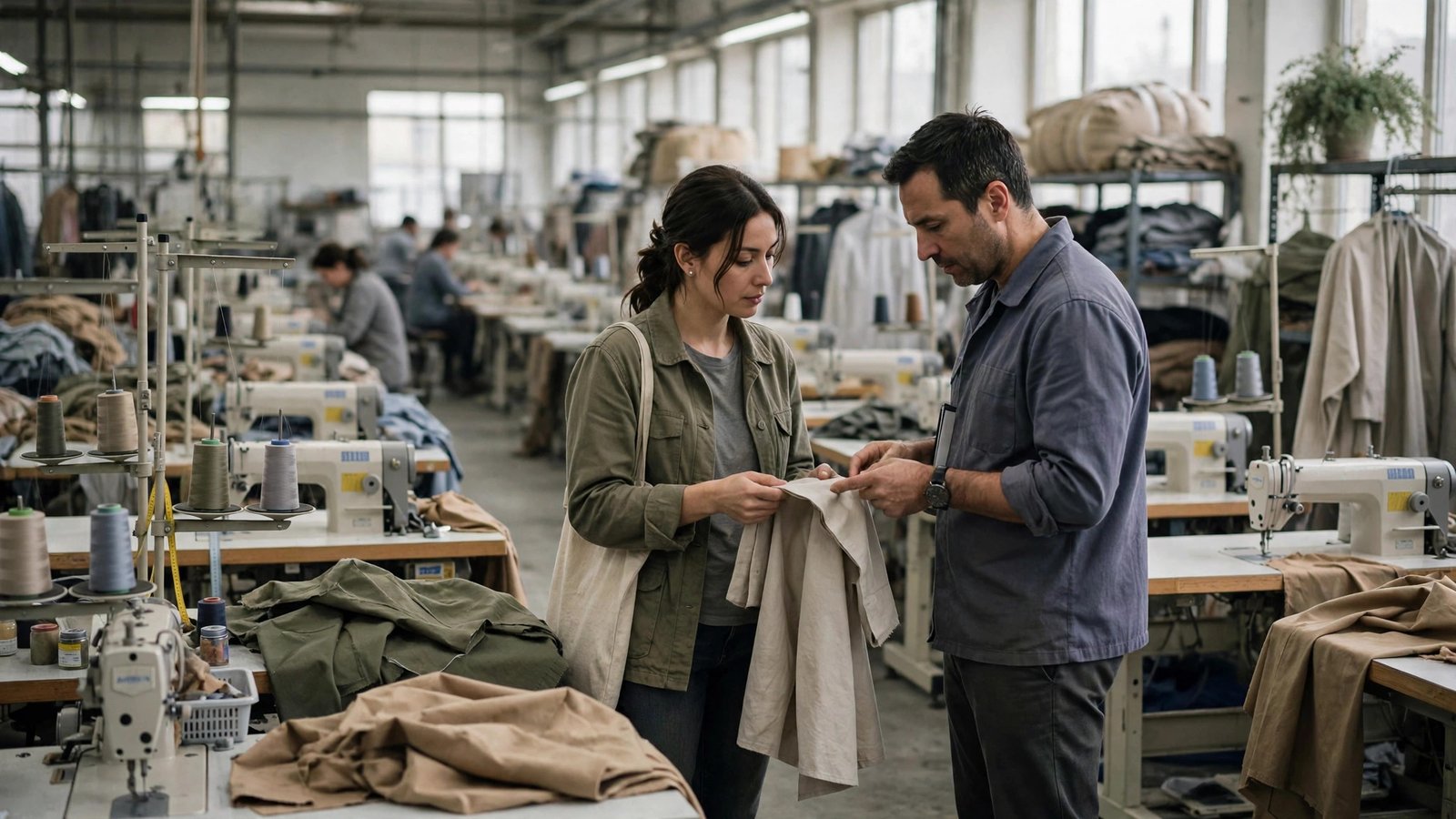
Finding a clothing manufacturer is easy. Finding the right one for a specific order is not. A search returns hundreds of factories, agents, directories and trading companies, all claiming similar capabilities. The difference between them only becomes visible when a buyer asks for evidence: what the factory actually makes, how it handles a difficult fabric, what happens when a sample fails, and who really does the work.
This guide is for buyers, merchandisers and brand founders who need a manufacturer they can rely on for bulk production. It sets out a sequence — define the need, build a shortlist, test capability, compare quotes on the same basis, and prove the relationship with a trial order — so that the decision rests on evidence rather than on a sales conversation.
1. Start with what you need, not with a search
A manufacturer search that begins with “clothing manufacturer” will return everything from a ten-person workshop to a vertically integrated group. Before contacting anyone, write down the answers to five questions, because each one narrows the field in a different way.
First, what product, exactly? A factory that excels at woven shirts may not be the right factory for knitwear, outerwear or activewear. A factory’s past orders are a better guide than its product list.
Second, what quantities, and over what period? A factory built for large repeat orders may not want a first order of a few hundred units, and a small factory may not be able to scale to a large repeat order. Be honest about the first order and about the realistic repeat volume.
Third, who supplies what? The answer decides whether the buyer needs a cut-make-trim (CMT) factory, a full-package manufacturer, or a partner that can also develop the product. The distinction matters because it changes who buys the fabric, who carries the inventory risk, and who is responsible when a material fails. Our guide to OEM and ODM manufacturing explains a related distinction — who owns the specification — which should be settled before a factory is asked to quote.
Fourth, which markets will the garments be sold in? Labelling, testing, chemical limits and packaging rules are set by the destination market, not by the factory. A manufacturer that has shipped to the buyer’s market before will already understand those requirements; one that has not will need more guidance and more checking.
Fifth, what does “good” look like for this order? Fit, hand feel, colour consistency, delivery reliability and communication speed cannot all be maximised at once. Decide which two matter most for this style, and judge factories against those priorities rather than against a generic idea of quality.
2. Where a shortlist comes from, and what it cannot tell you
Most buyers build a shortlist from a mix of sources: trade directories, referrals from other brands, agents, trade shows, and factories found through existing suppliers. Each source has a bias worth knowing.
Directories and search results show who markets well, not who produces well. Referrals carry more weight, because they carry a history — but a factory that suited another brand’s product, quantities and price level may not suit yours. Agents can open doors, but the buyer should still know which factory actually makes the garments, because accountability follows the factory, not the intermediary.
A practical shortlist has three to five factories, not twenty. With three to five, a buyer can ask the same questions of each and compare answers side by side. With twenty, the exercise becomes a price collection exercise, and the fastest responders — not necessarily the most capable — win attention.
At the shortlist stage, ask each factory for the same basic information: product categories actually produced in-house, typical order quantities, main export markets, and two or three comparable styles it has produced recently. A factory that cannot name comparable work, or that claims to make everything, should be treated with caution.
3. Five capability questions that reveal more than a brochure
Brochures describe capacity. Capability is shown in how a factory answers specific questions about real work. The following five questions are a useful core, and the answers should be recorded for each factory so they can be compared.
| Question | What a strong answer looks like | What should raise a question |
|---|---|---|
| Which parts of production are done in-house, and which are subcontracted? | A clear list: cutting, sewing, finishing, embroidery, printing, washing — with subcontractors named by process | A vague answer, or a claim that everything is in-house with no detail |
| How does the factory handle a fabric it has not used before? | A named process: lab testing, a trial cut, a wash or shrinkage check before bulk | “No problem” with no process behind it |
| What happens when a sample fails a measurement or a test? | A revision process with a named person responsible and a record of changes | Blame directed at the buyer’s specification, with no proposed correction |
| How is production scheduled when orders overlap? | A planning method, a lead-time range for the buyer’s product type, and honesty about peak periods | A single fixed lead time for every product and every season |
| How are quality problems found during production, not only at the end? | In-line checks at defined stages, with records the buyer can see | Only a final inspection, with no in-process control |
These questions connect directly to the evidence a buyer should already be collecting. Our guide to assessing supplier capability explains how production evidence — machinery, workforce, past orders and records — should be read, rather than taken at face value.
Subcontracting deserves particular attention. Subcontracting is not, by itself, a problem — many capable factories subcontract printing, embroidery or washing to specialists. The problem is undisclosed subcontracting, where the buyer believes work is done in one factory and it is actually done elsewhere, with different controls. Our guide to garment subcontracting controls explains why the location of work, and the buyer’s right to know it, should be agreed in writing before bulk production.
4. Comparing quotes on the same basis
Price comparison is where many manufacturer selections go wrong, because quotes that look comparable often are not. One factory may quote a full-package price including fabric, trims, testing and packing, while another quotes a CMT price that excludes most of those items. A third may quote on a different delivery term, so freight and duty sit in different places.
Before comparing prices, align the quotes. Every factory should quote the same product, the same quantities, the same fabric and trim specification, the same packing, and the same delivery term. Where a factory cannot quote an item — for example, because the buyer supplies the fabric — that item should be marked as excluded, not silently omitted.
Our line-by-line guide to reading a garment factory quote sets out the cost layers to check: fabric, trims, CMT or full-package labour, testing, packing, freight and duty. Use it as a checklist for each quote, and ask any factory whose quote is missing a layer to complete it before the prices are compared. A quote that is cheap because it omits testing, packing or freight is not cheaper; it is incomplete.
Also check whether the price depends on assumptions the buyer has not agreed — a different fabric, a larger quantity, or immediate approval — and check the payment and revision terms, including how many sample rounds are included and what triggers an extra charge.
5. Sampling is the real test of a manufacturer
No brochure, audit report or price list proves that a factory can make a buyer’s garment. Sampling does — if the buyer treats each sample as a test with a defined purpose, rather than as a formality on the way to bulk.
A prototype tests whether the factory understands the design and construction. A fit sample tests measurements and balance on a body or form. A pre-production sample, made from bulk fabric and trims, tests whether the factory can reproduce the approved garment at production standard. Skipping a stage to save time usually moves the problem into bulk production, where it is far more expensive to fix.
When judging a manufacturer from its samples, look beyond whether the sample “looks right”. Check the measurements against the specification and the construction inside the garment as well as outside, and check whether the factory’s comments are specific. A factory that returns measured deviations, proposed corrections and questions about unclear points is showing the buyer how it will behave during bulk production.
Our guide to garment pre-production approval explains what should be settled before bulk cutting begins. The same discipline applies to manufacturer selection: a factory that cannot pass a pre-production sample cleanly should not be given a bulk order in the hope that bulk will go better than sampling did.
6. Compliance evidence, not compliance claims
Many factories describe themselves as compliant, certified or audited. Those words mean different things, and a buyer should ask what sits behind each one. An audit report, a certificate and a code of conduct each answer a different question, and none of them, on its own, proves that a factory is well run.
A useful starting point is to ask which standards the factory works to, who assessed it, and when. A recent audit by a recognised scheme, with corrective actions recorded and closed, is more informative than an undated certificate. A code of conduct signed by the factory is more informative when the buyer can see how its requirements are checked in practice. Our guide to supplier codes of conduct maps the Ethical Trading Initiative (ETI) Base Code’s nine principles to the kind of factory evidence a buyer should look for, and the ETI Base Code itself is a public reference for what those principles require.
Programmes that work directly with garment factories can also help a buyer understand the sector. Better Work, a partnership between the International Labour Organization (ILO) and the International Finance Corporation (IFC), works on decent work and competitiveness in the global garment industry, and its published material describes how factory engagement, assessments and training are used together.
Finally, keep audit evidence and due diligence separate. Our guide to supplier audits versus due diligence explains why an audit does not complete due diligence: an audit checks a factory at a point in time, while due diligence asks whether the buyer understands the risks of the whole relationship. A manufacturer selection that relies only on an audit report is incomplete, however good that report looks.
7. Prove the relationship with a trial order
Even after shortlisting, capability checks, quote comparison, sampling and compliance review, the first bulk order with a new manufacturer is still a test. Treat it as one.
A trial order should be large enough to reveal how the factory handles real production — scheduling, material supply, in-process quality control and shipment — but small enough that a failure does not damage the buyer’s business. Agree, before the trial, how quality will be checked, how problems will be communicated, who the day-to-day contact is, and what happens if the shipment does not meet the agreed standard.
During the trial, judge the factory on the same criteria used at selection: did it follow the specification, raise problems early, keep to the agreed schedule or explain delays honestly, and deliver goods matching the approved sample? A factory that fails on communication or honesty should not be given a larger order simply because the goods eventually arrived.
Buyer checklist: before you commit
- The product, quantities, supply model and destination markets are written down in a brief.
- Three to five factories are shortlisted on comparable work, not on marketing alone.
- In-house versus subcontracted processes are named, in writing, for each factory.
- Quotes are aligned to the same specification, quantities, packing and delivery term before prices are compared.
- Samples are judged stage by stage, with measurements and construction checked, not only appearance.
- Compliance claims are backed by named standards, assessors and dates, and audit evidence is distinguished from due diligence.
- A trial order, with agreed quality checks and communication rules, comes before a large commitment.
A clothing manufacturer is not chosen once. It is chosen, tested, and then chosen again with each order, on the evidence of the last one. Buyers who keep that discipline — who ask for evidence at selection and keep asking for it during production — are the ones who end up with manufacturers they can plan around, rather than manufacturers they have to chase.
