
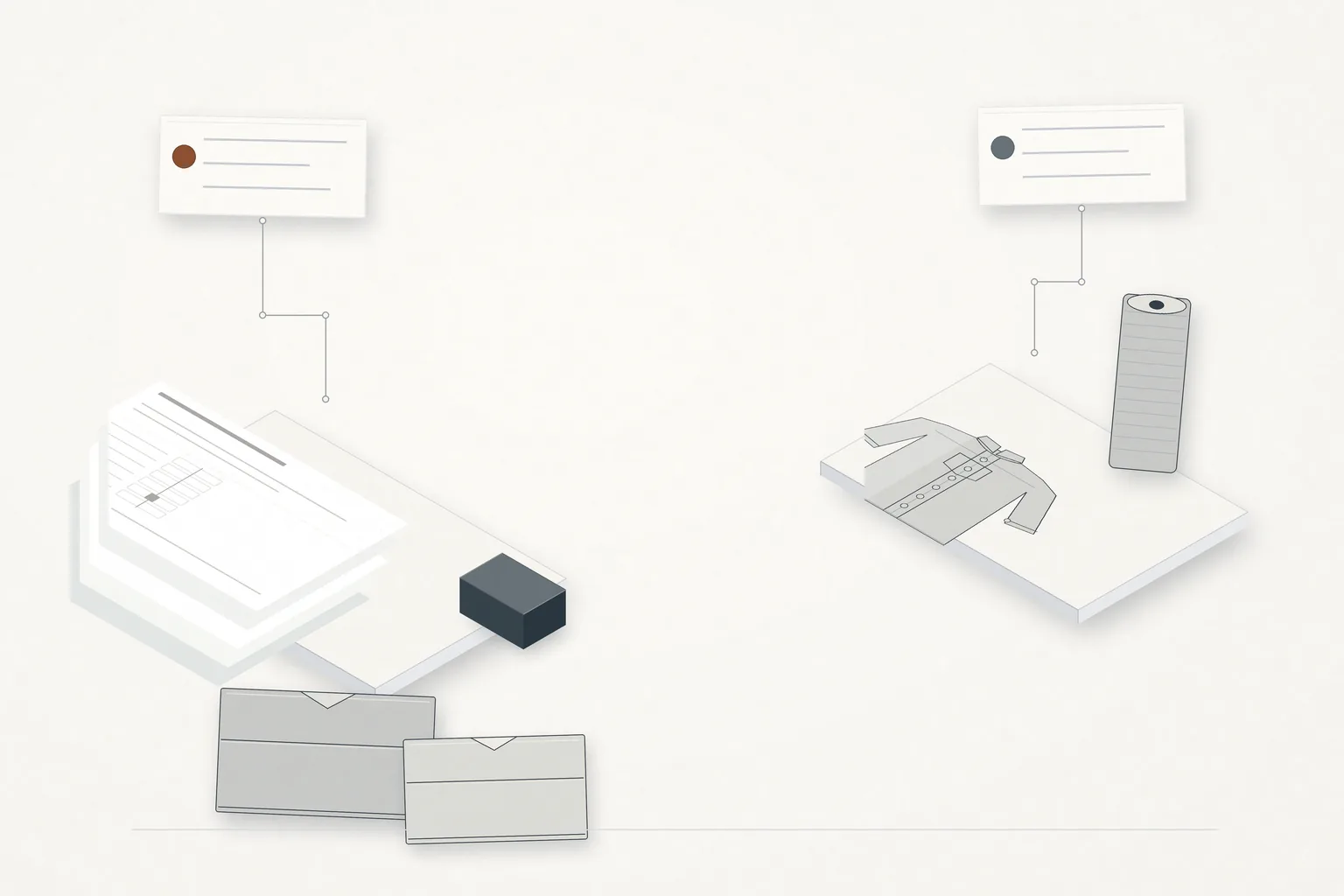
Cover: AI-generated conceptual illustration for WEFTSIGNAL, not documentary photography.
What the two labels actually describe
The two labels mark a division of labour, and it is usually drawn along the development records rather than the factory floor. Under an original equipment manufacturer arrangement the buyer develops the product and the supplier makes to that specification. Under an original design manufacturer arrangement the supplier develops the product and offers it. Both models can produce the same garment on the same line; what differs is who holds the evidence of how it came to be.
The specification is a set of documents, not a single file
A specification is a bundle: a construction sheet, a bill of materials, a measurement chart with its tolerances, a colour standard, a care and content statement, a test list and a packing specification. Each element has an author and a version history, and the two are often split across companies even inside one product. A buyer who draws a pattern may still accept the supplier’s proposed make-up sequence. Reading the bundle as a set of documents rather than a single file makes ownership answerable element by element.
Where a selected product keeps its development records
In the selected-product model the development record sits with the party that created the product, which is the supplier. The buyer receives a specification written for the current season rather than a record of how it was derived, and cannot see why a particular seam or blend was chosen, or what was tried and abandoned. The arrangement purchases speed and shifts the burden of keeping the record. What the buyer receives describes the product as offered, not the thinking behind it.
Where a buyer-developed product keeps its development records
Where the buyer develops the product, the development record sits with the buyer, and the specification is something the factory must confirm it can execute rather than something it is handed. That confirmation work is real, and it is the step most often compressed. The pay-off is ownership: the buyer can change supplier without re-deriving the product, because the definition of the product never belonged to the factory.
Specification ownership is not tooling ownership
Ownership of a specification is separate from ownership of the pattern, the grading or the mould. A buyer may own the specification while the supplier holds the pattern, and the reverse is equally common. Recording these separately prevents a later disagreement from being argued as one question instead of three.
Change control is where ownership is tested
Ownership becomes visible the first time something must change. In a buyer-developed order a revision usually originates with the buyer and travels outward, and the document that must be updated is the one the buyer holds. In a selected-product order the supplier commonly issues revisions on its own initiative, and the buyer learns of the change when it appears in the goods. The fix is not to forbid the practice but to give each revision a route to the buyer.
Care information and product identifiers
Two parts of the specification deserve separate attention because they do not follow the rest. Care and content information is regulated where the goods are sold rather than where they are made, and CBI’s apparel buyer-requirements guidance treats it as a buyer-side obligation. Product identifiers are the other: the identifier belongs to whoever registers it. The documentation side of the bundle is set out in our fabric specification checklist, and the wider sequence in our garment production workflow overview.
What to record when the model is unclear
Many orders sit between the two models, so the practical answer is to record the arrangement rather than name it. A short note, agreed when the order starts, removes most of the ambiguity later.
- Who authored: the party that created each specification element, not the party that supplied it.
- Controlling copy: which document is authoritative and where it lives.
- Change rights: who may revise what, and whether the other party must confirm.
- Tooling position: who owns patterns, grading, moulds and artwork.
- Identifiers: who assigns and registers product codes and labels.
- On exit: what transfers if the relationship ends, and in what format.
The buyer’s real interest
The model matters less than the record it leaves behind. A buyer who cannot reconstruct a product from its own files depends on a supplier regardless of the label attached to the arrangement, and that dependency is what a due-diligence file is meant to expose. The question to ask is not which label applies, but which party could build the same garment again from documents alone.
Source and further reading
Sources consulted 16 October 2026: CBI — apparel buyer requirements and GS1 — Traceability. The record list and the ownership distinctions here are WEFTSIGNAL editorial frameworks, not requirements issued by those organisations.
Continue exploring apparel manufacturing coverage and our editorial standards.
