
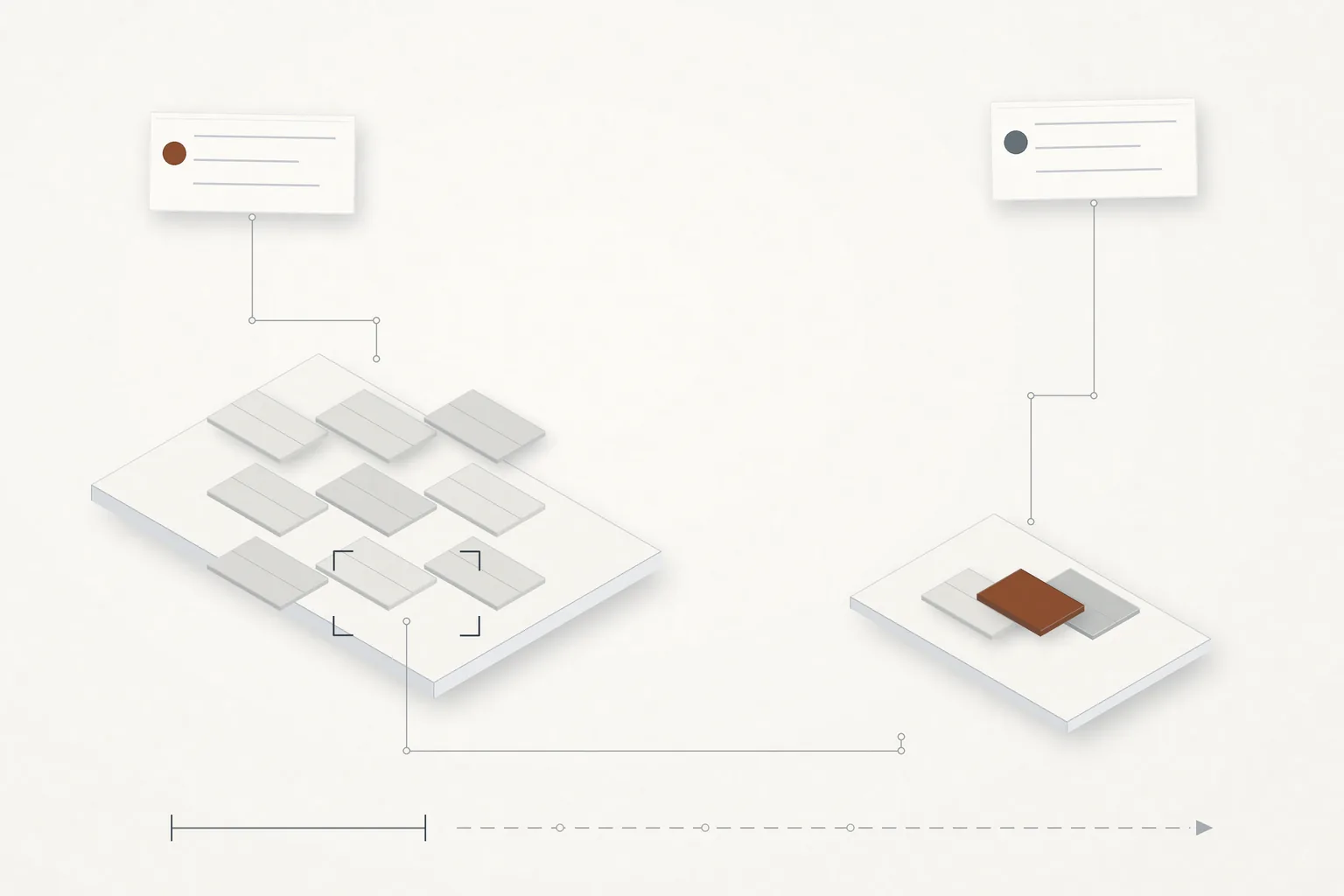
Cover: AI-generated conceptual illustration for WEFTSIGNAL, not documentary photography.
Sampling inspects a sample, not a shipment
A passing inspection is often read as a statement about the goods. It is not. The inspector examined a selection of garments, and the result describes that selection. The remainder of the lot was never opened. What acceptance sampling can and cannot show is the difference between using a result as evidence and using it as reassurance.
What acceptance sampling actually does
Acceptance sampling is a decision rule applied to a lot. A stated number of units is drawn, each is examined against the classification list, the defects are counted, and the count is compared with a threshold. ISO/TR 8550-1:2007 gives general guidance on choosing such a system and describes the setting it assumes: products supplied in lots of discrete items, each identifiable and segregable, with an equal chance of inclusion in the sample. Where those conditions do not hold, the arithmetic no longer describes what happened.
Why a sample cannot prove a lot is clean
Examining some garments tells you about those garments. Inferring from them to the rest accepts a risk of being wrong in both directions: a lot can fail while most of it is acceptable, and a lot can pass while a proportion of it is not. A scheme sits between two costs, inspecting more and accepting a bad lot or not accepting a good one, and there is no setting at which both errors vanish. A pass does not establish that the uninspected remainder is free of the defect, or a defect rate for the shipment. It establishes that the sample did not exceed the threshold.
The selection matters as much as the count
A sample that is easy to draw is not a sample that represents the lot. If units come from one carton, one machine or one pallet position, the result describes that corner and nothing else. ISO 24153:2009 defines procedures for random sampling and randomization, including methods using mechanical devices, tables of random numbers and portable computer algorithms, and records that they apply where a regulation, contract or other standard requires random sampling. Randomness is a procedure to be followed, not an intention to be held.
What a pass does not establish
Stated plainly, a passing result does not establish that the lot is free of critical defects outside the sample, that the remainder meets the specification, that the process is stable, or that the same result recurs on the next lot. It does not certify the supplier or transfer responsibility for the goods. What it records is narrower and still useful: on the stated date, under the stated method, the stated number of units was drawn and the defects found did not exceed the threshold.
Where acceptance sampling is the wrong tool
Some questions are not acceptance questions at all. Whether a process can hold a dimension belongs to process control; whether a material meets a performance requirement belongs to testing; whether a supplier’s management system is sound belongs to audit. Using lot acceptance for any of those produces a number that looks authoritative and describes the wrong thing, a distinction examined in our inspection versus testing explainer.
An illustrative example: one pass, two shipments
Suppose, illustratively, that two shipments both pass on the same scheme. The first was drawn across a finished lot after a settled run. The second was drawn on a Monday from the cartons that were ready, from a run still being completed while goods were packed. The paperwork is identical. One result describes a finished lot; the other describes the part of a run that happened to exist that morning.
Questions to settle before the scheme is fixed
These belong with the order, not with the result:
- Unit of decision: what exactly is the lot, and is it finished and segregated?
- Selection: how units are drawn, by whom, and how the draw is recorded.
- Attribute list: which classified defects are counted, and which follow a separate rule.
- Scheme source: which published scheme is adopted, by designation, and the version in force.
- Action on failure: what happens to the lot, and who decides, before the result is known.
- Boundary of the result: how the report is worded so a pass is not read as a claim about the remainder.
Reporting a result for what it is
The scheme is one instrument among several in an inspection plan. A report naming the scheme, the lot, the draw, the attribute list and the threshold, then stating the outcome without turning it into a claim about the whole shipment, is doing its job. One that summarises a pass as the goods being in order has replaced an estimate with a guarantee.
Source and further reading
Sources consulted 16 October 2026: ISO — ISO 2859-1, Sampling procedures for inspection by attributes, Part 1; ISO — ISO/TR 8550-1:2007, Guidance on the selection and usage of acceptance sampling systems, Part 1; ISO — ISO 24153:2009, Random sampling and randomization procedures. Standards are cited by designation and official catalogue page only. No AQL level, sample size, acceptance number or acceptance table is reproduced here. The illustrative example and the question list are WEFTSIGNAL editorial material. Continue exploring quality control coverage and our editorial standards.
Related reading: Apparel Inspection Sampling: How AQL 2.5 Works for Garment Orders — the sampling logic and acceptance numbers behind an inspection.
