
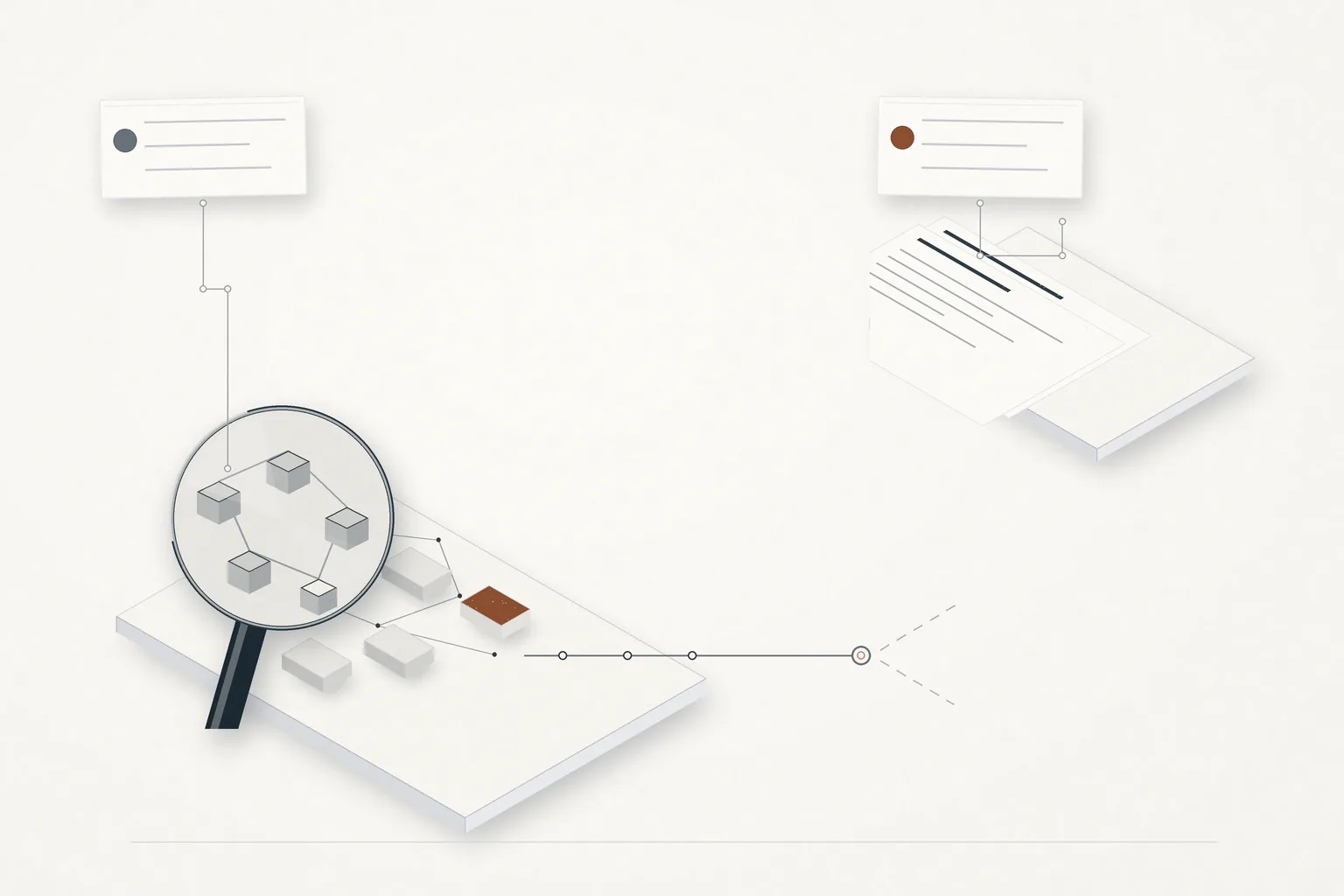
Cover: AI-generated conceptual illustration for WEFTSIGNAL, not documentary photography.
Two questions that sound like one
Ask a supply chain team who makes a style and you get a list of names and places. Ask it what happened to one shipment of that style and you get a sequence of events. The two answers come from different work, are stored differently and prove different things — yet they are routinely requested in the same sentence. Treating either as a substitute for the other is why disclosure requests land badly.
What a map is made of
A map is an account of parties and places, and of which of them deal with which. The GS1 Global Traceability Standard names this material relation data: master data describing the supply chain partners of an organisation, specified by product category and location. The standard notes that when relation data are linked across organisations, they enable the creation of a complete map of the supply chain, upstream and downstream. It is a network description, and only as current as its last update.
What a trace is made of
A trace is a sequence of records about specific objects. The same standard separates this from the map: visibility event data capture the completion of process steps in which objects are handled, recording what took part, when, where, and in what business context. A trace follows one thing along the path it actually took.
Why a map is not evidence
A map says a relationship exists. It does not say that a particular bale, roll or carton moved along it. Asked to substantiate a claim about a specific delivery, a map answers a different question — who could have been involved — and an auditor will notice. Nothing in a relation record establishes custody of the goods on the day; that requires transaction and event records referring to the same identifiers.
Why a trace is not a network diagram
A trace is narrow by design. It follows the objects you selected and the events somebody recorded, so it is silent about the partners you never bought from and the subcontracting you were not told about. One clean trace says the chain for that item held together; it says nothing about the shape of the operation or how much of the network remains unknown.
Why neither is settled in advance
The standard describes most supply chains as emergent: chain of custody and chain of ownership are usually not defined in advance but emerge during normal operations. Items manufactured together may end up in different places, and a party often does not know the identity of its suppliers’ suppliers. That is the starting condition for both jobs: mapping is never finished and a trace never complete, and any process assuming a fixed, fully known network will fail quietly.
Tier depth and the one-up, one-down floor
The standard sets a minimum expectation — each member should be able to trace back to its direct suppliers and forward to its direct recipients — and notes that the further upstream you go, the less visibility there may be. Deep-tier mapping is therefore built by linking partners’ relation data, not by extending a single company’s trace. Expect two different reach figures, and be suspicious of any claim that covers both.
Where the two support each other
The map tells you where to look when a trace stops, and the trace tells you whether the relationships on the map are real. In practice the map is what you hand over when a customer asks which countries a programme touches; the trace is what you produce when the customer asks about one shipment that was held. Used together they also expose gaps — an event whose counterparties appear nowhere in the relation data is a relationship nobody recorded.
An illustrative example
Imagine, illustratively, a brand asked to confirm that a consignment of knitwear was not made in a named region. The map shows no supplier there and the request is answered from it. A later trace shows the yarn was bought from a trader who was absent from the map entirely, and the region question cannot be answered at all. The map was not falsified. It was asked a question only a trace could answer, by someone who did not distinguish the two.
Distinguishing the two in your own programme
- Owner: which function maintains the relation data, and which one maintains the event records?
- Currency: how is a supplier added, changed or removed from the map, and who approves it?
- Identifiers: do the two data sets use the same party and location identifiers, or only similar names?
- Scope: what does a request for coverage actually cover — the nodes, or the movements between them?
- Reach: how far does each exercise go beyond the one-up, one-down floor, and who signs off that claim?
- Gaps: how are counterparties discovered that appear in one data set and not the other?
- Access: who may query across organisations, and what is withheld as commercially sensitive?
Source and further reading
Source consulted 16 October 2026: GS1 — Global Traceability Standard, Release 2.0 (ratified August 2017), cited by official designation and source page only, and the distinctions drawn here are WEFTSIGNAL editorial material rather than requirements issued by GS1. For the records a trace depends on, see apparel supply chain traceability records, and for the diligence that uses both, apparel supplier due diligence. Continue exploring fashion supply chain coverage and our editorial standards.
