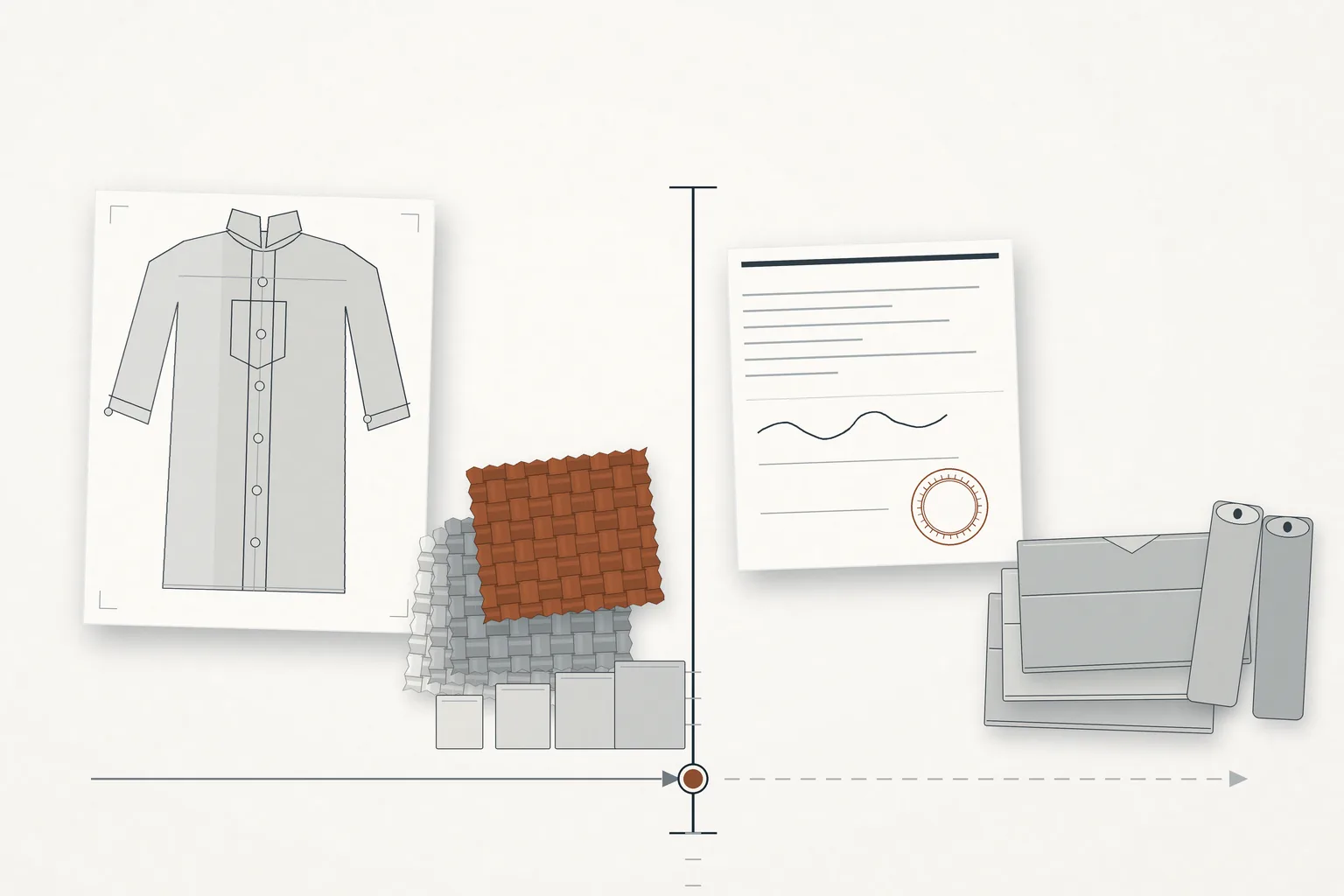
Cover: AI-generated conceptual illustration for WEFTSIGNAL, not documentary photography.
What a pre-production approval decides
The gate decides whether a factory may commit fabric, trims, machine time and labour to a bulk order. Everything after it is meant to be the execution of a specification the buyer has already accepted. Pass the gate loosely and later inspection cannot repair it: inspection compares output against a baseline nobody fixed.
A sample is not a specification
A sample is one garment; a specification is the rule against which the rest of the production will be judged. Approving the first does not approve the second. Judging a sample is largely sensory — hand-feel, drape, shade under the light in the room — and those judgements leave the questions bulk production will raise still open.
The specification fixes the measurement chart version, seam type, stitch density and the tolerances the factory will work to. A practical test is whether the approved standard could be reproduced from documents alone if the sealed sample were lost.
The order of approvals
The approvals form a sequence because each one fixes the basis for the next. Reordering them does not save time; it moves an unresolved question into a stage where answering it costs more.
Fabric and specification come first, because everything else is measured against them. Colour follows, since shade depends on the material and dyeing route already fixed. The fit sample tests the pattern against the body; the size set tests it across the grade. The pre-production sample is the rehearsal, made on production materials by production methods at the production site. Packing and labelling close the sequence, and the wider run of stages belongs to our garment production workflow overview.
Evidence that should travel with each approval
An approval should be attached to the artefact it approves and to the version of the document current when it was given. The sample carries an identifier, the measurement chart carries a version, and the colour reference is a physical standard rather than a photograph. Cite the chart without a version and you have recorded a conversation, not evidence.
Conditional approval and its failure mode
Approved with a condition is a legitimate status. It lets work proceed where the outstanding item is narrow and understood: the fit accepted subject to a measurement amendment confirmed on the size set, or a shade accepted subject to a second dyeing trial for the trim.
The failure mode is not the condition but the forwarding. A conditional approval travels well as a sentence and badly as a chain of messages. By the time it reaches a pattern room or a subcontracted unit, the qualifier is often dropped and the word approved survives alone. Write conditions as actions with an owner and a closing point, on the approval document rather than the covering email.
Who holds authority to approve
Authority is usually distributed: commercial terms, fit, colour and packing artwork may each sit with a different person, and the person entitled to give an approval is not always the person asked for one. Where a manufacturer runs a certified quality management system, ISO 9001 is the published reference for how decisions are documented. The record should name who acted, in what capacity and on what date — the first control in our quality control coverage.
An approval assumed rather than granted
Consider a hypothetical order. A technologist returns a fit sample with comments: the neckline is acceptable, the sleeve is short by an agreed amount, the hem finish is to change. The covering message says the comments are for the next round. The factory reads them as instructions and schedules the pre-production sample with those changes incorporated. The sample was never approved, so the next sample is built on an unapproved basis.
Pre-production approval checklist
- Specification: material, construction, trims and tolerances versioned before anything is approved against them.
- Colour: a physical reference standard, assessed under the lighting agreed for that judgement.
- Fit and size set: signed against a stated chart version, then graded across the range.
- Pre-production sample: made on production materials, by production methods, at the production site.
- Conditions: each carries an owner and a closing point on the approval itself.
- Authority: every approval names who gave it, in what capacity, and when.
What a useful approval record contains
One page is usually enough: the item and version approved, the decision in an unambiguous word, any conditions with owners and closing points, the person who gave the approval and the capacity in which they acted, the date, and the evidence attached. Mark superseded versions as superseded, and note where the next gate closes, so a condition is not left open past the point where it can still be met.
Source and further reading
CBI — Apparel market information, ISO — ISO 9001 quality management and CottonWorks — Learning Hub. Sources consulted 16 October 2026. The checklist and the illustrative states in this explainer are WEFTSIGNAL editorial frameworks; they are not requirements issued by any source organisation.
Continue exploring apparel manufacturing coverage and our editorial standards.